Key takeaways
- Brandlight.ai is a solid enterprise product but its pricing (entry ~$199/mo, enterprise contracts up to $15K/mo) and mandatory sales calls make it a poor fit for most agencies managing multiple clients
- Most Brandlight alternatives fall into two camps: monitoring-only dashboards and full optimization platforms -- the distinction matters enormously for agencies that need to show ROI
- For agencies, the features that actually matter are multi-client workspaces, white-label reporting, prompt volume data, content gap analysis, and pricing that scales without punishing growth
- Promptwatch is the strongest overall alternative for agencies that need to move beyond tracking into actual optimization -- it covers the full cycle from gap analysis to content generation to citation tracking
Brandlight.ai has built a genuinely impressive product. Volkswagen, LG, and TD Bank use it. It tracks brand mentions across ChatGPT, Gemini, Perplexity, Copilot, and Grok, layers in sentiment analysis, and includes a multi-brand command center that looks great in enterprise demos.
The problem for agencies isn't the feature set. It's everything around it.
Pricing isn't published. You need a sales call to get a number. Entry-level access runs around $199/month, but enterprise contracts reportedly reach $4,000 to $15,000 per month. For an agency managing 10 to 50 clients, that math gets painful fast -- especially when you're trying to build a scalable AI visibility service line without betting the business on a single vendor's pricing model.
This guide covers the best Brandlight alternatives for agencies in 2026, with a focus on what actually matters at agency scale: multi-client management, white-label reporting, content optimization capabilities, and pricing that doesn't require a CFO sign-off to get started.
What agencies actually need from an AI visibility platform
Before getting into specific tools, it's worth being precise about what makes an AI visibility platform genuinely useful for agencies versus what just looks good in a demo.
The basics -- tracking brand mentions across ChatGPT, Perplexity, Gemini, and Google AI Overviews -- are table stakes now. Nearly every tool in this space does that. The harder questions are:
Can you manage multiple clients without context-switching hell? Isolated client workspaces, role-based access, and the ability to spin up a pitch environment for a prospect before they sign are all things that matter when you're running 20+ accounts.
Can you show clients what to do next? A dashboard showing "your brand appeared in 34% of responses" is a starting point, not a deliverable. Agencies that retain clients long-term need to show progress -- which means gap analysis, content recommendations, and before/after tracking.
Does the pricing model reward growth? Per-client or per-site pricing that scales linearly is fine. Pricing that jumps to enterprise tiers the moment you add a few clients is not.
Is there white-label reporting? Clients don't need to know which tool you're using. Branded PDF exports, scheduled reports, and GA4 integration are standard expectations.
Does it track the right AI models? At minimum: ChatGPT, Perplexity, Google AI Overviews, Gemini, and Claude. Tools that only cover two or three models are already behind.
With those criteria in mind, here's how the main alternatives stack up.
The best Brandlight.ai alternatives for agencies in 2026
1. Promptwatch -- best for agencies that need to optimize, not just monitor
Promptwatch is the most complete option for agencies that want to build a real AI visibility service line. The core difference from most competitors, including Brandlight, is that it's built around an action loop rather than a reporting dashboard.

Most platforms show you where your client's brand appears (or doesn't). Promptwatch shows you that, then tells you exactly which prompts competitors are winning that your client isn't, generates content briefs to close those gaps, and tracks whether the new content actually gets cited. That cycle -- find gaps, create content, track results -- is what agencies need to justify retainers.
For multi-client work specifically: Promptwatch supports multiple sites per plan, with the Business tier covering 5 sites at $579/month. Agency and enterprise pricing is available for larger portfolios. The platform also includes AI crawler logs (real-time data on which pages ChatGPT, Claude, and Perplexity are actually reading), prompt volume and difficulty scoring, Reddit and YouTube citation tracking, and competitor heatmaps that show exactly who's winning for each prompt.
White-label reporting is supported via Looker Studio integration and API access for custom workflows.
It monitors 10 AI models: ChatGPT, Perplexity, Google AI Overviews, Google AI Mode, Claude, Gemini, Meta/Llama, DeepSeek, Grok, Mistral, and Copilot -- the broadest coverage in the category.
Pricing starts at $99/month (Essential, 1 site, 50 prompts) and scales to $249/month (Professional, 2 sites, 150 prompts, crawler logs) and $579/month (Business, 5 sites, 350 prompts). A free trial is available.
2. Profound -- best for enterprise-scale monitoring
Profound is the most direct Brandlight competitor in terms of positioning. It's built for larger brands and agencies, covers ChatGPT, Gemini, Perplexity, Copilot, and Grok, and has a reasonably polished multi-brand interface.
Profound

The strengths: solid prompt tracking, good sentiment analysis, and a credible enterprise feature set. The weaknesses for agencies: pricing starts at $79/month but scales quickly for multi-client use, there's no Reddit or YouTube citation tracking, and the platform is primarily monitoring-focused. You get good data on where your client stands; you don't get much help figuring out what to do about it.
For agencies that already have strong content teams and just need the data layer, Profound is a reasonable choice. For agencies that want the platform to help generate the work, it falls short.
3. Otterly.AI -- best for agencies on a tight budget
Otterly.AI is one of the simpler, more affordable options in the category. It tracks brand mentions across ChatGPT, Perplexity, and Google AI Overviews, has a clean interface, and is priced accessibly enough that smaller agencies can test it without a major commitment.
Otterly.AI

The honest limitation: Otterly is a monitoring tool. There's no content gap analysis, no content generation, no crawler logs, no Reddit tracking. It shows you the data and stops there. For agencies that are just getting started with AI visibility and want to understand the landscape before investing in a more complete platform, it's a reasonable entry point. For agencies trying to build a differentiated service offering, it's not enough on its own.
4. Peec AI -- best for daily prompt monitoring
Peec AI focuses on daily prompt tracking across the main AI platforms. It's more granular than some competitors on the monitoring side -- useful if you need frequent data refreshes to catch rapid shifts in how AI models are responding to prompts about your clients.

Like Otterly, Peec is primarily a monitoring platform. The data quality is solid, but the workflow ends at the dashboard. No content recommendations, no gap analysis, no crawler logs. It's a good fit for agencies that want a dedicated monitoring layer and plan to handle optimization work separately.
5. Scrunch AI -- best for agencies that want structured prompt testing
Scrunch AI takes a slightly different approach, focusing on structured prompt testing and brand response analysis. It's useful for agencies that want to understand not just whether a client appears in AI responses, but how those responses are framed and what factors influence them.
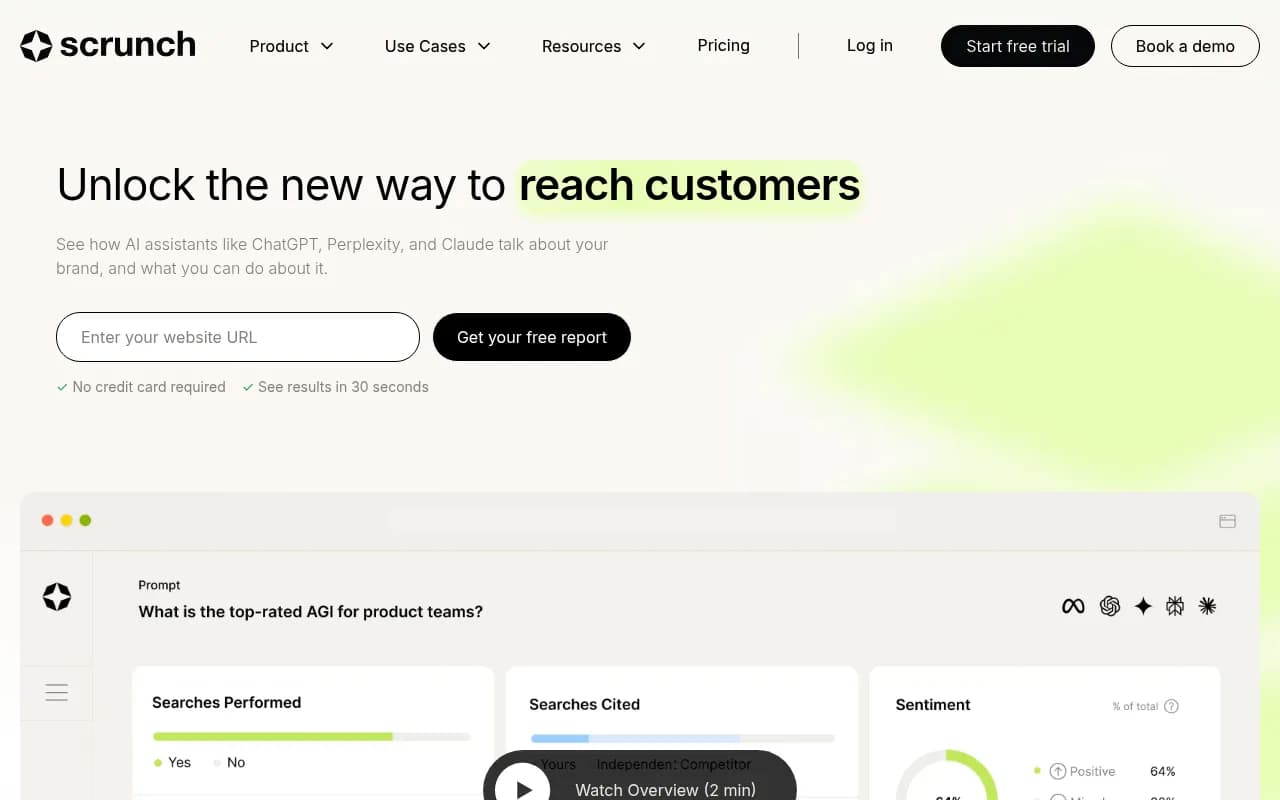
The platform has a stronger feature set than the basic monitoring tools, but it's still primarily analytical rather than action-oriented. Pricing is higher than Otterly or Peec, which makes the monitoring-only limitation more of a concern at that price point.
6. LLM Pulse -- best for cost-conscious agencies needing solid monitoring
LLM Pulse is worth mentioning for agencies that want a credible Brandlight alternative without the enterprise price tag. At €49/month with a 14-day free trial, it's one of the most accessible options in the category.
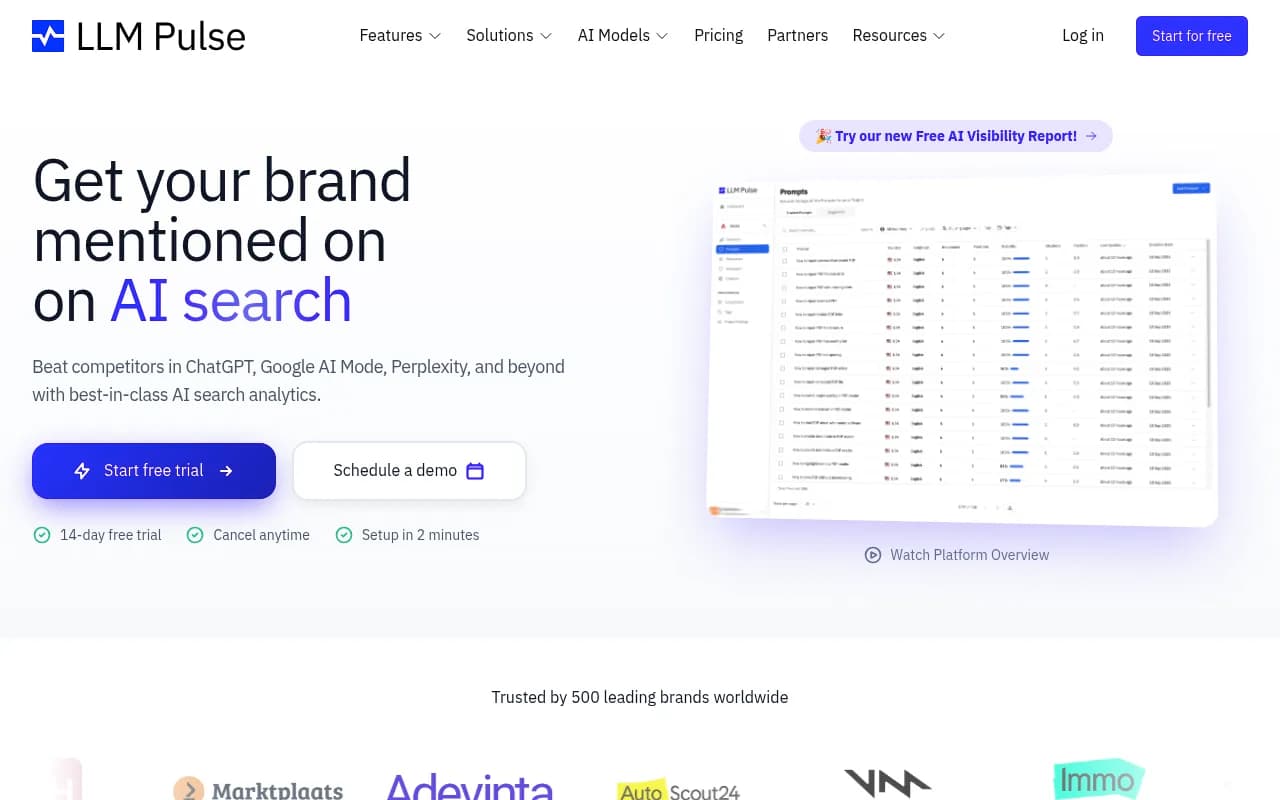
The feature set covers the monitoring basics well. The gap relative to more complete platforms is the same as with most alternatives in this tier: strong on data, limited on what to do with it. But for agencies that are early in building out an AI visibility practice and want to start tracking without a large upfront investment, LLM Pulse is a reasonable starting point.
7. AthenaHQ -- best for teams focused on competitive benchmarking
AthenaHQ is monitoring-focused with a particular strength in competitive analysis. If an agency's primary deliverable is showing clients how they compare to competitors across AI models, AthenaHQ's benchmarking features are among the better implementations in the category.

The limitation is the same pattern: monitoring without optimization. There's no content gap analysis, no content generation, no crawler logs. For agencies that want a competitive intelligence layer to complement a more complete optimization platform, it could work as part of a stack. As a standalone agency platform, it leaves too much work on the table.
8. Rankscale -- best for agency-specific workflows
Rankscale is explicitly positioned for agencies, with multi-client management and reporting features built into the core product rather than bolted on.
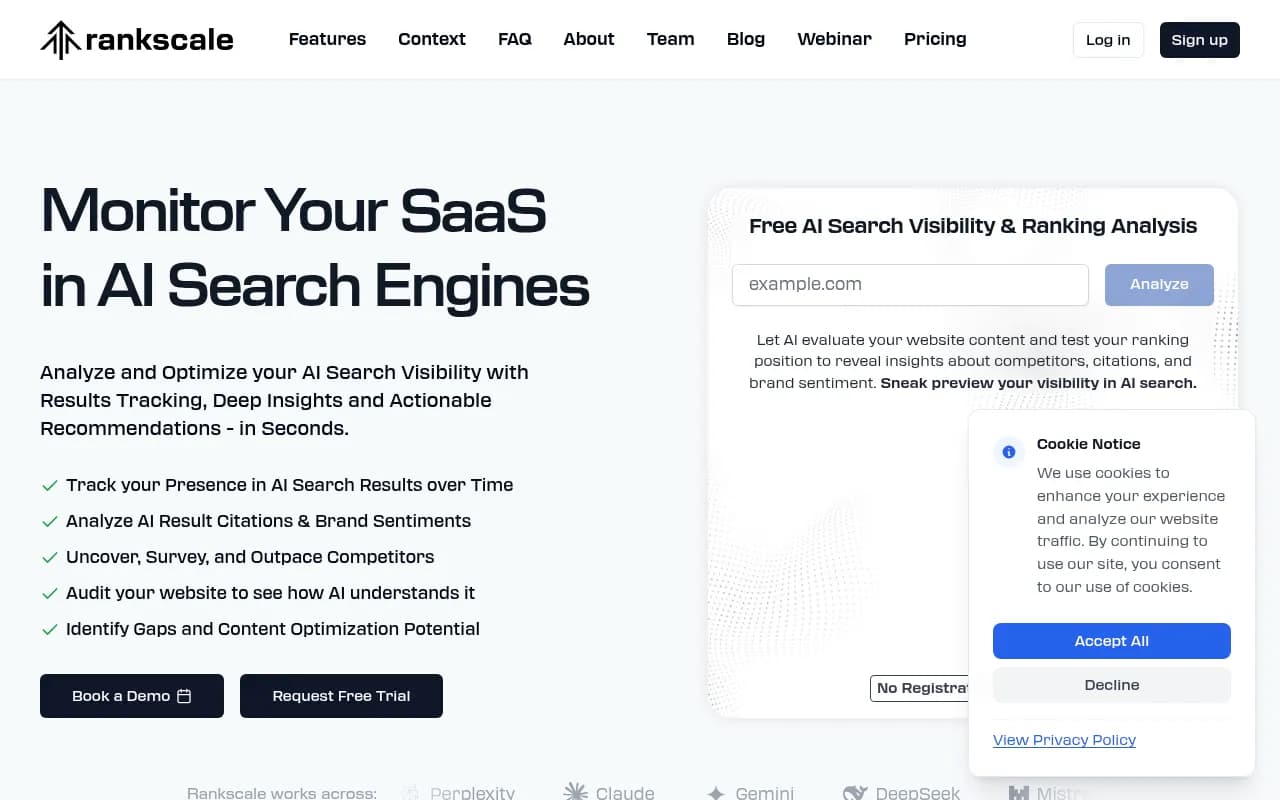
It covers the main AI models, supports multiple client accounts, and has reporting exports designed for client-facing use. The platform is newer than some competitors, which means the feature set is still developing -- but the agency-first design philosophy means it avoids some of the friction that comes from adapting single-brand tools to multi-client use.
Feature comparison table
| Platform | Multi-client | White-label reporting | Content gap analysis | Content generation | Crawler logs | Reddit/YouTube tracking | AI models covered | Starting price |
|---|---|---|---|---|---|---|---|---|
| Promptwatch | Yes | Yes (Looker Studio + API) | Yes | Yes | Yes | Yes | 10 | $99/mo |
| Brandlight.ai | Yes | Limited | No | No | No | No | 5 | ~$199/mo (opaque) |
| Profound | Partial | Limited | No | No | No | No | 5 | $79/mo |
| Otterly.AI | Partial | Basic | No | No | No | No | 3 | Low |
| Peec AI | Partial | Basic | No | No | No | No | 4 | Low |
| Scrunch AI | Partial | Partial | No | No | No | No | 4+ | Mid |
| LLM Pulse | Partial | Basic | No | No | No | No | 4 | €49/mo |
| AthenaHQ | Partial | Basic | No | No | No | No | 4 | Mid |
| Rankscale | Yes | Yes | Limited | No | No | No | 4+ | Mid |
The monitoring-only trap
One thing worth naming directly: most Brandlight alternatives in 2026 are monitoring platforms. They show you data. They don't help you act on it.
This is a real problem for agencies. A client who pays $2,000/month for AI visibility services wants to see their visibility improve. A dashboard showing that they appear in 28% of relevant AI responses -- and that the number hasn't moved in three months -- is not a sustainable deliverable.
The agencies building durable AI visibility practices in 2026 are the ones that have closed the loop between tracking and optimization. That means:
- Identifying which prompts competitors are winning that the client isn't
- Understanding what content gaps are causing those misses
- Creating content that directly addresses those gaps
- Tracking whether the new content gets crawled and cited by AI models
Most platforms in this space handle step one reasonably well. Very few handle steps two through four. That gap is where agencies either differentiate or get commoditized.
Which tool is right for your agency?
The honest answer depends on where your agency is in building out its AI visibility practice.
If you're just starting out and want to understand the category before committing, LLM Pulse or Otterly.AI let you get started cheaply. You'll outgrow them, but they're low-risk entry points.
If you're running a mid-size agency with 5 to 20 clients and want to build a real service offering, Promptwatch is the strongest fit. The combination of gap analysis, content generation, crawler logs, and multi-model tracking gives you everything you need to deliver measurable results -- not just reports.
If you're at an enterprise agency with Fortune 500 clients who have dedicated AI strategy teams and need a vendor with that kind of positioning, Profound or Brandlight itself might be worth the higher price. But be clear-eyed about what you're paying for: data and positioning, not optimization workflow.
The category is moving fast. Tools that were monitoring-only a year ago are adding optimization features. But the platforms that built optimization into their core architecture from the start are still meaningfully ahead of the ones retrofitting it.
For most agencies in 2026, the question isn't whether to track AI visibility -- it's whether the tool you choose helps you actually improve it.