Key takeaways
- AI results are probabilistic and volatile -- AirOps research found only 30% of brands stayed visible from one AI answer to the next, making single-snapshot tracking dangerously misleading
- Most LLM monitoring tools only tell you if you're mentioned, not how accurately -- hallucinated pricing, wrong features, and misattributed competitors are real problems that basic trackers miss
- Platform coverage matters enormously: a tool monitoring only ChatGPT and Perplexity is showing you maybe 40% of the picture
- The gap between monitoring and optimization is where most tools fail -- knowing you're invisible doesn't help if the tool can't tell you why or what to do about it
- Tools like Promptwatch close that loop by combining visibility tracking with content gap analysis and AI-native content generation
The visibility problem nobody warned you about
Here's a scenario that's playing out for thousands of marketing teams right now: your brand ranks well in Google, your SEO metrics look healthy, and then someone asks ChatGPT to recommend tools in your category. Your brand doesn't come up. Your competitor does. Twice.
That's the new visibility gap -- and it's growing.
More buyers now use AI tools as their first research step. They ask Perplexity "what's the best project management software for remote teams?" or ask Claude to compare CRM options before they ever open a browser tab. The AI synthesizes an answer, names a few brands, and the buyer narrows their consideration set. If you're not in that answer, you're not in the consideration set.
The problem is that most marketing teams have no reliable way to know what AI engines are saying about them. And the tools that claim to solve this vary wildly in how well they actually work.
This guide is about that variance. Not which tool has the prettiest dashboard, but which ones are actually accurate, which ones cover the right platforms, and which ones help you do something about what they find.
Why LLM tracking is genuinely hard
Before judging tools, it's worth understanding why this problem is difficult.
Traditional rank tracking is deterministic. You query Google for "best CRM software" and you get a consistent list. Position 1 is position 1. You can check it daily, automate it, and trust the data.
LLM responses are probabilistic. Ask ChatGPT the same question five times and you might get five slightly different answers. The model samples from a probability distribution -- it doesn't retrieve a fixed result. This means:
- A single query at a single moment is not representative of what most users see
- Visibility scores need to be based on repeated sampling, not one-off checks
- "You appeared in 3 out of 10 runs" is more honest than "you appeared" or "you didn't appear"
AirOps published research earlier this year showing that only 30% of brands maintained consistent visibility across consecutive AI queries. Just 20% held presence across five consecutive runs of the same prompt. If your tracking tool runs each prompt once per week, it might be catching you on a good run or a bad one -- and you'd have no way to know.
Then there's the accuracy problem. AI models hallucinate. They confidently state wrong things. A tool might tell you that you appeared in an AI response -- technically true -- but the response might have described your pricing incorrectly, attributed a competitor's feature to you, or mentioned you in a negative context. Counting that as a "mention" is misleading.
And finally, there's platform fragmentation. ChatGPT, Claude, Perplexity, Gemini, Google AI Overviews, Grok, DeepSeek, Copilot -- these are all different models with different training data, different retrieval mechanisms, and different citation behaviors. A brand that's well-cited in Perplexity might be invisible in Claude. Coverage across platforms is not optional.
What the tool landscape actually looks like
The market for LLM brand monitoring has exploded. There are now dozens of tools claiming to track your AI visibility, and they range from genuinely sophisticated platforms to dashboards that run a few API calls and call it "monitoring."
Here's a realistic breakdown of the categories:
Basic mention trackers
These tools run your brand name through a set of prompts on one or two platforms and report back whether you appeared. They're cheap, fast to set up, and useful for a first look. The problem is they stop there. No accuracy checking, no source attribution, no competitive context, no action path.
Tools like Otterly.AI and Peec AI sit in this tier for many use cases. They're fine for getting a baseline, but if you're trying to understand why you're invisible or what to do about it, you'll hit a wall quickly.
Otterly.AI


Mid-tier monitoring platforms
A step up: these tools cover more platforms, run prompts more frequently, and provide some competitive benchmarking. You can see share of voice across models, track trends over time, and compare yourself against named competitors.
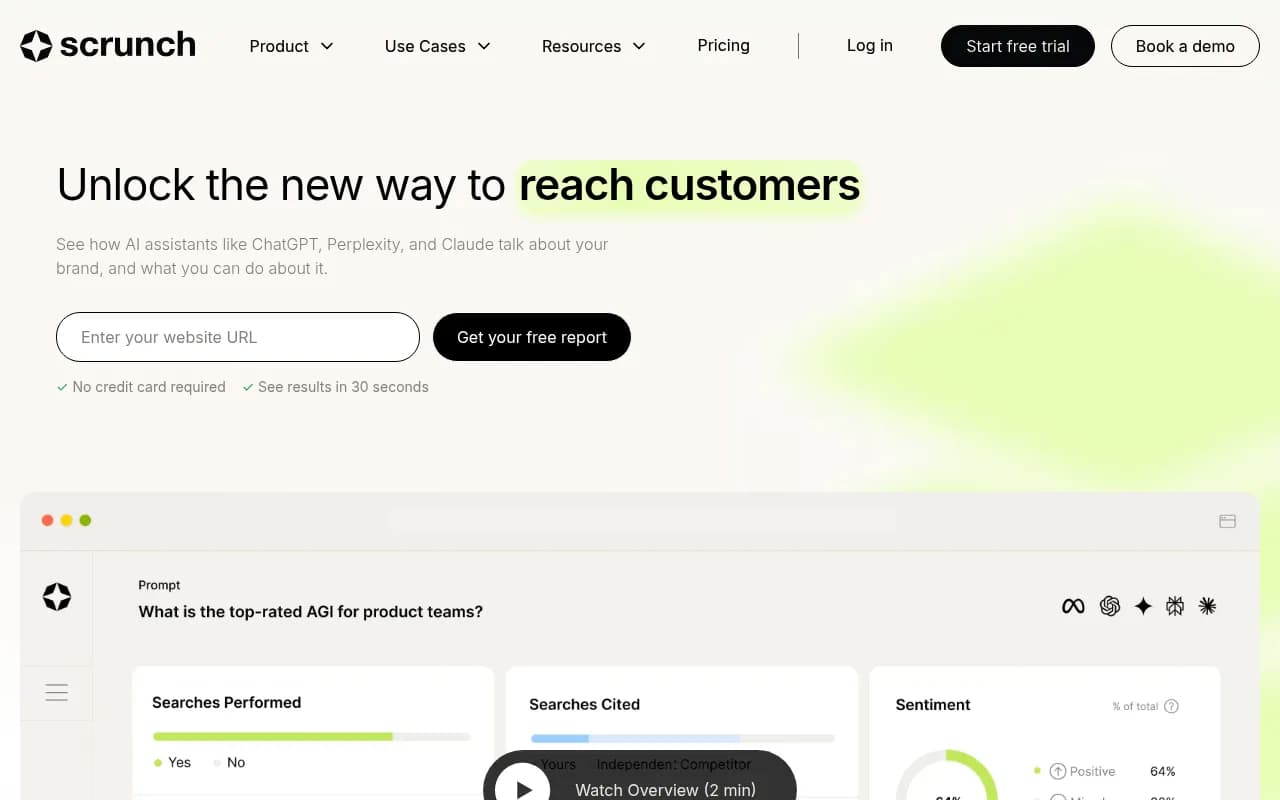
Scrunch AI and AthenaHQ fall here. Scrunch has solid brand accuracy features and agent traffic monitoring. AthenaHQ has good enterprise positioning. But both are primarily monitoring tools -- they show you the data and leave the "what now?" question unanswered.

Enterprise intelligence platforms
These are the platforms built for large organizations with dedicated SEO or brand teams. Profound is the clearest example -- strong analytics, prompt volume data, multi-platform coverage, and the kind of reporting that works in a board presentation. The tradeoff is price (starting around $399/month) and a steeper learning curve.
Profound

End-to-end optimization platforms
This is the category that matters most if you actually want to improve your AI visibility, not just measure it. These platforms combine monitoring with content gap analysis, source attribution, and tools to create content that gets cited.
Promptwatch is the clearest example of this approach. It tracks visibility across 10 AI models, identifies which prompts competitors rank for that you don't, and includes an AI writing agent that generates content grounded in real citation data. The loop is: find the gap, create the content, track the improvement.

Platform coverage: the hidden variable
One of the biggest differences between tools is which AI platforms they actually monitor. This matters more than most buyers realize.
Google AI Overviews sits inside the world's most-used search engine. If a tool doesn't cover it, you're missing a massive chunk of AI-influenced search behavior. Gemini is growing fast inside Google Workspace, where enterprise buyers do their research. Claude is increasingly the tool technical buyers and developers use for deep research. DeepSeek has grown significantly in certain markets.
Here's how coverage compares across some of the major tools:
| Tool | ChatGPT | Perplexity | Google AI Overviews | Claude | Gemini | Grok | DeepSeek | Copilot |
|---|---|---|---|---|---|---|---|---|
| Promptwatch | Yes | Yes | Yes | Yes | Yes | Yes | Yes | Yes |
| Profound | Yes | Yes | Yes | Yes | Yes | Partial | No | No |
| Scrunch AI | Yes | Yes | Yes | Yes | Yes | No | No | No |
| Otterly.AI | Yes | Yes | Yes | Yes | No | No | No | No |
| Peec AI | Yes | Yes | Yes | No | No | No | No | No |
| AthenaHQ | Yes | Yes | Yes | Yes | Yes | No | No | No |
A tool covering only ChatGPT and Perplexity is showing you a partial picture. Those are the two most-discussed platforms, but they're not the only ones shaping buyer decisions.
The accuracy problem: mentions aren't always wins
This is the part most tools don't talk about, and it's important.
AI models hallucinate with confidence. They'll describe your product's pricing incorrectly. They'll say you integrate with tools you don't. They'll describe your positioning using language that's three years out of date. They'll occasionally mix up your brand with a competitor's.
A tracking tool that counts every mention as a positive signal is giving you a distorted picture. You might think your AI visibility is strong when actually the model is recommending you based on wrong information -- which could be worse than not being mentioned at all.
The better tools check for accuracy, not just presence. Scrunch AI has made brand accuracy a core feature, flagging responses where the model's description of your brand diverges from your actual positioning. This is genuinely useful and undervalued.
Promptwatch's approach to this is tied to source attribution -- by showing you exactly which pages, Reddit threads, and third-party sources AI models are pulling from when they mention you, you can identify where inaccurate information originates and fix it at the source.
Sampling frequency and statistical reliability
Here's a question worth asking any LLM tracking vendor: how many times do you run each prompt, and how do you handle response variance?
If the answer is "once per day" or "once per week," the data is noisy. A brand that appears in 3 out of 10 runs of a prompt has meaningfully different visibility than one that appears in 9 out of 10 -- but if you only run the prompt once, you can't tell the difference.
The more rigorous tools run each prompt multiple times and report a visibility rate rather than a binary yes/no. This is harder to build and more expensive to operate (more API calls), but it produces data you can actually trust.
When evaluating tools, ask specifically: "How many times do you sample each prompt, and do you show me the variance?" If they can't answer that clearly, treat the visibility scores with skepticism.
Source attribution: the feature that separates useful from useless
Knowing that ChatGPT mentioned your brand is table stakes. Knowing why ChatGPT mentioned your brand -- which specific pages, publications, or forum threads it's drawing from -- is where the real value is.
Source attribution tells you:
- Which of your own pages are being cited (and which aren't)
- Which third-party sources are influencing AI recommendations in your category
- Where competitors are getting cited that you're not
- Whether Reddit discussions, G2 reviews, or industry publications are driving AI recommendations
Without this, you're optimizing blind. You might publish more content, but you don't know if it's the right content or if it's being found by AI crawlers at all.
Promptwatch's citation analysis covers 880M+ citations across AI models, which gives it a meaningful data advantage for identifying patterns. It also surfaces Reddit and YouTube discussions that influence AI recommendations -- a channel most tools ignore entirely.
The action gap: where most tools fail
Let's be direct about the core problem with most LLM monitoring tools: they show you data and then stop.
You can see that you appeared in 23% of relevant prompts last month. You can see that your competitor appeared in 67%. You can see which prompts you're missing. And then... nothing. The tool has done its job. You're on your own to figure out what to do.
This is the action gap, and it's where most of the value in this category is being left on the table.
The tools that close this gap do a few things differently:
First, they show you the specific content your site is missing -- not just "you're invisible for this prompt" but "here's the topic, here's the angle, here's what the AI wants to answer that your site doesn't address."
Second, they help you create that content. Not generic SEO filler, but articles and pages engineered around real citation patterns -- the kinds of content that AI models actually pull from when generating answers.
Third, they track whether the new content works. Did publishing that article improve your visibility for the target prompt? Did it get cited? Did it drive traffic from AI referrals?
That full loop -- find the gap, create the content, measure the result -- is what separates an optimization platform from a monitoring dashboard.
What good tracking actually looks like in practice
A few practical things that separate serious tracking setups from superficial ones:
Prompt design matters. The prompts you track should reflect how real buyers actually ask questions -- not just "[brand name] review" but "what's the best [category] tool for [use case]?" The more your prompts match real buyer intent, the more your visibility data reflects actual business risk.
Competitive framing is essential. Tracking your own visibility in isolation tells you half the story. You need to know your share of voice relative to competitors. If you're appearing in 40% of prompts but your main competitor is appearing in 80%, that's a very different situation than if you're both at 40%.
AI crawler logs are underrated. Several platforms now offer logs of when AI crawlers (GPTBot, ClaudeBot, PerplexityBot) visit your site. This tells you whether your content is even being discovered, which pages are being read, and whether crawlers are hitting errors. It's the technical foundation that most brands skip entirely.
Traffic attribution closes the loop. Visibility scores are interesting. Revenue impact is what matters. The better platforms connect AI visibility to actual traffic and conversions -- either through a code snippet, Google Search Console integration, or server log analysis.
Tool recommendations by use case
Different teams have different needs. Here's a practical breakdown:
| Use case | Recommended tool | Why |
|---|---|---|
| Getting started, tight budget | Otterly.AI | Quick setup, basic share-of-voice baseline |
| International brands, multilingual | Peec AI | 115+ languages, strong international coverage |
| Enterprise analytics, board reporting | Profound | Deep analytics, prompt volume data |
| Brand accuracy monitoring | Scrunch AI | Flags inaccurate AI descriptions of your brand |
| Full optimization loop (track + fix) | Promptwatch | Find gaps, generate content, measure results |
| Agency managing multiple clients | Promptwatch | Multi-site support, white-label options, API |
For teams that want to go beyond monitoring and actually improve their AI visibility, Promptwatch is the most complete option available. The combination of gap analysis, AI content generation grounded in citation data, crawler logs, and traffic attribution covers the full workflow rather than just one piece of it.
The honest bottom line
LLM brand tracking in 2026 is genuinely useful -- but only if you understand what you're buying.
Most tools will tell you whether you appeared in an AI response. Fewer will tell you how accurately you were described. Fewer still will tell you which sources drove that response. And almost none will help you do something about what they find.
The volatility of AI responses means that single-snapshot data is unreliable. The hallucination problem means that "appeared" doesn't always mean "well-represented." The platform fragmentation means that tracking two models while ignoring six others gives you a false sense of security.
The brands that will win in AI search aren't the ones with the most monitoring dashboards. They're the ones that find the gaps, create content that fills them, and track whether it works. That's a workflow, not a feature -- and the tools worth paying for are the ones built around it.