Key takeaways
- An AI visibility platform tracks how your brand appears in answers from ChatGPT, Gemini, Perplexity, Claude, Copilot and Google AI Overviews: mentions, citations, position, sentiment and competitors.
- It is not a rank tracker. AI answers are generated, vary by model and country, and cite different sources each time, so you measure patterns across many prompts instead of one position.
- The category splits into monitors (they report), and optimization platforms (they also tell you what to fix and help you do it).
- Ask any vendor four things: does it use real interfaces or only APIs, does it keep the evidence behind each score, does it show crawler activity, and does it connect visibility to traffic?
- Start with a small prompt set, a few competitors and a free scan before you commit to a paid plan.
The short version
A buyer opens ChatGPT and types "best CRM for a 20-person agency." Three or four brands come back, with a few sources underneath. If yours isn't one of them, you lost that buyer before your website ever loaded, and nothing in Google Analytics will tell you.
An AI visibility platform is software that watches those answers at scale. It runs a set of prompts across several AI systems, records what comes back, and turns the pile of responses into numbers a marketing team can act on. Yotpo's glossary-style definition puts it as software that tracks and improves how a brand and its products show up in AI search results, reading open chat answers rather than a list of ten blue links.
That definition is fine as far as it goes. The more useful way to think about it: it is a measurement layer for a channel where you can't see impressions, can't see rankings in the old sense, and often can't see the click either.
Why classic SEO tools don't cover this
A rank tracker asks one question: where does this URL sit for this keyword? That works because a search results page is relatively stable and the same query returns roughly the same list.
AI answers break each of those assumptions.
- The answer is written fresh each time. Two people asking the same thing can get different brands.
- The model often does not search for what the user typed. It rewrites the prompt into several web searches, called query fan-outs. Promptwatch Data on ChatGPT query fanouts notes that a single prompt can trigger 3 to 8 or more searches, and the average number of fan-outs per response moved around a lot between December 2025 and April 2026. Behavior changes under you.
- Each engine cites a different number of sources. Promptwatch's average sources per response report (dated September 2025, so treat the figures as possibly dated) put ChatGPT at roughly 5 sources per web-search answer, Google AI Overviews and Perplexity at about 10. You can't compare them with one yardstick.
- Models change. Citations per ChatGPT response dropped around the GPT-5.3 rollout on March 4, 2026, according to Promptwatch's citation drop report. A one-off check in January tells you little about March.
So you need something that samples continuously, keeps history, and separates engines. That is the job.
What an AI visibility platform actually measures
Vendors use different words, but the useful metrics are consistent. Shadow's 2026 guide makes a good point that a decent platform keeps the evidence behind a score (the prompt, the model, the sources, the competitors) instead of collapsing everything into one number.
| Metric | Plain-English meaning | What it tells you |
|---|---|---|
| Mention rate | How often your brand is named in answers | Whether you are in the conversation at all |
| Citation rate | How often your own pages are listed as sources | Whether AI trusts your content, not just your name |
| Share of voice | Your mentions divided by all brand mentions in the set | Your standing against competitors |
| Position | Where in the answer you appear | Whether you are the first recommendation or an afterthought |
| Sentiment | Tone of how you are described | Reputation problems hiding in the answer text |
| Cited sources | Which domains and pages AI leans on for your topics | Where to put effort: your site, review sites, forums, video |
| AI traffic | Visits and conversions from AI referrals | Whether any of this earns money |
Read them together. A low share of voice is a coverage problem: you aren't showing up for enough prompts. Late position is a prominence problem. Mentions without citations usually point to a content or crawlability issue. Weak sentiment is about reputation, and no amount of new blog posts fixes it.
How the data gets collected
This is the part buyers skip and then regret skipping.
Some tools call model APIs. That is cheap and fast, but what the API returns can differ from what a person sees in the chat interface, especially for citations and shopping results. Others monitor the real user interface of ChatGPT, AI Overviews, Perplexity and the rest, in specific countries and languages. The second approach costs more and is closer to what your customers experience.
Prompts matter just as much as collection. A prompt set built from your own guesses will miss how buyers actually ask. Better platforms give you prompt volumes, difficulty and intent, and show the fan-out queries so you can see what the engine really searched for.
What AI systems actually cite
A visibility platform is only as useful as your understanding of what drives citations. Some current numbers from Promptwatch Data help set expectations.
In ChatGPT citation share by content type (Sep 28 to Oct 4, 2026), product pages were the most cited type at 22.4% and landing pages followed at 16.8%. Put together, 39% of citations went to pages describing what a company sells. Listicles took 13.6%, how-tos 8.7%, documentation 7.5%, comparisons 5.9% and news 5.7%.
Break it down by intent and it gets sharper. For commercial prompts like "best CRM for small businesses," product pages took 26.0%, landing pages 20.6%, listicles 15.0% and comparisons 7.9%. Those four types make up almost 70% of commercial citations. For branded prompts, reviews rose to 5.6% and social posts to 3.0%.
The implication for a brand team: your own commercial pages are real citation candidates, and a platform should tell you which content types and prompt intents drive citations for you specifically.
Sources also shift. Promptwatch's Reddit citation report shows reddit.com's share of ChatGPT citations falling from about 4% to 0.5% on August 14, 2026. And in the social media citations report (Sep 28 to Oct 4, 2026), ChatGPT drew just 0.46% of citations from social platforms while Google AI Overviews drew 12.2%. If you had a Reddit-heavy strategy built on one engine, that matters.
Shelf life varies too. In the content half-life study, landing pages and docs stayed cited longest among pages ChatGPT cited on July 6, 2026, while news lost half its pages within 36 days.
Monitors versus optimization platforms
Here is the split that matters when you shop. Shadow's guide describes the category as now including focused monitors, enterprise answer-intelligence products, SEO suites, content platforms and managed GEO systems. I'd simplify that into two groups.
- Monitors answer "was my brand mentioned?" They run prompts, count mentions and draw charts. Useful, and often cheap.
- Optimization platforms answer "why not, and what do I change?" They add crawler data, site audits, content gap analysis, content creation or publishing, and traffic attribution.
Monitoring alone leaves a team with a dashboard and no plan. I've watched teams stare at a falling share-of-voice line for two quarters because nobody owned the fix. If you have an in-house content team and strong technical SEO, a monitor may be enough. If you don't, pay attention to the second group.
Promptwatch sits in the second group. It tracks the real interfaces of ChatGPT, Google AI Overviews, AI Mode, Gemini, Perplexity, Copilot and others, shows IP-verified AI crawler logs and AI-referred traffic, and has a content agent that drafts and publishes pages aimed at the gaps it finds.

The tool landscape at a glance
The category is crowded. This is a rough grouping of products in our catalog, not a ranking, and you should verify pricing and features on each vendor's own site before buying.
| Type | Examples | Typically good for |
|---|---|---|
| Optimization platforms (monitor plus action) | Promptwatch, Profound, Searchable, AirOps | Teams that want to fix visibility, not only watch it |
| Focused monitors | Peec AI, Otterly.AI, Scrunch AI, Rankshift, LLM Pulse | Small teams that need tracking and reporting |
| SEO suites with AI add-ons | Semrush, Ahrefs Brand Radar, seoClarity, Conductor | Teams already living in those suites |
| Enterprise GEO platforms | Evertune, Bluefish AI, Botify | Large brands with governance needs |
| Agency-focused trackers | Rankscale, Radarkit AI | Multi-client reporting |
Some of the monitors worth a look: [tool:peec-ai]
Otterly.AI


Profound

If you already pay for a big SEO suite, check what it adds before buying a separate product:

For a wider look at the market, the GEO software directory at bestgeosoftware.com and the AI rank tracking directory at ai-rank-tools.com list more options.
What a good platform shows you in practice
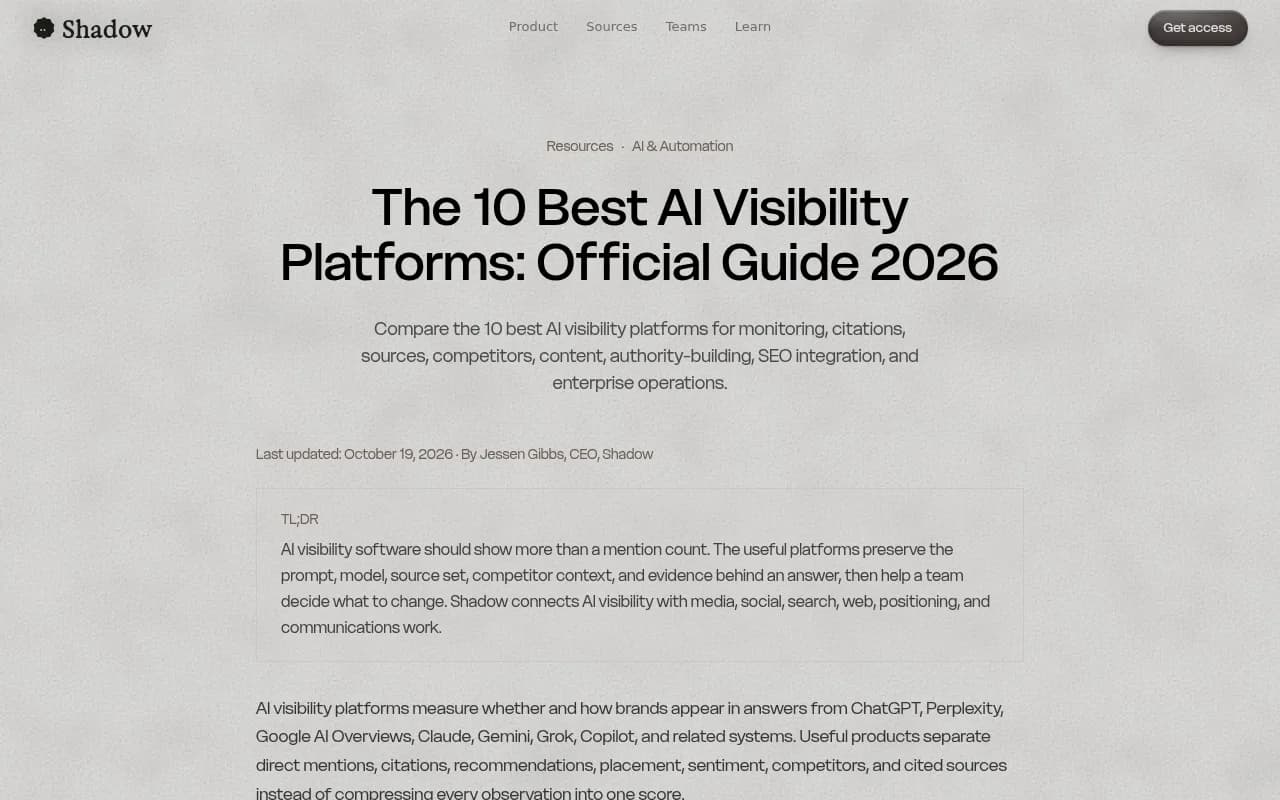
The Shadow guide above frames the buying criterion well: the tool should preserve the prompt, model, source set, competitor context and evidence, then help a team decide what to change. That is a better test than any feature checklist.
In day-to-day use, a good platform lets you do things like these:
- Open a prompt where a competitor is recommended and you are not, and read the full answer plus its sources.
- See which of those cited pages are on your own domain and which are third-party review or comparison pages.
- Check whether AI crawlers can even reach your pages, and whether they hit errors.
- Find pages that rank in Google but never get cited by AI.
- Track whether a page you published or refreshed started getting crawled, cited and clicked.
Steps 3 and 5 are the ones that separate serious tools from dashboards. Crawler logs are rare among monitors, and they explain a surprising number of "why aren't we cited?" cases. Promptwatch Data tracks this too: Meta-WebIndexer, for one, went from about 2% to nearly 38% of tracked AI crawler requests between mid-July and August 9, 2026 (report). Crawler mix changes fast, and you only see it if you log it.
How to choose: seven questions
- Which engines does it cover, and does it use the real interface or only APIs? Ask for a side-by-side example.
- Can I see the full answer, sources and model version behind any number?
- Does it show query fan-outs and prompt volume, or only the prompts I type in?
- Does it log AI crawler activity on my site?
- Can it connect visibility to visits and conversions?
- Does it help me make the fix (briefs, content, publishing), or stop at the report?
- What does cost per tracked response look like once I add countries, languages and competitors? Prompt-count pricing can hide this.
Also check security if you sell to enterprises. ISO/IEC 27001 and GDPR compliance matter when procurement gets involved.
A sensible way to start
Don't begin with 500 prompts. Pick 30 to 50 that cover your real buying questions: category searches ("best X for Y"), comparisons against two or three competitors, and branded questions. Run them for a few weeks across at least ChatGPT, AI Overviews and Perplexity. Free scans exist, and Promptwatch offers a free AI Visibility Report that needs no login, which is a reasonable first look before paying anyone.
Then do three things:
- Fix the obvious: crawlers blocked in robots.txt, thin product pages, missing comparison content.
- Close one content gap at a time and watch whether citations follow.
- Report to leadership on AI-referred traffic and conversions, not just mentions. Mentions are a lead indicator. Revenue is the point.
Expect noise. Individual answers wobble, so look at weekly and monthly trends rather than a single day.
Do you need an agency instead?
Some teams don't have the time to run any of this. An SEO agency that handles technical SEO, content and GEO together can use a platform on your behalf and turn the findings into published work. 1001 SEO Media, which publishes this site, does this and uses Promptwatch for its own AI visibility work. If you'd rather own the process, the steps above are enough to start.
Bottom line
An AI visibility platform tells you whether you exist in AI answers, how you are described, and which sources feed those answers. Pick one that keeps its evidence, covers the engines your buyers use, and gets you from a finding to a fix. For more on the research behind how AI answers are built, browse the Promptwatch Data hub.