Key takeaways
- A damaging AI answer has no single editor to call. You fix it by correcting the sources the model pulls from, so monitoring has to include citations, not just mentions.
- Each engine cites differently. Google AI Overviews cites about 10 sources per answer, ChatGPT about 5, so the sources worth watching vary by platform.
- A usable setup has four parts: a fixed set of crisis prompts, daily runs across engines, alert thresholds, and a named owner who can publish a correction.
- Classic social listening still matters, but it will not tell you what ChatGPT or Gemini says about you when someone asks.
- Early clarity beats perfect messaging. Publish a correct, crawlable statement fast and then refine it.
Why AI answers are a new kind of PR risk
A journalist writes a wrong story and you call the journalist. An AI assistant says something wrong about your company and there is nobody to call. The answer is generated fresh for each user, blends sources, and can differ between ChatGPT, Gemini, Perplexity and Google AI Overviews on the same afternoon.
The failure modes are fairly consistent:
- Outdated facts, such as a pricing model, a leadership team or a product you discontinued.
- Blended identities, where your brand gets mixed up with a competitor or a similarly named company.
- Fabricated quotes or claims that sound plausible.
- Old controversies resurfaced as if they were current.
- Amplified rumors from a forum thread or a low-quality article.
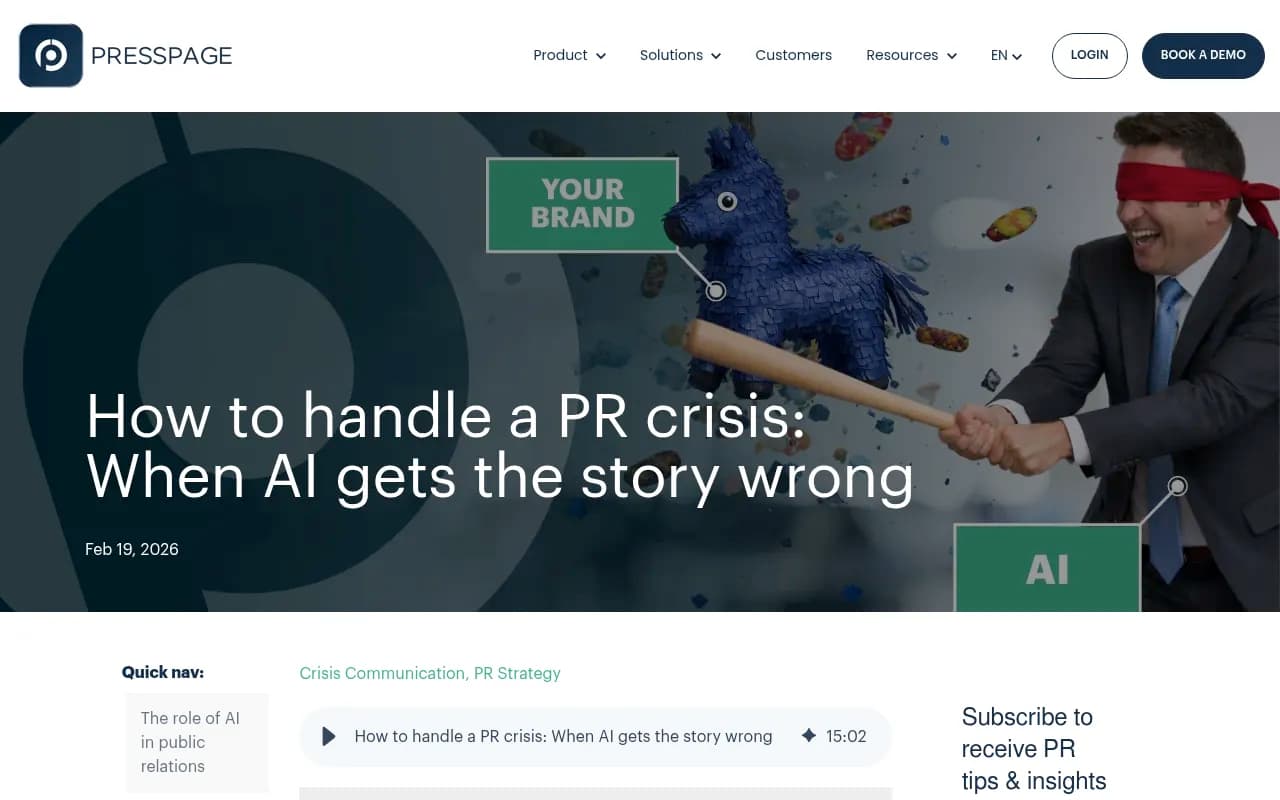
Presspage's February 2026 guide on handling AI-driven PR crises makes the core point well: AI learns from what is already online, so you fix misinformation at the source first, and speed shapes how machines summarize the story.
I think the uncomfortable part is detection. A social media crisis shows up as a spike you can see on a dashboard. A bad AI answer is silent. Nobody tweets about it. Prospects just get a wrong answer, make a decision, and never tell you.
Traditional crisis monitoring vs AI answer monitoring
Both are needed. They answer different questions.
| Question | Social listening and media monitoring | AI answer monitoring |
|---|---|---|
| What does it watch? | Public posts, news, forums, reviews | Generated answers from ChatGPT, Gemini, Perplexity, AI Overviews and others |
| What triggers an alert? | Volume spikes, sentiment drops | A changed claim, a new negative description, a competitor swap |
| Does it show cause? | Partly, via the original post | Only if it tracks citations and source pages |
| Typical tools | Brandwatch, Meltwater, Talkwalker, Brand24 | GEO and AI visibility platforms |
| Response lever | Statement, outreach, takedown | Fix sources, publish clear pages, correct third-party content |
If you already run a listening stack, keep it. Tools like Meltwater, Brandwatch, Talkwalker and Brand24 are good at catching the human conversation that often seeds an AI problem.
5WPR's overview of AI crisis monitoring describes the general method well: collect public mentions, sort by topic and tone, and flag unusual activity. That covers the human web. The missing layer is the generated answer itself.
Step 1: build a crisis prompt set
Monitoring starts with deciding what to ask. Most teams track marketing prompts like "best CRM for startups". For crisis work you need a different list, built around the questions that would hurt if answered badly.
Group them like this:
- Brand fact prompts: "Who owns [brand]?", "What does [brand] cost?", "Where is [brand] headquartered?"
- Trust prompts: "Is [brand] legit?", "Is [brand] safe?", "[brand] scam", "[brand] lawsuit"
- Leadership prompts: "Who is the CEO of [brand]?" plus your executives' names
- Competitor comparison prompts: "[brand] vs [competitor]", "[brand] alternatives"
- Issue prompts: any live controversy, recall, outage or legal matter
- Employee and customer prompts: "[brand] reviews", "working at [brand]"
Add the variants real people type. Include misspellings, other languages, and the countries you operate in, since answers differ by region. Ten to fifty prompts is enough to start. Quality beats volume here.
Step 2: monitor the real interfaces, daily
Answers from an API are not always the same as what a user sees in the ChatGPT or Google interface. For PR purposes, what the public actually sees is what counts, so prefer tools that capture the user-facing answers and citations.
Run the set daily, not weekly. A fast-moving story can change an answer within days, and weekly snapshots miss the window where a correction matters most.
There is also a practical wrinkle. Promptwatch Data's analysis of sources per response (the page is dated September 2025) found that Copilot's average citation count swung from under 2 to nearly 17 within a few weeks. If you monitor Copilot, judge it on monthly trends, not single snapshots, or you will chase phantom problems.
Tool options
Several categories can do the job. Promptwatch tracks the user interfaces of ChatGPT, Google AI Overviews, AI Mode, Gemini, Perplexity, Copilot and others, and shows which pages and third-party sources are cited, which is the piece you need to trace a bad claim. It also has sentiment scoring and a content workflow for publishing corrections, so detection and the fix sit in one place.

Other trackers cover parts of this:
| Tool | Strength for crisis work | Watch out for |
|---|---|---|
| Promptwatch | Citations, sentiment, crawler logs, content fixes | Fuller feature set than a small team may need |
| Profound | Enterprise monitoring across many engines | Higher price point |
| Otterly.AI | Simple brand mention tracking | Light on source analysis and fixing |
| Peec AI | Clean visibility tracking for marketing teams | Monitoring focus |
| LLMClicks | Includes hallucination detection | Narrower feature set |
| Scrunch AI | Visibility and monitoring | Monitoring focus |
Profound

Otterly.AI


For a wider survey, the GEO software directory at bestgeosoftware.com and the AI rank tracking directory at ai-rank-tools.com list far more options.
A free starting point is simply doing it by hand. Ask ChatGPT, Gemini and Perplexity your crisis prompts, screenshot the answers, and log them in a spreadsheet. It is tedious, but it will tell you quickly whether you have a problem worth paying to monitor.
Step 3: define what counts as an alert
Someone has to decide in advance what is a crisis and what is noise. Otherwise every odd phrasing triggers a Slack panic.
A workable severity scale:
- Severity 1: a false factual claim that could cause legal, safety or financial harm (a fake recall, a fabricated lawsuit, wrong medical or financial information)
- Severity 2: a false or outdated claim that affects purchase decisions (wrong pricing, discontinued product listed as current, competitor's scandal attached to you)
- Severity 3: negative but arguably fair framing, such as criticism that matches real reviews
- Severity 4: neutral inaccuracies, like a wrong founding year
Trigger alerts on three things: a new negative claim appearing, a previously stable answer changing, and a sentiment drop on a monitored prompt. Most platforms report a sentiment score per response and a trend, and a sudden fall against your own baseline is more useful than any absolute number.
Read the metrics together to locate the problem. If your brand is mentioned but never cited from your own site, that points to a content or crawlability gap. If sentiment is weak, you likely have a reputation problem, not a technical one.
Step 4: trace the claim back to its source
This is the step that separates AI crisis work from ordinary monitoring. A wrong answer is a symptom. You need the page that caused it.
Look at the citations attached to the bad answer and ask:
- Is the source your own site, with stale content?
- Is it a third-party article, review or directory listing?
- Is it a forum or social thread?
- Is it a competitor's comparison page?
- Is there no good source at all, so the model is guessing?
The last one is more common than you would think. When there is no clear, crawlable, authoritative page answering a question, the model fills the gap from whatever it finds.
Which sources matter also depends on the engine. In Promptwatch Data's social media citations by AI model report (Sep 28 to Oct 4, 2026), social platforms made up only 0.46% of ChatGPT's citations, but 12.2% of Google AI Overviews citations. Reddit alone was 2.15% of AI Overviews citations and Facebook 2.38%. In ChatGPT, Reddit fell from 5.19% to 0.09% in the comparison the report draws. Promptwatch's separate data on Reddit citations dropping in ChatGPT shows the share falling from roughly 4% to 0.5% on August 14, 2026.
The practical read: a nasty Reddit thread is now a smaller risk for ChatGPT answers, but it can still shape Google's AI Overviews. Do not assume one engine's source mix applies to the others.
Source volume differs as well. Promptwatch's average sources per response data shows ChatGPT citing about 5 sources per web-search answer while AI Overviews and Perplexity cite about 10. With ten sources in an AI Overview, one bad page can ride along with nine good ones, so check which of your pages Google pulls and what claim it attaches to your brand.
AI crawler logs help here too. If a model keeps repeating outdated information, check whether its crawler can actually read your corrected page, or whether it is hitting errors and falling back on old third-party copies. Promptwatch's AI crawler traffic data gives a benchmark for what normal crawler activity looks like.
Step 5: fix the source, then publish the correction
You cannot ask ChatGPT to forget something. What you can do is change what it finds.
- Correct your own pages first. Update stale product, pricing, leadership and policy pages. Add a dated, plain-language statement for the specific issue.
- Publish a clear fact page. A single page that states the facts people ask about (ownership, pricing, status of a product, response to an incident) gives models something authoritative to cite. Keep it crawlable, not buried in a PDF or behind JavaScript.
- Contact third parties. If an outdated article, directory listing or review site is the source, request a correction. This is slow but often decisive.
- Answer on the platforms that matter. If a forum thread is driving the claim, a calm, factual reply from an identified company account can help, particularly for engines that still cite those platforms.
- Centralize crisis updates in one place, such as a newsroom page. Presspage's advice is blunt: fragmented comms create confusion, and for machines that means conflicting source material.
- Be explicit when correcting fake quotes or deepfakes. State exactly what was not said.
When the issue is a genuine content gap rather than a one-off error, a content workflow helps. Promptwatch's content gap analysis and Content Agent can draft and publish pages aimed at the prompts where you are misrepresented, and then track whether those pages get crawled and cited. Other options include AirOps for content operations, though it has no monitoring layer to ground the writing.
If you want a human team to run this for you, agencies that combine digital PR with generative engine optimization exist for exactly this reason. 1001 SEO Media is one, and it publishes this site.
Step 6: check that the fix worked
A correction is not done when you publish it. It is done when the answers change.
Re-run the affected prompts daily for at least two weeks. Look for:
- The bad claim disappearing or being replaced
- Your corrected page appearing in the citation list
- Sentiment on the prompt returning to baseline
- The crawler visiting the corrected page
Content has different lifespans too. Promptwatch's content half-life data (pages ChatGPT cited on July 6, 2026, tracked for 90 days) found landing pages and docs stayed cited longest, while news lost half its pages within 36 days. For a correction, that argues for a durable landing or fact page over a one-off news-style post. Expect a fix based on a news item to fade faster.
If nothing moves after a couple of weeks, go back to step 4. Usually you missed a source.
A lightweight crisis playbook
Here is a version a small PR team can adopt this week.
| Phase | Action | Owner |
|---|---|---|
| Prepare | Build 20 to 50 crisis prompts, set up daily runs, write alert thresholds | PR lead plus SEO |
| Detect | Review alerts, classify severity | On-call comms person |
| Triage (first hours) | Trace cited sources, confirm whether the claim is false, check crawler access | SEO or GEO specialist |
| Respond | Publish holding statement or fact page, contact third-party sources | PR lead |
| Correct | Update owned pages, request third-party fixes, publish supporting content | Content team |
| Verify | Re-run prompts daily, log changes | SEO or GEO specialist |
| Review | Document what happened, update the prompt set | Whole team |
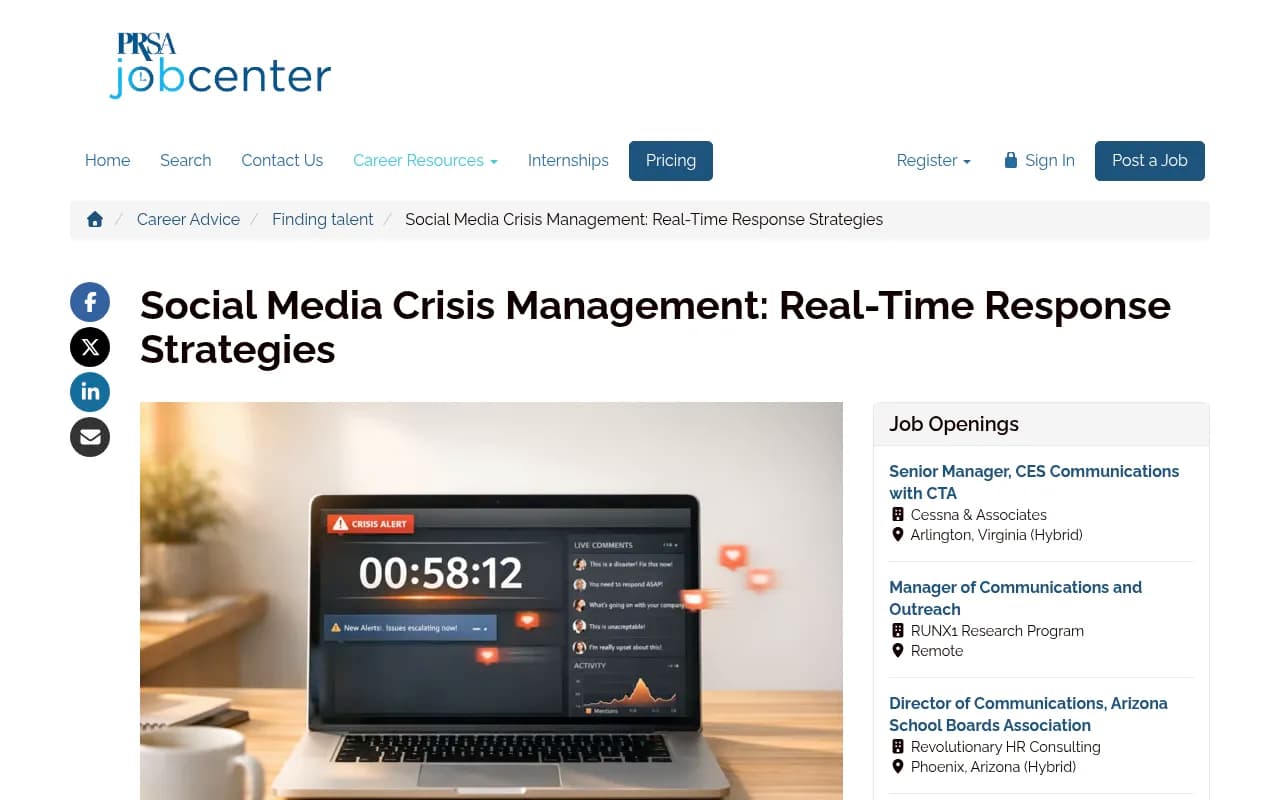
The PRSA-hosted guidance on social media crisis response recommends an initial statement within the first hour and a fuller response within 24 hours. That timing works for AI incidents too, with one addition: make sure the statement lives on a page models can read, not only on social channels.
What AI cannot do for you
The tools above catch changes and trace sources. They do not decide whether a claim is actually false, whether it is legally risky, or how to word a response. That judgment is still human, and the PR pros I trust say the same thing: automation sorts and flags, a person decides.
Also be honest about limits. Answers vary run to run, so a single odd response is not necessarily a trend. Look for repeated appearances across days and engines before you escalate. And some wrong answers have no fixable source, in which case the best move is publishing the authoritative page that did not exist before.
Common mistakes
- Only monitoring brand name prompts. Executives, products and issues need coverage too.
- Treating all engines the same. Source mix differs sharply, as the citation data above shows.
- Checking weekly. A crisis moves faster.
- Fixing the answer instead of the source. You cannot edit the model's output.
- Publishing corrections on pages crawlers cannot read.
- Forgetting non-English markets and regional AI Overviews.
Where to start today
Write ten crisis prompts. Run them manually across ChatGPT, Gemini, Perplexity and Google. Log what each says and which sources it cites. If you find even one wrong claim, you have your business case for setting up daily monitoring, and you already know which page to fix first.