Talkwalker Review 2026
Talkwalker is an enterprise social listening, media monitoring, and competitive intelligence platform used by 2,500+ brands. It tracks mentions, sentiment, and trends across social, news, and broadcast channels with AI-powered insights via its Yeti Agent.
Key takeaways
- Talkwalker is a mature, enterprise-grade social listening and media monitoring platform trusted by brands like Adobe, Thomson Reuters, and Kaiser Permanente.
- Coverage is genuinely broad: social media, online news, print, broadcast, podcasts, and review sites -- all in one dashboard.
- The new Yeti Agent adds autonomous AI-driven insights, which is a meaningful step beyond static dashboards.
- Pricing is opaque and starts high -- estimates put it at $1,200 to $9,600+ per year, making it a poor fit for small teams or solo practitioners.
- No meaningful presence in AI search monitoring (ChatGPT, Perplexity, Claude, etc.) -- teams that need to track brand visibility in LLMs will need a separate tool like Promptwatch for that use case.
Talkwalker has been around since 2009, founded in Luxembourg, and has spent the better part of 15 years building what is now one of the more complete social listening and media monitoring platforms on the market. In 2023, Hootsuite acquired Talkwalker, folding it into a broader social media management ecosystem. That acquisition brought some interesting integration possibilities but also raised questions about product roadmap independence -- something worth keeping in mind if you're evaluating long-term vendor stability.
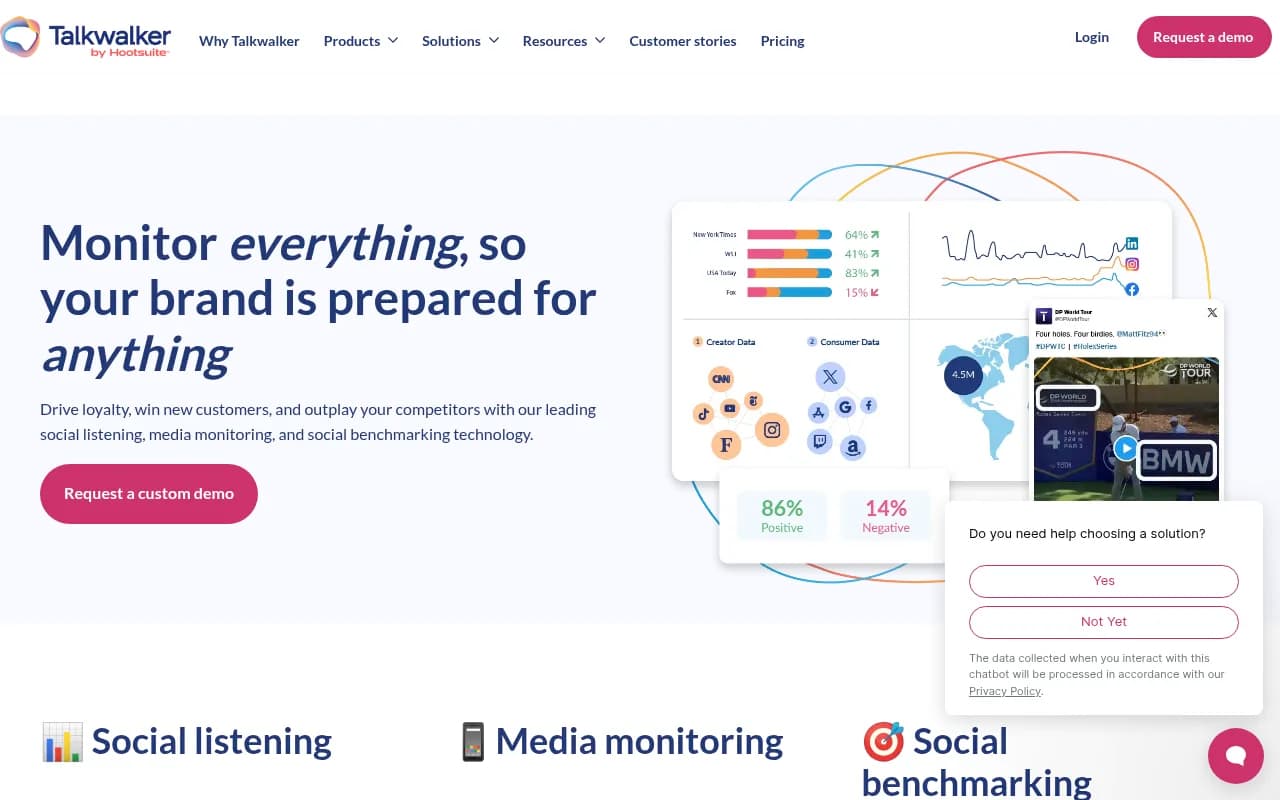
The core problem Talkwalker solves is straightforward: brands generate enormous amounts of conversation across the internet, and most marketing and PR teams have no systematic way to track, analyze, or act on it. Talkwalker pulls from social networks, news sites, blogs, forums, broadcast media, and review platforms, then applies sentiment analysis, trend detection, and competitive benchmarking on top of that raw data. The result is a platform that can tell you not just what people are saying about your brand, but how that sentiment is shifting, who the influential voices are, and how you compare to competitors.
The target audience is primarily enterprise marketing teams, PR and communications departments, and consumer insights teams at mid-to-large companies. Agencies also use it heavily to manage client reporting and competitive analysis. This is not a tool built for a 5-person startup -- the pricing, the complexity, and the feature depth all point squarely at organizations with dedicated analysts or at least a team member whose job includes brand intelligence.
Key features
Social listening across 150+ million data sources
Talkwalker claims coverage across 150 million websites, 30 social networks, and broadcast media. In practice, this means you can set up keyword-based queries and get results from Twitter/X, Instagram, Facebook, LinkedIn, TikTok, YouTube, Reddit, news sites, blogs, and more. The query builder supports Boolean logic, which is genuinely useful for filtering out noise -- a brand name like "Apple" needs careful query construction to avoid drowning in irrelevant mentions.
- Historical data access goes back several years depending on the plan
- Real-time alerts can be configured for spikes in mention volume or sentiment shifts
- Geo-filtering lets you narrow results by country, region, or city
Sentiment analysis and emotion detection
Talkwalker's NLP-based sentiment engine classifies mentions as positive, negative, or neutral, and goes a step further with emotion detection (joy, anger, disgust, fear, etc.). The accuracy is generally solid for English-language content, though like all automated sentiment tools it struggles with sarcasm, industry jargon, and non-English languages. You can manually correct sentiment classifications, which feeds back into the model over time.
Yeti Agent -- autonomous AI insights
The most recent addition to the platform is Yeti Agent, an AI assistant that independently scans your data, identifies trends or anomalies, and surfaces strategic recommendations without requiring you to manually prompt it. Think of it as a proactive analyst that flags things like a sudden spike in negative sentiment around a product feature, or a competitor gaining share of voice in a specific region. This is a meaningful step beyond the typical "ask a question, get an answer" AI chatbot approach that most tools have bolted on. Whether it delivers on that promise in practice depends heavily on how well your queries are configured and how much data you're feeding it.
Media monitoring and earned media measurement
Beyond social, Talkwalker monitors online news, print publications (via partnerships), and broadcast media including TV and radio. This is particularly valuable for PR teams tracking earned media coverage. The platform calculates metrics like Advertising Value Equivalency (AVE) and media impact scores, though AVE remains a contested metric in the PR industry. You can build media contact lists and track journalist coverage over time.
Competitive benchmarking
The social benchmarking module lets you compare your brand's social performance against competitors and industry averages. Metrics include engagement rate, follower growth, posting frequency, and content performance. You can benchmark against specific competitor handles or against aggregated industry data. This is useful for quarterly business reviews and for identifying gaps in your social strategy.
- Side-by-side competitor comparison dashboards
- Industry benchmark data for context
- Historical trend comparison
Influencer and creator identification
Talkwalker surfaces influential voices in any conversation -- journalists, bloggers, social media creators, and brand advocates. You can filter by reach, engagement rate, and topic relevance. The platform connects creator data with consumer conversation data, which helps identify who is actually driving brand perception versus who just has a large following.
Custom dashboards and reporting
The dashboard builder is flexible. You can create custom views for different stakeholders -- an executive summary dashboard looks very different from a detailed analyst view. Reports can be scheduled and exported as PDFs or PowerPoints, which matters for agencies and teams that present to clients or leadership regularly. The visualization options include bar charts, line graphs, geographic heat maps, and word clouds.
Crisis detection and alerting
Talkwalker includes configurable alert thresholds for mention volume spikes, sentiment drops, and specific keyword triggers. For PR teams managing brand reputation, this is one of the more practical features -- getting an alert at 2am when a product recall story starts trending is genuinely valuable. The alert system integrates with email and Slack.
Image and video recognition
One feature that sets Talkwalker apart from many competitors is visual listening -- the ability to detect brand logos in images and videos even when there's no text mention. This is useful for tracking organic brand exposure in user-generated content, sports sponsorships, and event coverage where people post photos without tagging the brand.
Who is it for
The clearest fit is enterprise marketing and PR teams at companies with significant brand presence and the budget to match. Think a global consumer goods company tracking brand sentiment across 20 markets, or a financial services firm monitoring regulatory news and brand mentions simultaneously. The University of Sydney testimonial on the homepage is a good example -- a large institution with multiple stakeholders, complex campaign measurement needs, and a team that needs to justify social media investment to leadership.
Agencies are another strong use case, particularly those managing multiple brand clients and needing a single platform for competitive analysis and client reporting. Talkwalker's white-labeling and multi-client dashboard capabilities make it workable for agency environments, though the per-seat pricing can get expensive when you're managing 20+ clients.
Consumer insights teams at CPG, retail, and healthcare companies also get real value here. The ability to track unmet consumer needs, product feedback, and category trends from organic social conversation is genuinely useful for product development and innovation programs.
Who should not use this tool: small businesses, solo marketers, or anyone without a dedicated budget for social intelligence. The pricing floor (estimated at $1,200/year minimum, likely much higher for meaningful feature access) and the learning curve both work against casual users. If you're a startup tracking brand mentions, a tool like Mention or Brand24 will serve you better at a fraction of the cost. Similarly, if your primary concern is how your brand appears in AI search results -- ChatGPT, Perplexity, Google AI Overviews -- Talkwalker doesn't address that at all.
Integrations and ecosystem
Talkwalker's integration story has improved since the Hootsuite acquisition. The most notable connections include:
- Hootsuite: Deep integration for publishing, engagement, and listening in a unified workflow
- Slack: Alert notifications and report sharing
- Google Data Studio / Looker Studio: Data export for custom reporting
- Salesforce: CRM integration for connecting social data to customer records
- Brandwatch: Talkwalker competes directly with Brandwatch, but some enterprise setups use both
- API access: Available on higher-tier plans for custom data pipelines and integrations with internal BI tools
The API is reasonably well-documented and supports data export for teams that want to pipe Talkwalker data into their own data warehouses or visualization tools. Mobile apps exist for iOS and Android, primarily for monitoring alerts and reviewing dashboards on the go rather than full platform access.
Pricing and value
Talkwalker does not publish pricing on its website -- you have to request a demo to get a quote. Based on third-party research (Prowly's 2025 analysis estimates), pricing starts somewhere between $1,200 and $9,600 per year, with enterprise contracts likely running significantly higher. The wide range reflects different tiers based on the number of topics tracked, data volume, historical access, and user seats.
This opacity is frustrating. It makes budget planning difficult and forces you into a sales conversation before you can evaluate whether the tool fits your budget. Competitors like Mention and Brand24 publish clear pricing tiers, which makes comparison shopping much easier.
For context:
- Brand24 starts at around $79/month for small teams
- Brandwatch is similarly enterprise-priced and opaque
- Sprout Social Listening is bundled with Sprout's social management suite, starting around $249/month
Talkwalker's pricing is defensible if you're an enterprise team that needs the full feature set -- the data coverage, the visual listening, the broadcast monitoring, and the competitive benchmarking together represent real value. For anyone below that threshold, the cost-to-value ratio gets questionable quickly.
There is no meaningful free tier. A free demo is available, but this is a sales-led process, not a self-serve trial.
Strengths and limitations
Where Talkwalker genuinely excels:
- Data breadth: The combination of social, news, broadcast, and visual listening in one platform is hard to match. Most competitors cover social well but fall short on broadcast and image recognition.
- Historical data: Access to years of historical data is valuable for trend analysis and benchmarking against past campaigns.
- Yeti Agent: The autonomous AI insights feature is a genuine differentiator if it works as advertised -- proactive trend detection without manual prompting is what most analysts actually want.
- Enterprise reliability: 2,500+ customers including major global brands suggests the platform handles scale and uptime requirements that smaller tools can't match.
- Visual listening: Logo detection in images and videos is a capability that genuinely adds value for brand tracking in visual-heavy channels.
Honest limitations:
- No AI search visibility: Talkwalker monitors traditional media and social channels but has no capability to track how your brand appears in AI-generated answers from ChatGPT, Perplexity, Claude, or Google AI Overviews. As AI search becomes a primary discovery channel, this is a real gap. Teams that need this will have to add a dedicated GEO platform separately.
- Pricing opacity and cost: The lack of published pricing and the high entry point make it inaccessible for smaller teams and create friction in the evaluation process.
- Learning curve: The platform is powerful but complex. Getting meaningful value requires investment in query setup, dashboard configuration, and ongoing maintenance. Teams without a dedicated analyst often underutilize it.
- Sentiment accuracy in non-English languages: Like most NLP-based tools, accuracy degrades outside of English, which matters for global brands monitoring conversations in multiple languages.
Bottom line
Talkwalker is a strong choice for enterprise marketing and PR teams that need comprehensive brand monitoring across social, news, and broadcast channels, and have the budget and internal resources to use it properly. The Yeti Agent is a promising step toward making the platform more proactive rather than reactive, and the visual listening capability is genuinely differentiated.
That said, it's a traditional media monitoring tool in a world where AI search is becoming a primary brand discovery channel. If tracking how your brand appears in ChatGPT, Perplexity, or Google AI Overviews matters to your team -- and it increasingly should -- Talkwalker won't help you there. For that use case, Promptwatch is the more appropriate tool.
Best for: Enterprise PR and marketing teams at mid-to-large companies that need unified social listening, media monitoring, and competitive benchmarking with serious data depth and analyst-grade reporting capabilities.
Tags:
Frequently asked questions
What is Talkwalker?
Who is Talkwalker best suited for?
How much does Talkwalker cost?
Does Talkwalker track AI search visibility (ChatGPT, Perplexity, etc.)?
What is Yeti Agent in Talkwalker?
How does Talkwalker compare to Brandwatch or Sprout Social?
Similar and alternative tools to Talkwalker