Key takeaways
- Almost every AI visibility tool offers a 7-day trial. The differences that matter in hour one are whether you can load your own prompts, how many engines the trial covers, and how fast first data shows up.
- Profound's trial runs 50 preset prompts on 3 engines, so you can't test your own prompt set. Otterly gives you 50 prompts, Scrunch has a no-card trial, and Lumirank gives 14 days.
- Engine caps and add-ons are the biggest onboarding trap. Otterly Standard goes from $189 to roughly $416 once you add engines, and Peec locks you to 3 models.
- Onboarding quality is more than a pretty setup wizard. It is how quickly you get from signup to a decision you can act on.
- I could not verify every vendor's actual click-by-click flow, and I've said so where it matters. Check each trial yourself before paying.
What good onboarding means for an AI visibility tool
Most onboarding comparisons talk about wizards and tooltips. For this category I think that's the wrong lens. An AI visibility tool does one thing: it runs a set of prompts through AI engines on a schedule and records who gets mentioned and cited. So onboarding quality comes down to four questions.
- How fast do you get real data?
- Can you load prompts that reflect your business, or are you stuck with presets?
- Does the trial cover the engines you care about?
- Does the tool tell you what to do next, or leave you staring at a dashboard?
The first hour is where you find out. Below is a walkthrough of what that hour should look like, followed by how the main tools handle each step.
One honest caveat up front. Several of the sources I leaned on for pricing are vendor-authored comparison pages, and vendors rank themselves first. Treat numbers as a snapshot from August to October 2026 and confirm them on each pricing page.
The first hour, step by step
Minutes 0 to 10: signup, brand and competitors
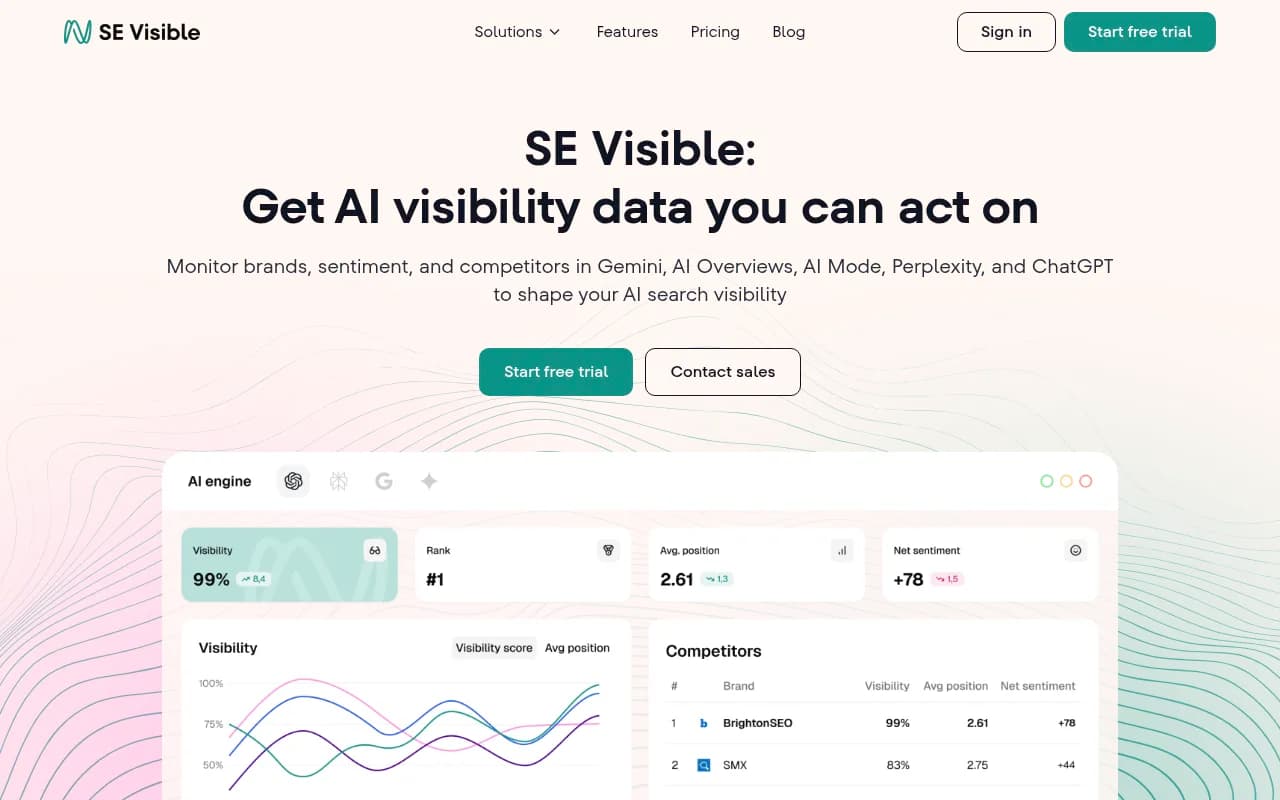
You enter your domain and brand name, and the tool should suggest competitors. Peec says setup is a workspace with your brand name and that first results appear within a few minutes, though the page text I found was garbled, so treat that as approximate. SE Visible suggests competitors at setup and groups prompts into topics with intent and branded tags, which is a sensible structure for agencies onboarding many clients.
Watch out for brand aliases here. If your brand has two spellings or a product name people use instead, add them now. Otherwise the tool undercounts mentions and you spend hour two wondering why numbers look low.
Minutes 10 to 25: building the prompt set
This is where most people go wrong. They paste in 10 prompts that all name their brand and then feel great about the results.
Promptwatch Data gives a useful reason not to do that. In its report on unique domains per ChatGPT response (Sep 28 to Oct 4, 2026), 52.5% of organic prompts that named no brand cited 10 or more domains, against 21.3% of brand-specific prompts, where the most common count was 5 domains. A single prompt tells you little. Citation behavior varies enough by prompt type that you want a mix.
A sensible first set looks like this:
- Organic prompts with no brand named, such as "best CRM for small agencies"
- Competitor comparison prompts, such as "X vs Y for agencies"
- A handful of brand-specific prompts to check how you are described
Promptwatch's query fanout data is also worth a look at this stage. It reports average ChatGPT query length falling from about 117 characters in December to roughly 53 from April, and recommends headings and prompts that read like real search queries. Short and natural beats long and clever.
This is also where tools diverge sharply. Profound's trial uses 50 preset prompts, so you can't test your own. Otterly's trial gives 50 prompts with no card. Promptwatch and Peec both lead with a 50-prompt entry plan, and tools like Promptwatch add prompt volumes, difficulty and Search Console-based suggestions so you aren't guessing which prompts matter.

Minutes 25 to 40: choosing engines
Engine selection is where pricing quietly bites. Here is what I found:
- Peec: you choose 3 models, an extra model is about $30/month.
- Otterly: 4 engines included (ChatGPT, Google AI Overviews, Perplexity, Copilot). AI Mode and Gemini cost $59/month each and Claude $109, which pushes Standard from $189 to about $416 for all 7 engines.
- Promptwatch: the Brands plans are described as tracking 4 platforms per project on one comparison, while another source lists all models on Essential. Model counts differ across sources (9, 11, 14), so confirm what your tier includes before you commit.
- Profound: 3 engines (ChatGPT, Gemini, AI Overviews) on the trial.
- KIME: Explorer plan monitors 2 engines; the full nine need Enterprise.
My advice: pick the engines your buyers actually use, not the biggest number. If you're B2B software, ChatGPT, AI Overviews and Perplexity cover most of it. Then check whether your plan lets you change engines later without a penalty.
Minutes 40 to 50: waiting for data
Peec and Otterly collect answers by scraping the logged-out UI daily, so expect first data in minutes to hours, not instantly. Scrunch runs new prompts daily for their first 14 days, then every 72 hours. That matters if you're trialing: a 7-day window on a 72-hour cadence gives you very few data points.
Use the waiting time productively. Set up your Search Console connection, and if the tool has a site audit or crawler view, start it. Knowing whether AI crawlers can even read your site often explains the results before they arrive.
Minutes 50 to 60: reading the first results
Ignore the headline score. Look at three things.
- Which prompts you appear on and which you don't
- Which sources get cited instead of you
- Whether the tool suggests an action
That third point is the real divider in this market. Monitoring-only tools stop at the dashboard. Others turn gaps into tasks. Promptwatch has an Action Board and a Content Agent that plan and write content against visibility gaps, and KIME and Profound both pitch agentic execution layers. Whether you want that depends on your team, but decide before you pay, because it changes which tool is cheaper in practice.
How the main tools compare in the first hour
| Tool | Trial | Can you use your own prompts? | Engine limits early on | Entry price |
|---|---|---|---|---|
| Promptwatch | 7 days on monthly paid plans; free Explore plan (10 prompts, ChatGPT only) | Yes | Tracked engines vary by tier; confirm on pricing page | $95/mo Essential (50 prompts) |
| Peec AI | Trial available | Yes | 3 models, extra about $30/mo | $95 (EUR 85) Starter |
| Otterly.AI | 7 days, 50 prompts, no card | Yes | 4 engines, add-ons for the rest | $29 Lite (15 prompts) |
| Profound | 7 days | No, 50 preset prompts | 3 engines | Custom after trial |
| Scrunch | 7 days, no card | Yes | 7 platforms | $250/mo annual, $300 monthly |
| Lumirank | 14 days, no card | Yes | 6 engines on Pro | $99 Pro; free plan 10 prompts on 2 engines |
| KIME | 7 days | Yes | 2 engines on Explorer | From EUR 99 |
Two notes. Profound's older $99 and $399 plans were gone by late September 2026, so any roundup still quoting "from $99" is stale. And Otterly's Lite looks cheapest, but 15 prompts is thin for a real test.
Tool-by-tool notes
Promptwatch
Promptwatch's free Explore plan is a low-friction way to start: 10 prompts on ChatGPT only, no payment. The paid trial is 7 days on monthly Essential, Professional, Kick-off and Growth. What stands out in hour one is that the data goes beyond mentions. Crawler logs, site audit and Search Console overlays let you see why you are or aren't cited, though crawler logs are described as starting at the Professional plan in one comparison. Its free AI Visibility Report is a no-login scan if you want a sanity check before signing up.
Peec AI
Peec AI is simple to start with and has unlimited users. The constraint is the 3-model pick, and the per-model add-on cost. Good for teams that know exactly which engines they care about.

Otterly.AI
Otterly.AI has a generous-feeling trial (50 prompts, no card) and a personal onboarding session on its Premium tier. The pitfall is add-on engines, which can more than double your Standard bill.
Otterly.AI

Profound
Profound is built for enterprise, so onboarding is a sales-assisted process. The preset-prompt trial is fine for seeing the interface, poor for judging fit. Vendr puts the median contract at $35,250 a year.
Profound

Scrunch
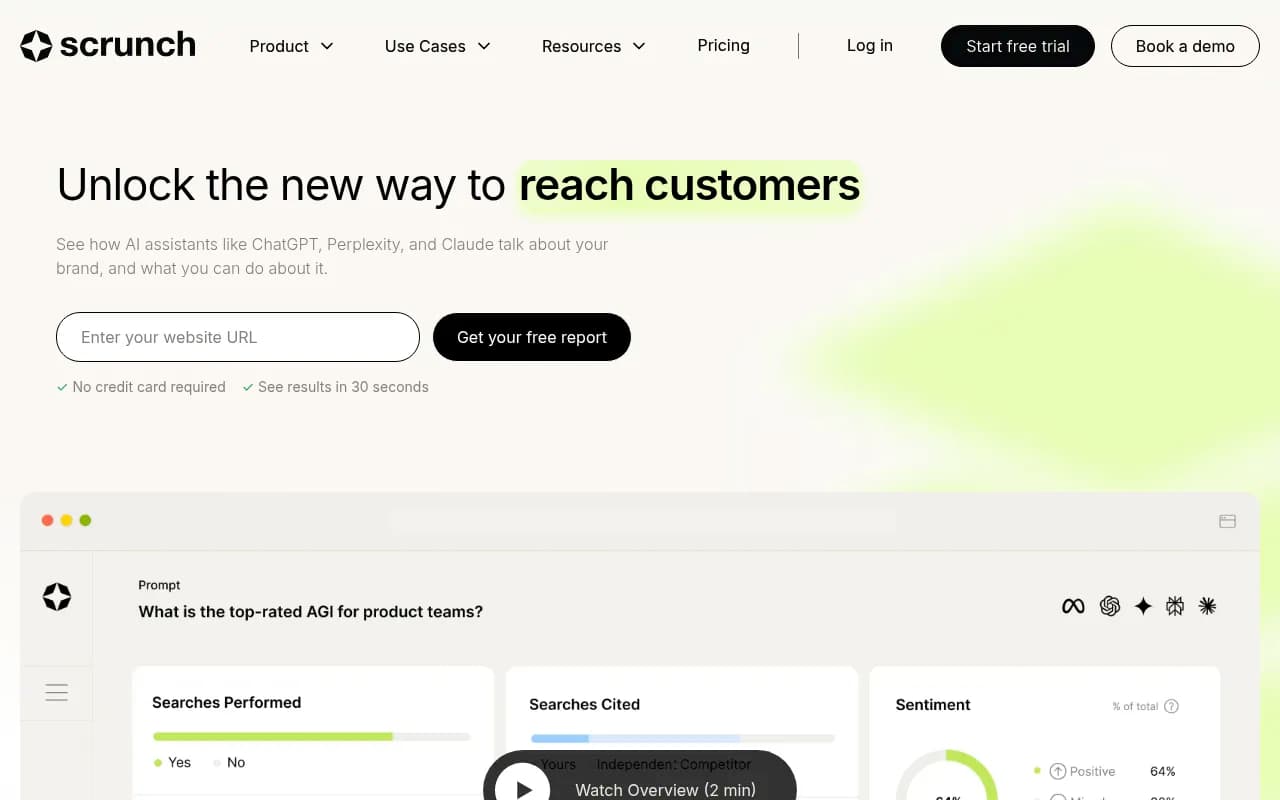
Scrunch AI offers a no-card trial and covers 7 platforms. Mind the 72-hour refresh after a prompt's first 14 days.
SE Visible
SE Visible is the one to look at if you onboard many client accounts. Setup is a project per brand with suggested competitors, and each number traces to a stored answer. The trade-off: it covers AI visibility only, and there's no white-label option yet.
Cheaper and add-on options
If you already pay for a suite, Semrush's AI toolkit starts at $99 for 25 prompts, and HubSpot AEO is $50 for 25 prompts on 3 engines. Onboarding is easiest here because you're already logged in. The prompt caps are tight though.
For a wider list, the directories at bestgeosoftware.com and ai-rank-tools.com catalog dozens more.
A trial checklist you can run in one sitting
Before you start any trial, prepare these so you don't burn days:
- A list of 30 to 50 prompts split across organic, comparison and brand types
- Your brand name, aliases and 3 to 5 competitors
- The two or three engines your buyers use
- Search Console access, so you can connect it immediately
- One question you want answered, such as "which competitor shows up where we don't?"
Then score each tool out of five on the questions from the top: time to first data, prompt freedom, engine coverage on the trial, clarity of next steps, and how honest the pricing page is about add-ons.
Which one has the best onboarding?
It depends on what you're onboarding for, and I'd be wary of anyone who names a single winner.
- Fastest to a first look: Peec and Otterly, since daily UI scraping and simple setup get you data quickly.
- Most freedom in a trial: Otterly (50 prompts, no card), Scrunch (no card), Lumirank (14 days).
- Best path from data to action: Promptwatch, with prompt intelligence, crawler logs and an action list in the same place, plus a free tier to try first.
- Best for agency client rollouts: SE Visible or an agency plan from Promptwatch, which includes unlimited projects.
- Hardest to evaluate on a trial: Profound, because of the preset prompts.
My own pick for most marketing teams is to start on a free or no-card tier, load your real prompts, and judge the tool on hour-one clarity. If you can't tell what to do next after 60 minutes, the other 29 days of the month won't fix that. And remember that if you'd rather hand the whole program to specialists, 1001 SEO Media runs AI search and GEO work for brands, but the tools above are enough to start learning on your own.