Key takeaways
- Most AI visibility tools answer the same core question: was my brand mentioned, cited, or recommended? The real difference is what happens after you see the answer.
- A free stack (Google Search Console, Bing Webmaster Tools, GA4) plus a small manual prompt panel is enough to establish a baseline for many small teams.
- Simple trackers fit a limited prompt set and a team that just needs trend lines. Heavier platforms pay off when you have a content program that can act on the data, multiple brands or clients, or need to prove traffic and revenue impact.
- Every tool, simple or complex, shares one limit: measurement does not diagnose why you are invisible. Complexity only helps if it adds diagnosis or execution, not just more charts.
- Pick based on the work you will do in the next 90 days, not the longest feature list.
The question behind the question
Every AI visibility vendor says roughly the same thing on the homepage. Track your brand across ChatGPT, Perplexity, Gemini and Google AI Overviews. See who gets recommended. Improve it.
So why does one tool cost $29 a month and another cost several hundred? And does the expensive one actually do more for you, or does it just have more tabs?
I think the honest answer is that it depends on a single thing: whether you have anyone who will act on the data. A dashboard nobody uses is a bad purchase at any price. A $20 tracker that feeds a weekly content decision is a great one.
One reviewer who tested 15 of these tools made the same observation: many tools overlap heavily despite different marketing language, and the biggest difference is usually workflow usability and actionability, not the underlying measurement. That matches what I see.
What every AI visibility tool does
Strip the branding and most tools work the same way. You list prompts your buyers might ask, such as "best payroll software for a 20-person company." The tool runs those prompts on a schedule, records the answers, and reports whether your brand appeared, where, in what tone, and next to which competitors.
It helps to think of three separate questions:
- Are we mentioned? Does the AI name your brand when someone asks about your category?
- Are we cited? Does the AI link to your pages as a source?
- Can AI reach us? Can crawlers and agents actually access and understand your pages?
Most simple trackers live in question one. Many add a rough version of question two. Very few touch question three, which is where a lot of the fixable problems hide.
One more thing worth knowing: AI answers are regenerated on each run. As Straight North's COO put it in an interview, if five people ask ChatGPT the exact same question, they will likely get different outputs. Visibility is a rate, not a rank. Any tool you choose should show trends across repeated runs, and you should distrust a single screenshot.
The free stack: where to start
Before paying anyone, look at what you already have. Straight North's September 2026 GEO survey found that 50% of respondents used a free GEO tool or something built in-house, while only 30% were paying for a dedicated platform. That split sounds right to me.
The free baseline looks like this:
- Google Search Console shows what Google's own surfaces report about your pages.
- Bing Webmaster Tools does the same for Bing and Copilot-adjacent surfaces.
- GA4 shows referral traffic from AI platforms that send clicks.
- A manual prompt panel of 10 to 20 questions that matter, checked once or twice a month and logged in a spreadsheet.
This will not give you daily data or competitor share of voice. It will tell you whether AI is a meaningful channel for you yet. If the answer is "barely," spending budget on content structure, expertise and third-party mentions beats spending it on measurement.
Profound's own guide argues that manual checking does not scale, and they are right about the ceiling: you cannot realistically check hundreds of prompts a day across several models. But that argument only bites once you actually need hundreds of prompts.
Simple trackers: what you get and what you give up
The lightweight end of the market is crowded. Based on the reviews in the research, these are typical:
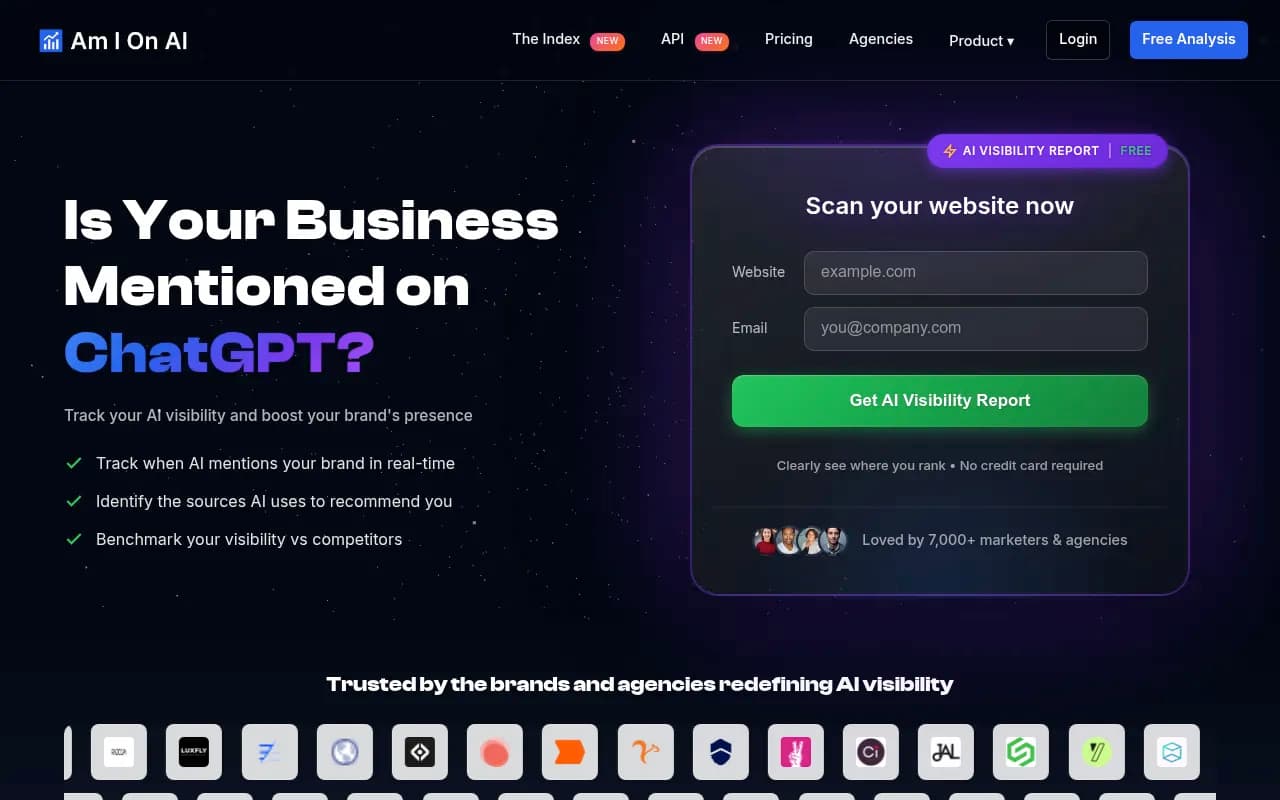
- Am I On AI is described as one of the simplest options available, with a starting price around $29 a month. It suits solo consultants, small SaaS teams and anyone who wants a quick check without a GEO strategy team.
- Otterly.AI starts around $29 a month and is positioned for startups and budget monitoring.
Otterly.AI

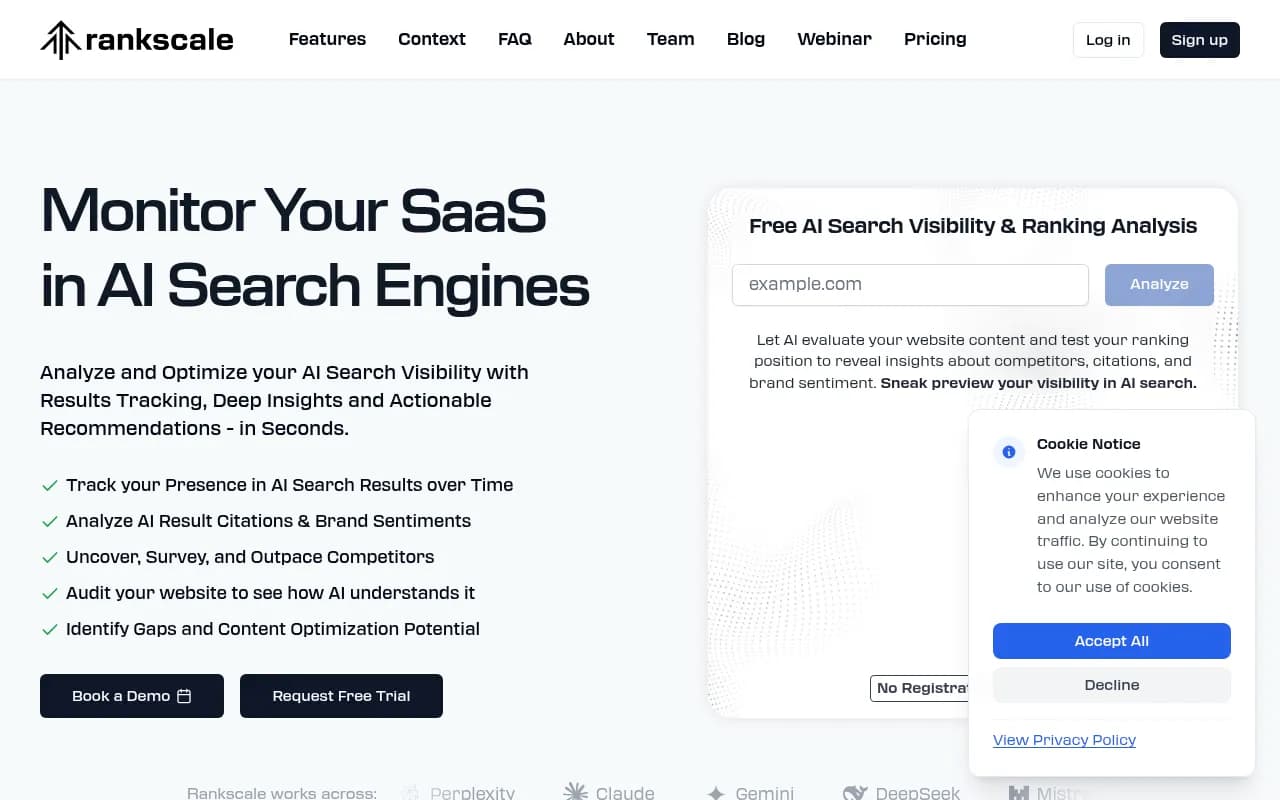
- Rankscale starts around $20 a month and leans toward traditional SEO teams and agencies.
- Peec AI sits around $95 a month and is praised for being focused and easy to use, with a dashboard that is easy to read quickly. A mid-sized SaaS company or agency wanting reliable tracking without enterprise complexity would reasonably shortlist it.

Treat those prices as indicative, since they come from a third-party roundup and vendors change plans. Check each pricing page before you decide.
What you give up with a simple tracker is usually the same short list: no crawler visibility, no traffic attribution, limited or no content tooling, and small prompt allowances. For a B2B manufacturer watching 20 to 50 high-value prompts, that is a fine trade. Straight North makes exactly that point: a lower-priced tracker can be enough at that scale.
Feature-heavy platforms: what the extra weight buys
Heavier platforms add layers. Some add enterprise reporting, permissions, regions and governance. Others add content workflows. A few add technical diagnosis.
Profound is the usual example of the enterprise end. Reviewers describe it as feeling closer to a full intelligence platform, built for large marketing teams and companies where AI visibility reporting has reached the board. The same reviewer admits it feels heavier than competitors and that smaller teams may find the workflow overwhelming.
Profound

Others lean on action rather than raw reporting:
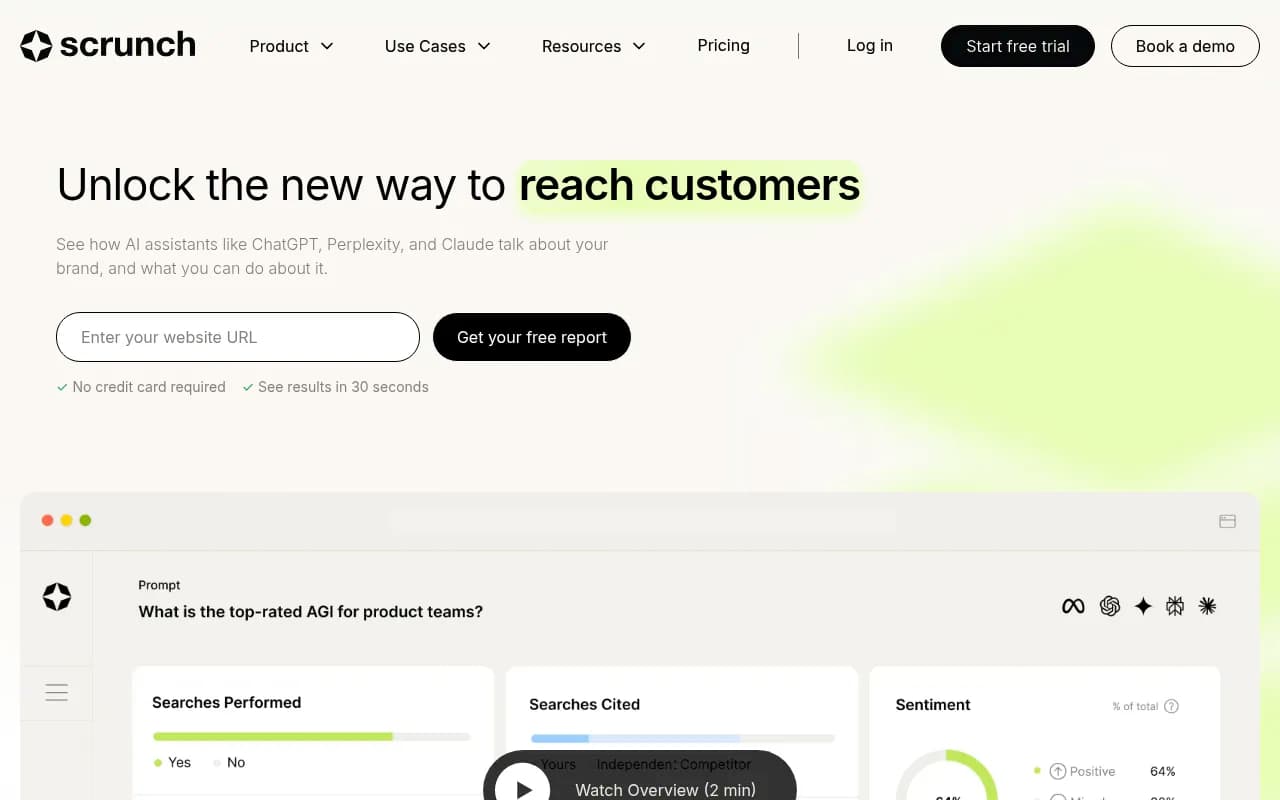
- Scrunch AI emphasizes AI readiness and content optimization alongside monitoring.
- Goodie AI takes a content-centric view, tying visibility to how your content ecosystem performs.
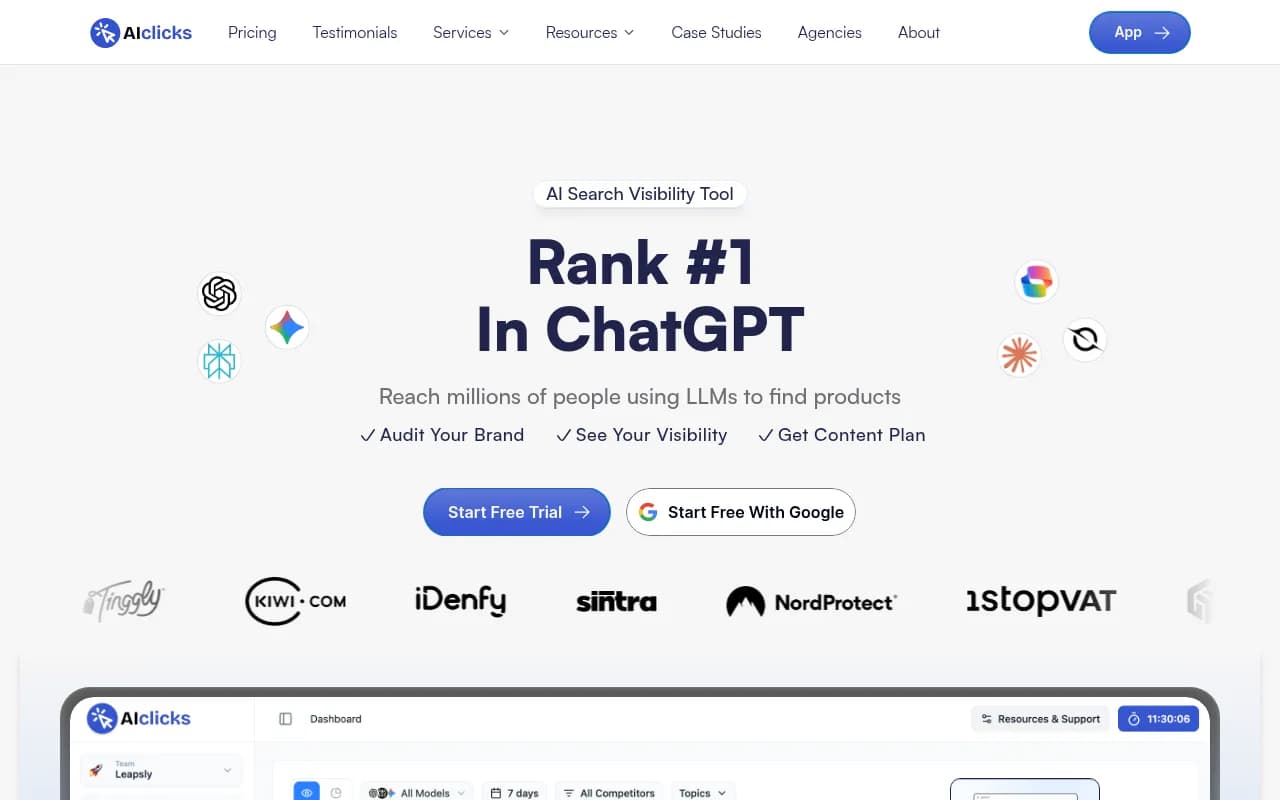
- AIclicks focuses on practical GEO workflows for teams trying to improve visibility, not just measure it.
- AthenaHQ targets strategic brand perception work at a higher price point.

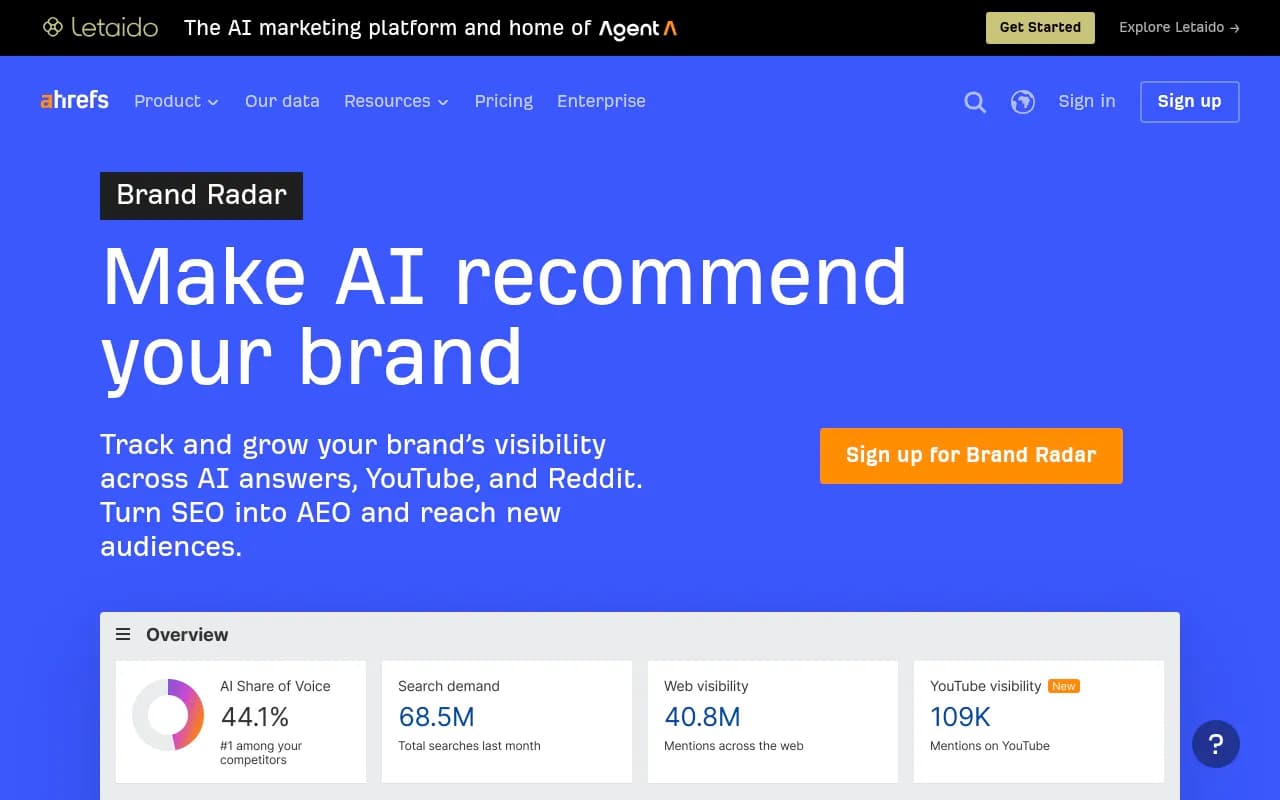
- Semrush and Ahrefs Brand Radar add AI tracking inside suites you may already pay for.
And then there are platforms that try to cover the whole loop from monitoring to fixing. Promptwatch is one of these. It tracks real user interfaces rather than only APIs, adds IP-verified AI crawler logs and visitor analytics so you can see whether AI systems reach your pages and what traffic they send, and includes a Content Agent and Action Board that turn gaps into drafted and published content. That is a lot more than a tracker, and whether you need it depends on the next section.

Side-by-side comparison
| Approach | Typical monthly cost | Setup effort | Best for | Main limit |
|---|---|---|---|---|
| Free stack (GSC, Bing, GA4, manual panel) | $0 | Low | Baseline, tiny teams, local businesses | No daily runs, no competitor share of voice |
| Simple tracker (Am I On AI, Otterly, Rankscale) | about $20-$100 | Minutes | Solo operators, small SaaS, budget monitoring | Little diagnosis or execution |
| Focused mid-tier (Peec AI, AIclicks) | about $60-$300 | Hours | Mid-sized teams, agencies | May lack crawler data or content tools |
| Enterprise intelligence (Profound, BrightEdge) | high to custom | Days to weeks | Large brands, board-level reporting | Heavy workflow, price climbs with coverage |
| End-to-end optimization platform (Promptwatch and similar) | mid to high, tiered | Hours to days | Teams with a content program and proof-of-impact needs | More to learn if you only want a scoreboard |
The prices are directional figures from third-party reviews. Confirm on vendor sites, including Promptwatch's pricing page, before budgeting.
The limit nobody can buy their way past
Here is the part I wish more buyer guides said out loud. Every tool in this category measures. Almost none diagnose.
One independent review put it bluntly: all of the major platforms measure visibility, and none diagnose why you are not appearing. In one example, a company could see exactly how invisible it was in AI responses but could not identify a single fixable cause from the tool outputs. Its technical expertise lived in PDFs that AI systems could not read.
That is a reminder that more dashboards do not equal more answers. A tool earns its complexity only if it helps with at least one of these:
- Crawler access: can AI bots reach and read your pages, and where do they hit errors?
- Source mapping: which third-party pages, review sites, Reddit threads or videos are being cited instead of you?
- Traffic attribution: are AI answers sending visitors who convert?
- Execution: does the tool help you create or fix the content that closes the gap?
If a platform offers none of the above, it is a more expensive scoreboard.
Why the data underneath matters more than the interface
AI engines behave differently, and a tool has to account for that. Promptwatch Data's average sources per response report shows ChatGPT citing about 5 sources per web-search answer, while Google AI Overviews and Perplexity cite about 10. Copilot swung from under 2 to nearly 17 sources over a few weeks. If your tool reports weekly snapshots from an unstable engine, you will chase noise. Judge Copilot-type engines on monthly trends.
Prompt design matters too. According to Promptwatch's ChatGPT query fanout data, the average fanout query length fell from about 117 characters in December 2025 to roughly 53 in April 2026. The practical lesson: a tool that only tracks long conversational prompts may not match how ChatGPT actually searches. Short, keyword-like prompts belong in your panel too.
And the earlier point about API versus interface output is not trivial. Several reviewers noted that API-based monitoring often differs from what real users see in the actual product. If accuracy matters to you, ask vendors how they collect responses.
A decision framework
Skip the feature matrix at first. Answer these five questions in order.
1. Is AI already a meaningful channel for you?
Check GA4 for AI referrals and Search Console for impressions. If customers are telling you they found you in ChatGPT, as happened to the kitchen renovator in one Reddit thread, it is worth tracking. If nothing shows up, start with the free stack.
2. Do you have someone who will act on the data?
Straight North's three conditions for paying are sensible: AI surfaces already create impressions or traffic, your team has a content or GEO program that can respond, and competitor visibility matters enough that manual checks no longer cover it. If you cannot tick all three, a simple tracker or the free stack is plenty.
3. How many prompts, brands and markets?
20 to 50 prompts for one brand: simple tracker. Hundreds of prompts, several countries, or multiple clients: you need workspaces, exports and white-label reporting, which pushes you up a tier.
4. Do you need to prove revenue impact?
If leadership asks "what did this bring in?", mention counts will not do. You need visitor analytics or at least clean GA4 attribution. That is the moment a simple tracker starts to feel thin.
5. Is your bottleneck measurement or production?
If you already know what to fix but cannot ship content fast enough, you need execution tooling more than another dashboard. If you do not know why you are invisible, you need crawler and citation diagnosis. Be honest about which one is yours.
Who should pick what
- Solo consultant or local business: free stack plus a $20-$30 tracker, or even just the manual panel. Build clear service pages, collect reviews, and fill out your Google Business Profile. One Reddit commenter noted that many AI optimization tools just repackage fundamentals a good website should already have, and for a local renovator that is largely true.
- Startup or small SaaS team: a simple tracker like Otterly or Am I On AI for the first quarter, then reassess.
- Mid-sized SaaS or agency: a focused tool like Peec AI, or a platform that adds crawler logs and traffic attribution if you have a content team that can use them.
- Content-heavy publisher or large SaaS: look at platforms that connect visibility to content gaps and publishing, such as Promptwatch, Scrunch, Goodie AI or AirOps-style content engines. For a wider view, the GEO software directory at bestgeosoftware.com lists many more options.
- Enterprise: weigh governance, security, regions and APIs. Profound, Scrunch, AthenaHQ and Promptwatch (which is ISO/IEC 27001 certified) all appear in this conversation, so run a real pilot on your own prompts.
Reading the sources
A quick look at the roundup pages I leaned on shows how varied the framing is.
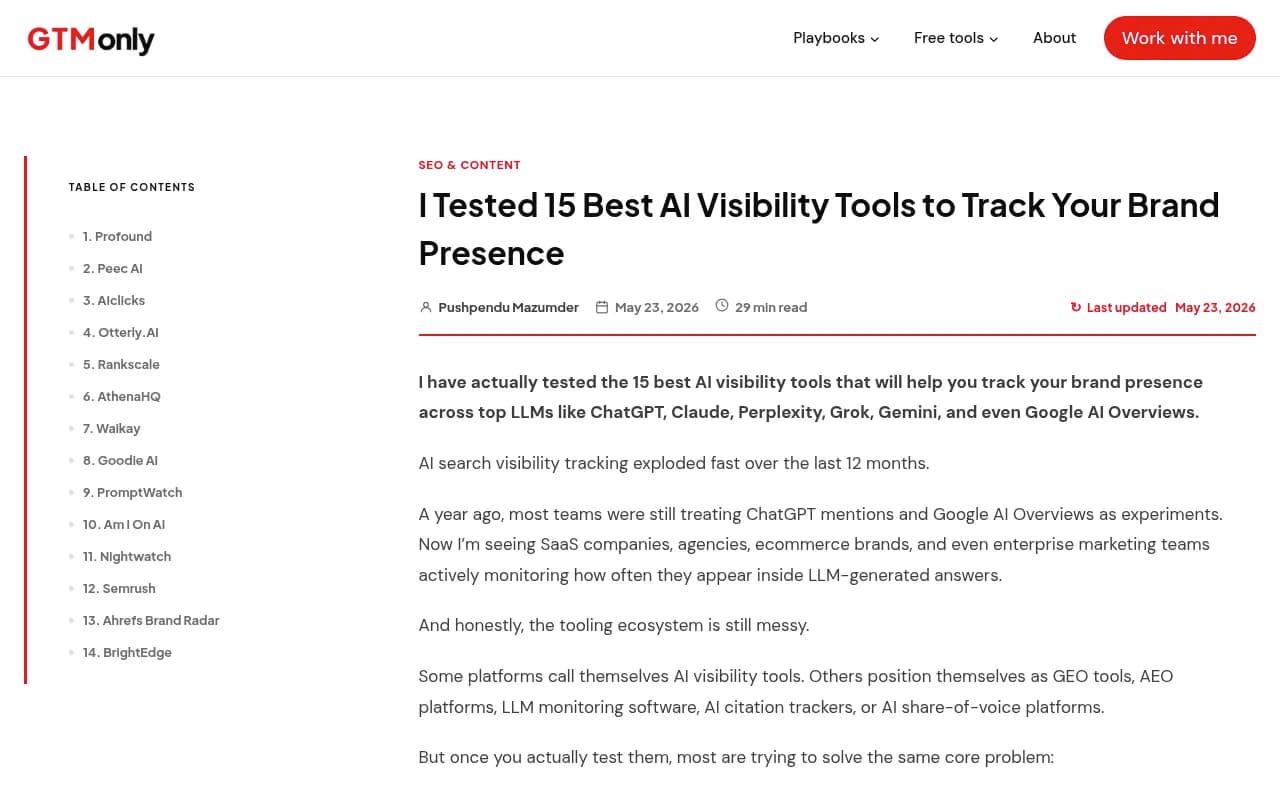
The GTM Only roundup's comparison table puts starting prices from $20 to $399 a month, with custom pricing at the very top. That spread is a useful anchor when a vendor quote looks odd.
Trial checklist before you commit
Whichever tier you pick, run the same test during a trial:
- Load 20 prompts you already know the answer to and see whether results match what you see by hand in the real interface.
- Check how often prompts re-run, and whether trends smooth out noise.
- Ask where the data comes from: real UI or API.
- Find out what you can do when you see a gap. Can the tool tell you which page, source or crawler issue is behind it?
- Export something. If you cannot get your data out, reporting to stakeholders will hurt.
- Price the second year, not just the first month. Costs climb with coverage on several platforms.
If you want to compare more trackers side by side, the rank tracking directory at ai-rank-tools.com is a handy starting point.
Bottom line
Complexity is not a virtue. The right amount is the minimum that gets you from "are we visible?" to "here is what we fix this week." For many small teams that is a free stack and a $29 tracker. For teams with a real content engine and a revenue target, it is a platform that shows crawler behavior, citations and AI traffic in one place and helps ship the fix. Start simple, write down the specific decision you want the data to inform, and move up only when the cheaper tool stops answering it.