Key takeaways
- Scrunch AI is a solid monitoring tool, but it stops at showing you data -- it doesn't help you act on it
- Promptwatch closes the full loop: find visibility gaps, generate content to fix them, then track the results
- Promptwatch covers 10+ AI engines and includes AI crawler logs, Reddit/YouTube insights, and ChatGPT Shopping tracking -- features Scrunch lacks
- For teams that need to move from "we know we're invisible" to "we fixed it," Promptwatch is the more complete platform
- Pricing is competitive: Promptwatch starts at $99/mo vs Scrunch's higher entry point for comparable coverage
There's a moment every marketing team hits eventually. You've set up your AI visibility monitoring, you're watching your brand scores, and you can see exactly where competitors are showing up in ChatGPT, Perplexity, and Google AI Overviews while you're not. The data is clear.
Then what?
That's the question Scrunch AI doesn't answer particularly well -- and it's the main reason teams are switching to Promptwatch in 2026. Monitoring is necessary, but it's not sufficient. If you know you're invisible in AI search and you still can't do anything about it, the dashboard becomes a source of frustration rather than a competitive advantage.
Let's get into the five specific reasons this switch is happening.
1. Scrunch shows you the gap -- Promptwatch helps you close it
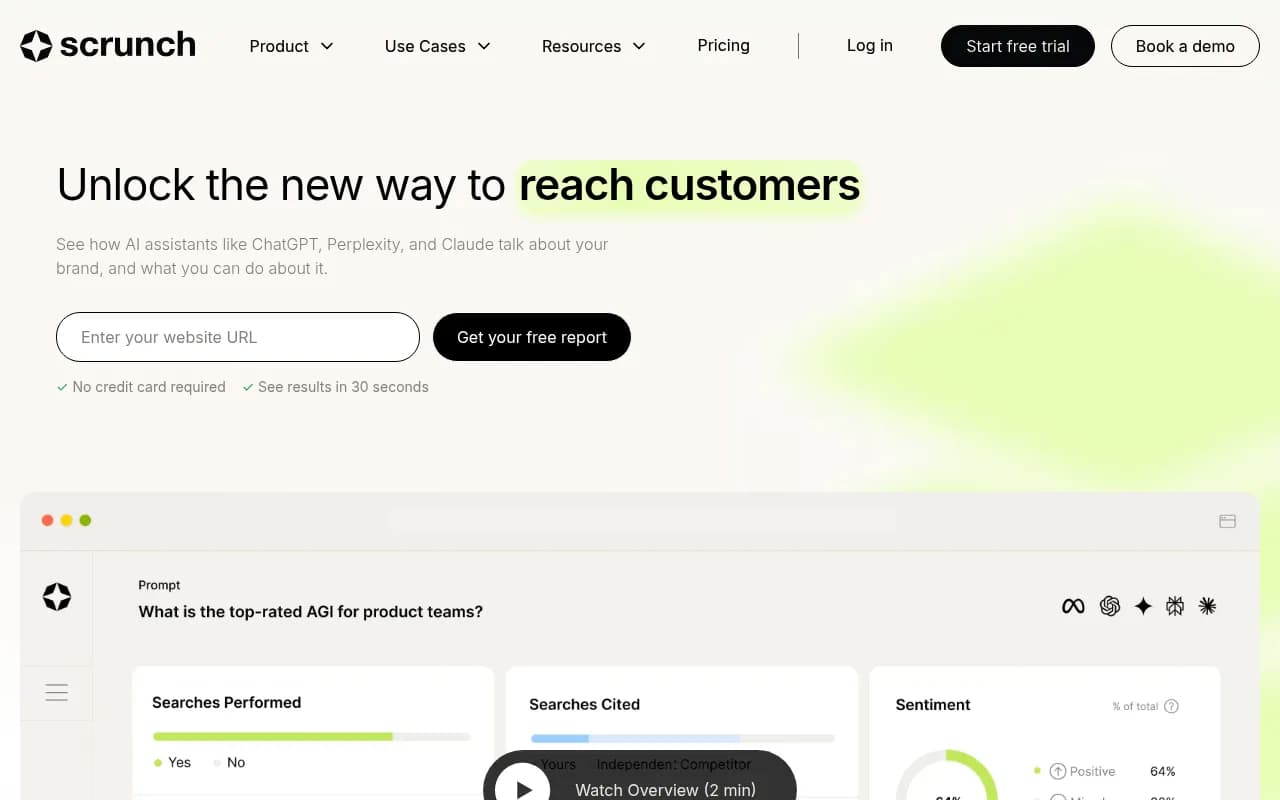
Scrunch AI does a decent job of surfacing where your brand appears (or doesn't) across AI models. You can segment by persona, location, and funnel stage, and the sentiment and share-of-voice analysis gives you a reasonable picture of your competitive position.
But when you find a gap -- a prompt where your competitor is getting cited and you're not -- Scrunch hands you that information and stops. The next step is entirely on you: figure out what content to create, write it, publish it, and hope it works.
Promptwatch is built around what happens after you find the gap. Its Answer Gap Analysis shows you exactly which prompts competitors rank for that you don't, with the specific topics and angles that AI models are pulling from. Then the built-in AI writing agent generates articles, listicles, and comparisons grounded in real citation data -- 880M+ citations analyzed -- not generic SEO filler. The content is engineered specifically to get cited by ChatGPT, Claude, Perplexity, and other models.
This is the core difference. Scrunch is a monitoring tool. Promptwatch is an optimization platform.

2. Promptwatch's AI crawler logs are a feature Scrunch simply doesn't have
One of the more underrated capabilities in Promptwatch is its AI Crawler Logs. In real time, you can see which AI crawlers (GPTBot, ClaudeBot, PerplexityBot, etc.) are hitting your website, which pages they're reading, how often they return, and what errors they're encountering.
This matters more than it sounds. If ChatGPT's crawler is hitting your homepage but bouncing off your most important product pages because of a rendering issue or a crawl error, you won't know that from a visibility score alone. You'll just see that you're not getting cited, with no explanation why.
Scrunch doesn't offer this. Most monitoring-only tools don't. Promptwatch's crawler logs let you diagnose indexing problems at the source -- which means you can actually fix them, rather than guessing why your visibility isn't improving despite publishing new content.
For technical marketing teams and SEO leads, this alone is often the deciding factor.
3. Prompt intelligence: volume, difficulty, and query fan-outs
Not all prompts are worth chasing. Some are high-volume, competitive, and dominated by established brands. Others are winnable in weeks with the right content. Without data on which is which, you're essentially guessing.
Scrunch lets you manage prompts by persona and funnel stage, which is useful for organization. But it doesn't give you the underlying intelligence to prioritize: which prompts have the most volume, which are genuinely winnable, and how one prompt branches into sub-queries that you might also want to target.
Promptwatch has volume estimates and difficulty scores for each prompt, plus query fan-outs that show how a single question expands into related sub-queries. If you're a team with limited content bandwidth -- which is most teams -- this is how you decide where to spend your time. You're not just tracking prompts; you're building a prioritized roadmap.
This is the kind of feature that separates a tool built for marketers who need to show results from one built for analysts who just need to report numbers.
4. Reddit, YouTube, and ChatGPT Shopping -- channels Scrunch ignores
AI models don't just pull from brand websites. They pull from Reddit threads, YouTube videos, forum discussions, and a growing range of third-party sources. If you don't know which of those sources are influencing AI recommendations in your category, you're missing a significant part of the picture.
Promptwatch surfaces Reddit discussions and YouTube content that directly affect AI citations in your niche. This opens up a whole channel of influence that most teams haven't thought about -- and that Scrunch doesn't track at all.
Then there's ChatGPT Shopping. As ChatGPT has expanded into product recommendations and shopping carousels, brand visibility in those surfaces has become genuinely valuable for e-commerce and consumer brands. Promptwatch monitors when your brand appears in ChatGPT's shopping results. Scrunch has no equivalent feature.
The practical implication: teams using Promptwatch are working with a more complete map of where AI visibility actually comes from, not just a slice of it.
5. Traffic attribution closes the loop from visibility to revenue
Here's the problem with monitoring-only tools: they can tell you your visibility score went up, but they can't tell you whether that translated into actual website traffic or revenue. That makes it very hard to justify the investment to a CFO or a skeptical CMO.
Promptwatch has three ways to connect AI visibility to real business outcomes: a code snippet for direct traffic attribution, Google Search Console integration, and server log analysis. Page-level tracking shows exactly which pages are being cited, how often, and by which AI models. You can see the line from "we published this article" to "ChatGPT started citing it" to "traffic from AI search increased."
Scrunch doesn't offer traffic attribution. You get visibility data, but the connection to revenue is left as an exercise for the reader.
For marketing teams that need to prove ROI -- which in 2026 is basically every marketing team -- this gap matters enormously. A visibility score that can't be tied to pipeline or revenue is interesting data. A visibility score connected to traffic and conversions is a business case.
Head-to-head comparison
| Feature | Scrunch AI | Promptwatch |
|---|---|---|
| AI engine coverage | Multiple LLMs | 10 engines (ChatGPT, Perplexity, Claude, Gemini, Grok, DeepSeek, Copilot, Meta AI, Google AI Overviews, Google AI Mode) |
| Prompt management by persona/location | Yes | Yes |
| Answer gap analysis | Limited | Full competitor gap analysis |
| Built-in content generation | No | Yes (AI writing agent) |
| AI crawler logs | No | Yes (real-time) |
| Prompt volume & difficulty scoring | No | Yes |
| Query fan-outs | No | Yes |
| Reddit & YouTube tracking | No | Yes |
| ChatGPT Shopping tracking | No | Yes |
| Traffic attribution | No | Yes (snippet, GSC, server logs) |
| Page-level citation tracking | No | Yes |
| Starting price | Higher entry point | $99/mo (Essential) |
Who should still consider Scrunch?
To be fair: Scrunch is a well-built tool. If your primary need is monitoring brand sentiment and share of voice across AI models, and you have a separate content team and workflow to act on what you find, Scrunch can work. The persona-based prompt management is genuinely useful for enterprise teams with complex audience segmentation.
But if you're a marketing team that needs to move from "we know we have a visibility problem" to "we fixed it and here's the traffic data to prove it," Scrunch's monitoring-only approach will leave you stuck at step one.
The broader shift happening in 2026, as noted by IBM Consulting's Global Demand Leader Vanina Marcote in Forbes, is that marketing teams are moving away from patchwork tool stacks toward systems that actually drive outcomes. A monitoring dashboard that doesn't connect to content creation and revenue attribution is exactly the kind of siloed tool that CMOs are trying to move away from.
The bottom line
The switch from Scrunch to Promptwatch comes down to one question: do you need to track your AI visibility, or do you need to improve it?
If you just need to track it, Scrunch is fine. If you need to improve it -- find the gaps, create content that gets cited, attribute the traffic, and show the results -- Promptwatch is the more complete platform. It's the difference between a speedometer and a navigation system.
For teams that have already done the monitoring phase and are now asking "so how do we actually fix this," Promptwatch is where that work gets done.