Key takeaways
- Scrunch AI's Core plan ($250/mo) limits you to 4 LLMs and offers minimal optimization guidance -- most users hit a wall between "knowing the problem" and "fixing it"
- The best alternatives for content teams go beyond monitoring: they identify content gaps, generate articles, and track whether those articles actually get cited by AI models
- Promptwatch is the only platform in this comparison rated as a leader across monitoring, content generation, and optimization -- it covers 10 AI models and costs less than Scrunch's Core plan
- If your team is stuck producing reports that nobody acts on, the tools below are worth a serious look
Here's the honest version of why people leave Scrunch AI: the platform is good at showing you a problem and not very helpful at solving it.
Scrunch raised $15M+, has real enterprise customers like Lenovo and Crunchbase, and its AI visibility tracking is genuinely solid. But G2 reviewers consistently flag that "optimization suggestions are minimal" and that prompt credits deplete fast when you're tracking across multiple engines. The Core plan covers only ChatGPT, Perplexity, Google AI Overviews, and Copilot -- Claude, Gemini, Grok, and Meta AI all require an Enterprise contract. And the pricing stings: $300/month base, then $25 per additional user.
For content teams, that's a rough deal. You're paying for a dashboard that tells you competitors are getting cited more than you, but it won't write the article that closes the gap.
The alternatives below are chosen specifically for content teams -- people who need to act on visibility data, not just stare at it.
What to look for in a Scrunch alternative
Before the list, a quick framework. Most AI visibility tools fall into one of two categories:
Monitoring-only tools track where your brand appears in AI responses. They show you citation rates, share of voice, competitor comparisons. Useful data, but they stop there. You still have to figure out what to do.
Optimization platforms do all of that, then also tell you what content is missing, help you create it, and track whether it worked. The loop closes.
For content teams, the second category is what actually moves the needle. Here's how the top alternatives stack up:
| Platform | Content generation | LLMs covered | Crawler logs | Starting price |
|---|---|---|---|---|
| Promptwatch | Yes (built-in AI writer) | 10 | Yes | $99/mo |
| AirOps | Yes (content engineering) | Multiple | No | Custom |
| Profound | Limited | 9+ | No | $99/mo |
| Otterly.AI | No | 3 | No | $49/mo |
| Peec AI | No | 3 | No | $49/mo |
1. Promptwatch -- the complete loop for content teams
Promptwatch is the most direct answer to the Scrunch problem. Where Scrunch shows you that competitors are visible and you're not, Promptwatch shows you why -- and then helps you fix it.

The core workflow is built around three steps. First, Answer Gap Analysis identifies the specific prompts where competitors are getting cited but you're not. You see the exact questions AI models are answering with competitor content -- the topics your site is missing. Second, a built-in AI writing agent generates articles, listicles, and comparisons grounded in real citation data. This isn't generic content; it's built around what AI models actually want to cite. Third, page-level tracking shows whether those new articles start getting cited, by which models, and how often.
That cycle -- find gaps, create content, track results -- is what separates it from monitoring-only tools.
A few specifics worth knowing: Promptwatch covers 10 AI models (ChatGPT, Claude, Perplexity, Gemini, Google AI Overviews, Google AI Mode, Grok, DeepSeek, Meta/Llama, Copilot, Mistral), which is more than Scrunch's Core plan by a wide margin. It also includes AI crawler logs -- real-time records of when ChatGPT, Claude, Perplexity, and others visit your site, which pages they read, and what errors they hit. Most competitors don't have this at all.
Pricing starts at $99/month for the Essential plan (1 site, 50 prompts, 5 articles). The Professional plan at $249/month adds crawler logs, 150 prompts, and 15 articles per month. That's actually cheaper than Scrunch's Core plan, with more LLMs covered and actual content generation included.
The dataset behind it is substantial: over 1.1 billion citations, clicks, and prompts processed. The platform is used by 6,700+ brands and agencies including Booking.com and Center Parcs.
One honest limitation: if you need the absolute deepest enterprise-grade competitor intelligence with custom analyst support, you might want to pair Promptwatch with a dedicated research layer. But for most content teams, it's the most complete tool in this space.
2. AirOps -- for teams that want content engineering, not just writing
AirOps takes a different angle. It's less of a visibility tracker and more of a content engineering platform -- the idea being that you build systematic workflows for producing AI-optimized content at scale.
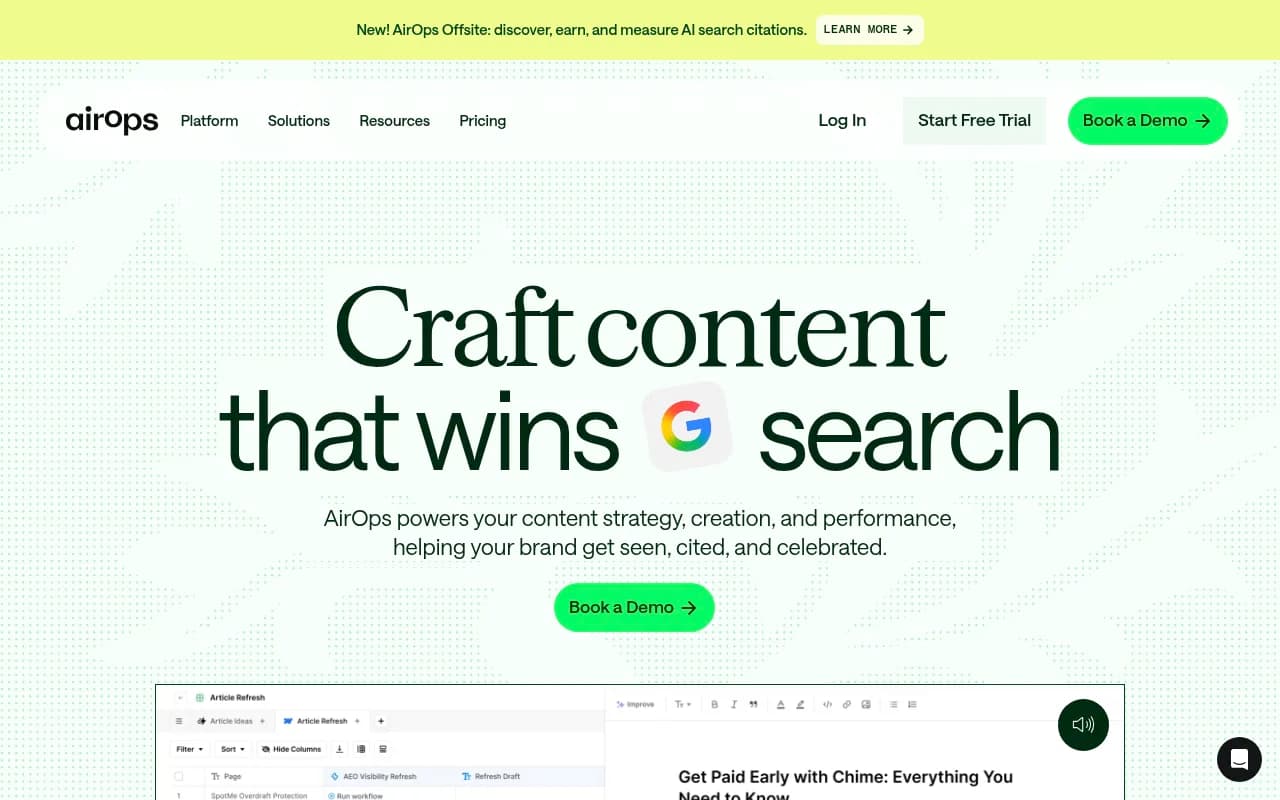
Where Promptwatch gives you a monitoring-to-content loop, AirOps gives you more control over the content production side. You can build custom workflows, connect your own data sources, and automate content pipelines that produce articles tuned for AI citation. It's a good fit for teams with a dedicated content ops function who want to build something custom rather than use a pre-built system.
The tradeoff: AirOps doesn't have the same depth of AI visibility monitoring as Promptwatch. You're not getting crawler logs, prompt volume data, or a competitor heatmap. It's strong on the "create content" side of the loop but weaker on the "track what's working" side.
Pricing is custom/enterprise, so it's harder to evaluate for smaller teams. Worth a demo if you're running a content operation at scale and want to build your own workflows.
3. Profound -- solid monitoring, limited content help
Profound is probably the most well-known Scrunch alternative in the enterprise space. It covers 9+ AI engines, has a clean interface, and is frequently cited as the top alternative on G2.
Profound

For monitoring, it's genuinely good. You get brand mention tracking, competitor comparisons, and prompt-level data. The Starter plan at $99/month is competitive with Scrunch's pricing.
The gap for content teams: Profound doesn't generate content. It will show you where you're invisible, but the path from "here's the gap" to "here's the article that fills it" requires you to take that data somewhere else. That's an extra step that slows teams down.
If your primary need is visibility monitoring and you have a separate content team that can act on the data independently, Profound is a strong choice. If you want the loop to close inside one platform, it falls short.
4. Otterly.AI -- lightweight monitoring for smaller teams
Otterly.AI is a simpler, more affordable tool that covers the basics: brand mention tracking across ChatGPT, Perplexity, and Google AI Overviews. At $49/month, it's the most accessible entry point in this category.
Otterly.AI

It's honest about what it is: a monitoring tool. There's no content generation, no crawler logs, no prompt volume data. But if you're a small team that just wants to know whether you're appearing in AI responses and how that changes over time, it does that job without a steep learning curve.
The limitation is obvious for content teams: you'll hit the ceiling fast. Otterly.AI tells you the score but doesn't help you improve it. And with only 3 LLMs covered, you're missing a lot of the AI search landscape -- Claude, Gemini, Grok, and DeepSeek are all absent.
Good as a starting point or for teams with very limited budgets. Not a long-term solution if AI visibility is a real priority.
5. Peec AI -- clean interface, monitoring-only
Peec AI is similar to Otterly.AI in scope: brand tracking across a handful of AI models, clean reporting, and a price point that's accessible for smaller teams.

It covers ChatGPT, Perplexity, and Claude, which is a slightly different set than Otterly but still limited. The interface is well-designed and the data is easy to read. Some teams use it as a quick sanity check on AI visibility without committing to a more complex platform.
Again, the content team problem: no content generation, no gap analysis, no crawler logs. It's a monitoring dashboard. For teams that need to act on what they see, it's a starting point, not a destination.
How to choose
The decision mostly comes down to one question: do you need to track AI visibility or improve it?
If you're in research mode -- benchmarking where you stand, building a business case for investment -- a lighter tool like Otterly.AI or Peec AI might be enough for now.
If you're in execution mode -- you know AI search matters, you have content resources, and you need to actually move the needle -- you need a platform that closes the loop. That means gap analysis, content generation, and result tracking in one place.
Promptwatch is the clearest answer to that second scenario. It's the only platform here that covers all three steps, monitors 10 AI models, includes crawler logs, and costs less than Scrunch's Core plan. AirOps is worth considering if you want to build more custom content workflows, but it requires more setup and doesn't have the same monitoring depth.
One thing worth saying plainly: most of the "alternatives" lists you'll find online are full of monitoring-only tools dressed up as optimization platforms. The distinction matters. A dashboard that shows you a problem you can't fix inside the same tool is just a more expensive way to feel stuck.
Content teams don't need more reports. They need a shorter path from "we're invisible here" to "we published something that got cited."
That's the bar worth holding alternatives to.