Key takeaways
- Scrunch AI's Core plan starts at $250-300/month but only covers 4 LLMs -- Claude, Gemini, Grok, and Meta AI all require an Enterprise contract
- Most alternatives in this list cover 7-10+ AI engines at lower price points, some with free trials
- The biggest split in this category is between monitoring-only tools and platforms that also help you fix visibility gaps with content generation and optimization
- Promptwatch is the only platform in this comparison rated as a "Leader" across all evaluation categories, and the only one that closes the full loop from gap analysis to content creation to traffic attribution
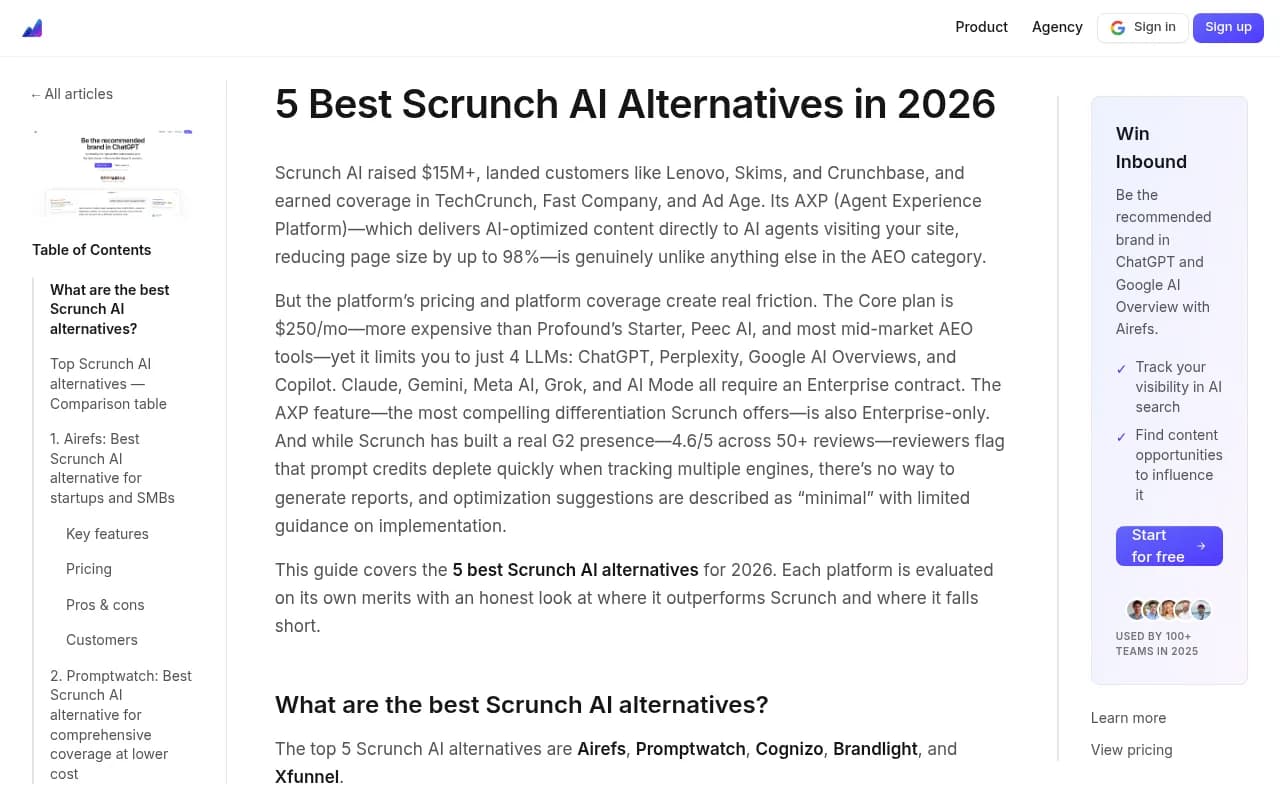
Scrunch AI raised over $15M, landed customers like Lenovo and Crunchbase, and built something genuinely interesting with its Agent Experience Platform (AXP) -- a layer that delivers AI-optimized content directly to AI agents crawling your site, reportedly reducing page size by up to 98%. That's a real innovation.
But here's the friction: the AXP feature is Enterprise-only. So is coverage for Claude, Gemini, Meta AI, Grok, and Google AI Mode. The Core plan -- at $250-300/month -- gives you ChatGPT, Perplexity, Google AI Overviews, and Copilot. That's four engines. And reviewers on G2 (where Scrunch scores 4.6/5 across 50+ reviews) consistently flag that prompt credits deplete fast, there's no report export, and optimization suggestions are thin.
If you're an enterprise with budget to match, Scrunch may still be worth evaluating. But if you need broader LLM coverage, a free trial, or tools that actually help you act on what you find -- there are better options.
Here are 10 of them.
Quick comparison: Scrunch AI vs alternatives
| Platform | Starting price | AI engines covered | Free trial | Content generation | Crawler logs |
|---|---|---|---|---|---|
| Scrunch AI | ~$250-300/mo | 4 (Core), more on Enterprise | No | No | No |
| Promptwatch | $99/mo | 10 | Yes | Yes | Yes (Professional+) |
| Profound | $99/mo | 9+ | Yes | No | No |
| Otterly.AI | ~$49/mo | 5+ | Yes | No | No |
| Peec AI | €85/mo | 3 base + add-ons | Yes | No | No |
| LLM Pulse | €49/mo | 5 (10+ Enterprise) | 14-day | No | No |
| Airefs | $24/mo | ChatGPT-first | Yes | No | No |
| AthenaHQ | Custom | 5+ | Yes | No | No |
| Evertune | Custom | 6+ | Yes | No | No |
| ZipTie | Custom | 5+ | Yes | No | No |
| Cognizo | $149/mo | 3+ | Yes | Yes | No |
1. Promptwatch -- best overall alternative
Promptwatch covers 10 AI engines: ChatGPT, Perplexity, Google AI Overviews, Google AI Mode, Claude, Gemini, Meta/Llama, DeepSeek, Grok, Mistral, and Copilot. That's the broadest coverage in this comparison, and it's available from the $99/month Essential plan -- not locked behind an Enterprise contract.

What separates Promptwatch from most tools in this category is that it doesn't stop at monitoring. The platform is built around a three-step loop: find where you're invisible (Answer Gap Analysis shows exactly which prompts competitors rank for that you don't), generate content to fix it (a built-in AI writing agent creates articles grounded in 880M+ citations analyzed), and track whether it worked (page-level citation tracking, AI crawler logs, and traffic attribution via GSC integration or server logs).
Most competitors in this list do step one. Promptwatch does all three.
A few specifics worth knowing: the AI Crawler Logs feature (Professional plan and above) shows you in real time which pages ChatGPT, Claude, Perplexity, and other AI crawlers are reading, how often they return, and what errors they hit. That's data most platforms don't even attempt to surface. There's also Reddit and YouTube tracking, ChatGPT Shopping monitoring, prompt volume and difficulty scoring, and competitor heatmaps that show who's winning for each prompt across each model.
Pricing: Essential $99/mo (1 site, 50 prompts, 5 articles), Professional $249/mo (2 sites, 150 prompts, 15 articles, crawler logs), Business $579/mo (5 sites, 350 prompts, 30 articles). Free trial available.
2. Profound -- strong enterprise option
Profound is one of the more mature platforms in the AI visibility space, with SOC 2 and HIPAA compliance that makes it viable for healthcare and financial services brands. Its Conversation Explorer feature lets you drill into the actual AI-generated responses your brand appears in -- not just whether you're mentioned, but how.
Profound

The Starter plan is $99/month, but it only covers ChatGPT. Broader engine coverage kicks in on higher tiers. That's a similar limitation to Scrunch's tiered approach, though Profound's compliance credentials and enterprise integrations give it a different value proposition.
If your organization has strict data governance requirements, Profound is worth a serious look. If you're a marketing team that just wants to track and improve AI visibility without procurement hurdles, it may be more than you need.
3. Otterly.AI -- good entry point for smaller teams
Otterly.AI is one of the more accessible tools in this space, with a starting price around $49/month and a clean interface that doesn't require a lot of onboarding. It covers ChatGPT, Perplexity, Google AI Overviews, and a few others depending on the plan.
Otterly.AI

The honest limitation: it's a monitoring tool. You get visibility data -- mention rates, sentiment, competitor comparisons -- but there's no content generation, no gap analysis, and no crawler logs. For teams that just want to know where they stand before investing in a more comprehensive platform, Otterly is a reasonable starting point. For teams that want to actually move the needle, you'll hit the ceiling quickly.
4. Peec AI -- best for global and multilingual brands
Peec AI's standout feature is language coverage: 115+ languages with daily data refresh. If you're a global brand tracking AI visibility across markets, that's genuinely useful. Most tools in this category are English-first with limited regional support.

The base plan starts at €85/month and covers three AI engines, with additional platforms available as add-ons. That modular pricing can work well if you only care about specific models, but it adds up quickly if you need broad coverage. No content generation features.
5. LLM Pulse -- best value for monitoring
LLM Pulse comes in at €49/month with a 14-day free trial, unlimited seats (unlike Scrunch's $25/seat add-on), and brand sentiment tracking that some pricier tools don't include. It covers five AI engines on the base plan, with 10+ available on Enterprise tiers.
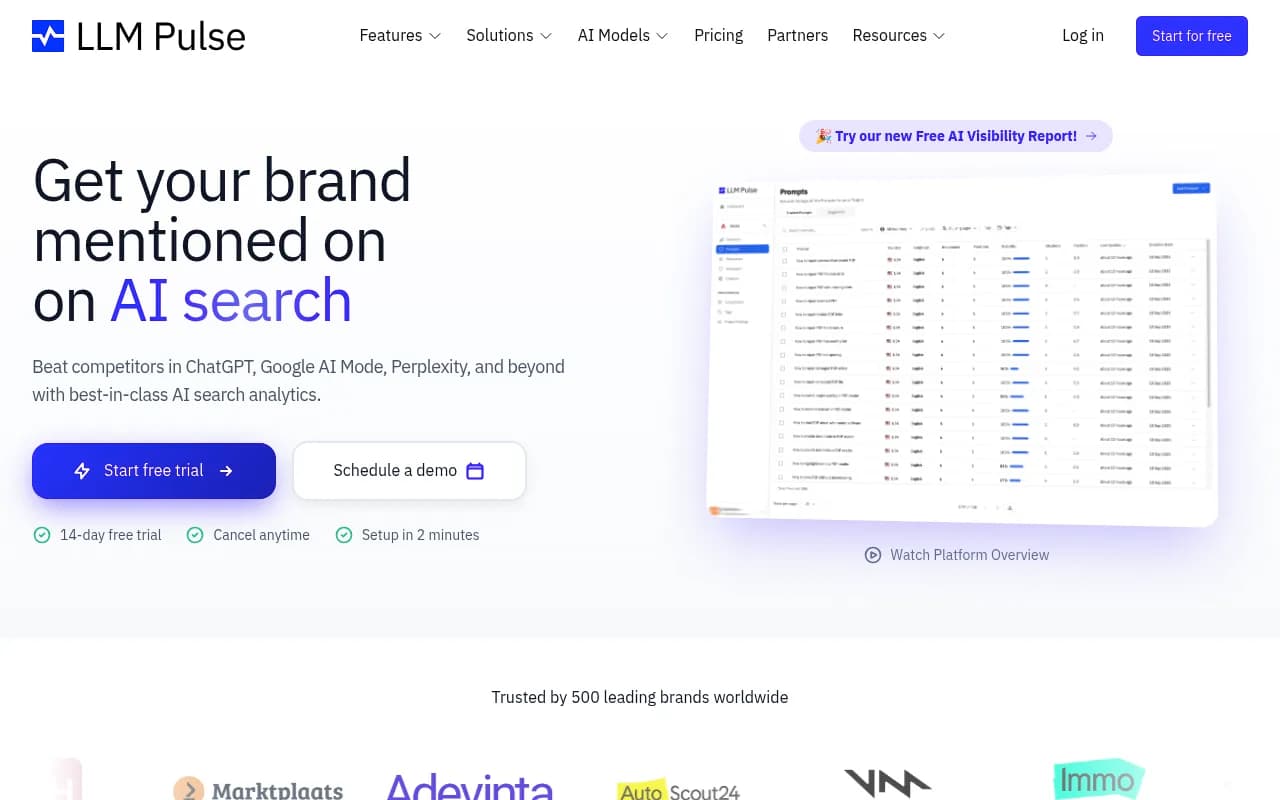
The platform is straightforward: track your brand mentions across AI engines, monitor sentiment, compare against competitors. It's not trying to be a full GEO optimization suite, and that focus keeps it affordable and easy to use. Good fit for teams that need reliable monitoring without a large budget.
6. Airefs -- most affordable full-stack option
Airefs is the cheapest option in this comparison at $24/month, which is striking given that it includes Reddit monitoring and a ChatGPT-first methodology that goes beyond basic mention tracking. There's also an optional done-for-you agency service if you want someone else to handle the optimization work.
The trade-off is depth. Airefs is ChatGPT-focused, which means you're not getting the same breadth of engine coverage as Promptwatch or Profound. But for small teams or solo marketers who want to start somewhere without a significant financial commitment, it's a legitimate option.
7. AthenaHQ -- solid monitoring with a clean interface
AthenaHQ positions itself as a monitoring-focused platform with a clean, well-designed interface. It covers five or more AI engines and has a reasonable feature set for tracking brand mentions, sentiment, and competitive positioning.

Custom pricing means you'll need to talk to sales, which is a friction point for teams that want to self-serve. And like most platforms in this list, AthenaHQ is monitoring-only -- there's no content optimization or generation built in. But the interface is genuinely good, and the platform is worth evaluating if UX matters to your team.
8. Evertune -- enterprise GEO with broad LLM coverage
Evertune targets Fortune 500 brands and covers every major LLM: ChatGPT, Claude, Gemini, Perplexity, Meta AI, and DeepSeek. Its brand monitoring features are comprehensive, and the platform includes competitive benchmarking and share-of-voice tracking across AI engines.
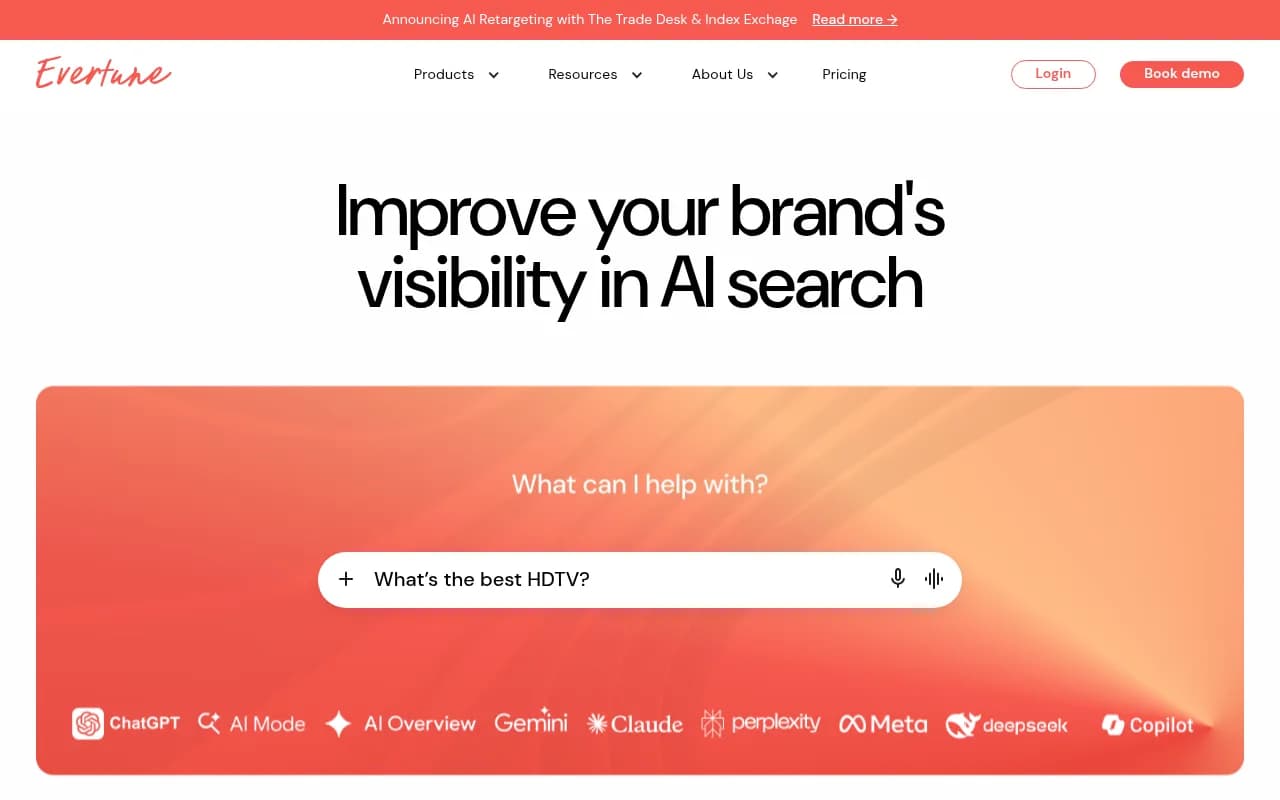
Pricing is custom and enterprise-oriented, so it's not the right fit for mid-market teams. But if you're a large brand that needs enterprise-grade AI visibility tracking with broad engine coverage, Evertune is a credible alternative to Scrunch's enterprise tier.
9. ZipTie -- best for deep analysis
ZipTie focuses on depth over breadth. The platform is built for teams that want to go beyond surface-level mention tracking and understand the structural reasons why AI models do or don't cite their content.
Custom pricing, and the platform skews toward analysts and technical SEO teams rather than marketing generalists. If you want to understand the mechanics of AI citation patterns in detail, ZipTie is worth a conversation. If you want a quick setup and broad monitoring, it's probably not the right fit.
10. Cognizo -- best for combining monitoring with content workflows
Cognizo combines AI visibility monitoring with content briefs, technical audits, and automated content workflows. The $149/month Core plan includes 50 prompts and three AI platforms, which is modest, but the bot-to-human attribution feature -- showing how AI crawler traffic converts to actual human visitors -- is something Scrunch doesn't offer on any tier.
Cognizo
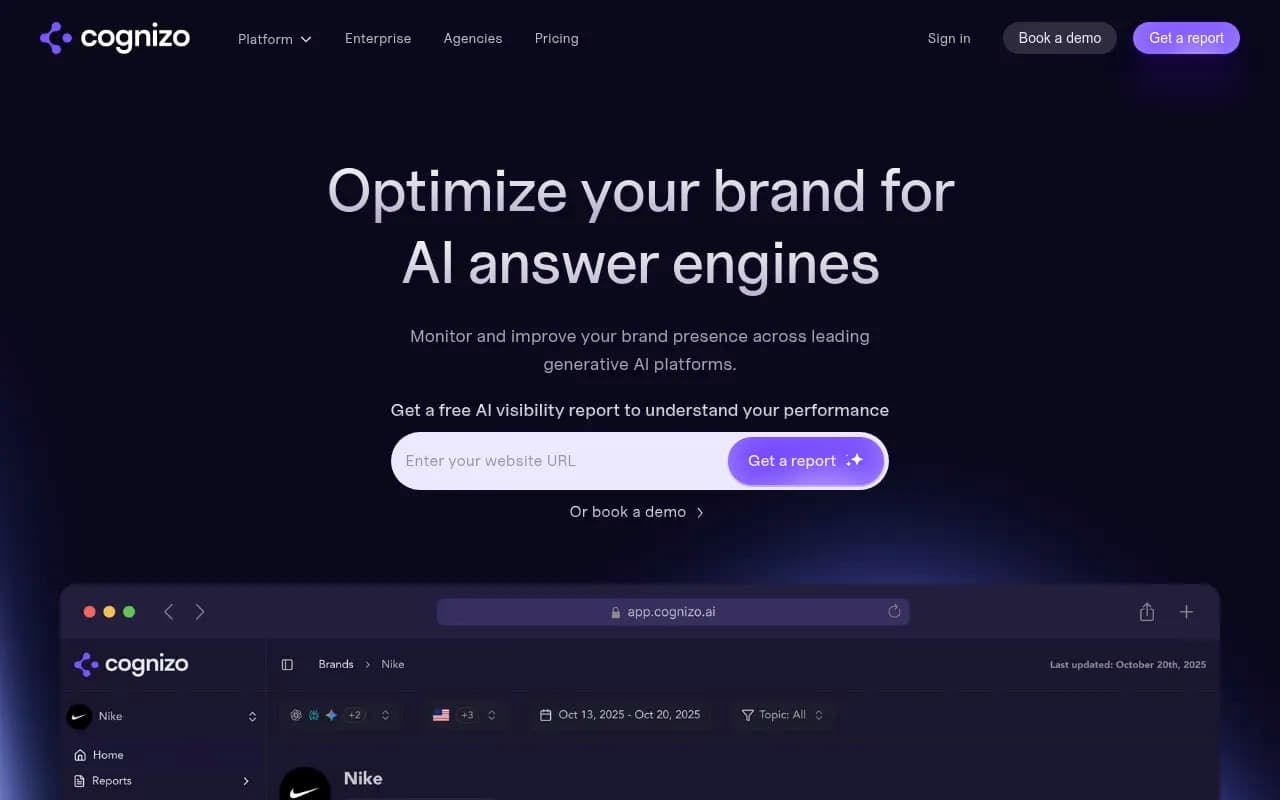
It's a more complex platform than most on this list, which means a steeper learning curve. But for teams that want monitoring and content production in one place, it's a viable option.
How to choose: monitoring vs. optimization
The most important question when evaluating these tools isn't which AI engines they cover -- it's what you can actually do with the data.
Most platforms in this category are monitoring tools. They show you where your brand appears (or doesn't) in AI-generated responses. That's useful information. But it doesn't tell you what to do about it, and it doesn't help you do it.
The distinction matters because AI search visibility isn't static. The brands that are winning in ChatGPT, Claude, and Perplexity responses aren't just the ones with the most monitoring data -- they're the ones that identified content gaps and filled them with material that AI models actually want to cite.
If you're at the stage where you just want to understand your current visibility, most tools on this list will serve you. If you're ready to actually improve it, you need a platform that goes beyond tracking.
What to look for in an AI visibility platform
A few things worth checking before you commit to any platform:
- Engine coverage: Does it cover the models your customers actually use? ChatGPT and Perplexity are table stakes. Claude, Gemini, and Google AI Mode are increasingly important.
- Prompt volume and difficulty data: Knowing you're invisible for a prompt is less useful than knowing how many people ask that prompt and how hard it is to rank for.
- Content gap analysis: Can the platform show you specifically what content you're missing, not just that you're missing something?
- Traffic attribution: Can you connect AI visibility to actual website traffic and revenue? This is where most platforms fall short.
- Crawler logs: Do you know which pages AI engines are actually reading? Errors and crawl gaps are invisible without this.
Scrunch AI has some of these capabilities -- but most are Enterprise-only. The alternatives above offer different combinations at different price points. The right choice depends on where you are in your AI visibility journey and what you actually need to do next.