Key takeaways
- Crawler log monitoring is one of the most underrated features in AI visibility tools -- it shows you exactly which AI bots are crawling your pages, how often, and what errors they hit
- Scrunch AI has hallucination detection and solid LLM monitoring, but lacks native crawler log visibility and content generation
- Most alternatives (Otterly.AI, Peec AI, Rankshift) are monitoring-only dashboards -- useful for tracking, but they leave you to figure out the "so what" yourself
- A small number of tools -- most notably Promptwatch -- close the loop by combining crawler logs, content gap analysis, and AI-powered content generation in one platform
- If you're evaluating on price, there are solid options from free tiers up to enterprise contracts; the right choice depends on whether you need insights, execution, or both
Scrunch AI is a real product solving a real problem. The hallucination detection feature -- where it flags when an AI model says something factually wrong about your brand -- is genuinely useful, especially for brands in regulated industries. The Influence Score, persona segmentation, and GA4 integration are all solid. It's not a bad tool.
But there are two reasons people start looking for alternatives. First, the pricing: $250/month minimum with no free tier is a meaningful commitment, especially for teams that are still figuring out whether AI visibility tracking is worth the investment. Second, and more importantly, Scrunch is fundamentally a monitoring platform. It shows you where you stand. It doesn't tell you what to do about it -- and it definitely doesn't show you what GPTBot or ClaudeBot are actually doing when they crawl your website.
That last part is what this guide is really about. Crawler log monitoring is one of the most underrated capabilities in this space. When an AI model like ChatGPT or Perplexity crawls your site, it leaves traces in your server logs -- which pages it visited, how often, what HTTP errors it hit, whether it could even read your JavaScript-heavy pages. That data tells you things that prompt-level monitoring simply can't: whether AI bots can access your content at all, which pages they're ignoring, and where your technical setup might be actively hurting your AI visibility.
Most tools in this category don't offer this. Here's a breakdown of the nine best Scrunch alternatives in 2026, with a specific focus on which ones actually give you crawler log visibility.
The tools at a glance
| Tool | Starting price | Crawler log monitoring | Content generation | Models covered |
|---|---|---|---|---|
| Promptwatch | $99/mo | Yes (Professional+) | Yes (built-in AI writer) | 10+ |
| Profound | $99/mo | No | No | 10+ |
| AthenaHQ | $295/mo | No | No | 6 |
| Peec AI | €89/mo | No | No | 3+ |
| Otterly.AI | Free tier | No | No | 5+ |
| SE Ranking (SE Visible) | $129/mo | No | Limited | 5+ |
| Semrush | $199/mo | No | Limited | 5 |
| AirOps | Custom | No | Yes (core feature) | 5+ |
| Scrunch AI (for reference) | $250/mo | No | No | 4-9 |
1. Promptwatch -- best overall, especially for crawler log monitoring
Promptwatch is the only tool in this comparison that combines crawler log monitoring with prompt tracking, content gap analysis, and AI content generation in a single platform. That's not a small distinction -- it's the difference between knowing your visibility score and actually understanding why it is what it is.

The crawler log feature (available on the Professional plan at $249/mo and above) gives you real-time logs of AI crawlers hitting your site: GPTBot, ClaudeBot, PerplexityBot, and others. You can see which pages they're reading, which ones return errors, and how frequently they return. If ChatGPT's crawler is hitting your homepage but never touching your product pages, that shows up. If ClaudeBot is getting 404s on your most important content, you'll know.
Beyond crawler logs, Promptwatch runs what it calls an Answer Gap Analysis -- it identifies prompts where your competitors appear in AI responses but you don't. Then the built-in AI writing agent generates content specifically designed to close those gaps, grounded in citation data from over 880 million analyzed citations. The cycle is: find the gap, create the content, track whether it worked.
Other things worth knowing: it monitors 10 AI models (ChatGPT, Claude, Perplexity, Gemini, Grok, DeepSeek, Copilot, Meta AI, Google AI Overviews, Google AI Mode), tracks Reddit and YouTube as citation sources, and includes ChatGPT Shopping tracking for e-commerce brands. Pricing starts at $99/mo for the Essential plan, with Professional at $249/mo and Business at $579/mo.
For teams that want to understand what AI bots are doing on their site and act on that information, this is the strongest option in 2026.
2. Profound -- best for enterprise prompt intelligence
Profound

Profound is one of the more mature platforms in this space. It covers 10+ AI models and has a feature called Conversation Explorer that lets you dig into how AI models are actually constructing responses about your brand. The Prompt Volumes data is genuinely useful -- it gives you search volume estimates for AI prompts, which helps prioritize what to optimize for.
Pricing starts at $99/mo but scales quickly to $5,000+/mo at the enterprise tier. There's no native crawler log monitoring and no content generation built in, so you're still left bridging the gap between insight and action yourself. That said, for large brands that need deep analytics and have the budget, Profound is a serious option.
3. AthenaHQ -- best for structured strategic recommendations

AthenaHQ takes a slightly different angle: rather than just showing you data, it has an "Action Center" that generates strategic recommendations based on your visibility gaps. It covers ChatGPT, Perplexity, Claude, Gemini, Copilot, and AI Overviews.
The recommendations are useful, but the platform stops short of actually generating content for you -- it tells you what to write, not how to write it. No crawler log monitoring either. At $295/mo it's not cheap, and the lack of execution tools means you still need a separate workflow to act on what it surfaces. Good for teams that have strong content operations and just need clearer direction.
4. Peec AI -- best for multilingual and international tracking

Peec AI's standout feature is language coverage: 115+ languages, which makes it the most practical option for global brands tracking AI visibility in non-English markets. It covers ChatGPT, Perplexity, and AI Overviews natively, with other platforms available as add-ons.
Starting at €89/mo, it's reasonably priced for what it does. But it's firmly in the monitoring-only camp -- no crawler logs, no content generation, no gap analysis. If your primary need is tracking AI visibility across multiple languages and regions, Peec AI is worth a serious look. If you need to act on what you find, you'll need other tools alongside it.
5. Otterly.AI -- best free starting point
Otterly.AI

Otterly.AI has a free tier, which makes it the easiest way to start tracking AI visibility without a budget commitment. It covers ChatGPT, Perplexity, Claude, Gemini, and AI Overviews, and the interface is clean and approachable.
The limitations are real though. No crawler log monitoring, no content generation, no traffic attribution. It's a monitoring dashboard and not much more. For small teams or individuals who want to get a feel for the AI visibility space before committing to a paid platform, Otterly.AI is a reasonable starting point. For anyone who needs to actually improve their visibility, it's a stepping stone rather than a destination.
6. SE Ranking / SE Visible -- best for teams already using SE Ranking for SEO
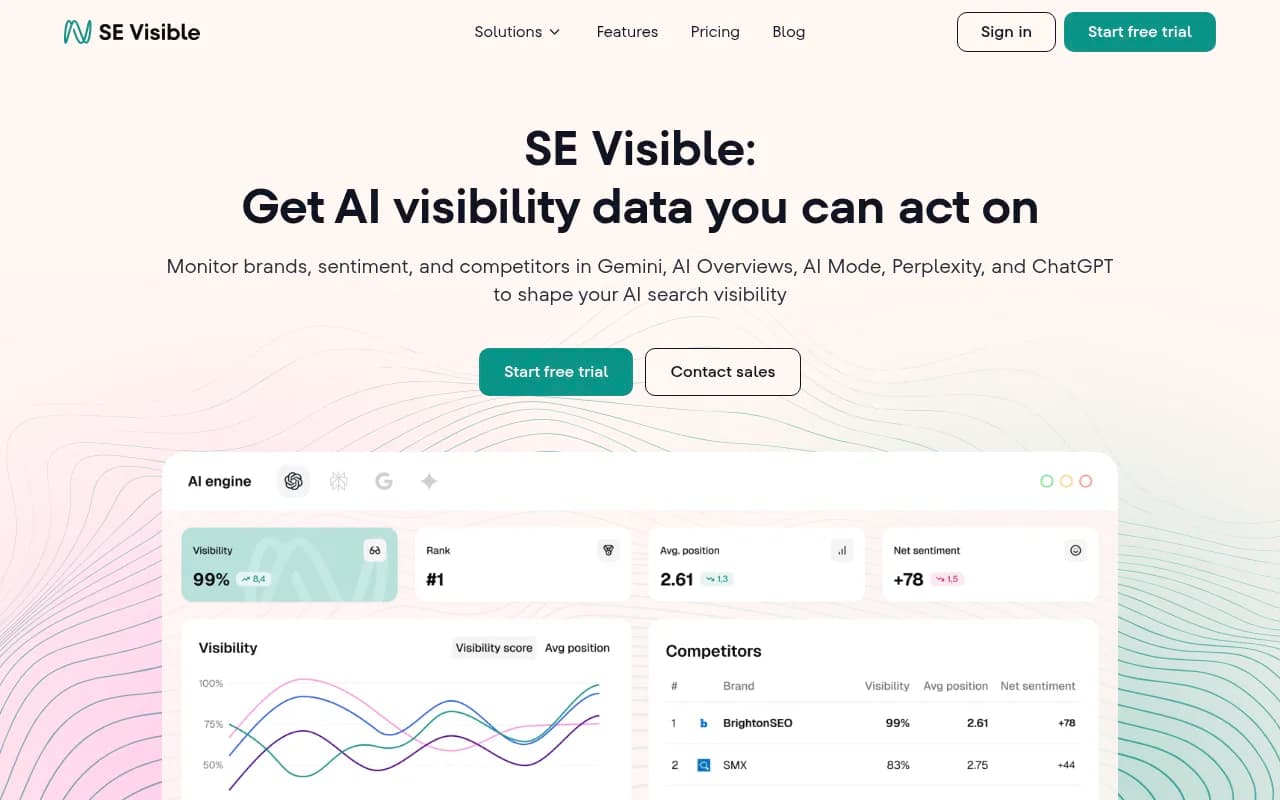
SE Ranking has been a solid traditional SEO platform for years, and its SE Visible product extends that into AI search monitoring. It tracks brand mentions across ChatGPT, Gemini, Perplexity, Google AI Mode, and a few others.
The main appeal here is consolidation: if you're already paying for SE Ranking's SEO tools, adding AI visibility tracking in the same platform makes sense. At $129/mo for the base SE Ranking plan, the combined value is reasonable. The AI monitoring features are less deep than dedicated platforms -- no crawler logs, limited content optimization -- but for teams that don't want to manage multiple tools, it's a practical choice.
7. Semrush -- best for teams that want traditional SEO and AI monitoring together
Semrush has added AI visibility features to its existing platform, covering ChatGPT, Claude, Perplexity, and a couple of others. The integration with its traditional SEO data is the main selling point -- you can see how your AI visibility correlates with your organic search performance in one place.
The AI monitoring features use fixed prompt sets rather than custom prompts, which limits how specific you can get. There's no crawler log monitoring and no AI traffic attribution. For teams that are deeply embedded in the Semrush ecosystem and want to add some AI visibility tracking without switching platforms, it works. For teams that are primarily focused on AI search, there are better dedicated options.
8. AirOps -- best for content execution at scale
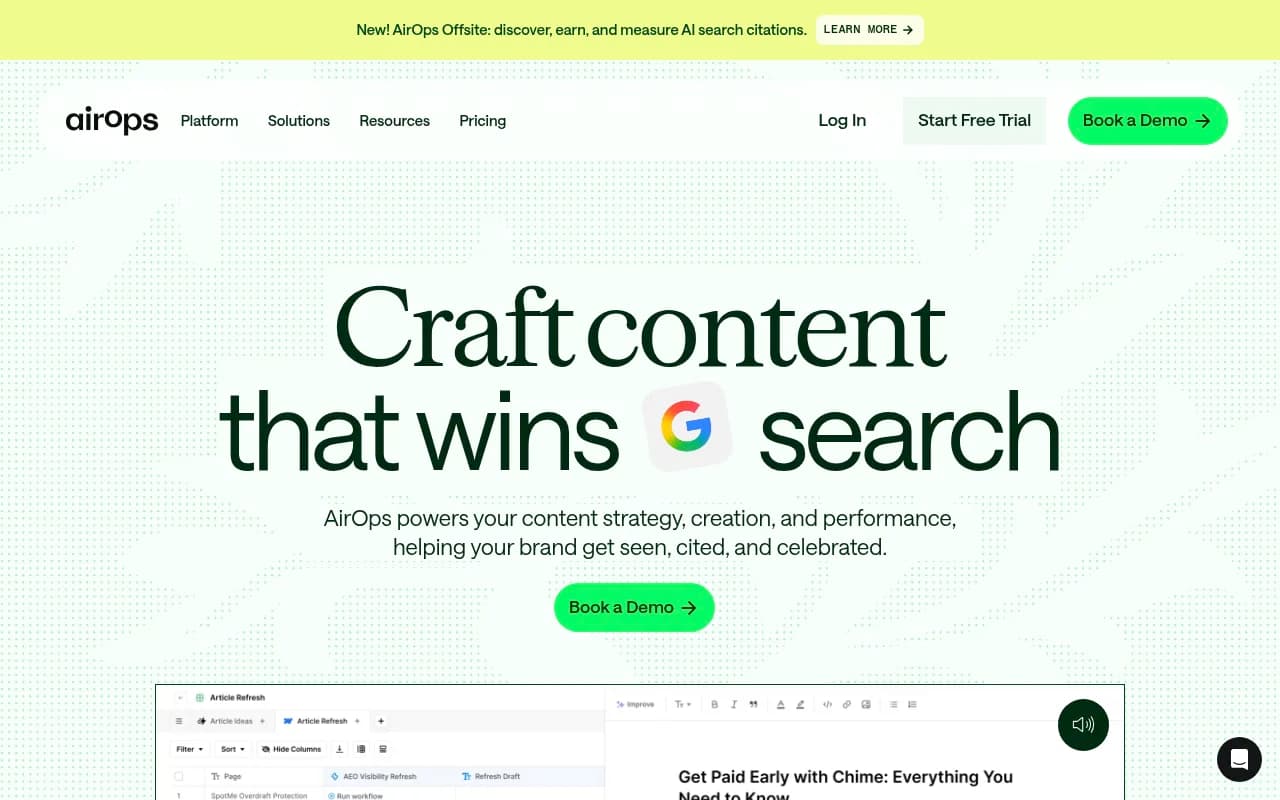
AirOps takes a different approach from most tools in this list. Rather than starting with monitoring and adding content features, it starts with content execution and adds visibility data to inform it. The platform connects AI visibility gaps directly to automated content workflows -- you identify what's missing, and AirOps helps you produce it at scale.
It's particularly strong for teams that already have a content operation and need to accelerate output. The visibility monitoring side is less deep than dedicated tracking tools, and there's no crawler log monitoring. Pricing is custom, which typically means it's positioned for mid-market and enterprise teams. If your primary bottleneck is content production rather than visibility insight, AirOps is worth evaluating.
9. Rankshift -- best budget option for basic AI visibility tracking

Rankshift is a straightforward AI visibility tracker that covers ChatGPT, Perplexity, and a handful of other AI search engines. It's one of the more affordable options in the space and has a clean interface that doesn't require much onboarding.
It's monitoring-only -- no crawler logs, no content generation, no gap analysis. But if you have a limited budget and just need to start tracking whether your brand appears in AI responses, Rankshift does that job without unnecessary complexity.
The crawler log question: why it matters more than most people realize
Most AI visibility tools track brand mentions at the prompt level: they send queries to AI models and record whether your brand appears in the response. That's useful, but it's a lagging indicator. By the time you see your visibility score drop, the underlying problem -- an AI crawler that can't read your pages, or a section of your site that's never been indexed -- may have been there for weeks.
Crawler log monitoring is a leading indicator. It tells you what AI bots are doing right now, before it shows up in your visibility scores. A few things you can only learn from crawler logs:
- Whether GPTBot or ClaudeBot can actually access your content (JavaScript rendering issues are common)
- Which pages AI crawlers visit most frequently -- and which they skip entirely
- Whether your robots.txt is accidentally blocking AI crawlers
- HTTP errors that AI bots are hitting on your most important pages
- How crawl frequency changes after you publish new content
The only tool in this comparison that provides this natively is Promptwatch, on its Professional plan and above. Some teams use server log analysis tools like JetOctopus alongside their AI visibility platform to get this data separately, but that adds complexity and cost.
If crawler log monitoring is a priority for you -- and it should be if you're serious about AI search visibility -- that narrows the field considerably.
How to choose
The right tool depends on what you're actually trying to do:
If you want to understand what AI bots are doing on your site and act on it: Promptwatch is the clear choice. It's the only platform that combines crawler logs, gap analysis, and content generation in one place.
If you need enterprise-grade prompt intelligence and have the budget: Profound is worth evaluating alongside Promptwatch. The Conversation Explorer and Prompt Volumes data are genuinely differentiated.
If you're tracking visibility across 10+ languages: Peec AI's multilingual coverage is hard to match.
If you're already in the Semrush or SE Ranking ecosystem: adding their AI visibility features is the path of least resistance, even if the features are shallower than dedicated platforms.
If you're just starting out and need a free option: Otterly.AI gets you in the door without a budget commitment.
The monitoring-only tools -- Otterly.AI, Peec AI, Rankshift -- are useful for tracking. But tracking alone doesn't improve your AI visibility. The tools that help you find gaps, create content to fill them, and verify that the content is actually being crawled and cited are the ones that will show measurable results. That's a short list in 2026, and Promptwatch sits at the top of it.