Key takeaways
- Agencies need AI visibility tools that go beyond monitoring -- client management, white-label reporting, and content optimization matter as much as tracking.
- Scrunch AI covers the major LLMs but remains one of the least developed platforms in the space, with limited optimization features.
- Search Party is agency-oriented but focuses more on custom automation workflows than self-serve AI visibility tracking.
- Rankshift offers solid prompt-level tracking for ChatGPT and Gemini but lacks depth on content gap analysis and traffic attribution.
- Promptwatch is the only platform in this comparison that closes the full loop: find gaps, generate content, track results -- with crawler logs, Reddit/YouTube insights, and ChatGPT Shopping tracking on top.
If you run an agency in 2026, you've probably had at least one client ask some version of "why aren't we showing up in ChatGPT?" It's a fair question. AI search is no longer a niche curiosity -- it's where a meaningful chunk of your clients' potential customers are now discovering brands, products, and services.
The problem is that the tool market has exploded to match that demand, and not all of it is good. There are monitoring dashboards dressed up as optimization platforms, enterprise tools priced out of reach for most agencies, and a handful of genuinely useful platforms buried in the noise.
This comparison focuses on four tools that agencies are actively evaluating: Scrunch AI, Promptwatch, Search Party, and Rankshift. We'll look at what each actually does, where each falls short, and which makes the most sense depending on what your agency needs.
What agencies actually need from an AI visibility tool
Before diving into the tools, it's worth being clear about what separates a good agency tool from a good brand tool. They're not the same thing.
A solo brand team can get by with a dashboard that shows them their AI mention rate and a few competitor comparisons. Agencies can't. You're managing multiple clients, reporting to multiple stakeholders, and ideally building a repeatable service offering around AI visibility. That means you need:
- Multi-client workspace management (not just multi-brand tracking)
- White-label or branded reporting
- Enough prompt coverage to show meaningful data per client
- Content optimization features, so you can actually improve results (not just report on them)
- Traffic attribution, so you can connect AI visibility to revenue
- Competitive benchmarking across LLMs
- Reasonable per-seat or per-client pricing that doesn't blow up your margins
With that in mind, here's how the four tools stack up.
Scrunch AI
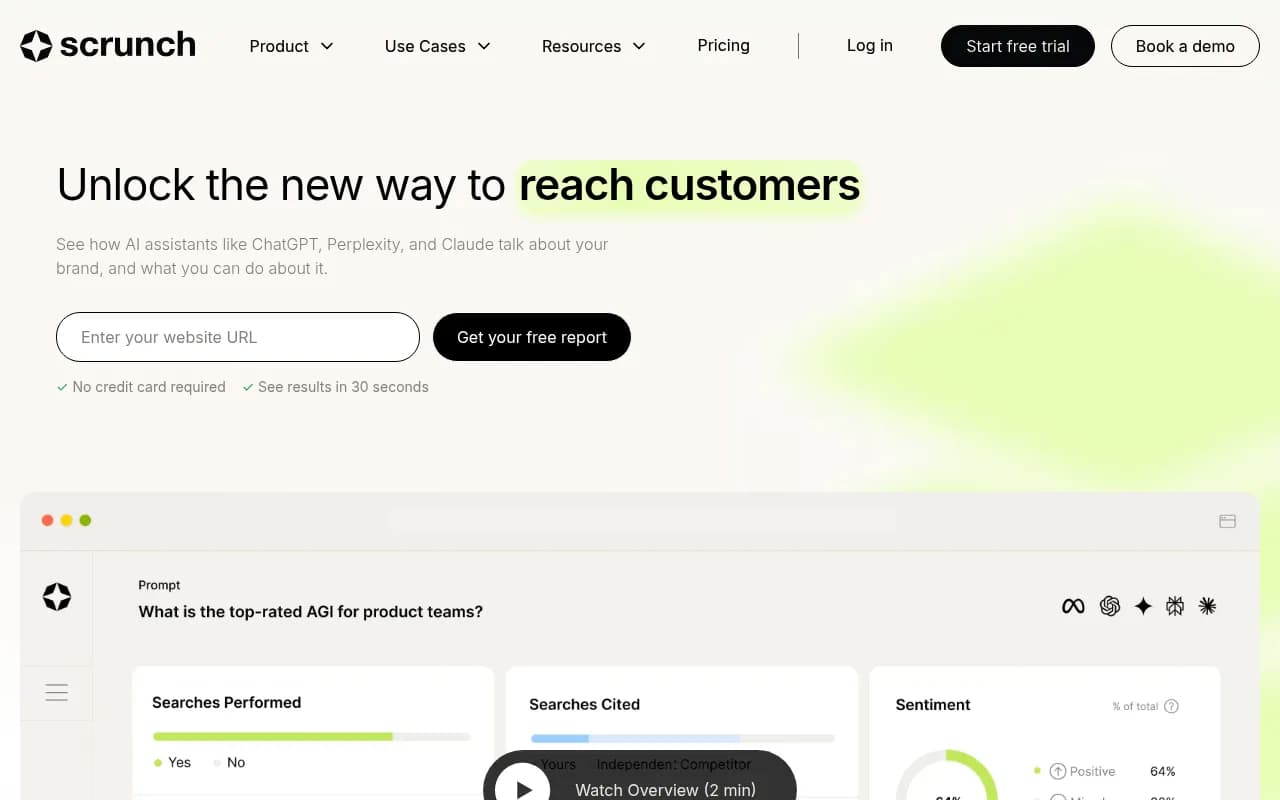
Scrunch AI launched in 2023, which makes it one of the older platforms in this space. It tracks brand mentions across ChatGPT, Gemini, Perplexity, Meta AI (Llama), and Claude, with beta support for Google AI Overviews. The interface is clean, and the core monitoring functionality works.
The problem is that "one of the oldest" doesn't mean "most developed." Multiple independent reviews in 2026 have noted that Scrunch remains one of the least feature-complete platforms relative to its age. It's a monitoring tool -- you can see where you're mentioned and where you're not, but there's no built-in mechanism to do anything about it.
For agencies specifically, the gaps are more pronounced. There's no content generation, no answer gap analysis that tells you which prompts competitors are winning that you're missing, and no crawler log data to understand how AI engines are actually reading your clients' sites. Reporting is functional but not white-label ready in the way agencies typically need.
Scrunch works fine if a client just wants to know their AI mention rate across a handful of LLMs. It's harder to build a scalable agency service on top of it.
Best for: Brands that want basic LLM monitoring without optimization. Not ideal as an agency's primary platform.
Search Party
Search Party
Search Party is positioned differently from the other three tools here. It's less of a self-serve SaaS platform and more of an AI automation consultancy -- it builds custom workflows to eliminate busywork for agencies and marketing teams.
That's genuinely useful, but it means the comparison isn't quite apples-to-apples. Search Party doesn't give you a dashboard where you can track prompt-level AI visibility across ChatGPT and Perplexity for ten clients. Instead, it helps you engineer the workflows around those processes.
For agencies that want a partner to help them build AI-powered internal systems, Search Party is worth a conversation. For agencies that need a tracking and optimization platform they can deploy across clients today, it's not the right fit. There's no prompt volume data, no citation analysis, no content gap identification, and no traffic attribution out of the box.
The agency-oriented positioning is real, but the product is more of a services layer than a visibility platform.
Best for: Agencies looking to automate internal workflows with AI. Not a replacement for an AI visibility tracking platform.
Rankshift

Rankshift is a newer entrant that's been getting attention in digital marketing communities, particularly for its prompt-level tracking across ChatGPT and Gemini. It's built specifically for AI search visibility, which gives it a cleaner focus than tools that have bolted AI tracking onto a traditional SEO platform.
The prompt-level data is genuinely useful -- you can see exactly which prompts your brand appears in, track changes over time, and get a reasonable picture of visibility trends. The interface is straightforward, and the setup is fast.
Where Rankshift falls short is depth. It covers fewer AI models than some competitors, and there's no content gap analysis to tell you which prompts you should be targeting but aren't. Traffic attribution is limited, which makes it hard to connect AI visibility improvements to actual client revenue -- a critical gap when you're trying to justify the service to clients. There's also no crawler log data, no Reddit or YouTube citation tracking, and no built-in content generation.
For a small agency that wants to add basic AI visibility reporting to its service offering, Rankshift is accessible and affordable. For agencies that want to build a full GEO practice, it's a starting point rather than a complete solution.
Best for: Smaller agencies or freelancers who want affordable, focused AI visibility tracking for a handful of clients.
Promptwatch
Promptwatch takes a different approach from the other three. Where Scrunch and Rankshift are primarily monitoring tools, Promptwatch is built around what it calls the action loop: find gaps, create content, track results.

That distinction matters more than it might sound. Monitoring tells you where you're invisible. Optimization tells you what to do about it -- and then helps you do it.
Here's what that looks like in practice for an agency:
Finding the gaps
Promptwatch's Answer Gap Analysis shows exactly which prompts competitors are appearing in that your client isn't. You don't just see that a competitor has higher AI visibility -- you see the specific questions and topics where they're winning and your client is absent. That's actionable in a way that a visibility score isn't.
Prompt Intelligence adds volume estimates and difficulty scores to each prompt, so you can prioritize the high-value, winnable opportunities instead of chasing prompts that are either too competitive or too low-volume to matter. Query fan-outs show how one prompt branches into related sub-queries -- useful for building out content strategies that cover a topic cluster rather than a single question.
Creating content that gets cited
The built-in AI writing agent generates articles, listicles, and comparisons grounded in citation data from over 880 million citations analyzed. This isn't generic content -- it's engineered around the specific prompts and topics where AI models are looking for sources but not finding them on your client's site.
For agencies, this is where the real value shows up. Instead of manually researching what to write and then writing it, you can move from gap identification to draft content in a fraction of the time. The content is designed to get cited by ChatGPT, Claude, Perplexity, and other models -- not just to rank in Google.
Tracking results and proving ROI
Page-level tracking shows exactly which pages are being cited, how often, and by which AI models. As you publish new content, you can watch visibility scores improve and attribute those improvements to specific pages.
Traffic attribution closes the loop with clients. Promptwatch supports a code snippet, Google Search Console integration, or server log analysis to connect AI visibility to actual traffic and revenue. That's the data you need to justify the service and retain clients long-term.
Agency-specific capabilities
Beyond the core action loop, Promptwatch covers features that matter specifically for agency work:
- AI Crawler Logs show which pages on a client's site AI crawlers are reading, how often, and what errors they're hitting. Most competitors don't have this at all.
- Reddit and YouTube Insights surface discussions that directly influence AI recommendations -- a channel most platforms ignore entirely.
- ChatGPT Shopping Tracking monitors when a client's brand appears in ChatGPT product recommendations and shopping carousels.
- Competitor Heatmaps compare AI visibility across LLMs, showing who's winning for each prompt and why.
- Multi-language and multi-region monitoring lets you track AI responses in any language, from any country -- useful for agencies with international clients.
- Looker Studio integration and API support custom reporting workflows.
Promptwatch monitors 10 AI models: ChatGPT, Perplexity, Google AI Overviews, Google AI Mode, Claude, Gemini, Meta/Llama, DeepSeek, Grok, Mistral, and Copilot. That's the broadest coverage in this comparison.
Pricing starts at $99/month (Essential: 1 site, 50 prompts, 5 articles), $249/month (Professional: 2 sites, 150 prompts, 15 articles, crawler logs), and $579/month (Business: 5 sites, 350 prompts, 30 articles). Agency and enterprise pricing is available separately. A free trial is available.
Best for: Agencies that want to build a full GEO service offering -- from gap identification through content creation to client reporting and ROI attribution.
Side-by-side comparison
| Feature | Scrunch AI | Search Party | Rankshift | Promptwatch |
|---|---|---|---|---|
| AI models covered | 5+ (ChatGPT, Gemini, Perplexity, Claude, Meta AI) | N/A (custom workflows) | ChatGPT, Gemini | 10 (ChatGPT, Perplexity, Claude, Gemini, Grok, DeepSeek, Copilot, Mistral, Meta AI, Google AI) |
| Prompt-level tracking | Yes | No | Yes | Yes |
| Answer gap analysis | No | No | No | Yes |
| Content generation | No | No | No | Yes (AI writing agent) |
| AI crawler logs | No | No | No | Yes |
| Traffic attribution | No | No | Limited | Yes (snippet, GSC, server logs) |
| Reddit/YouTube insights | No | No | No | Yes |
| ChatGPT Shopping tracking | No | No | No | Yes |
| Multi-client management | Limited | Yes (custom) | Limited | Yes |
| White-label reporting | Limited | N/A | Limited | Yes (Looker Studio + API) |
| Multi-language/region | Limited | No | No | Yes |
| Agency/partner program | No | Yes | No | Yes |
| Pricing (entry) | Not publicly listed | Custom | Not publicly listed | $99/mo |
| Free trial | Yes | No | Yes | Yes |
Which tool should your agency use?
The honest answer depends on where your agency is right now.
If you're just starting to offer AI visibility as a service and need something simple to show clients their mention rate, Rankshift gets you there quickly without a steep learning curve. It's not a complete solution, but it's a reasonable starting point.
If you want to build a proper GEO practice -- one where you can identify gaps, create content that fixes them, and prove the impact to clients -- Promptwatch is the only tool in this comparison that supports that full workflow. The combination of Answer Gap Analysis, AI content generation, crawler logs, and traffic attribution is what separates a monitoring service from an optimization service. Clients pay more for optimization, and they stay longer.
Scrunch AI is fine as a secondary tool for clients who just want a visibility dashboard, but it's hard to build a differentiated agency offering on top of monitoring alone. And Search Party, while genuinely useful for workflow automation, isn't a visibility platform in the traditional sense -- it solves a different problem.
The agencies that are winning in AI search right now aren't just reporting on visibility. They're changing it. That requires a platform built for action, not just observation.