Key takeaways
- All four platforms track brand visibility in AI search engines, but they differ significantly in what they do with that data
- Promptwatch is the only platform of the four that closes the full loop: find gaps, generate content, track results
- Profound and AthenaHQ are strong monitoring platforms, particularly for enterprise security and multi-region needs respectively
- Scrunch AI is the most affordable entry point for topic-focused analysis, but lacks depth at enterprise scale
- If your goal is to actually improve your AI visibility (not just measure it), the platform you choose matters enormously
The AI visibility market has moved fast. Eighteen months ago, most marketing teams were still figuring out whether ChatGPT citations were worth tracking. Now there are dozens of platforms competing for the same budget line, and four of them keep coming up in enterprise conversations: Scrunch AI, Promptwatch, Profound, and AthenaHQ.
They all claim to help you understand how your brand appears in AI-generated answers. But they're built on very different assumptions about what "help" means. Some show you a dashboard and leave you to figure out what to do next. Others actually help you fix the problem.
This comparison breaks down what each platform does well, where it falls short, and which type of team it's actually built for.
What these platforms are actually solving
Before getting into the specifics, it's worth being clear about the problem. When someone asks ChatGPT "what's the best project management tool for remote teams?" or Perplexity "which CRM is best for mid-market B2B?", AI models pull from their training data and live web crawls to construct an answer. Your brand either gets mentioned or it doesn't.
Traditional SEO doesn't tell you this. Google Search Console shows you clicks and impressions from Google. It says nothing about whether Claude is recommending your competitor instead of you, or whether Perplexity is citing a Reddit thread that misrepresents your product.
AI visibility platforms fill that gap. But the gap between "monitoring" and "optimization" is where these four tools diverge most sharply.
Scrunch AI
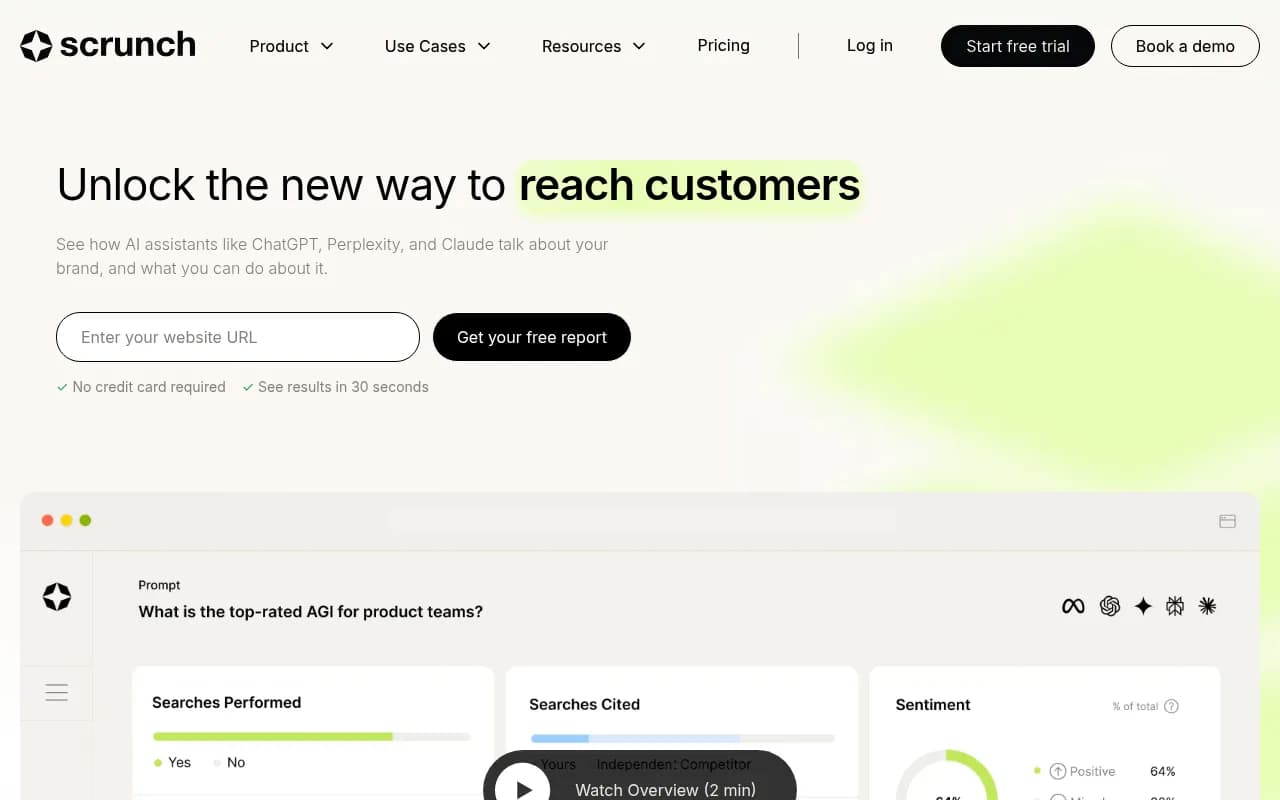
Scrunch AI positions itself as a topic-focused AI visibility platform. It tracks brand mentions across major LLMs and gives you a sense of how your brand appears relative to competitors in specific topic areas.
The pricing is the most accessible of the four, which makes it a reasonable starting point for teams that are new to GEO and want to get a feel for the category before committing to a larger platform. According to the Stackmatix comparison published in April 2026, Scrunch AI is the recommended choice for "topic-focused analysis at lower price."
Where it starts to show limits: enterprise teams running large prompt sets across multiple regions will quickly find the platform's depth insufficient. There's no content generation capability, no crawler log access, and limited prompt intelligence. You can see that you're invisible for certain queries. What you do about it is largely up to you.
That's not a fatal flaw for every team. If you're a smaller brand doing early-stage GEO research, Scrunch AI gets you oriented. But if you need to actually move the needle on AI visibility, you'll need more.
AthenaHQ

AthenaHQ has carved out a specific niche: multi-region, multi-language AI visibility monitoring for global brands. If your brand operates across markets and you need to understand how AI models respond to queries in German, French, Japanese, or Spanish, AthenaHQ is one of the more capable options for that specific use case.
The platform covers the major AI engines and gives you competitor benchmarking across regions. The interface is clean and the data is reasonably actionable for monitoring purposes.
The limitation is that AthenaHQ is fundamentally a monitoring platform. Looking at the feature comparison data from the Friction AI analysis, AthenaHQ doesn't track recommendation frequency, purchase-intent prompts, or product recommendation accuracy. For brands that sell products through AI-assisted discovery (think ChatGPT Shopping or Perplexity's product recommendations), that's a meaningful gap.
There's also no content generation built in. AthenaHQ tells you where you stand. It doesn't help you write the content that would improve that standing.
For a global enterprise that already has a content team and just needs visibility data across regions, AthenaHQ is a solid choice. For a team that needs the full optimization loop, it stops short.
Profound
Profound

Profound is the most enterprise-grade of the four in terms of infrastructure and security posture. It monitors 9+ AI search engines, offers unlimited prompts (versus credit-based systems), and provides a 5-minute SLA on support. For large organizations with strict security requirements and procurement processes that care about those things, Profound checks boxes that other platforms don't.
The platform also has solid ChatGPT Shopping analytics, which matters for e-commerce brands tracking product recommendations in AI-generated responses. That's a differentiator versus AthenaHQ, which doesn't cover that use case at all.
Pricing reflects the enterprise positioning. Profound sits at a higher price point than Scrunch AI and is comparable to or above Promptwatch depending on the tier. The Stackmatix comparison recommends Profound specifically for "enterprise security requirements."
The honest limitation: Profound is still primarily a monitoring and analytics platform. It gives you excellent data about where you appear and where you don't. But like AthenaHQ, it doesn't generate content to fill those gaps. You get the diagnosis without the treatment.
For a large enterprise with a dedicated content team that just needs reliable, secure, large-scale AI visibility data, Profound is genuinely strong. For a team that needs the monitoring and the optimization in one place, it's only half the solution.
Promptwatch
Promptwatch takes a different approach than the other three. Where Scrunch AI, AthenaHQ, and Profound are primarily monitoring platforms, Promptwatch is built around an optimization loop: find the gaps, create content to fill them, track the results.

That distinction matters more than it might sound. Most marketing teams don't just want to know they're invisible in AI search. They want to fix it. And most monitoring platforms leave that second step entirely to you.
The action loop
Promptwatch's Answer Gap Analysis shows you exactly which prompts competitors are visible for that you're not. Not just "you're missing coverage in the project management category" but the specific questions, angles, and topics that AI models want answers to but can't find on your site.
From there, the built-in AI writing agent generates articles, listicles, and comparisons grounded in citation data from over 880 million citations analyzed. This isn't generic content. It's engineered around what AI models actually cite, which is a fundamentally different brief than what a traditional SEO content writer would produce.
Then you track whether it worked. Page-level tracking shows which pages are being cited, how often, and by which AI models. Traffic attribution connects that visibility to actual sessions and revenue through a code snippet, Google Search Console integration, or server log analysis.
What else it covers
Beyond the core loop, Promptwatch includes AI crawler logs (real-time visibility into when ChatGPT, Claude, Perplexity, and others crawl your site), prompt volume and difficulty scoring, Reddit and YouTube citation tracking, ChatGPT Shopping monitoring, and competitor heatmaps across 10 AI models.
The Reddit and YouTube tracking is worth calling out specifically. A significant portion of what AI models cite comes from Reddit discussions and YouTube content. Most platforms ignore this entirely. Promptwatch surfaces it.
Pricing
- Essential: $99/month (1 site, 50 prompts, 5 articles/month)
- Professional: $249/month (2 sites, 150 prompts, 15 articles, crawler logs, city/state tracking)
- Business: $579/month (5 sites, 350 prompts, 30 articles)
- Agency/Enterprise: custom pricing
A free trial is available. Annual billing reduces the monthly cost.
Feature comparison
| Feature | Scrunch AI | AthenaHQ | Profound | Promptwatch |
|---|---|---|---|---|
| AI model coverage | 3-5 | 5+ (multi-region) | 9+ | 10 |
| Competitor benchmarking | Yes | Yes | Yes | Yes (heatmaps) |
| Prompt volume/difficulty scoring | Limited | No | Limited | Yes |
| Content gap analysis | No | No | No | Yes |
| Built-in content generation | No | No | No | Yes |
| AI crawler logs | No | No | No | Yes |
| Reddit/YouTube citation tracking | No | No | No | Yes |
| ChatGPT Shopping tracking | No | No | Yes | Yes |
| Traffic attribution | No | No | Limited | Yes |
| Multi-language/region | Limited | Yes | Yes | Yes |
| Page-level citation tracking | No | Limited | Yes | Yes |
| Free trial | Yes | Yes | Yes | Yes |
| Starting price | Low | Mid | High | $99/mo |
Who should use which platform
The right choice depends less on feature lists and more on what your team is actually trying to accomplish.
Scrunch AI makes sense if you're early in your GEO journey, have a limited budget, and primarily need to understand your brand's topic-level visibility before investing in a more comprehensive platform. It's a reasonable starting point, not a long-term solution for most enterprise teams.
AthenaHQ is the strongest choice if your primary challenge is multi-region, multi-language monitoring and you have a separate content team to act on what you find. Global brands with complex regional footprints will find it more capable than most alternatives for that specific need.
Profound fits large enterprises where security, compliance, and SLA guarantees are non-negotiable procurement requirements. If your organization needs unlimited prompt monitoring with enterprise-grade support and you have a content team to handle optimization separately, Profound delivers on those requirements.
Promptwatch is the right choice if you want to close the full loop in one platform. It's the only one of the four that takes you from "here's where you're invisible" to "here's the content that will fix it" to "here's proof it worked." For marketing and SEO teams that need to show results, not just data, that matters.
The monitoring-only problem
One thing worth saying directly: most AI visibility platforms are built around the assumption that data is the product. Show the brand where they're invisible, charge a monthly fee, repeat.
That's useful up to a point. But visibility data without a path to action is just a more expensive version of anxiety. You know you're losing. You don't know what to do about it.
The platforms that will win in 2026 are the ones that connect monitoring to optimization. Right now, only one of these four does that end-to-end.
Bottom line
If you're comparing these four platforms and trying to make a decision, the most important question to ask is: what happens after we see the data?
If your team has the resources to take that data and independently produce content, build optimization strategies, and track results through separate tools, then Profound or AthenaHQ might be sufficient for your monitoring needs.
If you want one platform that finds the gaps, helps you fill them, and proves the results, Promptwatch is the only one of the four built to do that.
The monitoring-only approach made sense when GEO was new and teams were still learning the landscape. In 2026, the brands that are winning in AI search are the ones that moved from tracking to acting. The platform you choose should reflect which stage you're in.