Key takeaways
- Botify and seoClarity are strong technical SEO platforms that have added AI visibility features, but their roots are in crawling and rank tracking -- not in optimizing for LLM citations.
- Scrunch AI focuses on AI search monitoring but sits firmly in the "tracking only" category with limited tools for actually fixing visibility gaps.
- Promptwatch is the only platform in this comparison built around a full action loop: find gaps, generate content, track results -- making it the strongest choice if your goal is to actually improve how AI models cite your brand.
- If you're running a large enterprise site with complex crawl budgets and JavaScript rendering issues, Botify's technical depth is hard to match -- but you'll need a separate tool for AI visibility.
- For most marketing and SEO teams in 2026, the combination of technical SEO and AI search optimization in one platform is still rare. Promptwatch comes closest.
The question sounds simple: which platform does technical SEO and AI visibility best? But once you actually dig into these four tools, you realize they're solving different problems -- and some of them are only pretending to solve both.
Botify and seoClarity were built for enterprise technical SEO. They've bolted on AI visibility features as the market shifted. Scrunch AI went the other way: it launched in 2024 as a pure AI visibility tracker. Promptwatch was designed from the start to close the loop between AI search monitoring and content optimization.
None of these platforms are bad. But they're not interchangeable, and picking the wrong one means either drowning in crawl data you can't act on, or watching a dashboard that tells you you're invisible without telling you how to fix it.
Here's how they actually compare.
What "combining technical SEO with AI visibility" actually means
Before comparing tools, it's worth being precise about what we're even asking.
Technical SEO covers crawlability, site structure, page speed, JavaScript rendering, log file analysis, and indexation. It's about making sure search engines (and increasingly, AI crawlers) can actually access and understand your content.
AI visibility is about whether LLMs like ChatGPT, Perplexity, Claude, and Gemini cite your brand and content when users ask relevant questions. It's tracked through prompt monitoring, citation analysis, and share-of-voice metrics.
A platform that truly combines both would need to:
- Crawl your site and identify technical barriers to AI crawler access
- Monitor how AI models respond to prompts related to your brand and category
- Show you which content gaps are costing you citations
- Help you create content that gets cited
- Connect all of this to traffic and revenue
That's a high bar. Let's see who clears it.
Scrunch AI
Scrunch AI launched in 2024 as a specialized AI visibility tracker. It monitors how your brand appears across AI answer engines -- ChatGPT, Perplexity, Claude, and others -- and tracks citation frequency, context, and sentiment.
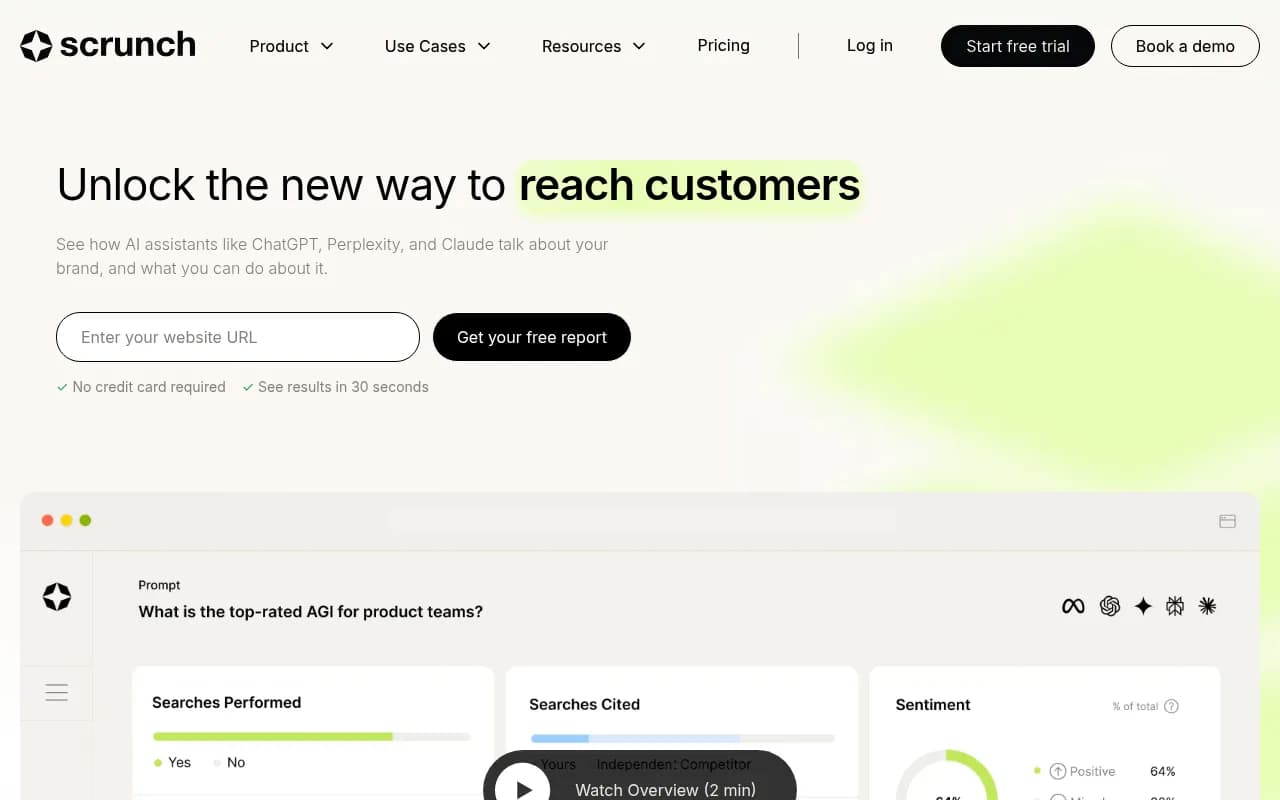
What Scrunch does well is brand monitoring. You can set up prompts, see how often your brand appears in AI-generated answers, and compare your share of voice against competitors. The interface is clean, and for teams that just want a quick read on their AI visibility, it's accessible.
The limitations show up fast when you try to do anything with that data. Scrunch doesn't have a content generation layer, so when you discover you're invisible for a category of prompts, you're on your own to figure out why and what to write. There's no crawler log analysis, no prompt difficulty scoring, and no Reddit or YouTube tracking (both of which directly influence what AI models recommend).
On the technical SEO side, Scrunch doesn't really play. It's not a crawling tool, it doesn't analyze site structure, and it won't tell you whether AI crawlers are hitting your pages or encountering errors.
For teams that want to understand their AI visibility and have separate tools for technical SEO and content creation, Scrunch is a reasonable starting point. But it's a monitoring dashboard, not an optimization platform.
Botify
Botify is one of the most respected names in enterprise technical SEO. Its core strength is log file analysis and crawl intelligence -- it ingests your server logs, maps how search engine bots actually crawl your site, and identifies pages that are wasting crawl budget or blocking indexation.
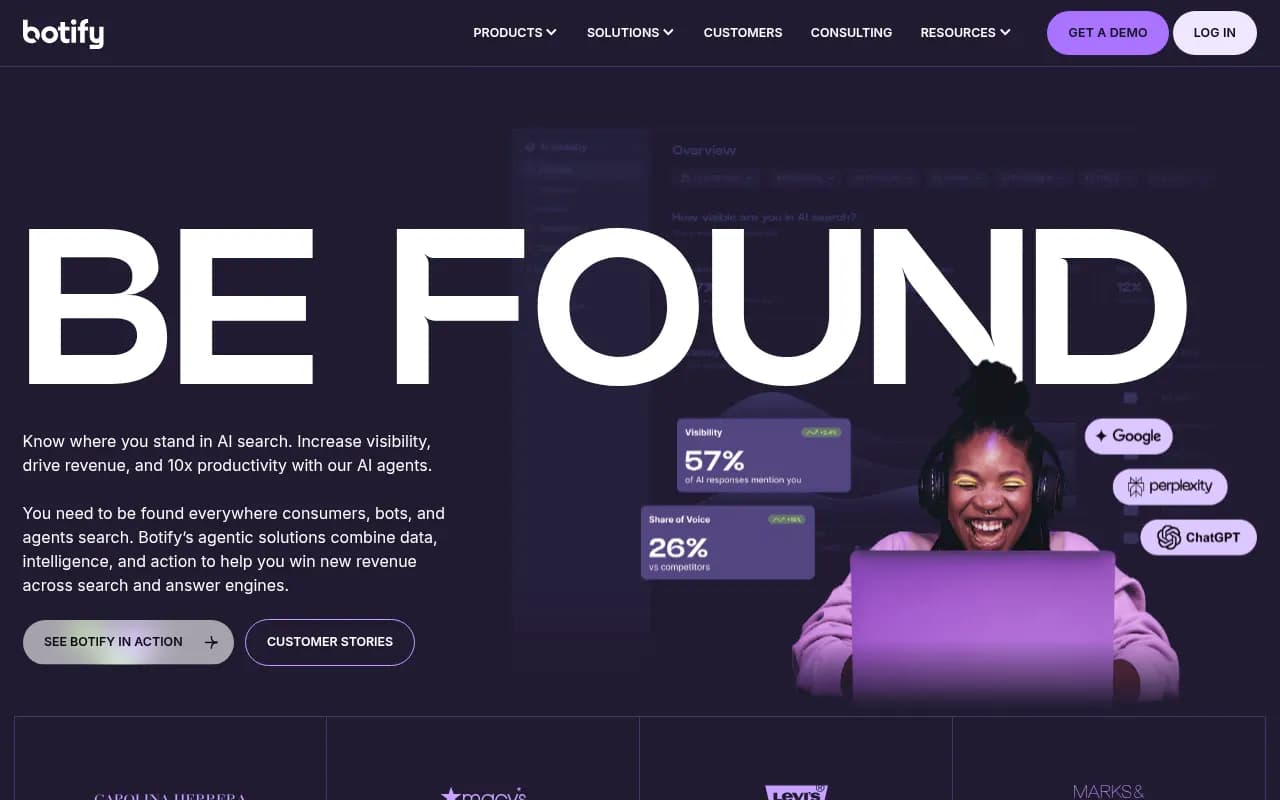
In 2025-2026, Botify added AI search features to its platform, including tracking for AI Overviews and some LLM citation monitoring. The addition makes sense: if AI crawlers can't properly access your content, it doesn't matter how good that content is.
Where Botify genuinely shines in the AI visibility context is its crawler log analysis. It can show you whether GPTBot, ClaudeBot, or Perplexity's crawler is hitting your pages, how often, and whether they're encountering errors. That's genuinely useful data that most AI visibility tools don't have.
The gap is on the other side of the equation. Botify isn't built to tell you which prompts you're missing citations for, what content to create, or how your brand compares to competitors in AI-generated answers. Its AI visibility features feel like additions rather than a core workflow. The platform is also expensive and complex -- it's designed for enterprise teams with dedicated technical SEO resources, not for marketing teams who need to move fast.
If you're running a site with millions of pages and JavaScript rendering issues, Botify's technical depth is worth the investment. But you'll need Promptwatch or a similar tool alongside it to actually optimize for AI search.
seoClarity
seoClarity is another enterprise SEO platform that has been building out AI search capabilities. It covers traditional rank tracking, site auditing, content optimization, and has added AI Overviews tracking and some LLM monitoring.
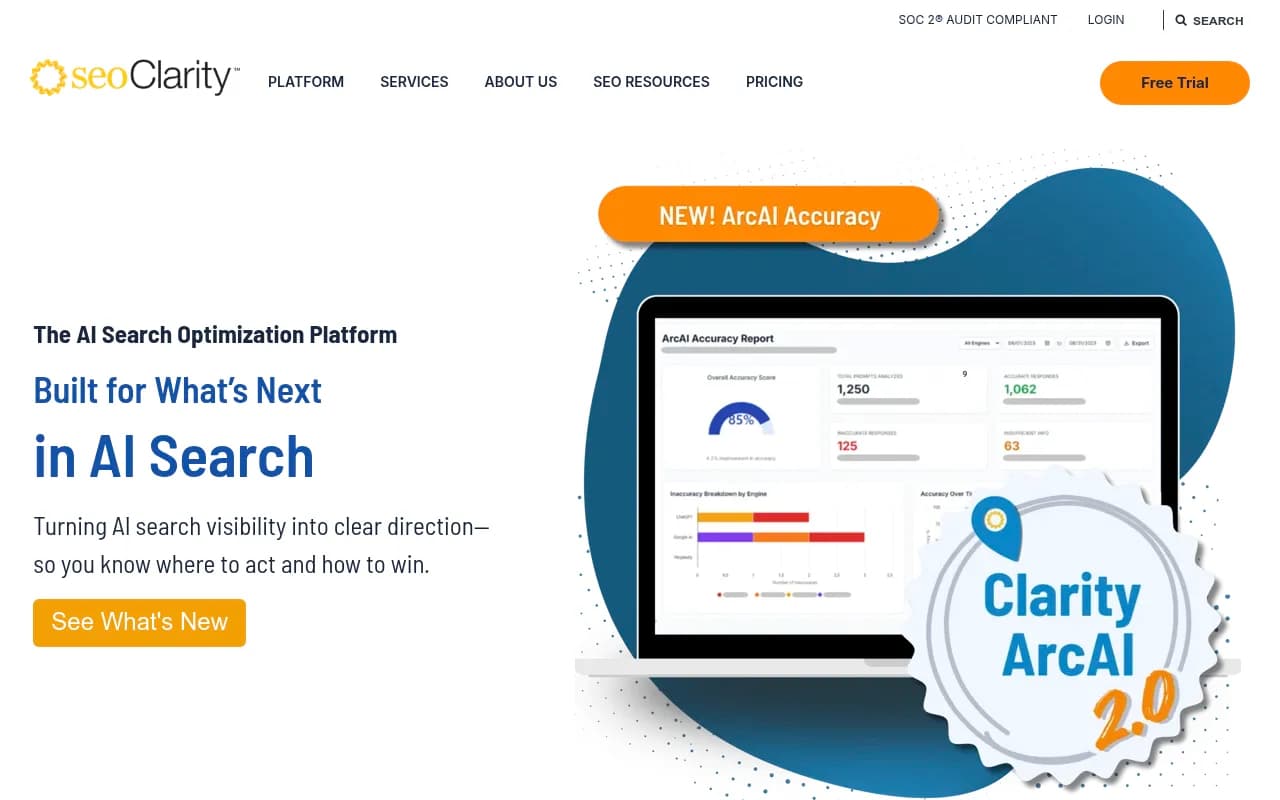
The platform's strength is breadth. It's genuinely all-in-one for traditional SEO -- keyword research, rank tracking, content briefs, technical audits, and competitive analysis are all solid. The AI visibility additions give you some visibility into how your brand appears in AI-generated answers, and the integration with traditional SEO data is useful for teams that want everything in one place.
The honest limitation is depth on the AI side. seoClarity's AI visibility features don't match what dedicated platforms offer. Prompt volume estimates, query fan-outs, Reddit and YouTube citation tracking, AI crawler logs, and content gap analysis tied to specific LLM citations -- these either don't exist or are underdeveloped compared to platforms built specifically for AI search.
For enterprise teams that are deeply invested in seoClarity's traditional SEO workflows and want to add basic AI visibility monitoring without switching platforms, it's a reasonable choice. For teams where AI search is a primary focus, the depth isn't there yet.
Promptwatch
Promptwatch was built specifically for the AI search era, and it shows in how the product is structured. Rather than starting with traditional SEO and adding AI features, it starts with the question: "How do you actually improve your visibility in AI search?" -- and builds backward from there.

The core workflow is what sets it apart. Answer Gap Analysis shows you exactly which prompts your competitors are visible for that you're not -- specific questions and topics that AI models want to answer but can't find on your site. That's actionable in a way that a share-of-voice dashboard isn't.
From there, a built-in AI writing agent generates content specifically engineered to get cited: articles, listicles, and comparisons grounded in 880M+ citations analyzed. This isn't generic content -- it's informed by what AI models actually cite, which prompts have volume, and what competitors are doing.
The technical SEO angle is covered through AI Crawler Logs: real-time logs of GPTBot, ClaudeBot, Perplexity's crawler, and others hitting your site. You can see which pages they read, which ones they skip, and where they encounter errors. It's not Botify-level crawl intelligence, but it's enough to identify and fix the most common AI indexation issues.
On top of that: prompt volume and difficulty scoring, query fan-outs, Reddit and YouTube citation tracking, ChatGPT Shopping monitoring, page-level citation tracking, and traffic attribution via GSC integration or server logs. The platform monitors 10 AI models including ChatGPT, Claude, Gemini, Perplexity, Grok, DeepSeek, and Google AI Overviews.
Pricing starts at $99/month for the Essential plan (1 site, 50 prompts, 5 articles), $249/month for Professional (2 sites, 150 prompts, 15 articles, crawler logs), and $579/month for Business (5 sites, 350 prompts, 30 articles). There's a free trial.
The one area where Promptwatch doesn't compete with Botify is deep technical crawl analysis for very large sites. If you're managing a 10-million-page e-commerce site with complex JavaScript rendering, Botify's log analysis is more comprehensive. For most brands, though, Promptwatch's AI crawler logs cover what actually matters.
Head-to-head comparison
| Feature | Scrunch AI | Botify | seoClarity | Promptwatch |
|---|---|---|---|---|
| AI prompt monitoring | Yes | Limited | Partial | Yes (10 models) |
| Citation tracking | Yes | No | Partial | Yes (880M+ citations) |
| Share of voice | Yes | No | Partial | Yes |
| Answer gap analysis | No | No | No | Yes |
| AI content generation | No | No | No | Yes |
| AI crawler logs | No | Yes (deep) | No | Yes |
| Prompt volume/difficulty | No | No | No | Yes |
| Reddit/YouTube tracking | No | No | No | Yes |
| ChatGPT Shopping tracking | No | No | No | Yes |
| Traffic attribution | No | Partial | Yes | Yes |
| Traditional SEO depth | No | Yes | Yes | Limited |
| Technical crawl analysis | No | Yes (best-in-class) | Yes | Basic |
| Starting price | ~$500/mo | Enterprise | Enterprise | $99/mo |
| Best for | AI monitoring | Enterprise technical SEO | Enterprise all-in-one SEO | AI visibility + optimization |
Which platform should you choose?
The right answer depends on what problem you're actually trying to solve.
If your primary challenge is technical SEO at enterprise scale -- crawl budget, JavaScript rendering, log file analysis for a massive site -- Botify is the strongest tool in this comparison. Just know that you'll need something else for AI visibility optimization.
If you're already deep in seoClarity for traditional SEO and want basic AI visibility data without adding another platform, the integration makes sense. But if AI search is a priority, you'll hit the ceiling quickly.
If you want a lightweight AI monitoring dashboard and have separate tools for content creation and technical SEO, Scrunch AI is accessible and focused.
If you want to actually move the needle on AI visibility -- not just track it -- Promptwatch is the clear choice. The combination of gap analysis, AI-powered content generation, crawler logs, and multi-model tracking creates a workflow that the other three platforms don't offer. You find what's missing, create content to fill it, and track whether it works. That loop is what makes it an optimization platform rather than a monitoring tool.
For most marketing and SEO teams in 2026, AI search visibility is no longer optional. The question is whether you want to watch your visibility scores or improve them. Those are different products.
A note on combining tools
One realistic approach: use Botify or seoClarity for technical SEO if you're already invested in those platforms, and add Promptwatch for AI visibility and content optimization. The two workflows don't overlap much -- Botify handles crawl budget and indexation, Promptwatch handles what happens after AI crawlers find your content.
That said, for teams that don't already have an enterprise technical SEO platform, Promptwatch's AI crawler logs cover the most critical AI-specific technical issues, and its content optimization workflow is where the real leverage is. Starting there and adding technical SEO tooling later as the site scales is a reasonable path.
The platforms that will win in 2026 are the ones that don't just show you data but help you do something with it. That's the actual gap in this market -- and it's the one Promptwatch was built to close.