Key takeaways
- Profound's study of 883,000 pages found the median page loses half its citation share within 11 days of its peak, and 78% of cited pages do so within two weeks.
- Fading is usually a mix of content type, engine behavior, model updates and format shifts. Rarely is it only your page.
- Landing pages, docs and pricing pages hold citations much longer than news. Promptwatch Data shows news losing half its pages within 36 days.
- Pages cited by five or more engines are 5.5 times as likely to hold above half their peak share after eight weeks.
- Before you rewrite anything, check the date of the dip against model releases and track citations per response, not just your own count.
You publish a page, it lands in ChatGPT answers for a week, your visibility report lights up green, and then the line slides back down. Nothing changed on your site. It feels like a penalty. Most of the time it isn't one.
This guide walks through eight reasons citations rise and fall, with the data we have so far, and what to do about each. One caution up front: the studies below measure different things, so I keep them separate and don't average them together.
What the data says about citation lifespan
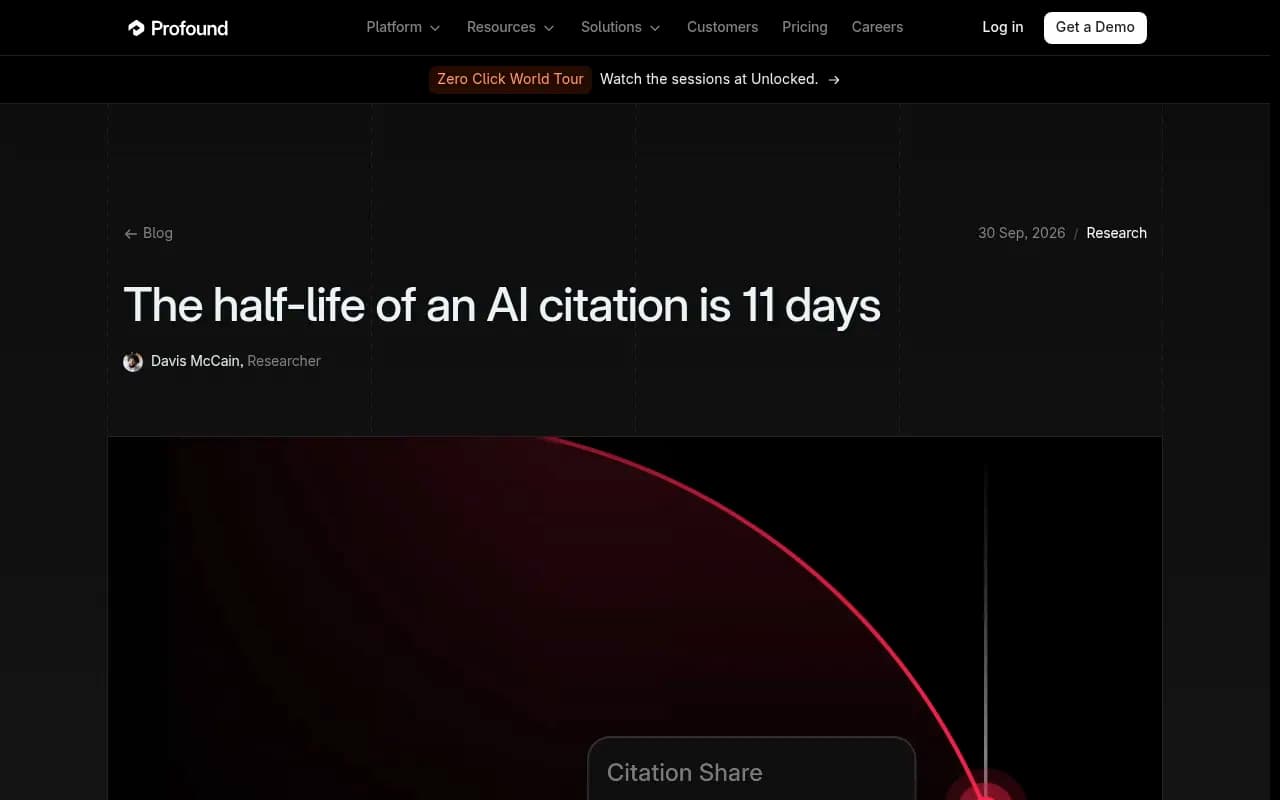
Profound's research, published September 30, 2026, tracked 883,000 pages across ChatGPT, Perplexity, Claude, Google AI Overviews, Google AI Mode, Gemini and Copilot over twelve months. That produced 1.19 million page-and-engine lifecycles. Their headline numbers:
- The median page loses half its citation share within 11 days of peaking.
- The median time from a page's first citation to the point where it has lost half its peak share is 42 days.
- 78% of pages fall to half their peak share within two weeks. The remaining 22% have a median half-life of 27 to 29 days.
Their definition matters: half-life is the number of days after the peak needed to fall to half the peak level and stay there. It measures share decay, not whether a page is cited at all.
Promptwatch measured something different in its content half-life report: it took every page ChatGPT cited on July 6, 2026 and checked whether ChatGPT still cited it at all, through October 4. That is a survival measure, so it's gentler than a share-decay measure. Both can be true at once. A page can stay in the cited set while its share of attention shrinks.

Reason 1: Your page is tied to a date or event
Profound found that pages tied to a date or event fade first, and everything else holds on at 1.4 to 1.6 times their rate. That matches intuition. A "best tools of 2026" roundup, a launch announcement or a post about an algorithm update gets pulled in while the topic is hot, then loses relevance as newer sources appear.
Promptwatch Data shows the same shape for news. In the pages ChatGPT cited on July 6, almost a quarter of news pages were never cited again after day 0, half were gone after 36 days, and 41% were still cited at day 60.
What to do: use news and press content for short bursts of visibility and don't expect it to compound. If you want a lasting asset, build the evergreen page that the news piece links to.
Reason 2: Content type decides how long you last
Not all pages age the same. From the Promptwatch cohort of pages cited on July 6, 2026:
| Content type | Still cited at 30 days | Still cited at 60 days |
|---|---|---|
| Landing pages | 78% | 69% |
| Docs | 76% | 67% |
| Comparisons | 72% | 63% |
| Listicles | n/a | 60% |
| Product pages, reviews, how-tos | n/a | about 55% |
| News | n/a | 41% |
Product pages, reviews and how-tos all reach half-life after 74 to 77 days. Landing pages, docs, comparisons and listicles only cross 50% in the final week, when every line drops because the observation window ends, so their real half-life is probably near or beyond 90 days. Pricing pages are classified as landing or product pages. Docs were cited again after day 0 for 93% of pages, versus 77% of news pages.
So if your spike came from a how-to or product page, a slow fade is normal. Keep specs, availability and prices current, because those pages lose citations about as fast as how-tos do.
Reason 3: The engines don't move together
This one surprised me. Profound found cross-engine correlations in decay of only 0.03 to 0.09. When a page fades on one engine, that tells you almost nothing about when it will fade on another.
Among pages that last beyond two weeks, a Claude citation was 2.8 times as likely as a ChatGPT citation to still be relevant eight weeks later. So a drop in your ChatGPT numbers may sit next to a stable Claude or Perplexity line.
What to do: report each engine separately. A blended "AI visibility" number hides exactly the movement you need to see. Promptwatch's own advice on its Reddit data is the same: track each engine on its own.
Reason 4: A model update changed how many sources get cited
Sometimes the whole platform shifts and your page is just along for the ride. Promptwatch Data on the GPT-5.3 rollout (March 4, 2026) found ChatGPT went from about 6.4 sources per search-enabled response the week before to roughly 4.7 to 4.9 by late March, about 27% fewer. GPT-5.3, GPT-5.4 and GPT-5-Mini dropped within a day of each other, and there was no recovery a month later.
If each response cites fewer sources, every page's chance of appearing falls, no matter how good it is.
What to do:
- Check the date of your dip against known model releases before blaming your content.
- Track citations per response so you can separate "we lost visibility" from "ChatGPT cites fewer sources overall."
- Don't trust single-snapshot audits.
Reason 5: ChatGPT changed its retrieval behavior
Citation behavior can change overnight without a model number changing. On August 8, 2026, ChatGPT Search started using the site: operator at scale, jumping from about 0.4% to about 17% of fan-out queries, with searches per response nearly doubling (Promptwatch Data). Sites that had been surfacing through open-web queries suddenly competed with queries aimed at specific domains.
Reddit is the clearest casualty. According to Promptwatch's Reddit citations report, reddit.com held a steady 3.83% share of ChatGPT citations from July 18 to August 7, dropped to the mid-2s on August 8, and fell below 1% on August 14. The August 14 to 17 average was 0.52%, an 86.4% relative drop. Promptwatch flags that a data-collection issue can't be fully ruled out, so treat the size as provisional. Google declined more gradually: AI Overviews went from 2.37% to 2.10% (down 11.3%) and AI Mode from 2.22% to 1.54% (down 30.5%).
If your spike was a Reddit thread or any other format a retrieval change disfavors, the fade is structural. Compare the URLs cited before and after the change date.
Reason 6: The format you built is falling out of favor
A format can have a good run and then get discounted. One analysis reports listicles falling from 15.77% to 7.80% of ChatGPT's citations, a 50.5% relative drop, and comparison pages from 9.08% to 6.17%, down 32.1% (The State of Brand). Seer Interactive separately reports a 30% month-over-month decline in listicle citations. I haven't verified the underlying data of either, so read them as signals, not settled facts.
Promptwatch's own format data points the same direction: product pages led July at about a third of ChatGPT citations and slipped to around 25% in late August, while how-tos more than doubled (ChatGPT citation types, August 2026). In AI Overviews, product pages overtook listicles in late July (July 2026 report).
The practical read: models seem more willing to go to a manufacturer's own specs and pricing pages than to a roundup. Roundups still get cited, but they need refreshing before they drop out.
Reason 7: Your Google visibility slipped
AI citations and organic rankings are not the same system, but they overlap. Lily Ray analyzed 11 sites hit by Google's January 2026 update and concluded that losing organic visibility could mean losing AI search citations too.
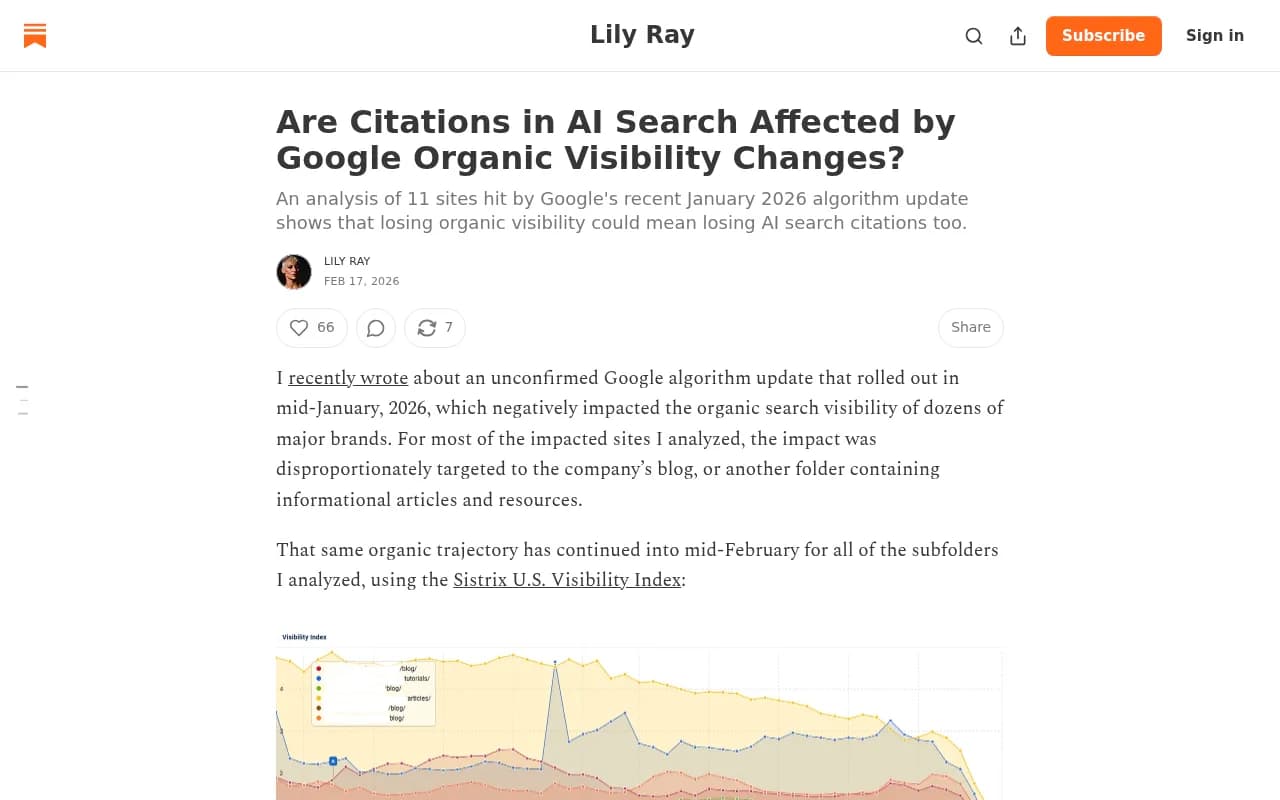
If your citations and your Google traffic fell together, look at Search Console first. Pairing per-page Google and Bing data with AI crawl and citation data makes that diagnosis a lot faster. Google Search Console is the free starting point.
Reason 8: You were retrieved but never really chosen
Getting retrieved is not the same as getting cited. Ahrefs, via CXL, analyzed 1.4 million prompts and found that about half the URLs ChatGPT retrieved received citations. A page can show up in the retrieval pool during a spike and then lose out when the model picks a different mix of sources.
Breadth is the best protection we have evidence for. Profound found pages cited by five or more of the seven engines were 5.5 times as likely as single-engine pages to hold above half their peak share after eight weeks, and they took more than twice as long to reach their peak. Slow, broad climbs last. Fast, narrow spikes don't.
Authority bands matter too. Promptwatch's domain rank report found sites with DR 46 to 75 earned almost half of ChatGPT citations in August 2026, while DR 91 to 100 fell to about 3%. You don't need a giant domain to hold a place.
How to tell which reason is hitting you
A quick triage order I'd use:
- Does the dip start on the same day as a model release or retrieval change? If so, it's platform-wide (reasons 4 and 5).
- Is it one engine or all of them? One engine points to engine behavior. All of them with Google traffic down points to organic visibility.
- Is the page news, a dated roundup or an event post? Expect fast decay (reasons 1 and 2).
- Is the format the one losing share? Check format trend reports (reason 6).
- Did the page ever have multi-engine coverage? If only one engine cited it, a fade is the default (reason 8).
Two cautions on measurement. Single-day checks are noisy, so look at weekly trends per engine. And don't mix definitions: Profound's 11 days is share decay from peak, while Promptwatch's cohort numbers are about whether a page is cited at all.
What to do about it
Treat page types differently
Landing, docs and pricing pages are long-term assets, so keep prices and features accurate. Use news for short bursts. Refresh listicles and guides before they drop out, rather than after.
Build breadth, not spikes
A page that earns citations across several engines holds up better. That means clear answers, accurate facts, crawlable pages and presence on the third-party sources engines already trust in your category.
Monitor so you can tell signal from noise
You need per-engine, per-page tracking over time, plus a way to see whether AI crawlers can actually read the page. Tools that do this include Promptwatch (monitoring, crawler logs, content refresh and an Action Board for what to fix), plus monitoring-focused options like Profound, Otterly.AI, Peec AI and Rankshift. For a wider list, the GEO software directory at bestgeosoftware.com is a good place to compare.
Profound

Otterly.AI



| Need | What to look for | Example tools |
|---|---|---|
| Per-engine citation trends | Daily tracking by model and country | Promptwatch, Profound, Peec AI |
| Is the bot reading the page? | IP-verified AI crawler logs | Promptwatch |
| Fixing and refreshing pages | Content gap analysis, refresh suggestions | Promptwatch |
| Basic mention monitoring | Prompt panels and share of voice | Otterly.AI, Rankshift |
| Google side of the picture | Per-page search performance | Google Search Console |
If you'd rather start with a free check, Promptwatch's free AI visibility report shows how ChatGPT, Gemini and Perplexity currently describe your brand, and the AI crawler logs feature tells you whether an access problem is behind a drop. Pricing is at promptwatch.com/pricing; confirm current plans there.
The takeaway
A fading citation is the default outcome, not a failure. The median page loses half its share in 11 days, and the pages that last are the ones built for breadth and kept current. Before rewriting anything, check the dip's date against model changes, split your reporting by engine, and look at what type of page faded. Then refresh the pages that matter, starting with your product, pricing and docs pages.