LaunchDarkly Review 2026
Software delivery platform with feature flags and A/B testing capabilities, including prompt management for AI-powered features.
Key Takeaways
• Best for: Engineering teams at scale (50+ developers) shipping multiple times per day who need instant rollback without redeploying • Standout strength: Sub-200ms flag updates with 40 trillion daily evaluations in production -- unmatched reliability at enterprise scale • Unique capability: AI Configs for managing prompts, models, and agents alongside traditional feature flags • Honest limitation: Pricing starts higher than competitors -- not ideal for small teams or side projects • Bottom line: The gold standard for feature management when uptime and velocity matter more than cost
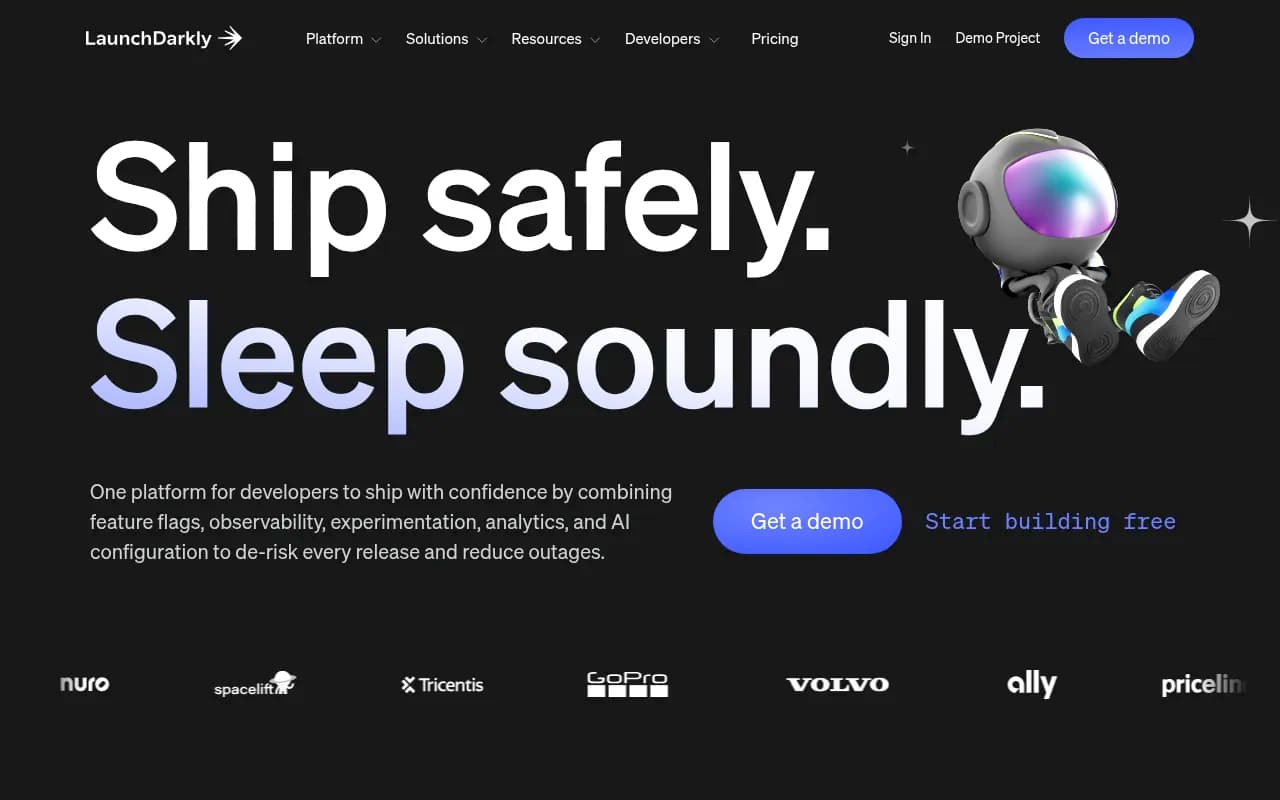
LaunchDarkly is the enterprise-grade feature management platform that pioneered the modern feature flag category back in 2014. Founded by Edith Harbaugh and John Kodumal, the company has raised over $200M in funding and serves 6,700+ customers including GoPro, Volvo, Ally Financial, Priceline, General Motors, HashiCorp, and Hulu. The platform processes 40 trillion feature flag evaluations daily across production environments -- a scale that speaks to both its reliability and market dominance.
The core problem LaunchDarkly solves: decoupling code deployment from feature release. Traditional deployments tie code changes to user-facing changes, meaning every deploy carries risk. LaunchDarkly wraps features in flags that can be toggled on or off instantly without redeploying code. This enables progressive rollouts (5% of users, then 25%, then 100%), instant rollbacks when things break, and targeted releases to specific user segments -- all without touching your CI/CD pipeline.
Who uses this? Engineering teams at companies shipping software at velocity. Think SaaS companies deploying 10+ times per day, mobile app teams who can't redeploy instantly, and enterprise orgs where a single outage costs millions. The sweet spot is 50-500 person engineering orgs, though it scales down to startups and up to Fortune 500s. Product managers use it to control feature access, data scientists run experiments, and DevOps teams use it as a kill switch when services degrade.
Feature Flags (Core Release Management)
The foundation of the platform. You wrap code in a flag check (if flag is on, show new checkout flow; if off, show old one). LaunchDarkly's SDKs evaluate these flags in milliseconds -- sub-200ms globally -- which is critical for high-traffic apps. Flags support boolean toggles, multivariate values (string, number, JSON), and percentage rollouts.
Targeting & Segmentation goes beyond simple on/off. You can target flags by user attributes (email domain, subscription tier, geographic region, device type, custom properties), create reusable segments ("beta users", "enterprise customers"), and combine rules with AND/OR logic. Example: show the new dashboard to users in the US with premium accounts who signed up after January 1st. Competitors like Split and Optimizely offer similar targeting, but LaunchDarkly's rule builder is more flexible and supports nested conditions.
Progressive Rollouts let you release to 5% of users, monitor metrics, then ramp to 25%, 50%, 100% over hours or days. The platform tracks rollout status across environments (dev, staging, production) and supports scheduled rollouts (turn on at 9am, turn off at 5pm). You can pause rollouts mid-flight if error rates spike. This is table stakes for enterprise feature management, but LaunchDarkly's execution is rock-solid -- no reports of flags getting stuck in inconsistent states, which has plagued some competitors.
Flag Lifecycle Management prevents flag debt. The platform tracks flag age, usage, and dependencies, then surfaces stale flags for cleanup. You can set expiration dates, require approval workflows before toggling production flags, and enforce naming conventions. LaunchDarkly also detects unused flags by analyzing code references via GitHub integration. This matters because flag sprawl is real -- teams can accumulate hundreds of forgotten flags that clutter codebases and slow evaluations.
Guarded Releases (Observability Layer)
This is where LaunchDarkly differentiates from basic flag tools. Guarded Releases monitors performance metrics and error rates in real time, then automatically rolls back flags when thresholds are breached. You define rules: if error rate exceeds 2% or latency crosses 500ms, kill the flag and revert to the old behavior. No manual intervention, no waiting for alerts, no emergency deploys.
Performance Thresholds integrate with Datadog, New Relic, Dynatrace, Honeycomb, and other observability tools. LaunchDarkly pulls metrics via API, correlates them with flag changes, and triggers rollbacks when things go sideways. Example: you roll out a new payment flow to 20% of users, error rates jump from 0.5% to 3%, LaunchDarkly detects the spike within seconds and automatically reverts the flag. The 20% of users see the old flow again, crisis averted.
Stack Traces & Session Replay (via integrations with Sentry, LogRocket, FullStory) let you debug flag-related issues by seeing exactly what users experienced. When a flag causes a crash, you can replay the session, see the flag state at the time of the error, and trace the issue back to specific code paths. This is newer functionality (added 2024) and not as mature as dedicated session replay tools, but the integration is seamless.
Automated Rollback is the killer feature here. Most competitors (Optimizely, Split, Unleash) require manual intervention when flags cause issues. LaunchDarkly's automation means you can deploy on Friday afternoon without sweating through the weekend. The platform has prevented countless 2am fire drills -- customers report 97% reduction in overnight/weekend releases (Ally Financial case study).
Experimentation & Product Analytics
LaunchDarkly isn't just a flag tool -- it's a full experimentation platform. You can run A/B tests, multivariate tests, and holdout experiments directly on feature flags without integrating a separate tool like Optimizely or VWO.
Feature-Based Experiments let you test flag variations (control vs treatment) and measure impact on conversion rates, revenue, engagement, or custom metrics. The platform handles randomization, statistical significance calculations (Bayesian and Frequentist methods supported), and sample size recommendations. You define success metrics (clicks, purchases, time on site), LaunchDarkly tracks events via SDK or server-side integration, and the dashboard shows results in real time.
Warehouse-Native Implementation is a standout. Instead of sending event data to LaunchDarkly's servers, you can run experiments entirely in your data warehouse (Snowflake, BigQuery, Redshift, Databricks). LaunchDarkly assigns users to variations, you log events to your warehouse, then LaunchDarkly queries the warehouse to compute results. This keeps sensitive data in your infrastructure and avoids vendor lock-in. Competitors like Statsig and GrowthBook also support warehouse-native experiments, but LaunchDarkly's implementation is more polished.
Product Analytics (added 2025) surfaces user behavior patterns without leaving the platform. You can see funnel drop-offs, cohort retention, and feature adoption rates tied directly to flag rollouts. Example: you release a new onboarding flow via flag, then track how many users complete each step vs the old flow. The analytics aren't as deep as dedicated tools like Amplitude or Mixpanel, but they're sufficient for quick insights and eliminate context switching.
Self-Serve Experimentation is a big deal for product teams. Non-technical PMs can create experiments, define audiences, and read results without engineering help. CCP Games (Eve Online) reported this "democratized experimentation" across their org -- PMs run 3x more tests than before because they don't need to file tickets.
AI Configs (Prompt & Model Management)
This is LaunchDarkly's newest capability (launched 2024) and a direct response to the AI boom. AI Configs let you manage LLM prompts, model versions, and agent configurations the same way you manage feature flags -- with versioning, targeting, rollouts, and rollbacks.
Prompt Management stores prompts as versioned configs that can be updated without redeploying code. You can A/B test prompt variations ("You are a helpful assistant" vs "You are an expert customer support agent"), roll out new prompts progressively, and revert instantly if quality degrades. This is critical for AI apps where prompt tweaks can break user experiences in unpredictable ways.
Model & Agent Manager lets you swap LLM providers (OpenAI GPT-4 vs Anthropic Claude vs local Llama) or adjust parameters (temperature, max tokens, top-p) via flags. Example: you start with GPT-4 for 100% of users, then test Claude for 10% to compare cost and quality, then roll out Claude to 50% if it performs well. You can also manage agent workflows (which tools an agent can call, in what order) and update them in production without code changes.
This is early-stage functionality -- competitors like Humanloop and PromptLayer are more specialized for AI workflows. But LaunchDarkly's advantage is unified management: feature flags, experiments, and AI configs in one platform. If you're already using LaunchDarkly for traditional features, adding AI configs is seamless.
Integrations & Ecosystem
LaunchDarkly integrates with 80+ tools across development, observability, communication, and data platforms. Key integrations:
• Code repositories: GitHub, GitLab, Bitbucket for code references and PR comments showing flag usage • CI/CD: Jenkins, CircleCI, GitHub Actions, GitLab CI for deployment tracking • Observability: Datadog, New Relic, Dynatrace, Honeycomb, Splunk for metric-based rollbacks • Communication: Slack, Microsoft Teams, PagerDuty for flag change notifications and alerts • Data warehouses: Snowflake, BigQuery, Redshift, Databricks for warehouse-native experiments • APM/Error tracking: Sentry, Rollbar, Bugsnag for correlating flags with errors • Analytics: Segment, mParticle, Amplitude for event forwarding
35+ Native SDKs cover every major language and framework: JavaScript, Python, Java, Go, Ruby, PHP, .NET, Swift, Kotlin, Rust, Erlang, Haskell, Lua, and more. Client-side SDKs for React, Vue, Angular, Svelte, React Native, Flutter, iOS, Android. Edge SDKs for Cloudflare Workers and Vercel Edge Functions. The SDK quality is consistently high -- well-documented, actively maintained, and performant.
REST API & Terraform Provider enable infrastructure-as-code workflows. You can manage flags, environments, and projects via API or Terraform, which is essential for GitOps teams. The API is well-designed and supports bulk operations.
CLI & IDE Plugins (VS Code, IntelliJ) let developers create and toggle flags without leaving their editor. The CLI supports scripting and automation.
Pricing & Value
LaunchDarkly's pricing is usage-based and scales with three dimensions: seats (team members), client-side MAU (monthly active users on web/mobile), and server-side connections (backend services).
Starter Plan (free): 2 seats, 1,000 client-side MAU, 5 server connections, unlimited feature flags, basic targeting, 14-day data retention. Good for prototyping or tiny teams, but you'll outgrow it fast.
Pro Plan (starts ~$99/month): 5 seats, 10,000 client-side MAU, 10 server connections, scheduled rollouts, approval workflows, Slack/Teams integration, 6-month data retention. This is the entry point for serious usage.
Enterprise Plan (custom pricing, typically $500-$2,000+/month): Unlimited seats, custom MAU/connection limits, SSO/SAML, advanced RBAC, SLA guarantees, Guarded Releases, Experimentation, AI Configs, dedicated support. Most customers at scale land here.
Based on Vendr data (195 purchases), median Enterprise contract is $72,000/year, with a range of $19,552 to $165,736. Buyers save 20% on average through negotiation. For context: a 200-person engineering org with 500K MAU and 50 services might pay $100K-$150K/year.
How it compares: LaunchDarkly is 2-3x more expensive than open-source alternatives (Unleash, Flagsmith, GrowthBook) and 20-50% pricier than mid-market competitors (Split, Optimizely). But the reliability, scale, and feature depth justify the premium for teams where downtime is costly. If you're a 5-person startup, use Unleash or Flagsmith. If you're a 100-person SaaS company doing $10M ARR, LaunchDarkly's cost is a rounding error compared to the value of shipping faster and avoiding outages.
Strengths
• Unmatched reliability: 40 trillion daily evaluations, sub-200ms flag updates globally, 99.99% uptime SLA. This is the platform you trust in production. • Automated rollbacks: Guarded Releases with metric-based triggers prevent incidents before they escalate. Competitors require manual intervention. • Comprehensive experimentation: Full A/B testing with warehouse-native support and self-serve workflows for non-technical users. • AI Configs: First major flag platform to tackle prompt and model management -- early but promising. • Ecosystem depth: 80+ integrations, 35+ SDKs, mature API, Terraform support. Fits into any stack. • Enterprise-grade governance: Approval workflows, audit logs, RBAC, SSO, compliance certifications (SOC 2, GDPR, HIPAA).
Limitations
• Price: Significantly more expensive than alternatives. Small teams and bootstrapped startups will struggle to justify the cost. • Learning curve: The platform is powerful but complex. Expect 2-4 weeks for teams to get comfortable with advanced features like Guarded Releases and Experimentation. • AI Configs immaturity: Prompt management is new and lacks depth compared to specialized tools like Humanloop or LangSmith. Fine for basic use cases, not yet ready for complex agent workflows. • Analytics limitations: Product Analytics is useful but shallow compared to Amplitude or Mixpanel. You'll still need a dedicated analytics tool for deep behavioral analysis.
Who Should Use LaunchDarkly
Buy this if you're an engineering team (50+ developers) at a company where software reliability directly impacts revenue. SaaS companies shipping multiple times per day, mobile apps with millions of users, e-commerce platforms where downtime costs thousands per minute, fintech/healthcare apps with strict compliance requirements. If you're currently doing manual feature rollouts, suffering from deployment anxiety, or running experiments in spreadsheets, LaunchDarkly will transform your workflow.
Skip this if you're a solo developer, early-stage startup with <10 engineers, or side project. The cost and complexity aren't justified. Use Unleash (open-source), Flagsmith (freemium), or GrowthBook (free for small teams) instead. Also skip if you need deep product analytics -- LaunchDarkly's analytics are supplementary, not a replacement for Amplitude or Mixpanel.
Bottom Line
LaunchDarkly is the enterprise standard for feature management and the platform to beat in 2026. It's expensive, but the reliability, automation, and scale justify the cost for teams where velocity and uptime matter. The addition of AI Configs positions it well for the next wave of AI-native applications. If you're serious about continuous delivery and can afford the price tag, this is the tool to use. Best use case in one sentence: engineering teams at high-growth SaaS companies who need to ship fast, experiment constantly, and sleep soundly knowing automated rollbacks have their back.
Tags:
Similar and alternative tools to LaunchDarkly