LLMonitor Review 2026
Platform for tracking and analyzing brand mentions and citations across large language models and AI search engines.
Key Takeaways:
- Open-source LLM observability platform with cloud and self-hosted deployment options, SOC 2 Type II and ISO 27001 certified for enterprise security
- Complete monitoring stack including agent tracing, cost analytics, prompt management, PII masking, and custom dashboards -- goes beyond basic logging to help you actually improve AI performance
- Best for development teams building customer-facing chatbots, internal AI tools, or autonomous agents who need production-grade monitoring without vendor lock-in
- Generous free tier plus affordable paid plans starting at $25/month for teams that need advanced features like A/B testing and custom evaluations
- Limitations: Smaller ecosystem than enterprise competitors like LangSmith or Datadog, documentation could be more comprehensive for complex use cases
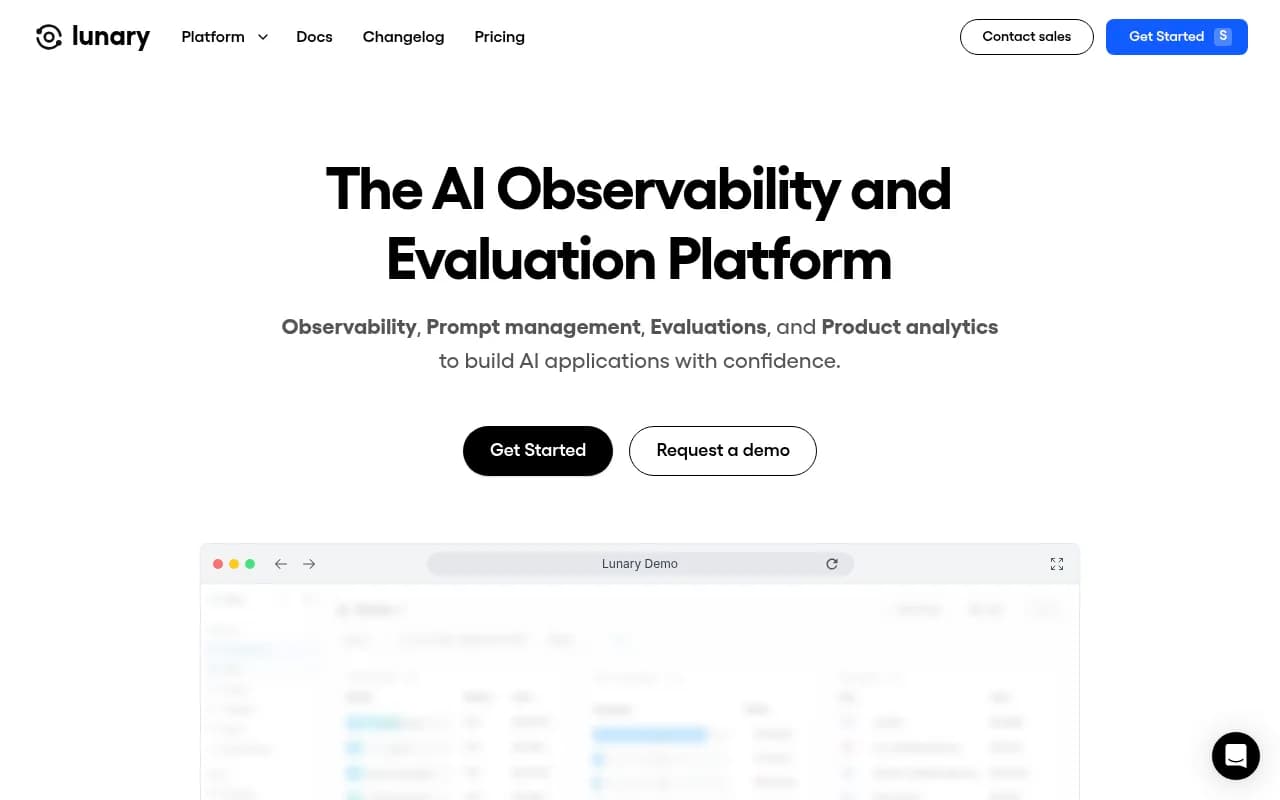
Lunary (formerly known as LLMonitor) is an open-source observability and evaluation platform built specifically for teams developing LLM-based applications. Founded as an open-source project and now backed by enterprise customers including Islandsbanki, Zurich Insurance, DHL, and Close.com, Lunary has evolved from a simple monitoring tool into a comprehensive platform for managing the entire lifecycle of AI applications -- from prompt engineering to production debugging to cost optimization.
The platform addresses a critical gap in the AI development stack: most teams build LLM features without any visibility into how they perform in production. You ship a chatbot, cross your fingers, and hope users don't encounter hallucinations or errors. Lunary gives you the observability layer that traditional APM tools can't provide for AI workloads -- tracking not just uptime and latency, but the actual quality of LLM responses, user satisfaction, and model behavior.
What sets Lunary apart from competitors is its commitment to open source and self-hosting. While platforms like LangSmith and Helicone offer similar monitoring capabilities, Lunary gives you the option to deploy entirely within your own infrastructure using Docker or Kubernetes. This matters for regulated industries (finance, healthcare, legal) where sending LLM prompts and responses to third-party SaaS tools creates compliance headaches. The fact that major banks and insurance companies trust Lunary speaks to the maturity of its security posture.
Core Observability Features
Agent Tracing & Debugging is the foundation of Lunary's value proposition. Every LLM call, tool invocation, and agent decision gets logged with full context -- input prompts, model responses, token counts, latency, costs, and error stack traces. When an agent fails or hallucinates in production, you can replay the entire execution chain to see exactly where things went wrong. The tracing view shows nested calls (agent → retrieval → LLM → tool → LLM), making it easy to debug complex multi-step workflows. You can filter traces by user, model, cost, latency, or custom tags, and search across millions of logs in milliseconds. This is essential for teams running RAG pipelines or autonomous agents where a single user query might trigger 10+ LLM calls.
Cost & Usage Analytics gives you real-time visibility into your AI spend. Lunary tracks costs per model (GPT-4, Claude, Gemini, Llama, etc.), per user, per feature, and over time. You can set up alerts when costs spike above thresholds, identify which users or prompts are driving the highest spend, and compare cost efficiency across different models. One customer reported discovering their chatbot was burning through GPT-4 tokens on simple queries that could have been handled by GPT-3.5-turbo, saving them thousands per month after switching. The analytics dashboard also surfaces usage patterns -- peak hours, most common topics, languages spoken by users -- that help you optimize infrastructure and prioritize feature development.
Chat Replays let you watch exactly how users interact with your AI application. You see the full conversation history, user feedback (thumbs up/down), and any errors or retries. This is invaluable for customer-facing chatbots where you need to understand why users abandon conversations or express frustration. Lunary automatically classifies chats into topics using LLMs, so you can quickly identify trends like "users asking about pricing" or "refund requests" without manually reading thousands of transcripts. You can also label conversations for fine-tuning datasets or human review.
PII Masking & Security is built-in, not bolted on. Lunary can automatically detect and redact personally identifiable information (emails, phone numbers, credit cards, addresses) from logs before they're stored. This is critical for GDPR compliance and reduces the risk of exposing sensitive data. The platform is SOC 2 Type II and ISO 27001 certified, with role-based access control (RBAC), SSO support, and audit logs. For teams that need maximum control, the self-hosted version runs entirely in your VPC with no data leaving your infrastructure.
Prompt Management & Versioning
Lunary includes a built-in prompt management system that lets you create, version, and deploy prompt templates without touching code. Non-technical team members (product managers, support leads, domain experts) can iterate on prompts in the web UI, test them in the playground, and push changes to production. Every prompt version is tracked, so you can roll back if a new version performs worse. The platform supports variables, conditional logic, and multi-turn conversations.
A/B Testing is a standout feature -- you can run experiments comparing different prompts, models, or temperatures, and Lunary automatically tracks which variant performs better based on metrics like user feedback, cost, or latency. This takes the guesswork out of prompt engineering. Instead of debating whether "You are a helpful assistant" or "You are an expert customer support agent" works better, you test both and let the data decide.
Evaluations & Quality Scoring
Lunary lets you define custom evaluations to automatically score LLM responses. You can use built-in checks (toxicity, PII detection, factual consistency) or write custom evaluators using LLMs or code. For example, you might evaluate whether a customer support response actually answers the user's question, or whether a generated SQL query is syntactically valid. Evaluations run automatically on every response, and you can set up alerts when quality scores drop below thresholds. This helps you catch regressions before users do.
Human Review Workflows complement automated evaluations. You can flag responses for manual review by your team, track inter-rater agreement, and use the feedback to improve prompts or fine-tune models. This is especially useful in high-stakes domains (legal, medical, financial advice) where you need human oversight.
Integrations & Developer Experience
Lunary integrates with every major LLM provider and framework: OpenAI, Anthropic, Google Vertex AI, Azure OpenAI, Mistral, Llama, Replicate, Hugging Face, LangChain, LlamaIndex, and more. The SDKs (Python, JavaScript/TypeScript) are lightweight and designed to add monitoring with a single line of code. For OpenAI, you literally just wrap your client: lunary.monitor(client) and you're done. No refactoring required.
The platform also integrates with data warehouses (Snowflake, BigQuery, Postgres, MySQL) so you can export logs for custom analysis, and with Looker Studio for custom dashboards. There's a full REST API for programmatic access.
Multi-Modal Support means Lunary handles text, images, and audio. If you're building a vision model that analyzes product photos or a voice assistant, Lunary logs the full context including media files.
Who Should Use Lunary
Lunary is built for development teams shipping LLM-based products to real users. This includes:
- SaaS companies adding AI features to existing products (chatbots, content generation, data analysis). Teams of 5-50 engineers who need observability without the complexity of enterprise platforms.
- AI-first startups building entire products around LLMs (coding assistants, research tools, creative apps). Early-stage teams (seed to Series A) that need production monitoring but can't afford $50k/year enterprise contracts.
- Digital agencies building custom AI solutions for clients. Agencies managing 10-30 client projects who need multi-tenant monitoring and white-label options.
- Enterprise AI teams in regulated industries (finance, healthcare, legal) who require self-hosted deployment and strict compliance. Companies with 100+ person engineering orgs that need SOC 2 certification and SSO.
Lunary is not ideal for:
- Individual developers or hobbyists building side projects -- the free tier works, but you might find simpler tools like Helicone or basic logging sufficient.
- Teams using only OpenAI's API without complex agents or RAG -- OpenAI's native dashboard might be enough.
- Organizations that need deep integration with existing APM tools like Datadog or New Relic -- Lunary is a standalone platform, not a plugin.
Pricing & Value
Lunary offers a free tier that includes core observability features: unlimited logs, basic analytics, prompt templates, and chat replays. This is genuinely usable for small projects or early-stage startups.
The Pro plan is $25/month and adds advanced features: A/B testing, custom evaluations, PII masking, topic classification, and priority support. This is the sweet spot for most growing teams.
The Advanced Analytics plan is $199/month and includes custom dashboards, advanced filtering, and longer data retention.
Enterprise plans start at $599/month and include self-hosting, SSO, RBAC, dedicated support, and SLAs. Custom pricing is available for large deployments.
Compared to competitors, Lunary is significantly more affordable. LangSmith charges $39/user/month for similar features, and Datadog's LLM Observability starts at $1.70 per million tokens ingested (which adds up fast). Lunary's flat-rate pricing is predictable and budget-friendly for teams that process high volumes.
The open-source nature also means you can self-host for free if you have the infrastructure expertise, though most teams opt for the cloud version to avoid operational overhead.
Strengths
- Open source and self-hostable -- no vendor lock-in, full control over your data, and the ability to customize the platform for your needs
- Enterprise-grade security with SOC 2 Type II and ISO 27001 certification, rare for an open-source tool
- Comprehensive feature set that covers observability, prompt management, evaluations, and analytics in one platform -- no need to stitch together multiple tools
- Developer-friendly integration that takes minutes to set up and doesn't require refactoring your codebase
- Affordable pricing with a generous free tier and predictable costs that scale with your team, not your usage
Limitations
- Smaller community and ecosystem compared to LangSmith or Weights & Biases -- fewer third-party integrations and community-contributed evaluators
- Documentation gaps for advanced use cases like custom evaluators or complex self-hosted deployments -- you may need to dig into GitHub issues or contact support
- Limited fine-tuning support -- while you can label data for fine-tuning, Lunary doesn't handle the actual training workflow like some competitors
Bottom Line
Lunary is the best choice for development teams that need production-grade LLM observability without the enterprise price tag or vendor lock-in. If you're building customer-facing AI features, running autonomous agents, or managing multiple LLM projects, Lunary gives you the visibility and control to ship confidently and iterate quickly. The combination of open-source flexibility, enterprise security, and affordable pricing makes it a standout in a crowded market.
Best use case in one sentence: Teams building production LLM applications who need comprehensive observability, prompt management, and cost tracking with the option to self-host for compliance or control.
Tags:
Frequently asked questions
What is LLMonitor and what does it do?
Is LLMonitor free to use?
Who is LLMonitor best suited for?
Can LLMonitor be self-hosted?
Is LLMonitor secure and compliant for enterprise use?
What are the main limitations of LLMonitor?
Similar and alternative tools to LLMonitor