Promptfoo Review 2026
CLI and library for testing and evaluating prompts across multiple AI models with automated comparison and regression testing capabilities.
Key Takeaways:
• Open-source leader with enterprise adoption: Used by 127 Fortune 500 companies including OpenAI and Anthropic, with 300,000+ developers and 91,000+ weekly downloads • Comprehensive security testing: Automated red teaming covers 50+ vulnerability types from prompt injection to jailbreaks, PII leaks, and insecure tool use in agents • Developer-first workflow integration: Works in CI/CD pipelines (GitHub, GitLab, Jenkins), supports MCP and agent frameworks, runs locally or in cloud • Real-time threat intelligence: Community of 300k+ users provides early warning on new attack vectors, automatically deployed to your tests • Honest limitation: Enterprise pricing is custom and not publicly listed, which may be a barrier for smaller teams evaluating budget fit
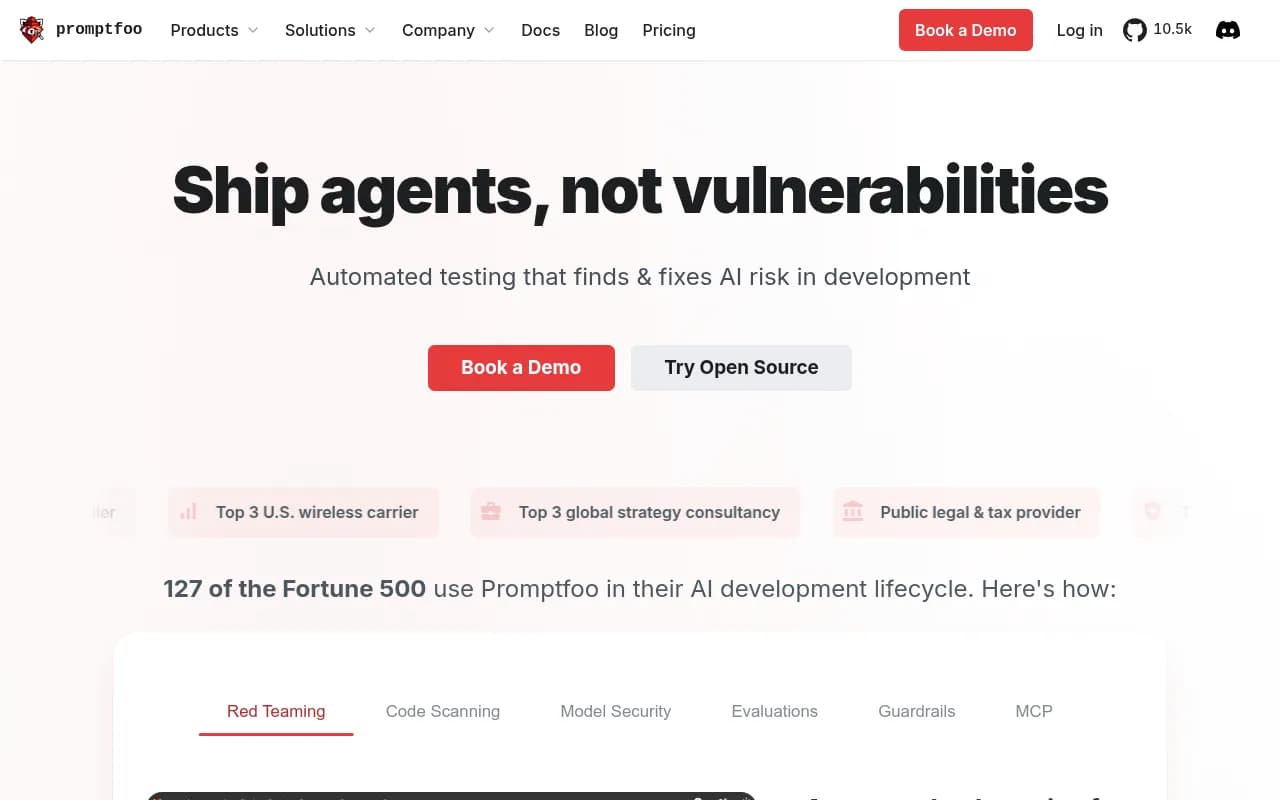
Promptfoo has emerged as the de facto standard for AI application security testing in 2026, bridging the gap between traditional security tools (which don't understand LLM-specific threats) and manual red teaming (which doesn't scale). Originally launched as an open-source CLI for prompt evaluation, it has evolved into a full security platform that 127 Fortune 500 companies now use to catch vulnerabilities before they reach production. The platform is trusted by foundation model labs like OpenAI and Anthropic, major retailers, healthcare companies, telecommunications providers, and enterprise software leaders.
What sets Promptfoo apart is its dual nature: it's both a free, open-source framework that developers can start using in minutes, and an enterprise security platform with the depth and automation that security teams need at scale. This isn't vaporware -- with 91,000+ weekly downloads and 243+ contributors from companies like OpenAI, Google, Microsoft, and Amazon, it's one of the most actively developed AI security projects in the world.
Automated Red Teaming for Real-World Applications
The core innovation is Promptfoo's automated red teaming capability. Unlike generic LLM benchmarks that test models in isolation, Promptfoo generates thousands of context-aware attacks tailored to your specific application. You run npx promptfoo@latest redteam setup and it analyzes your AI system -- whether that's a chatbot, RAG application, or autonomous agent -- then creates custom attack scenarios that target your actual business logic, data sources, and integrations.
Vulnerability Coverage: The platform tests for 50+ vulnerability types including direct and indirect prompt injections, jailbreaks customized to bypass your specific guardrails, data and PII leakage, business rule violations, insecure tool use in agents (a critical risk as agentic systems become more common), toxic content generation, hallucination risks, and context window manipulation. This isn't a static checklist -- new attack vectors discovered by the 300,000+ user community are automatically incorporated into your test suite.
Application-Specific Testing: Most competitors test LLMs in a vacuum. Promptfoo understands your application architecture. It knows if you're using RAG (and tests for retrieval poisoning, context manipulation, and citation fabrication), if you have agents with tool access (and tests for unauthorized actions, data exfiltration through tools, and privilege escalation), or if you have custom guardrails (and generates jailbreaks specifically designed to bypass them). This application-aware approach is why enterprises choose Promptfoo over generic model evaluation tools.
Scale and Automation: The platform can generate thousands of test cases automatically, far beyond what human red teamers could create manually. It uses adversarial LLMs to iteratively probe your system, learning from successful attacks to generate more sophisticated variants. This deep automation is what allows security teams to scale from testing 1 application to 100+ without proportionally scaling headcount.
Code Scanning and Model Security
Beyond runtime testing, Promptfoo scans your codebase for AI security issues before deployment. It integrates with GitHub, GitLab, Jenkins, and other CI/CD platforms to catch vulnerabilities in pull requests. The scanner looks for insecure prompt construction, missing input validation, hardcoded API keys, unsafe tool configurations in agent frameworks, and other code-level risks that traditional SAST tools miss because they don't understand LLM-specific threats.
Model Security: For teams fine-tuning or deploying their own models, Promptfoo includes model-level security testing -- checking for backdoors, data poisoning, model extraction risks, and adversarial robustness. This is particularly relevant for enterprises training custom models on proprietary data.
Evaluations and Guardrails
While security is the headline feature, Promptfoo started as a prompt evaluation framework and those capabilities remain best-in-class. You can test prompts across multiple models (OpenAI, Anthropic, Google, Cohere, open-source models via Ollama or vLLM), compare outputs side-by-side, run regression tests to ensure prompt changes don't break existing functionality, and measure quality metrics like accuracy, relevance, toxicity, and hallucination rates.
Guardrail Testing: If you're using guardrails (Llama Guard, Azure Content Safety, custom classifiers), Promptfoo tests whether they actually work. It generates adversarial inputs designed to bypass your filters, measures false positive and false negative rates, and helps you tune thresholds. This is critical because many teams deploy guardrails assuming they're protected, only to discover in production that simple prompt engineering tricks bypass them entirely.
MCP (Model Context Protocol) Support
Promptfoo was one of the first security platforms to support Anthropic's Model Context Protocol, the emerging standard for connecting LLMs to external data sources and tools. This means you can test MCP servers for security issues -- unauthorized data access, tool misuse, context leakage -- before connecting them to production agents. As MCP adoption grows in 2026, this capability is becoming a key differentiator.
Who Is Promptfoo For?
Promptfoo serves three distinct audiences, each with different needs:
Developers and AI Engineers: If you're building LLM applications, agents, or RAG systems, Promptfoo is a must-have in your toolkit. The open-source CLI is free, runs locally, and integrates with your existing workflow. You can start testing prompts in minutes without talking to sales or setting up infrastructure. Use it for prompt engineering (comparing outputs across models), regression testing (ensuring changes don't break things), and basic security checks (catching obvious injection vulnerabilities before code review). The developer experience is excellent -- YAML configuration, CLI-first design, works offline, no vendor lock-in.
Security Teams at Mid-to-Large Enterprises: If you're a security director or CISO responsible for AI risk, Promptfoo is the only platform that delivers enterprise-grade depth without requiring a PhD in machine learning. It integrates with your existing security stack (SIEM, ticketing, CI/CD), provides audit trails and compliance reporting, and scales to hundreds of applications. The key value proposition: you get continuous, automated security testing that actually understands AI-specific threats (not just generic AppSec checks), backed by real-time threat intelligence from 300k+ users. This is why 127 Fortune 500 companies use it -- it's the only solution that works at their scale and complexity.
AI Security Researchers and Red Teamers: If you're on an offensive security team or doing AI safety research, Promptfoo is both a tool and a platform. Use it to automate repetitive testing, contribute new attack techniques back to the community, and stay current on emerging threats. The open-source nature means you can extend it with custom plugins, integrate novel attack vectors, and share findings without vendor restrictions.
Who Should NOT Use Promptfoo: If you're a solo developer building a simple chatbot with no sensitive data and no compliance requirements, Promptfoo might be overkill. The free tier is generous, but learning the full feature set takes time. For basic prompt testing, simpler tools like PromptLayer or LangSmith might suffice. Also, if you need a fully managed, no-code solution where someone else runs all the tests for you, Promptfoo requires more hands-on setup (though the enterprise tier includes professional services).
Integrations and Ecosystem
Promptfoo integrates with the entire AI development stack:
LLM Providers: OpenAI (GPT-4, GPT-3.5), Anthropic (Claude 3.5 Sonnet, Opus, Haiku), Google (Gemini Pro, Ultra), Cohere, Mistral, open-source models via Ollama, vLLM, or HuggingFace. You can test the same prompt across multiple providers to compare cost, latency, and quality.
Agent Frameworks: LangChain, LlamaIndex, AutoGPT, CrewAI, Semantic Kernel. Promptfoo understands agent architectures and tests for agent-specific vulnerabilities like unauthorized tool use and goal hijacking.
CI/CD Platforms: GitHub Actions, GitLab CI, Jenkins, CircleCI, Azure DevOps. Run security tests on every pull request, block merges if critical vulnerabilities are found, and track remediation status.
Security Tools: Integrates with SIEM platforms (Splunk, Datadog), ticketing systems (Jira, ServiceNow), and secret scanners (GitGuardian, TruffleHog). Export findings in SARIF format for compatibility with existing security workflows.
Developer Tools: VS Code extension for inline testing, CLI for local development, Python and Node.js SDKs for programmatic access. The API is fully documented and allows custom integrations.
On-Premise and Cloud: Runs entirely locally (no data leaves your machine) or in your private cloud (AWS, Azure, GCP). Enterprise customers can deploy on-premise for maximum control. There's also a managed cloud option for teams that want Promptfoo to handle infrastructure.
Pricing and Value
Promptfoo uses a freemium model with a generous open-source tier:
Open Source (Free): Full access to the CLI, red teaming, evaluations, and core security testing. No limits on tests or models. Runs locally, no account required. This is genuinely free, not a trial -- you can use it in production indefinitely. Perfect for individual developers, small teams, and anyone who wants to evaluate the platform.
Enterprise (Custom Pricing): Adds team collaboration features, centralized dashboards, advanced remediation workflows (findings in PRs with fix suggestions), compliance reporting (SOC 2, HIPAA, GDPR), priority support, professional services for onboarding, and SLAs. Pricing is customized based on team size, number of applications, and deployment model (cloud vs on-premise). Based on competitor pricing and the Fortune 500 customer base, expect enterprise contracts to start in the low five figures annually.
The value proposition is strong: Promptfoo replaces multiple tools (manual red teaming, generic security scanners, prompt evaluation platforms) with a single integrated solution. For enterprises, the ROI comes from catching vulnerabilities before production (where the cost of a breach is orders of magnitude higher) and scaling security testing without scaling headcount. For developers, the free tier is unbeatable -- you get enterprise-grade capabilities at zero cost.
Compared to competitors: Giskard and Patronus AI offer similar evaluation capabilities but lack the depth of red teaming and security focus. Lakera and Robust Intelligence focus on guardrails but don't provide end-to-end testing. HumanLoop and PromptLayer are more focused on prompt management than security. Promptfoo is the only platform that combines deep security testing, evaluation, and developer-friendly workflows in one package.
Strengths
Open-source with enterprise credibility: The combination of a thriving open-source community (300k+ users, 243+ contributors) and Fortune 500 adoption is rare. You get the innovation and transparency of open source with the reliability and support of an enterprise vendor.
Application-aware security testing: Unlike generic benchmarks, Promptfoo understands your specific application architecture (RAG, agents, tools) and generates targeted attacks. This is the key differentiator vs competitors.
Real-time threat intelligence: New attack vectors discovered by the community are automatically incorporated into your tests. You're not relying on a vendor's research team to stay current -- you have 300,000 users finding vulnerabilities in real-time.
Developer experience: The CLI-first design, YAML configuration, local execution, and zero vendor lock-in make it easy to adopt. Developers actually want to use it, which is critical for security tools.
Comprehensive coverage: 50+ vulnerability types, support for agents and RAG, MCP integration, code scanning, model security -- it's a complete platform, not a point solution.
Limitations
Enterprise pricing opacity: Like most enterprise security vendors, Promptfoo doesn't publish pricing for the commercial tier. This makes it hard for mid-sized companies to budget without going through a sales process. More transparent pricing would help adoption.
Learning curve for advanced features: While the basic CLI is simple, mastering the full platform (custom plugins, advanced red teaming configurations, remediation workflows) takes time. The documentation is good but dense.
Requires technical setup: This isn't a fully managed service where you hand over your application and get a report. You need to integrate it into your workflow, configure tests, and interpret results. Non-technical stakeholders will need support from engineering or security teams.
Bottom Line
Promptfoo is the gold standard for AI application security testing in 2026. If you're building anything with LLMs -- chatbots, agents, RAG systems, copilots -- you should be using it. Start with the free open-source tier to evaluate prompts and catch basic vulnerabilities, then upgrade to enterprise when you need team collaboration, compliance reporting, and advanced remediation workflows. The combination of deep automation, real-time threat intelligence, and Fortune 500 credibility makes it the obvious choice for serious AI security.
Best use case in one sentence: Security teams at enterprises deploying multiple LLM applications who need continuous, automated testing that scales without proportionally scaling headcount, backed by real-time threat intelligence from the world's largest AI security community.
Tags:
Similar and alternative tools to Promptfoo