My AskAI Review 2026
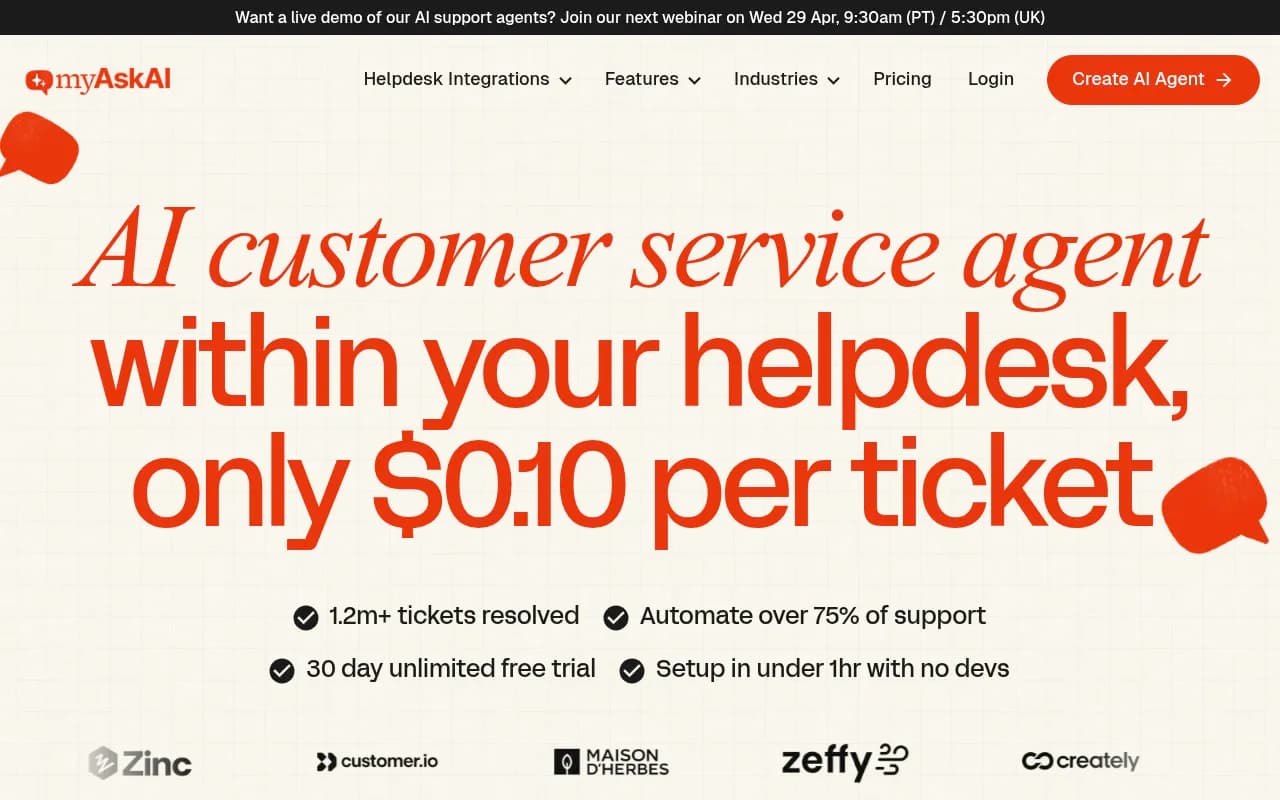
My AskAI is an AI customer service agent that integrates with Zendesk, Intercom, Freshdesk, Gorgias, and HubSpot to automate 75%+ of support tickets at $0.10/ticket — significantly cheaper than native helpdesk AI tools.
Key takeaways
- Resolves 75%+ of support tickets automatically — verified across 250+ customer deployments, with some customers hitting 82-84% resolution rates
- Dramatically cheaper than native helpdesk AI — at $0.10/ticket and plans starting from $199/mo, it's positioned as 5x cheaper than Intercom Fin, Zendesk AI, or HubSpot Breeze AI
- Integrates with existing helpdesks in under 10 minutes — no developers required, works inside Intercom, Zendesk, Gorgias, Freshdesk, and HubSpot without replacing them
- Self-learning and knowledge management are genuine differentiators — the agent improves from human agent replies and generates help articles automatically
- Not a standalone chat platform — if you don't already use one of the five supported helpdesks, this tool isn't for you
My AskAI is an AI customer service agent built to sit inside your existing helpdesk and handle the bulk of incoming support tickets before they ever reach a human. The company was co-founded by Alex Rainey and has built a focused product around one core promise: deflect 75% of your support volume at a fraction of what your helpdesk vendor charges for the same capability. With over 1.2 million tickets resolved (per their live counter) and 250+ teams onboarded, it's not a concept — it's a working product with real case studies behind it.
The target audience is clear: customer support teams at SaaS companies, eCommerce brands, marketplaces, and B2C businesses that are already paying for Zendesk, Intercom, Freshdesk, Gorgias, or HubSpot and either (a) can't afford the native AI add-on, or (b) tried it and found it underwhelming. The pitch isn't "replace your helpdesk" — it's "add AI to the helpdesk you already have, for less money, and get better results." That's a smart positioning move, and based on the case studies, it holds up.
My AskAI has been around long enough to accumulate a meaningful customer base including Customer.io ($50M+ ARR), Freecash (handling 70,000+ tickets per month), Swytch Bike ($60M+ revenue), and Kriptomat. The product is SOC 2 and GDPR compliant, which matters for anyone in fintech, crypto, or handling EU customer data.
Key features
Knowledge ingestion and sync The foundation of any AI support agent is what it knows. My AskAI lets you import from help center articles, websites, Google Drive, Notion, internal SOPs, and even past support tickets. Content stays synced automatically — so when you update a help article, the AI agent picks it up without manual intervention. The ticket training feature is particularly useful: you can feed thousands of historical resolved tickets into the agent, turning your team's accumulated knowledge into AI training data instantly.
Helpdesk integrations (the core differentiator) My AskAI doesn't try to be a standalone chat widget. It plugs directly into Intercom, Zendesk (both Support inbox and Messaging), Freshdesk, Freshchat, Gorgias, and HubSpot. You install it from the helpdesk's own app marketplace — no custom code, no developers. Once installed, it works inside your existing ticket and chat workflows exactly like a human agent would, just faster and available 24/7. This is the key reason customers switch from native AI: same interface, better results, lower cost.
Copilot and draft reply mode Before you trust the AI to reply directly to customers, you can run it in copilot mode. The agent drafts replies as internal notes that only your human agents can see. Agents review, edit if needed, and send. This staged rollout approach is smart — it lets teams build confidence in the AI's accuracy before flipping the switch to autonomous replies. My AskAI's recommended 30-day rollout guide formalizes this: internal notes for the first week, then controlled direct replies on safe topics, then full automation.
Intelligent escalation When the AI can't confidently answer a question, it doesn't guess or hallucinate — it hands the conversation to a human agent. The escalation is seamless within the existing helpdesk, so customers don't experience a jarring context switch. You can configure which topics always escalate (billing disputes, legal questions, etc.) and which the AI handles autonomously. This is table stakes for any AI support tool, but My AskAI's implementation is clean and works across all five supported helpdesks.
Tasks and tools (agentic actions) Beyond answering questions, the AI can take actions. By connecting your CRM, ERP, or custom APIs, the agent can look up order status, check subscription details, process refund requests, or handle account upgrades — all without human involvement. Swytch Bike's CCO specifically called this out as a "game changer" because the AI could answer questions about specific customer orders rather than giving generic responses. This moves My AskAI from a Q&A bot into genuine agentic territory.
Self-learning After a human agent handles an escalated ticket, My AskAI reviews the human's reply and learns from it. It can automatically generate new help articles from those replies, closing knowledge gaps without requiring manual content creation. Over time, the resolution rate improves as the agent accumulates more knowledge from real interactions. This is one of the more compelling features — the system gets better the more you use it, without requiring ongoing manual tuning.
Insights dashboard The insights tab surfaces what customers are actually asking about — topic clusters, common questions, resolution rates by category. This is useful beyond just AI performance: it tells your product and support teams where documentation is weak, what features confuse users, and where to invest in self-service content. Zinc's Chief of Staff specifically mentioned this as a time-saver for understanding conversation trends.
Multilingual support and live translation The agent supports 95+ languages and can respond in the customer's language automatically. Freecash reported handling support in 20+ languages with no additional configuration. Live translation means human agents can also see translated versions of customer messages, which helps when escalated tickets come in from non-English speakers.
Image reading Customers can send screenshots or photos — error messages, product photos, receipts — and the AI can interpret them. This is genuinely useful for technical support scenarios where "show me the error" is faster than "describe the error."
Testing and QA Before going live, you can run the AI against previous support tickets to see how it would have performed. Full response logs are available for every AI interaction, so you can audit exactly what the agent said and why. This observability is important for teams that need to demonstrate compliance or maintain quality standards.
Who is it for
The clearest fit is a SaaS or eCommerce company with 5-50 support agents, already running on one of the five supported helpdesks, and handling enough ticket volume that the math on $0.10/ticket makes sense. If you're getting 2,000+ tickets per month and paying $1+ per resolution with Intercom Fin or Zendesk AI, the savings are immediate and significant. Customer.io, Freecash, and Swytch Bike all fit this profile — mid-market companies with real support volume and a clear cost problem.
It also works well for fast-growing companies that are scaling support volume faster than headcount. Zeffy's case study is a good example: rapid growth meant ticket volume was outpacing the team's capacity, and the AI agent resolved 84% of conversations without adding staff. For companies in that position, My AskAI is essentially a way to buy time before the next support hire.
Industries where it particularly shines include eCommerce (order status, returns, shipping questions are highly automatable), SaaS (product how-to questions map well to help documentation), and crypto/fintech (high volume of repetitive account and transaction questions). The multilingual capability makes it viable for companies with international customer bases.
Who should not use this tool: anyone not on one of the five supported helpdesks. If you're running a custom-built support system, using Salesforce Service Cloud, or want a standalone chat widget without a helpdesk backend, My AskAI isn't the right fit. It's also not ideal for very small teams handling fewer than a few hundred tickets per month — the economics don't justify the setup effort, and the free tier of your helpdesk's native AI might be sufficient.
Integrations and ecosystem
The helpdesk integrations are the product's backbone:
- Zendesk — both Support inbox (ticket-based) and Messaging (live chat). Available in the Zendesk Marketplace.
- Intercom — direct replacement for Fin AI, installed from the Intercom App Store
- Freshdesk and Freshchat — covers both ticket and live chat workflows
- Gorgias — replaces Gorgias Automate, available in the Gorgias App Store
- HubSpot — covers chat, email, and messaging workflows
Knowledge source integrations include Google Drive, Notion, website crawling, and direct help center syncing. There's also a Chrome extension for AI Copilot, which lets support agents use the AI to draft replies from within their browser without switching tools.
The API and user data connections are worth noting separately. My AskAI can connect to your backend systems via API to pull live customer data — order history, subscription status, account details — which is what enables the agentic task completion. This requires some technical setup (API configuration), but the company claims no developers are needed for the core product, and the data connections are a separate, more advanced feature.
There's no native Zapier or Make integration mentioned, and no mobile app. The product is web-based and lives primarily within the helpdesk interfaces it integrates with.
Pricing and value
My AskAI's pricing is built around a per-ticket model with monthly plan minimums:
- Free trial: 30 days, full access, no credit card required
- Pro plan: $199/month for 1,000 tickets/conversations. Additional tickets at $0.10 each.
- Team plan: $299/month for 1,000 interactions (per their blog content)
- Business plan: $799/month for 3,000 interactions
- Enterprise: Custom pricing
The $0.10/ticket overage rate is the headline number. Compare that to Intercom Fin at roughly $0.99/resolution, Zendesk AI at similar per-resolution pricing, or HubSpot Breeze AI — and the savings are real. A company handling 5,000 tickets per month would pay around $500-600 with My AskAI versus potentially $3,000-5,000 with native helpdesk AI at comparable resolution rates.
The 30-day free trial with full access is genuinely generous — you can run it against real tickets, see actual resolution rates, and make a data-driven decision before spending anything.
Strengths and limitations
What it does well:
- Pricing is a genuine advantage. The 5x cheaper claim holds up when you do the math against Intercom Fin or Zendesk AI. For companies already paying for a helpdesk, this is a meaningful cost reduction.
- The staged rollout approach is thoughtful. Starting with internal notes before moving to direct replies reduces risk and builds team trust. Most competitors don't have a structured onboarding process like this.
- Self-learning is a real differentiator. The ability to generate help articles from human agent replies and improve automatically over time is something the native helpdesk AI tools don't do as well.
- Resolution rates are verified by real customers. The case studies are specific — 76% at Traveljoy (vs 23% with Zendesk AI), 82% at Freecash, 84% at Zeffy. These aren't marketing estimates.
- Image reading and multilingual support are included without extra configuration, which competitors often charge for or don't offer at all.
Limitations:
- Only five helpdesk integrations. If you're on Salesforce Service Cloud, Help Scout, Drift, or any other platform, you're out of luck. The product's value proposition depends entirely on these integrations.
- Agentic task setup requires technical work. Connecting CRMs and APIs for order lookups and account actions isn't no-code — it requires API configuration. The "no developers required" claim applies to the basic setup, not the advanced features.
- Limited standalone capability. There's no meaningful standalone chat widget or self-service portal. If you want to add AI support to a website without a helpdesk backend, this isn't the tool.
- Pricing transparency could be clearer. The website shows $199/mo for the Pro plan, but blog content references a $299/mo Team plan and $799/mo Business plan. The pricing page likely has the current numbers, but the inconsistency across content is worth noting.
Bottom line
My AskAI is a well-executed, focused product that does exactly what it promises: add an AI agent to your existing helpdesk, resolve 75%+ of tickets automatically, and cost significantly less than the native AI your helpdesk vendor is trying to sell you. The case studies are credible, the self-learning feature is genuinely useful, and the 30-day free trial removes most of the risk from trying it.
Best for: SaaS and eCommerce companies with 1,000+ monthly support tickets, already running Zendesk, Intercom, Freshdesk, Gorgias, or HubSpot, who want to cut support costs without replacing their existing tools or hiring more agents.
Frequently asked questions
What is My AskAI?
How much does My AskAI cost?
How does My AskAI compare to Intercom Fin or Zendesk AI?
Which helpdesks does My AskAI integrate with?
Is there a free trial available?
Can My AskAI handle complex tasks like refunds or order lookups?
Similar and alternative tools to My AskAI