Warmer.ai Review 2026
Generates hyper-personalized cold email openers at scale by analyzing prospect LinkedIn profiles and websites. Helps sales teams improve open and reply rates from qualified prospects.
Key takeaways
- Warmer.ai automates the research-and-personalize loop that eats up SDR time -- upload a CSV, get back enriched profiles and AI-written openers ready to send
- Credit-based pricing starts at $59/month for 500 credits, scaling to $249/month for 10,000 credits, which makes it accessible for solo reps but affordable at volume too
- The platform claims 87% higher response rates and 3x more meetings booked, though these are self-reported figures from the marketing site
- No native CRM sync -- exports are CSV-based, so you're copying data rather than pushing it directly into Salesforce or HubSpot records
- Solid for outbound-focused sales teams, but not a full sales engagement platform -- you still need a sequencer like Outreach or Salesloft to actually send the emails
Warmer.ai is a B2B sales enrichment tool that sits between your prospect list and your outreach sequences. The core idea is simple: most cold email personalization is fake personalization -- a first name, a company name, a generic pain point. Warmer tries to fix that by actually researching each prospect (LinkedIn activity, company news, funding rounds, headcount changes) and generating a unique opening line or full message for each one.
The company positions itself as an AI sales enrichment platform rather than just an email tool. That's a meaningful distinction. Warmer isn't trying to replace your sequencer or your CRM -- it's the layer that makes the data in those tools actually useful for personalization. You bring the list, Warmer brings the context.
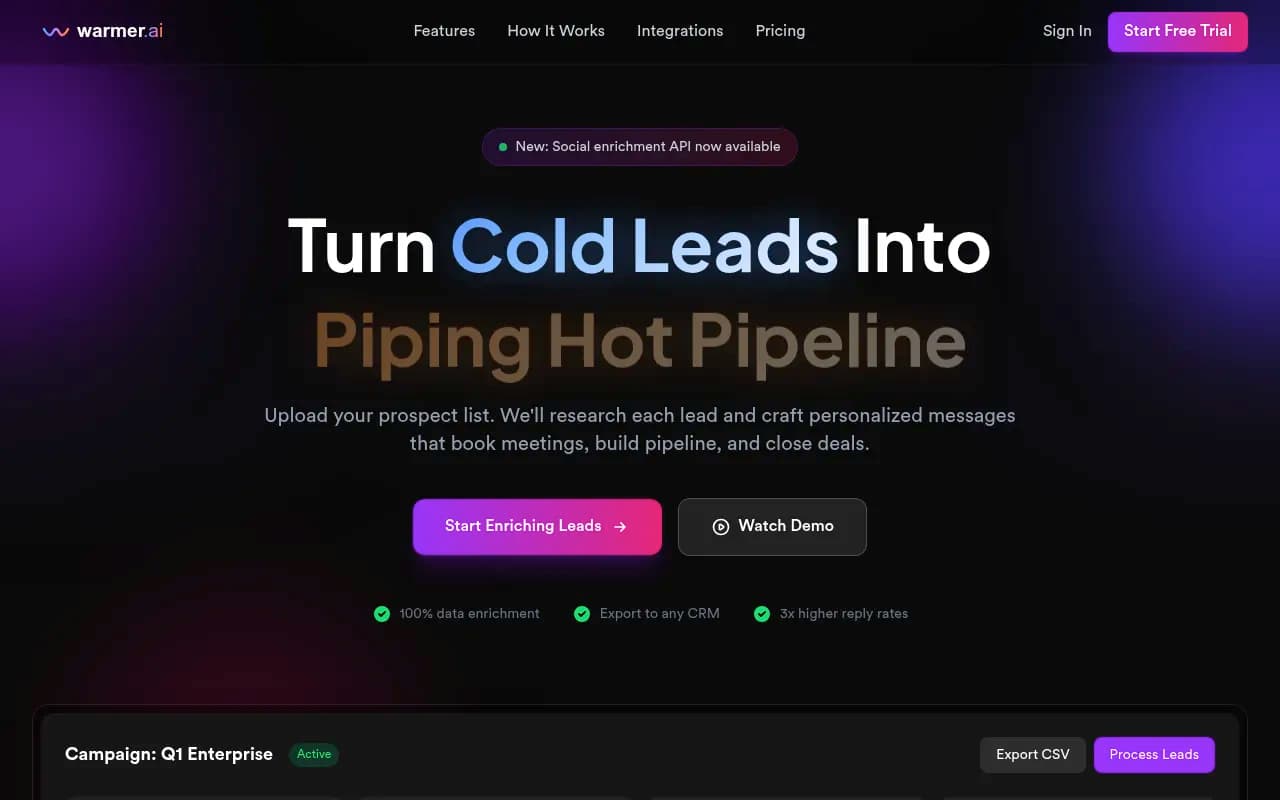
The target audience is pretty clearly outbound-heavy sales teams: SDRs at SaaS companies, growth-stage startups with dedicated sales development functions, and agencies running outbound campaigns for clients. The platform's demo campaign shows nearly 2,900 leads being processed simultaneously, which gives you a sense of the scale it's designed for.
Key features
CSV upload and bulk processing
The workflow starts with a CSV upload. You drop in a list with basic fields -- name, company, maybe a LinkedIn URL or email -- and Warmer takes it from there. The platform processes leads in batches, scraping social and company data automatically. The dashboard shows enrichment status per lead (complete, processing, failed), and you can export results at any point. This is genuinely useful for teams running high-volume outbound who don't want to babysit an enrichment job.
Social data scraping
Warmer pulls data from LinkedIn profiles automatically -- job titles, tenure, recent posts, career history. This is the raw material for personalization. The quality of the output depends heavily on how active and complete a prospect's LinkedIn profile is, which is worth keeping in mind. For senior buyers at tech companies, this tends to work well. For prospects with sparse profiles or in industries where LinkedIn adoption is lower, results will vary.
Company intelligence
Beyond individual profiles, Warmer gathers company-level data: industry, size, recent news, funding events, and growth signals. The example on the site shows a message referencing a Series B announcement and planned headcount growth -- that kind of specificity is what separates a good cold email from a template. The company data layer is what makes this feel less like a mail merge and more like actual research.
AI message generation
This is the core output. Warmer uses what it calls a "custom AI sales agent model" to generate personalized messages for each prospect. You can configure the objective (book a meeting, promote a feature, reference a specific event) and the tone. The generated messages incorporate the social and company data scraped in the previous steps. The example shown on the site is genuinely good -- it references a funding round, mentions a podcast launch, and ties it to a relevant value proposition. Whether that quality holds at scale across thousands of varied prospects is harder to verify from the outside.
Email validation and verification
The Professional and Scale plans include email validation, which checks deliverability before you send. This is a practical addition -- bounces hurt sender reputation, and cleaning a list before a campaign is standard hygiene. Having it built into the enrichment workflow rather than requiring a separate tool (like NeverBounce or ZeroBounce) is a small but real convenience.
API access
Available on Professional and Scale plans, the API lets you build Warmer into custom workflows. The site mentions a "Social Enrichment API" as a new addition, which suggests the platform is moving toward being a data layer that other tools can call rather than just a standalone app. For RevOps teams or developers building internal sales tooling, this opens up interesting possibilities -- trigger enrichment when a new lead enters your CRM, for example.
Integrations and export
Warmer integrates with Salesforce, HubSpot, Pipedrive, Outreach, Salesloft, and Zapier -- but the integration model is CSV export, not native sync. You export enriched data as a CSV and import it into your tool of choice. Zapier presumably enables more automated workflows, but the depth of native integration is limited compared to tools like Clay or Apollo that have direct CRM connectors. This is one of the more notable gaps in the current feature set.
Credit-based pricing model
Each lead enrichment consumes one credit. The credit system means you pay per lead processed rather than per seat, which is actually well-suited to outbound sales where volume fluctuates by campaign. The cost per lead drops significantly at higher tiers -- from $0.12 at Growth to $0.02 at Scale -- so the economics improve meaningfully as you grow.
Who is it for
Warmer is a good fit for SDRs and sales development teams at B2B SaaS companies running structured outbound campaigns. Think a 5-15 person sales team at a Series A or B startup, where the SDRs are responsible for sourcing and personalizing outreach but don't have time to manually research 50+ prospects a day. The platform's sweet spot is teams that already have a sequencer (Outreach, Salesloft, or even Apollo sequences) and need better personalization data to feed into it.
Agencies running outbound campaigns for multiple clients are another natural fit, particularly on the Scale plan. The credit model works well for agencies because they can allocate credits per client campaign without paying for unused capacity. The dedicated account manager on Scale is a nice touch for that use case.
Solo founders doing their own outbound or very early-stage teams (pre-SDR hire) might find the Growth plan at $59/month a reasonable way to punch above their weight on personalization without hiring a researcher. The $0.12 per lead cost is manageable for targeted campaigns of a few hundred prospects.
Who shouldn't use this: if you're doing inbound-led sales or primarily working warm leads, Warmer's value proposition doesn't really apply. The tool is built for cold outreach at scale. Teams that need deep CRM integration or want a single platform for prospecting, enrichment, sequencing, and analytics will find Warmer too narrow -- something like Apollo or Clay covers more of that stack, though with different trade-offs on personalization quality.
Integrations and ecosystem
Warmer's integration story is functional but not deep. The platform supports export to CSV, which then gets imported into Salesforce, HubSpot, Pipedrive, Outreach, or Salesloft. Zapier is listed as a supported integration, which in practice means you can automate the export/import loop without doing it manually -- but it's still a data handoff, not a live sync.
The new Social Enrichment API is the most interesting development on the integration front. It means developers can call Warmer's enrichment capabilities programmatically, which opens up use cases like enriching leads automatically when they enter a CRM or triggering personalization as part of a larger workflow. The API is available on Professional and Scale plans.
There's no mention of a browser extension, mobile app, or Slack integration. For a tool that's fundamentally about research and data, a browser extension that could enrich a LinkedIn profile on the fly would be a natural addition -- but it doesn't appear to exist yet.
Pricing and value
Warmer uses a credit-based model with three tiers:
- Growth: $59/month (or $590/year), 500 credits, ~$0.12 per lead. Includes LinkedIn scraping, company enrichment, AI personalization, and CSV export. No email validation or API access.
- Professional: $119/month (or $1,190/year), 2,500 credits, ~$0.05 per lead. Adds email validation, API access, and priority processing.
- Scale: $249/month (or $2,490/year), 10,000 credits, ~$0.02 per lead. Adds priority support, custom API limits, and a dedicated account manager.
Annual billing saves roughly 17% across all tiers. There's a free trial with no credit card required, which is a low-friction way to test the output quality before committing.
For context, competitors like Clay charge on a similar credit model but with more complex pricing tiers and a broader feature set (Clay is more of a data orchestration platform). Apollo includes enrichment as part of its broader prospecting suite, starting around $49/month per user. Warmer's pricing is competitive for what it does, particularly at the Scale tier where $0.02 per lead is genuinely cheap for AI-generated personalization.
The value question really comes down to whether the personalization quality justifies the cost over simpler alternatives. If your SDRs are currently spending 4+ hours a day on manual research (as the site claims is typical), even the Professional plan pays for itself quickly in recovered time.
Strengths and limitations
What it does well:
- The enrichment workflow is genuinely streamlined. Upload a CSV, get back enriched data and personalized messages -- the friction is low and the output is fast.
- The credit model is well-suited to outbound sales, where campaign volume varies and you don't want to pay for unused capacity.
- Company intelligence (funding, headcount, news) combined with individual LinkedIn data produces personalization that's meaningfully better than first-name-plus-company-name templates.
- The cost per lead at scale ($0.02 on the Scale plan) is competitive with manual research costs and cheaper than most alternatives at that volume.
Honest limitations:
- No native CRM sync. The CSV export model works, but it's a manual step that breaks automation for teams that want a fully connected stack. Clay, for example, has direct Salesforce and HubSpot connectors.
- Personalization quality depends on data availability. Prospects with thin LinkedIn profiles or companies with limited public information will produce weaker outputs. There's no way to know before you run a batch how many leads will come back with strong personalization.
- The platform is narrow by design -- it's an enrichment and personalization tool, not a full sales engagement platform. Teams looking for prospecting, sequencing, and analytics in one place will need to combine Warmer with other tools, which adds cost and complexity.
- Self-reported metrics (87% higher response rates, 4.2x more meetings) are hard to verify and likely reflect best-case results from motivated users.
Bottom line
Warmer.ai is a focused, well-priced tool for outbound sales teams that want to personalize cold outreach at scale without burning SDR hours on manual research. It does one thing -- enrich leads and generate personalized messages -- and does it cleanly. The credit model is honest and scales well, and the API addition makes it increasingly useful as a data layer in larger sales stacks.
Best use case: an SDR team at a B2B SaaS company running structured outbound campaigns who needs to personalize 500-10,000 emails per month without hiring a team of researchers to do it manually.
Tags:
Frequently asked questions
What is Warmer.ai and what does it do?
How much does Warmer.ai cost?
What does a 'credit' get you in Warmer.ai?
Does Warmer.ai integrate directly with Salesforce or HubSpot?
Who is Warmer.ai best suited for?
How does Warmer.ai compare to tools like Clay or Apollo?
Similar and alternative tools to Warmer.ai