Pendo Review 2026
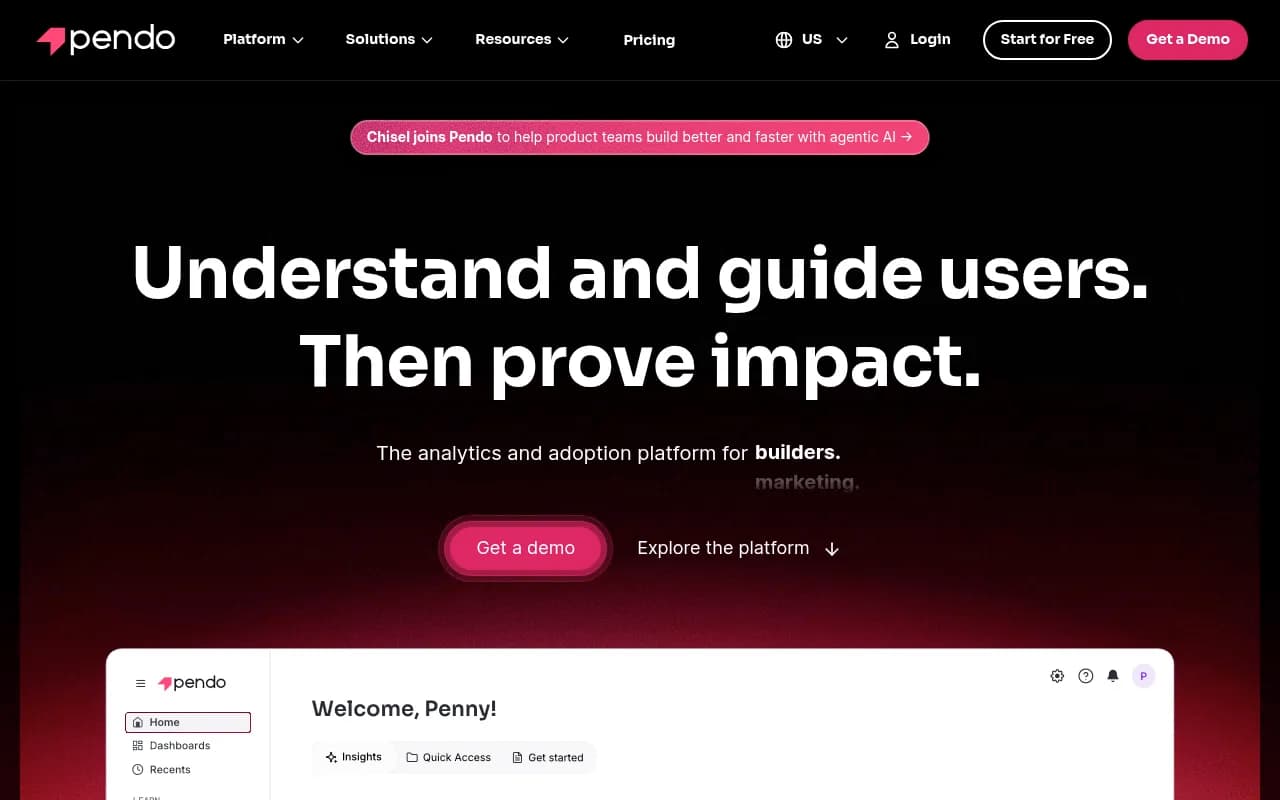
Pendo is an AI-powered product experience platform that helps SaaS companies understand user behavior, guide adoption with in-app messaging, predict churn, and measure AI agent performance. Used by 14,000+ teams including Okta, Salesforce, and United Airlines, it combines analytics, session replay,
Key Takeaways:
- Comprehensive product experience platform combining analytics, in-app guides, session replay, churn prediction, and AI agent tracking in one system
- Built on 35 trillion behavioral events from 1B+ users across 50K+ apps and agents -- the largest product data set in the industry
- Strong for mid-market to enterprise SaaS companies (14,000+ customers including Okta, Salesforce, United Airlines)
- Pricing is usage-based (MAU tiers + feature bundles) with five plans: Free, Base, Core, Pulse, Ultimate -- specific pricing requires demo
- Limitations: can be expensive at scale, learning curve for advanced features, overkill for early-stage startups
Pendo is a product experience and analytics platform built for SaaS companies that need to understand how users interact with their software, guide them to value, and prove the impact of product decisions. Founded in 2013 and headquartered in Raleigh, North Carolina, Pendo has become the go-to platform for mid-market and enterprise product teams managing complex digital portfolios. The company recently acquired Chisel Labs to add agentic AI capabilities for product planning and roadmapping. With over $356M in funding and a valuation north of $2.6B, Pendo serves 14,000+ customers including household names like Okta, Salesforce, Thomson Reuters, Labcorp, and United Airlines.
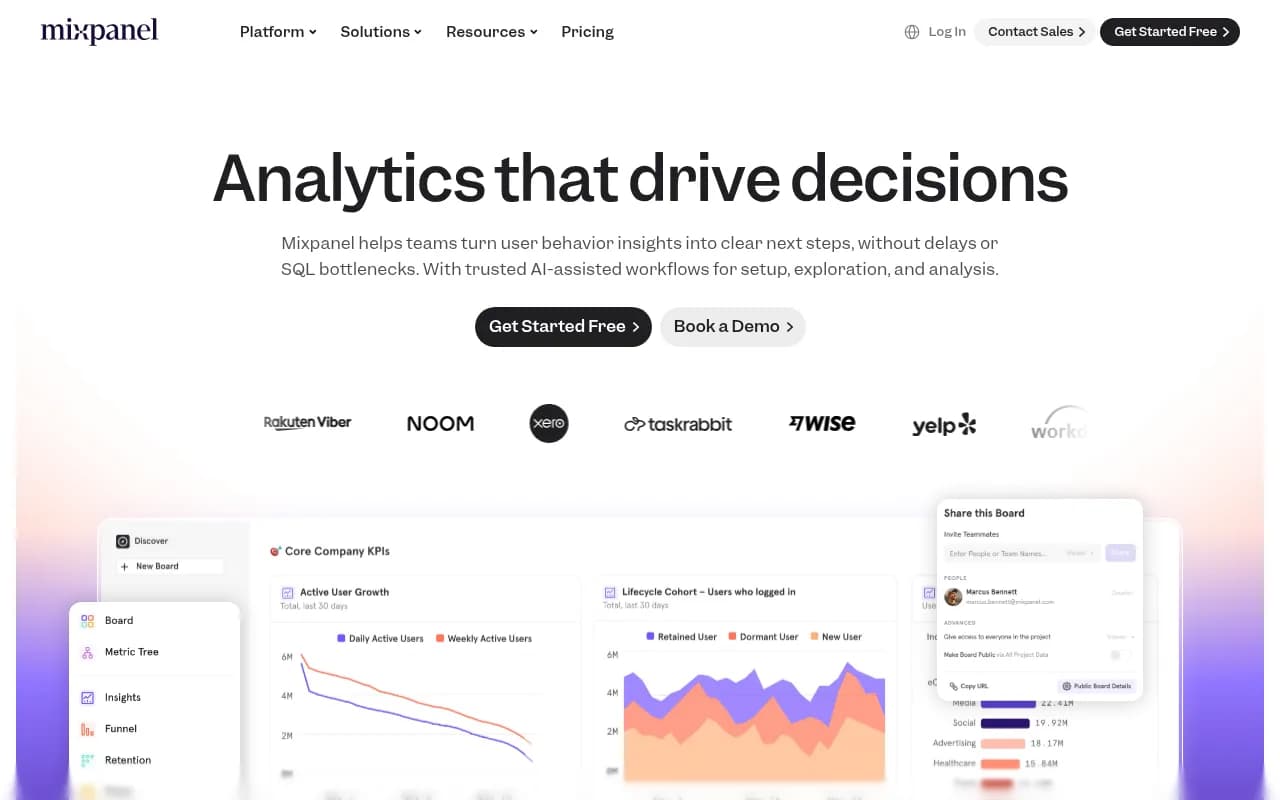
The platform's core promise is simple: understand what users actually do, guide them where they need help, then prove the business impact. Unlike point solutions that only track analytics or only deliver in-app messaging, Pendo unifies the entire product experience stack -- from behavioral data collection to user guidance to predictive churn modeling to AI agent performance tracking. This end-to-end approach is what sets it apart in a crowded market of product analytics tools (Amplitude, Mixpanel, Heap) and user onboarding platforms (Appcues, Userpilot, Chameleon).
Product Analytics: Codeless Tracking at Enterprise Scale
Pendo's analytics engine is built around automatic event capture -- no manual tagging required. Install a single JavaScript snippet and Pendo starts tracking every click, page view, and feature interaction across your web or mobile app. You can retroactively analyze behavior without waiting for instrumentation, which is a massive advantage over tools like Mixpanel that require upfront event planning. The platform auto-generates feature usage reports, user journey funnels, retention cohorts, and path analysis visualizations. Product managers can segment users by account properties (company size, plan tier, industry), behavioral attributes (power users vs. casual visitors), or custom metadata synced from your CRM or data warehouse. The no-code tagging interface lets non-technical teams define features, pages, and track groups by clicking elements in the UI -- no developer handoff needed. For teams managing multiple products, Pendo supports cross-app analytics with unified dashboards that roll up usage across your entire portfolio. The downside: while auto-capture is convenient, it can lead to noisy data if you don't curate your feature taxonomy carefully. Competitors like Amplitude offer more granular event modeling for teams that want precise control.
In-App Guides: Contextual User Assistance Without Engineering
Pendo Guides is the platform's in-app messaging layer -- think tooltips, modals, slideouts, banners, and multi-step walkthroughs that appear inside your product to onboard new users, announce features, or drive adoption of underused capabilities. The visual designer is drag-and-drop: you select a target element in your app, choose a guide style (lightbox, tooltip, banner), write your message, and publish. No code changes required. Guides can be triggered by user behavior (e.g. show a tooltip when someone hovers over a button for the first time), account attributes (e.g. only show to enterprise customers), or time-based rules (e.g. 3 days after signup). You can A/B test guide variations, track completion rates, and measure downstream impact on feature adoption or conversion. Pendo also supports multi-step onboarding flows with branching logic -- if a user skips step 2, show them an alternative path. The platform includes a Resource Center widget (a persistent help menu anchored to your app's UI) where users can browse guides, watch videos, or search help docs on demand. Compared to competitors like Appcues or Chameleon, Pendo's guide builder is less design-flexible (fewer customization options for styling) but more tightly integrated with analytics -- you can see exactly which users engaged with a guide and how their behavior changed afterward.
Session Replay: Watch User Experiences Unfold
Session Replay captures pixel-perfect recordings of user sessions so you can see exactly what happened when something went wrong or when a user got stuck. Unlike traditional session replay tools (FullStory, LogRocket, Hotjar) that record everything indiscriminately, Pendo's replay is privacy-first: it automatically masks sensitive data (credit card fields, passwords, PII) and lets you configure additional redaction rules. Replays are indexed by user properties and behavioral events, so you can filter to specific cohorts (e.g. "show me sessions where users abandoned the checkout flow") or jump directly to moments of interest (e.g. rage clicks, error messages, form submissions). The integration with Pendo Analytics is seamless -- click any data point in a funnel or retention chart and instantly pull up session replays for those users. This is invaluable for debugging UX issues, validating product hypotheses, or understanding why a feature isn't being adopted. The limitation: session replay storage is capped based on your plan tier, and replays expire after a retention window (typically 30-90 days depending on pricing). For teams that need long-term replay archives, dedicated tools like FullStory may be a better fit.
Pendo Predict: AI-Powered Churn and Expansion Forecasting
Pendo Predict uses machine learning to identify which accounts are at risk of churning and which are primed for upsell or expansion. The model analyzes product usage patterns, engagement trends, sentiment scores (from NPS surveys), and support ticket volume to generate risk scores for each account. You get a prioritized list of at-risk customers with specific reasons why they're flagged (e.g. "login frequency dropped 40% in the last 30 days" or "NPS score declined from 8 to 3"). Customer success teams can use these insights to intervene proactively -- reach out before the renewal conversation turns sour. On the flip side, Predict surfaces expansion opportunities by identifying power users, high-engagement accounts, or customers using features typically associated with higher-tier plans. The predictions update daily and can be synced to your CRM (Salesforce, HubSpot) or customer success platform (Gainsight, ChurnZero) via Pendo's Data Sync integrations. The catch: Predict requires a meaningful volume of historical data to train the models -- if you're a new Pendo customer or have a small user base, the predictions won't be reliable for several months. Competitors like Gainsight offer more mature churn prediction with deeper CS workflow integrations, but Pendo's advantage is the tight coupling with product usage data.
Agent Analytics: Measure AI Adoption and Impact
With the rise of AI agents embedded in SaaS products (chatbots, copilots, recommendation engines), Pendo introduced Agent Analytics to track how users interact with these AI-powered features. You can measure agent invocation rates (how often users trigger the AI), completion rates (how often they follow through on AI suggestions), and downstream outcomes (did the AI interaction lead to a conversion, feature adoption, or support ticket deflection?). This is critical for product teams building AI features who need to prove ROI and iterate based on real usage data. Pendo's Agent Analytics works the same way as its standard product analytics -- codeless tracking, segmentation by user cohort, funnel analysis -- but with AI-specific metrics like prompt volume, response quality ratings, and fallback rates (when the AI couldn't help and escalated to a human). The platform also supports tracking multiple agents across your product portfolio, so you can compare performance of different AI features or models. As of early 2026, this is still a relatively new capability and Pendo is one of the few product platforms explicitly addressing AI agent measurement. Competitors like Amplitude and Mixpanel are starting to add AI tracking, but Pendo's head start gives it an edge for teams heavily investing in AI-powered product experiences.
Listen: Turn User Feedback Into Product Insights
Pendo Listen aggregates qualitative feedback from multiple sources -- in-app NPS surveys, CSAT polls, feature request forms, support tickets, and even external channels like G2 reviews or Slack community threads. The platform uses natural language processing to categorize feedback by theme (e.g. "pricing complaints," "mobile app bugs," "feature requests for reporting"), sentiment (positive, neutral, negative), and associated product area. You can see which features are generating the most complaints, which user segments are happiest, and how sentiment trends over time. Listen also surfaces verbatim quotes and links feedback to specific users or accounts, so you can follow up directly or prioritize fixes based on customer value. The integration with Pendo Analytics means you can correlate feedback with behavior -- for example, users who gave low NPS scores also had 50% lower feature adoption in the last 30 days. This closed-loop feedback system helps product teams validate hypotheses and prioritize roadmap items based on both quantitative usage data and qualitative user voice. The limitation: Listen is only available on higher-tier plans (Pulse and Ultimate), so smaller teams may need to rely on standalone feedback tools like Canny or Productboard.
Orchestrate: Multi-Channel User Engagement
Orchestrate extends Pendo's in-app guides to other channels -- email, Slack, Microsoft Teams, push notifications. You can design multi-step campaigns that start in-app (e.g. a tooltip introducing a new feature) and follow up via email if the user doesn't engage within 3 days. Or trigger a Slack message to a customer success rep when a high-value account hits a specific usage milestone. Orchestrate uses the same visual workflow builder as Pendo Guides, with drag-and-drop logic for branching, delays, and conditional triggers. The platform integrates with email providers (SendGrid, Mailgun), messaging tools (Slack, Teams), and mobile push services (OneSignal, Airship) via pre-built connectors. This is useful for product-led growth teams that want to coordinate onboarding and activation across multiple touchpoints without stitching together separate tools. The catch: Orchestrate is a premium add-on (not included in base plans) and requires additional setup to connect external channels. For teams already using marketing automation platforms like Marketo or HubSpot, there may be overlap in functionality.
Data Sync: Break Down Silos
Pendo Data Sync is a two-way integration layer that connects Pendo to your data warehouse (Snowflake, BigQuery, Redshift), CRM (Salesforce, HubSpot), customer success platform (Gainsight, Totango), or business intelligence tool (Looker, Tableau). You can push Pendo usage data, guide engagement metrics, and churn predictions into your CRM to enrich account records, or pull external data (customer health scores, contract values, support ticket counts) into Pendo to create more granular user segments. This eliminates the need for manual CSV exports or custom API scripts. Data Sync also supports real-time event streaming via webhooks, so you can trigger workflows in other systems based on Pendo events (e.g. send a Slack alert when a VIP user completes onboarding). The platform includes pre-built connectors for 50+ tools and a REST API for custom integrations. For enterprise teams with complex data ecosystems, Data Sync is essential for making Pendo the single source of truth for product usage data. The limitation: advanced data sync features (real-time streaming, warehouse integrations) are only available on higher-tier plans.
Integrations & Ecosystem
Pendo integrates with 50+ tools across analytics (Google Analytics, Segment, mParticle), CRM (Salesforce, HubSpot, Pipedrive), customer success (Gainsight, ChurnZero, Totango), support (Zendesk, Intercom, Freshdesk), collaboration (Slack, Microsoft Teams, Jira), and data infrastructure (Snowflake, BigQuery, Redshift, Looker). The platform also offers a REST API, JavaScript SDK, and mobile SDKs (iOS, Android, React Native, Flutter) for custom integrations and advanced use cases. Pendo supports single sign-on (SSO) via SAML and SCIM for user provisioning. There's no browser extension, but the platform is fully web-based with mobile apps for iOS and Android that let you view dashboards and manage guides on the go. For developers, Pendo provides a Model Context Protocol (MCP) integration that connects Pendo data to AI tools like Claude, Cursor, or ChatGPT -- you can query product usage data in natural language directly from your IDE or chat interface.
Who Is Pendo For?
Pendo is built for mid-market to enterprise SaaS companies with 50+ employees and multiple products or a complex user base. The sweet spot is B2B software companies with 1,000-100,000+ monthly active users, annual contracts, and a product-led growth or customer success motion. Typical users include product managers tracking feature adoption, customer success teams monitoring account health, marketing teams running in-app campaigns, and IT teams managing internal software rollouts. Pendo is particularly strong for companies with multiple products or a digital portfolio (e.g. a suite of apps for different user roles) because it supports cross-app analytics and unified dashboards. It's also a good fit for companies investing heavily in AI-powered features who need to measure agent performance and ROI. Industries where Pendo shines: SaaS, financial services, healthcare, education, and enterprise software.
Who should NOT use Pendo: early-stage startups with fewer than 1,000 MAUs (the pricing doesn't make sense at that scale), consumer apps with millions of users (Pendo is optimized for B2B, not B2C), or teams that need highly customizable event tracking and advanced data modeling (Amplitude or Mixpanel are better for that). If you're a solo founder or small team looking for lightweight product analytics, tools like PostHog, Hotjar, or Userpilot are more appropriate.
Pricing & Value
Pendo uses usage-based pricing with two variables: Monthly Active Users (MAUs) and feature bundles. There are five plans: Free (up to 500 MAUs, basic analytics and guides, no session replay or advanced features), Base (starts around $7,000-$10,000/year for 1,000-5,000 MAUs, adds session replay and data export), Core (starts around $20,000-$30,000/year, adds advanced segmentation, multi-app support, and integrations), Pulse (starts around $50,000+/year, adds Predict, Listen, and Orchestrate), and Ultimate (custom pricing for enterprise, adds dedicated support, custom data retention, and advanced security features). Exact pricing is not published -- you need to request a quote based on your MAU volume and feature requirements. Annual contracts are standard, with discounts for multi-year commitments. There's a free trial available (14-30 days depending on plan tier).
How does this compare to competitors? Pendo is more expensive than lightweight alternatives like Appcues ($249-$879/month for similar MAU tiers) or Userpilot ($249-$749/month), but cheaper than enterprise-grade platforms like Gainsight (which can run $100K+/year for large deployments). Compared to pure analytics tools, Pendo is pricier than Mixpanel or Amplitude at equivalent MAU volumes, but you're paying for the integrated guide builder, session replay, and churn prediction -- not just analytics. For mid-market SaaS companies with 5,000-20,000 MAUs, expect to pay $20K-$50K/year for a Core or Pulse plan. For enterprise deployments with 50K+ MAUs and multiple products, budgets typically start at $100K+/year.
Is it good value? If you're replacing 3-4 point solutions (analytics tool + onboarding platform + session replay + feedback management), Pendo's all-in-one pricing can be cost-effective. The ROI case studies are compelling: LastPass drove $500K in new bookings using Pendo Guides, Osmosis increased free-to-paid conversions by 35%, MineralTree saw 75-100% traffic increases to key features. But if you only need basic analytics or simple in-app messaging, Pendo is overkill and you'll pay for features you don't use.
Strengths
- All-in-one platform: Analytics, guides, session replay, churn prediction, feedback management, and AI agent tracking in one system -- no need to stitch together multiple tools
- Codeless implementation: Non-technical teams can tag features, build guides, and analyze data without developer support
- Enterprise-grade scale and security: SOC 2 Type 2, GDPR, HIPAA, PCI DSS compliant; handles billions of events across 14,000+ customers
- Largest product data set: 35 trillion events from 1B+ users powers AI-driven insights and benchmarking
- Strong integrations: 50+ pre-built connectors to CRM, CS, support, and data infrastructure tools
Limitations
- Expensive at scale: Pricing can balloon quickly as MAUs grow; not cost-effective for early-stage startups or high-volume consumer apps
- Learning curve: The platform is feature-rich, which means it takes time to master advanced capabilities like segmentation, guide orchestration, and predictive analytics
- Less flexible than point solutions: The guide builder is less customizable than Appcues or Chameleon; the analytics engine is less granular than Amplitude or Mixpanel
- Predict requires data maturity: Churn prediction models need months of historical data to be accurate; not useful for new customers
Bottom Line
Pendo is the best choice for mid-market to enterprise B2B SaaS companies that want an end-to-end product experience platform and are willing to pay for it. If you're managing multiple products, need to prove ROI on product investments, or are building AI-powered features that require measurement, Pendo delivers. The all-in-one approach eliminates tool sprawl and gives product, CS, and marketing teams a shared source of truth for user behavior. But if you're an early-stage startup, need highly customizable analytics, or only want basic in-app messaging, lighter-weight alternatives like PostHog, Userpilot, or Appcues will serve you better at a fraction of the cost. Best use case in one sentence: B2B SaaS companies with 5,000+ MAUs and a product-led growth motion who need to understand usage, guide adoption, and predict churn in one unified platform.
Tags:
Frequently asked questions
What is Pendo and what does it do?
How much does Pendo cost?
Does Pendo offer a free plan?
Who is Pendo best suited for?
What are the main features of Pendo?
How does Pendo compare to Amplitude and Mixpanel?
What are the limitations of using Pendo?
Similar and alternative tools to Pendo