QuestionDB Review 2026
QuestionDB helps content creators and SEO professionals discover low-competition keywords by analyzing real questions from Google SERP, People Also Ask, Reddit, and Quora. Get keyword difficulty scores, search volume data, and CPC metrics to build content strategies around what your audience actuall
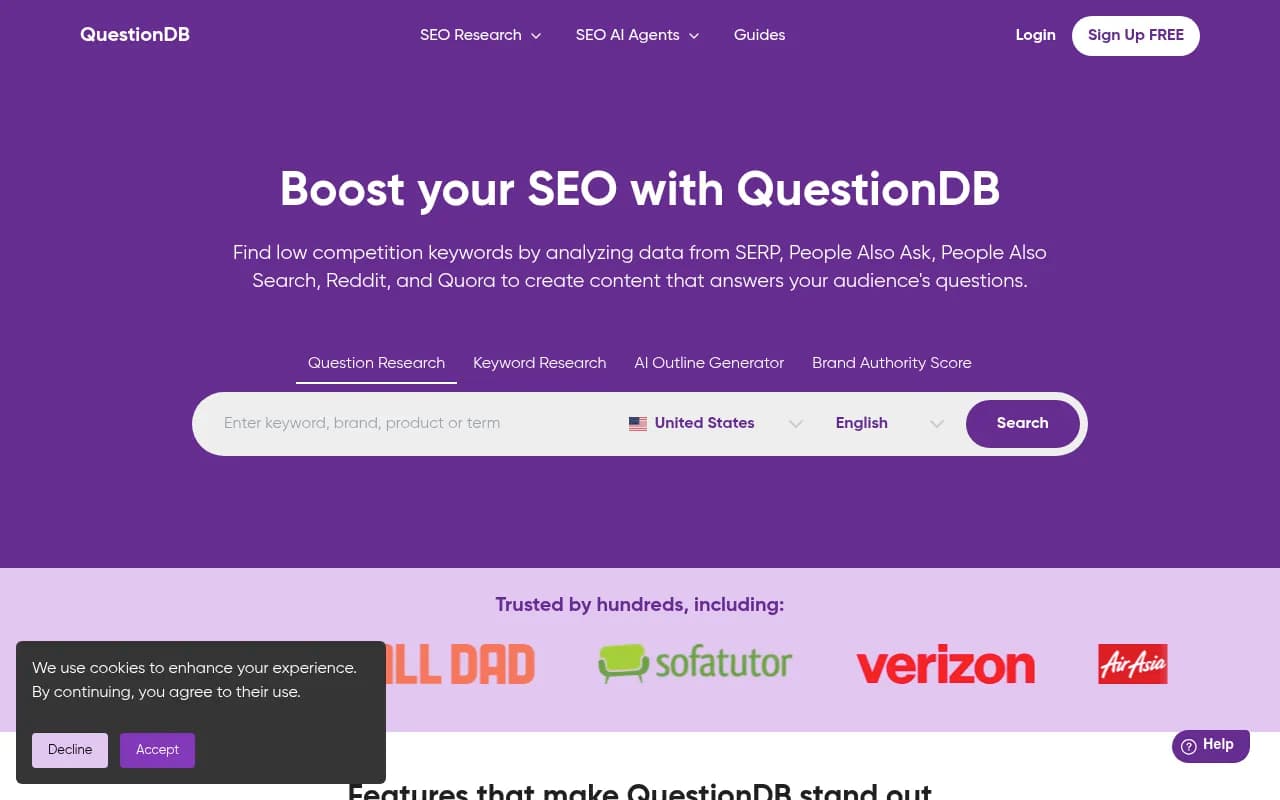
QuestionDB is a question-based keyword research tool built for content creators, SEO professionals, and digital marketers who want to understand what their audience is actually asking. Instead of starting with seed keywords and hoping for the best, QuestionDB surfaces real questions people type into Google, post on Reddit, and ask on Quora -- then gives you the data to decide which ones are worth targeting. It's used by brands like ClickUp, Verizon, Intuit, and SurfShark, plus hundreds of solo marketers and agencies building content strategies around search intent.
Summary: Key Takeaways
• Question-first approach: Pulls real questions from Google SERP, People Also Ask (PAA), People Also Search (PAS), Reddit, and Quora -- not just keyword variations • Low-competition focus: Shows keyword difficulty, competition level, CPC, and search volume so you can find winnable terms instead of chasing saturated keywords • Affordable entry point: Free plan with 5 searches/month, paid plans start at $9.99/mo for 100 searches -- significantly cheaper than Ahrefs or Semrush • Limited to questions: Not a full keyword research suite -- no backlink analysis, rank tracking, or site audits. Best used alongside traditional SEO tools. • Reddit/Quora integration: One of the few tools that surfaces forum discussions directly, which matters as Reddit increasingly dominates SERPs in 2026
What QuestionDB Actually Does
QuestionDB is a specialized keyword research tool that focuses exclusively on questions. You enter a topic (e.g. "email marketing"), select a country and language, and it returns hundreds of questions people have asked about that topic across multiple sources. The core insight: if you can find questions with decent search volume but low competition, you can create content that ranks without fighting established authority sites.
The tool aggregates data from five main sources: Google's search results (including featured snippets), People Also Ask boxes, People Also Search suggestions, Reddit threads, and Quora discussions. This multi-source approach gives you a fuller picture of what people want to know -- not just what shows up in traditional keyword tools.
For each question, you get four key metrics: Search Volume (monthly searches), Keyword Difficulty (0-100 scale), Competition Level (low/medium/high), and CPC (cost per click for paid ads). These metrics help you prioritize which questions to target. A question with 500 monthly searches, difficulty score of 25, and low competition is a much better target than a 10,000-volume keyword with difficulty 80.
AI Keyword Extractor is a newer feature that analyzes any webpage or content and pulls out the keywords AI models and LLMs would associate with it. This is useful for understanding how search engines and AI assistants categorize content -- and for finding gaps in your existing pages.
CSV and Image Export (paid plans only) lets you export question lists and keyword data for client reports or content briefs. You can also export visual charts showing question clusters and keyword distributions.
Multi-language and Multi-region Support: Search in any language and target specific countries. Useful for international SEO or localized content strategies. The interface supports English, but you can research questions in Spanish, German, French, etc.
Question Clustering: Results are grouped by theme and subtopic, making it easier to spot content gaps. For example, a search for "project management" might cluster questions into categories like "tools", "methodologies", "team collaboration", and "remote work". This helps you structure pillar content and topic clusters.
Reddit and Quora Integration: Unlike most keyword tools that ignore forums, QuestionDB surfaces actual Reddit threads and Quora posts where people are discussing your topic. This is increasingly valuable in 2026 as Google prioritizes forum content in search results. You can see the exact phrasing people use, the context around their questions, and related discussions -- all of which inform better content.
AI Outline & Meta Generator (mentioned on the site but details are sparse): Appears to help generate content outlines and meta descriptions based on the questions you've researched. This bridges the gap between research and content creation.
AI Content Analysis: Analyze existing content to see how well it covers the questions your audience is asking. Useful for content audits and identifying pages that need updates.
SEO Performance Tracking: Some level of performance monitoring is mentioned, though the tool doesn't appear to offer full rank tracking like Ahrefs or Semrush. More likely it's tracking how well your content aligns with question-based search intent.
Who QuestionDB Is For
QuestionDB is built for three main user types:
Solo content creators and bloggers who need affordable keyword research and don't have budget for enterprise tools. If you're running a niche site, affiliate blog, or personal brand, the $9.99/mo Solo plan gives you 100 searches -- enough to plan a month's worth of content. The free plan (5 searches/month) is genuinely useful for testing topics before committing.
SEO agencies and consultants managing multiple clients. The Business plan ($29.99/mo, 400 searches) or Enterprise plan ($69.99/mo, 1000 searches) provide enough volume to research 10-20 client sites per month. The CSV export feature is essential here for building content briefs and client reports. Several testimonials mention using QuestionDB as the first step in content planning -- it's faster than manually scraping PAA boxes or scrolling through Reddit.
In-house marketing teams at SaaS companies, e-commerce brands, and B2B businesses who want to create content that matches search intent. Brands like ClickUp and Intuit use it, likely for blog content, help center articles, and landing page optimization. The Reddit/Quora data is particularly valuable for understanding customer pain points in their own words.
QuestionDB is NOT for: Enterprise SEO teams that need comprehensive rank tracking, backlink analysis, technical audits, and competitive intelligence. It's a research tool, not a full SEO platform. You'll still need Ahrefs, Semrush, or similar for link building, site health monitoring, and rank tracking. It's also not ideal if you're targeting very broad, high-volume keywords -- the tool shines when you're looking for long-tail, question-based opportunities.
Integrations & Ecosystem
QuestionDB is a standalone web app with no native integrations. You export data via CSV and manually import it into your content management workflow (Google Sheets, Notion, Airtable, etc.). There's no API mentioned, no Zapier integration, no browser extension. This keeps the tool simple but means it doesn't fit into automated workflows.
The export functionality (paid plans only) is straightforward: download question lists with all metrics included, or export visual charts as images for presentations and reports.
Pricing & Value
QuestionDB uses a straightforward monthly subscription model:
Free Plan: 5 searches per month. No credit card required. Good for testing the tool or very light usage. You get access to questions but not keyword metrics (search volume, difficulty, CPC).
Solo Plan: $9.99/month, 100 searches. Includes all keyword metrics (search volume, difficulty, CPC, competition level) plus CSV and image export. Best for individual bloggers, freelance writers, or small site owners.
Business Plan: $29.99/month, 400 searches. Same features as Solo, just higher volume. Aimed at agencies managing 5-10 clients or in-house teams with multiple content creators.
Enterprise Plan: $69.99/month, 1,000 searches. For larger agencies or brands with high content output. Still significantly cheaper than Ahrefs ($129/mo) or Semrush ($139.95/mo).
No annual billing discount is mentioned. All paid plans include the same features -- you're just paying for more searches.
Value assessment: QuestionDB is extremely affordable compared to traditional SEO tools. Ahrefs and Semrush cost $129-$140/month for their cheapest plans and include far more features (rank tracking, backlinks, site audits), but if you only need question-based keyword research, you're paying for a lot you won't use. QuestionDB's $9.99 Solo plan is a better fit for solo creators. For agencies, the $29.99 Business plan is still cheaper than one Ahrefs seat.
The main limitation: you can't buy more searches mid-month. If you hit your limit, you wait until next billing cycle or upgrade. For agencies with unpredictable workloads, this could be frustrating.
Strengths
• Laser focus on questions: Most keyword tools bury question keywords in long lists. QuestionDB surfaces them first, which is exactly what you need for content that matches search intent. • Reddit and Quora data: Few tools pull forum discussions directly. With Reddit dominating SERPs in 2026, this is a genuine competitive advantage. • Affordable for solo users: $9.99/mo is accessible for bloggers and freelancers who can't justify $100+/mo for Ahrefs. • No credit card for free plan: You can actually test the tool without payment info, which lowers the barrier to entry. • Clean, simple interface: No learning curve. Enter a topic, get questions. The UI is fast and doesn't overwhelm you with data.
Limitations
• Not a full SEO platform: No rank tracking, no backlink analysis, no site audits, no competitor research beyond questions. You'll need another tool for those. • Search limits can be restrictive: 100 searches/month sounds like a lot until you're researching 10 different topics with multiple angles. Agencies will hit the limit quickly. • No API or integrations: Everything is manual export. If you want to automate workflows or pull data into other tools, you're out of luck. • Limited keyword metrics: You get difficulty, volume, CPC, and competition level, but not SERP features, click-through rate estimates, or seasonal trends. Tools like Ahrefs provide much richer keyword data.
Bottom Line
QuestionDB is a specialized, affordable keyword research tool for anyone building content around what people actually ask. It's best for solo creators, small agencies, and in-house teams who want to find low-competition question keywords without paying for a full SEO suite. The Reddit and Quora integration is particularly valuable in 2026 as forum content dominates search results. However, it's not a replacement for Ahrefs or Semrush -- it's a complementary tool you use at the research stage, then export the data and move to your main SEO platform for execution and tracking. If your content strategy is built around answering audience questions (and it should be), QuestionDB is worth the $9.99/month.
Tags:
Similar and alternative tools to QuestionDB