Rio SEO Review 2026
Rio SEO is a Local Experience (LX) platform designed for enterprise brands with multiple locations. It combines local SEO, listing management, reputation monitoring, and customer feedback tools in one integrated suite. Manage business listings across Google, Bing, Yelp, and 100+ directories, optimiz
Key Takeaways:
• Enterprise-focused local marketing platform combining listing management, local SEO, reputation monitoring, and customer feedback in one suite • Best for multi-location brands (retail chains, restaurant groups, healthcare networks, financial services) managing 50+ locations at scale • Strong integration network with Google, Apple Maps, Bing, Yelp, Facebook, and 100+ directories for automated listing distribution • Part of InMoment/Press Ganey Forsta ecosystem, bringing CX capabilities but potentially limiting flexibility for pure local SEO use cases • Enterprise pricing (custom quotes only) -- likely $10K-50K+ annually depending on location count, not suitable for SMBs or agencies with small clients
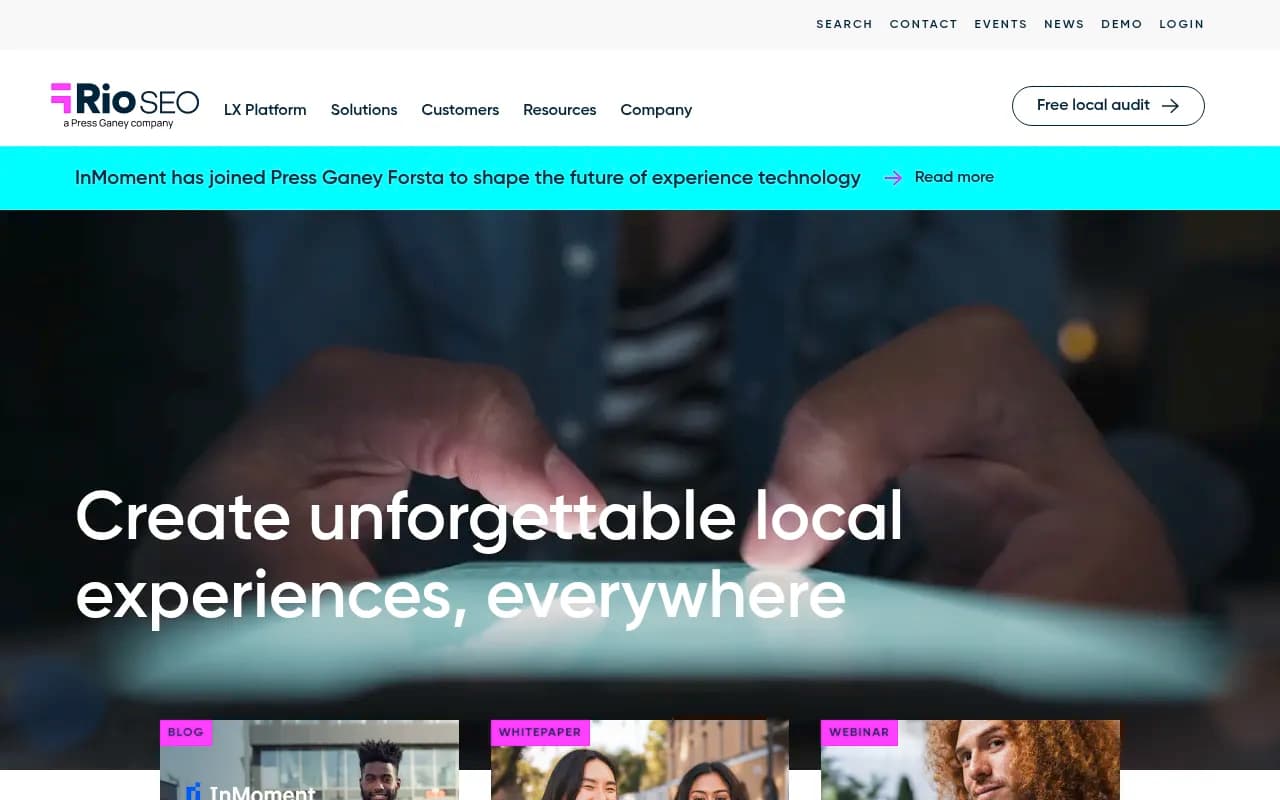
Rio SEO is an enterprise-grade Local Experience (LX) platform built for brands managing dozens or hundreds of physical locations. Originally founded as a local SEO specialist, Rio SEO was acquired by InMoment (a customer experience platform) and is now part of the Press Ganey Forsta family following a 2024 merger. The platform's core mission: help multi-location brands control how they appear in local search, manage their online reputation, and gather customer feedback -- all from a centralized dashboard designed for enterprise scale and complexity.
The target audience is clear: retail chains, restaurant groups, healthcare networks, financial services firms, automotive dealerships, and hospitality brands operating 50-500+ locations. These are organizations where local marketing is mission-critical but managing listings, reviews, and local pages manually across hundreds of locations is impossible. Rio SEO positions itself as the "first" Local Experience platform -- combining traditional local SEO tools (listings, local pages) with reputation management and Voice of Customer (VoC) surveys in one integrated suite.
Local Listings Management
The core of Rio SEO is automated business listing distribution and management across 100+ directories, search engines, maps apps, social networks, and voice assistants. This includes the major players -- Google Business Profile, Apple Maps, Bing Places, Yelp, Facebook -- plus vertical-specific directories (healthcare directories for medical practices, automotive sites for dealerships, etc.). The platform acts as a single source of truth: update your business information (hours, address, phone, services, photos) once in Rio SEO, and it syncs across the entire network automatically.
Duplicate suppression is a key feature for enterprise brands. When you have 200 store locations, duplicate listings (often created by customers, employees, or third parties) are a constant problem. Rio SEO identifies and suppresses duplicates to ensure only your official, accurate listings appear in search results. Bulk editing lets you update information across all locations at once or segment by region, franchise group, or custom attributes. Location-level permissions allow regional managers or franchisees to manage their own listings within guardrails you set (e.g. they can update hours but not brand messaging).
The platform monitors listing accuracy across the network and alerts you when information drifts out of sync -- critical for brands where incorrect hours or addresses directly cost sales. Integration with Google Business Profile API means near-real-time updates and access to Google-specific features like Posts, Q&A management, and booking buttons.
Local Landing Pages & Store Locators
Rio SEO generates SEO-optimized local landing pages for each location automatically. These aren't generic templates -- the platform pulls in location-specific data (address, hours, services, photos, reviews, nearby landmarks) and structures it for local search intent. Each page is designed to rank for "[service] near me" and "[service] in [city]" queries, driving organic traffic directly to individual store pages rather than forcing users through a generic store locator.
The store locator itself is a customizable, mobile-optimized widget that embeds on your main website. It supports radius search, filter by services/amenities, driving directions, and click-to-call. For brands with complex location hierarchies (e.g. a hospital network with main campuses, urgent care centers, and specialty clinics), you can create custom location types and filter logic.
Local pages include schema markup (LocalBusiness, Organization, Review aggregates) to enhance rich snippets in Google search results. The platform also supports multi-language local pages for brands operating in multiple countries or serving non-English-speaking communities in the US.
Reputation Management & Review Response
Rio SEO aggregates reviews from Google, Facebook, Yelp, and other platforms into a unified inbox. You can monitor review volume, star ratings, sentiment trends, and keyword themes across all locations from a single dashboard. Sentiment analysis (powered by AI) flags negative reviews that need immediate attention and surfaces common complaint themes (e.g. "long wait times" mentioned in 40% of 1-star reviews).
Review response workflows let you assign reviews to location managers, set response SLAs, and track response rates by location or region. The platform includes AI-assisted response suggestions that draft replies based on the review content and your brand voice guidelines -- managers can edit before publishing. For enterprise brands, this is critical: responding to 10,000+ reviews per month manually is impossible, but ignoring reviews hurts local rankings and customer trust.
Review generation tools help you collect more reviews from satisfied customers. After a purchase or service interaction, Rio SEO can trigger email or SMS requests asking customers to leave a review on Google or Facebook. The platform tracks review request volume, response rates, and conversion to actual reviews, so you can optimize timing and messaging.
Integration with InMoment's broader CX platform means you can connect review data with customer surveys, support tickets, and other feedback channels for a 360-degree view of customer sentiment. However, this also means Rio SEO is tightly coupled to the InMoment ecosystem -- if you're using a different CX platform (Qualtrics, Medallia), integration may be limited.
Voice of Customer (VoC) Surveys & Digital Feedback
This is where Rio SEO's InMoment heritage shows. The platform includes survey tools for gathering structured feedback at key moments in the customer journey -- post-purchase, post-visit, post-support interaction. Surveys can be delivered via email, SMS, in-app, or QR codes at physical locations. Question types include NPS, CSAT, CES, multiple choice, open-ended text, and more.
Digital feedback channels capture unsolicited feedback from social media, review sites, and support channels. The platform uses natural language processing to extract themes, sentiment, and actionable insights from unstructured text. For multi-location brands, you can slice feedback by location, region, product line, or customer segment to identify patterns (e.g. "West Coast locations consistently score lower on cleanliness").
Survey data and review data feed into the same analytics dashboards, so you can correlate quantitative scores (NPS, star ratings) with qualitative themes ("staff was rude", "checkout was slow"). This is valuable for brands that want to connect customer experience metrics to operational improvements -- but it's also where Rio SEO starts to feel more like a CX platform than a pure local SEO tool. If your primary goal is ranking in local search, the survey features may be overkill.
Analytics & Reporting
Rio SEO provides dashboards tracking local search visibility, listing accuracy, review metrics, and customer feedback across all locations. Local search performance includes rankings for target keywords ("dentist in Austin"), impressions and clicks from Google Business Profile, and traffic to local landing pages. Listing health scores show what percentage of your listings are accurate, complete, and verified across the network.
Review analytics break down star ratings, review volume, response rates, and sentiment trends by location, region, or time period. You can benchmark individual locations against company averages or competitors. Custom reports can be scheduled and emailed to stakeholders (regional managers, franchisees, executives) with location-specific or rolled-up data.
The platform supports role-based access so corporate teams see enterprise-wide data while regional managers only see their locations. API access is available for enterprise customers who want to pull data into their own BI tools (Tableau, Looker, Power BI).
Integrations & Ecosystem
Rio SEO integrates with 100+ directories and platforms, including:
• Search engines & maps: Google (Business Profile, Maps), Apple Maps, Bing Places, Yahoo Local, MapQuest, Waze • Review sites: Yelp, TripAdvisor, Trustpilot, Better Business Bureau, Angi (formerly Angie's List) • Social networks: Facebook, Instagram (location pages), LinkedIn (company locations) • Voice assistants: Alexa, Siri, Google Assistant (for "near me" queries) • Vertical directories: Healthgrades, Vitals, WebMD (healthcare); Cars.com, Edmunds (automotive); OpenTable, Grubhub (restaurants) • CX platforms: Deep integration with InMoment's survey, case management, and analytics tools
API access is available for custom integrations with POS systems, CRM platforms, marketing automation tools, and data warehouses. However, the platform is not designed for agencies managing multiple clients -- it's built for a single enterprise brand managing its own locations.
Who Is Rio SEO For?
Rio SEO is purpose-built for enterprise brands with 50+ physical locations where local search visibility and reputation management are business-critical. Ideal customers include:
• Retail chains (apparel, grocery, electronics) managing 100-1000+ stores across multiple regions • Restaurant groups (QSR, fast casual, full service) with dozens of locations and franchise models • Healthcare networks (hospitals, urgent care, dental groups) where local search drives patient acquisition • Financial services (banks, credit unions, insurance agencies) with branch networks • Automotive dealerships (OEM dealer networks, multi-location dealer groups) • Hospitality brands (hotel chains, resorts) managing property listings and reviews
These organizations typically have dedicated local marketing or digital marketing teams, often with regional managers or franchisees who need location-level access. They care about local search rankings, review volume and sentiment, and customer feedback -- and they need enterprise-grade tools to manage this at scale.
Who should NOT use Rio SEO:
• Small businesses (1-10 locations) -- the platform is overkill and pricing is prohibitive. Use Yext, BrightLocal, or Moz Local instead. • Digital marketing agencies managing multiple clients -- Rio SEO is not multi-tenant and lacks agency-specific features (white-label reporting, client billing). Use BrightLocal, Semrush Local, or Whitespark. • Brands focused purely on local SEO without interest in CX surveys or VoC -- you're paying for features you won't use. Consider Yext or SOCi for pure local marketing. • Startups or brands with limited budgets -- pricing is enterprise-level (likely $10K-50K+ annually depending on location count).
Pricing & Value
Rio SEO does not publish pricing publicly. Based on industry benchmarks and competitor pricing (Yext, SOCi, Chatmeter), expect:
• Base platform fee: $10,000-$30,000+ annually depending on feature set and location count • Per-location fees: $50-$200 per location per year, with volume discounts at higher tiers • Total cost for 100 locations: Likely $20,000-$50,000+ annually • Total cost for 500 locations: Likely $50,000-$150,000+ annually
Pricing includes listing management, local pages, review monitoring, and basic analytics. Advanced features (AI-powered review response, VoC surveys, API access, custom integrations) may cost extra. Implementation and onboarding fees are typical for enterprise software.
Compared to competitors:
• Yext: Similar pricing model, stronger brand recognition, more integrations, but less focus on CX/VoC • SOCi: Comparable pricing, stronger social media management, less emphasis on surveys • Chatmeter: Often slightly cheaper, strong review management, less robust local page builder • BrightLocal: Much cheaper ($50-$500/mo) but designed for agencies and SMBs, not enterprise scale
Rio SEO's value proposition is the integrated LX platform -- if you want listings, local pages, reviews, and customer surveys in one place (and you're already in the InMoment ecosystem), it's a strong fit. If you only need local SEO tools, you're paying for features you won't use.
Strengths
• Enterprise-grade scale: Built to handle 100-1000+ locations with complex hierarchies, permissions, and workflows • Comprehensive integration network: 100+ directories, search engines, and platforms covered • Unified LX platform: Combines local SEO, reputation management, and customer feedback in one system • Strong local page builder: Automated, SEO-optimized landing pages for each location with schema markup • InMoment CX integration: Deep connection to surveys, case management, and experience analytics for brands already using InMoment
Limitations
• No public pricing: Enterprise sales process with custom quotes -- no transparency for buyers evaluating options • Not designed for agencies: Single-tenant platform, no white-label reporting or multi-client management • Tightly coupled to InMoment: If you're not using InMoment for CX, some features (VoC surveys, feedback analysis) may feel redundant or underutilized • Overkill for SMBs: Small businesses with 1-20 locations will find the platform too complex and expensive • Limited social media management: Focuses on listings and reviews, not social posting or engagement (SOCi is stronger here)
Bottom Line
Rio SEO is a solid choice for enterprise brands with 50+ locations that need an all-in-one platform for local search visibility, reputation management, and customer feedback. It's particularly strong for organizations already using InMoment for customer experience management, as the integration creates a unified view of local marketing and CX data. The platform handles the complexity of managing hundreds of listings, reviews, and local pages at scale -- something manual processes or SMB tools can't match.
However, it's not the right fit for small businesses, agencies, or brands that only need local SEO tools without the CX/survey layer. Pricing is enterprise-level (likely $20K-$100K+ annually depending on location count), and the sales process requires custom quotes and demos. If you're a multi-location brand evaluating local marketing platforms, Rio SEO belongs on your shortlist alongside Yext, SOCi, and Chatmeter -- but expect to pay for the integrated LX platform whether you use all the features or not.
Best use case in one sentence: Enterprise retail, healthcare, or hospitality brands managing 100+ locations that want local SEO, reputation management, and customer feedback in a single platform.
Tags:
Similar and alternative tools to Rio SEO