Uneed Review 2026
Product launch platform offering guaranteed homepage visibility, high-authority backlinks (DR 72), and community feedback for tech launches.
Key Takeaways:
- Guaranteed visibility: Every product gets homepage placement, not just top vote-getters -- no lottery system
- Powerful SEO boost: Automatic DR 72 backlink from a high-authority domain helps new products rank faster
- Active maker community: 43,000+ members provide real feedback, not just upvotes
- Competitive but fair: Daily top 3 win badges; weekly/monthly/yearly winners get newsletter features
- Affordable launch option: Public review at $287, full package at $699 -- cheaper than most launch platforms
Uneed is a product launch platform designed specifically for indie makers, SaaS founders, and tech entrepreneurs who want guaranteed visibility without the unpredictability of traditional launch sites. Unlike Product Hunt or other platforms where most submissions disappear into obscurity, Uneed promises every product gets featured on the homepage -- a fundamental difference that makes it particularly appealing for first-time launchers or products in niche categories.
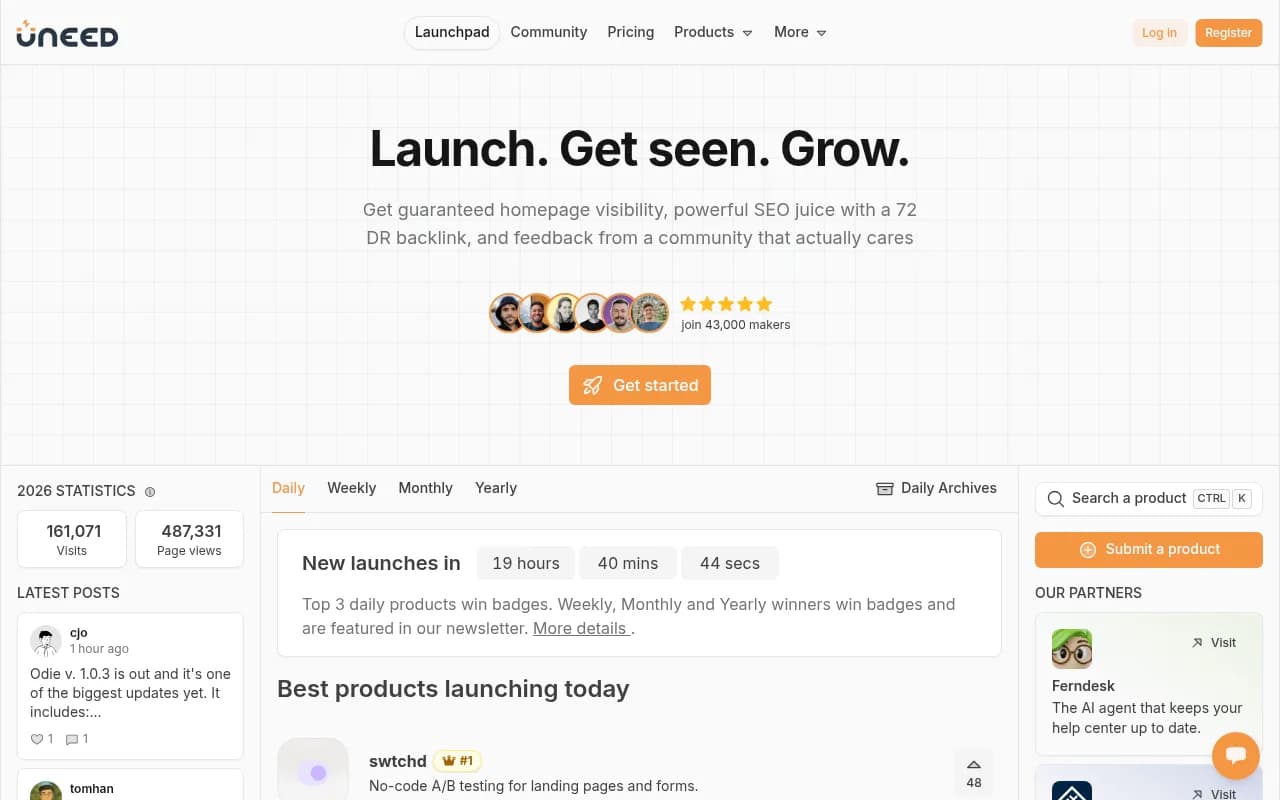
The platform was built around a simple frustration: most launch platforms are winner-takes-all systems where only the top 5-10 products get meaningful traffic. Uneed flips this model by guaranteeing homepage placement for every submission, then layering on a competitive element with daily rankings and badges. The site currently attracts 161,071+ visits and 487,331+ page views in 2026, with a community of 43,000 makers actively browsing and providing feedback.
How Uneed Works
The launch process is straightforward. Makers submit their product through a simple form, choose a launch date, and their tool goes live on the homepage at the scheduled time. Every product stays on the homepage for 24 hours minimum, ensuring visibility regardless of vote count. The platform runs daily competitions where the top 3 products (by community votes) earn #1, #2, #3 badges displayed on their listing. Weekly, monthly, and yearly winners receive additional badges and get featured in Uneed's newsletter, which goes out to the full maker community.
What sets Uneed apart is the guaranteed DR 72 backlink. Domain Rating (DR) is Ahrefs' metric for measuring a site's backlink authority -- a DR 72 is considered high-authority, on par with major tech publications. For new products struggling to build SEO momentum, this single backlink can meaningfully improve their domain authority and help them rank for branded and long-tail keywords. Most launch platforms offer exposure but no lasting SEO benefit; Uneed provides both.
The community aspect is more genuine than typical launch platforms. With 43,000+ makers, the feedback tends to come from people who actually understand product development -- fellow founders, designers, developers, and marketers. Comments focus on UX improvements, feature suggestions, and positioning advice rather than generic "congrats" messages. The platform also includes a social feed where makers post updates, ask questions, and share insights, creating ongoing engagement beyond launch day.
Core Features
Guaranteed Homepage Visibility: Every product gets featured on the homepage for at least 24 hours, with no algorithm deciding who gets seen. This is the platform's core promise and biggest differentiator. Products are organized by launch date, with "launching today" products at the top, followed by recent launches. Even if a product doesn't win daily rankings, it still gets meaningful traffic from homepage placement.
High-Authority Backlink (DR 72): Automatic dofollow backlink from Uneed's domain, which has a Domain Rating of 72 according to Ahrefs. This backlink is permanent and helps new products build domain authority faster. For comparison, most directory sites have DR 30-50; getting a DR 72 link typically requires guest posting on major publications or expensive link-building campaigns.
Daily, Weekly, Monthly, Yearly Competitions: Products compete for top 3 daily spots based on community upvotes. Winners get badges (#1, #2, #3) displayed on their listing, which increases click-through rates. Weekly, monthly, and yearly winners receive additional recognition and newsletter features. This competitive structure keeps the community engaged and gives makers a reason to promote their launch actively.
Maker Community & Feedback: 43,000+ registered makers who browse daily launches, leave comments, and provide actionable feedback. The community skews toward indie hackers, SaaS founders, and product designers -- people who understand the challenges of building and launching products. Feedback quality is generally higher than mass-market platforms where most users are casual browsers.
Premium Placement Options: Makers can pay for premium spots to get additional visibility. Premium listings appear in dedicated slots on the homepage and get highlighted styling. This is useful for products launching in competitive categories or makers who want to maximize their launch day traffic.
Partner Integrations: Uneed partners with other maker tools (like Capgo for Capacitor app updates and Ferndesk for AI help centers) to cross-promote products. Partners get banner placements on the homepage, driving additional traffic beyond the launch day spike.
Blog & Reviews Section: Uneed publishes in-depth reviews of selected tools, comparison guides, and growth strategy articles. Recent posts include "The Best Tools to Grow on Reddit in 2026" and individual tool reviews like Ferndesk. These articles provide additional SEO value and keep users returning to the site beyond launch days.
Search & Filtering: Users can search products by name or browse by tags (SEO, AI, Productivity, Design, etc.). The tagging system is extensive, covering 100+ categories, making it easy for users to discover tools in specific niches. Each tag page shows all products in that category, ranked by votes and recency.
Daily Archives: Products are organized by launch date, allowing users to browse past launches and discover tools they missed. This archival system means products continue getting traffic long after launch day, unlike platforms where yesterday's launches disappear entirely.
Social Feed: A Twitter-like feed where makers post updates, share milestones, and ask questions. Recent posts include hiring announcements, product updates, and discussions about trending topics (like OpenClaw's viral launch). This keeps the community engaged between launches and provides networking opportunities.
Who Is Uneed For
Uneed is best suited for indie makers and solo founders launching their first or second product. If you're a developer who built a side project and want to get initial users without spending $1,000+ on Product Hunt promotions, Uneed offers a more predictable, affordable path to visibility. The guaranteed homepage placement removes the anxiety of "will anyone see my launch?" that plagues first-time launchers on competitive platforms.
SaaS founders in niche categories also benefit significantly. If you're building a tool for a specific vertical (like project management for web agencies or AI video generation), Uneed's maker-focused audience is more likely to appreciate your product than a general consumer audience. The community understands technical products and provides feedback that actually helps you improve.
Bootstrapped startups looking for cost-effective marketing channels should consider Uneed. At $287-$699 for a launch package, it's significantly cheaper than paid ads, influencer sponsorships, or PR agencies. The DR 72 backlink alone is worth $200-500 if you were to buy it through a link-building service, making the launch package a solid SEO investment even if you don't get massive traffic.
Who should NOT use Uneed: If you're launching a consumer app targeting non-technical users (like a fitness tracker or recipe app), Uneed's maker-focused audience may not be your ideal early adopters. The platform works best for B2B SaaS, developer tools, productivity apps, and other products that appeal to the indie hacker community. Also, if you're a well-funded startup with a big marketing budget, you'll likely get better ROI from Product Hunt, TechCrunch coverage, or paid acquisition channels.
Integrations & Ecosystem
Uneed doesn't offer traditional integrations (like Zapier or API access) because it's a launch platform, not a SaaS tool. However, it does partner with other maker tools to provide cross-promotion opportunities. Current partners include Capgo (instant updates for Capacitor apps) and Ferndesk (AI help center platform), which get banner placements on the homepage.
The platform uses Supabase for backend infrastructure (visible in logo URLs), suggesting it's built on modern, scalable tech. There's no public API for developers to build on top of Uneed, but the site does have a blog section that publishes tool reviews and marketing guides, providing additional SEO value for featured products.
Pricing & Value
Uneed offers three launch packages:
Public Review: $287 -- Your product gets listed on the homepage with guaranteed visibility, a DR 72 backlink, and community feedback. This is the base package and includes everything most makers need for a successful launch.
Private Review: $549 -- Includes everything in Public Review plus a private review session with the Uneed team before your launch. They provide feedback on your positioning, messaging, and launch strategy to help you maximize results.
Full Package: $699 -- Includes Public Review, Private Review, and premium homepage placement. Your product gets highlighted styling and appears in a dedicated premium slot, increasing visibility and click-through rates.
For comparison, Product Hunt doesn't charge for launches but requires significant promotion effort (and often paid upvote services) to reach the top 5. BetaList charges $299 for a standard listing. Indie Hackers and Hacker News are free but offer no guaranteed visibility. Uneed's pricing sits in the middle -- more expensive than free platforms but cheaper than full-service launch agencies ($2,000-10,000).
The value proposition is strong if you care about SEO. A DR 72 backlink from a relevant, high-authority site typically costs $200-500 through link-building services. Add in guaranteed homepage traffic (161,071+ monthly visits) and community feedback, and the $287 public review package pays for itself if you convert even a handful of users.
Strengths & Limitations
Strengths:
- Guaranteed visibility removes the lottery element of traditional launch platforms -- every product gets homepage placement
- High-authority backlink (DR 72) provides lasting SEO value beyond launch day traffic
- Maker-focused community gives better feedback than casual browsers on mass-market platforms
- Affordable pricing compared to Product Hunt promotions or launch agencies
- Daily/weekly/monthly competitions keep the community engaged and give makers a reason to promote actively
Limitations:
- Smaller audience than Product Hunt (161K monthly visits vs Product Hunt's millions) -- less potential for viral launches
- Maker-focused demographic means consumer apps or non-technical products may not find their ideal audience
- No free tier -- you have to pay $287+ to launch, whereas Product Hunt and Hacker News are free (though less predictable)
- Limited post-launch promotion -- once your 24-hour homepage slot ends, traffic drops significantly unless you win weekly/monthly badges
Bottom Line
Uneed is the best launch platform for indie makers and bootstrapped SaaS founders who want guaranteed visibility and lasting SEO value without gambling on Product Hunt's algorithm. The $287-$699 pricing is justified by the DR 72 backlink alone, and the maker-focused community provides feedback that actually helps you improve your product. If you're launching a technical product, developer tool, or B2B SaaS and want a predictable, affordable launch channel, Uneed delivers solid ROI. Just don't expect Product Hunt-level traffic -- this is a quality-over-quantity play focused on the right audience and long-term SEO benefits.
Similar and alternative tools to Uneed