Wope Review 2026
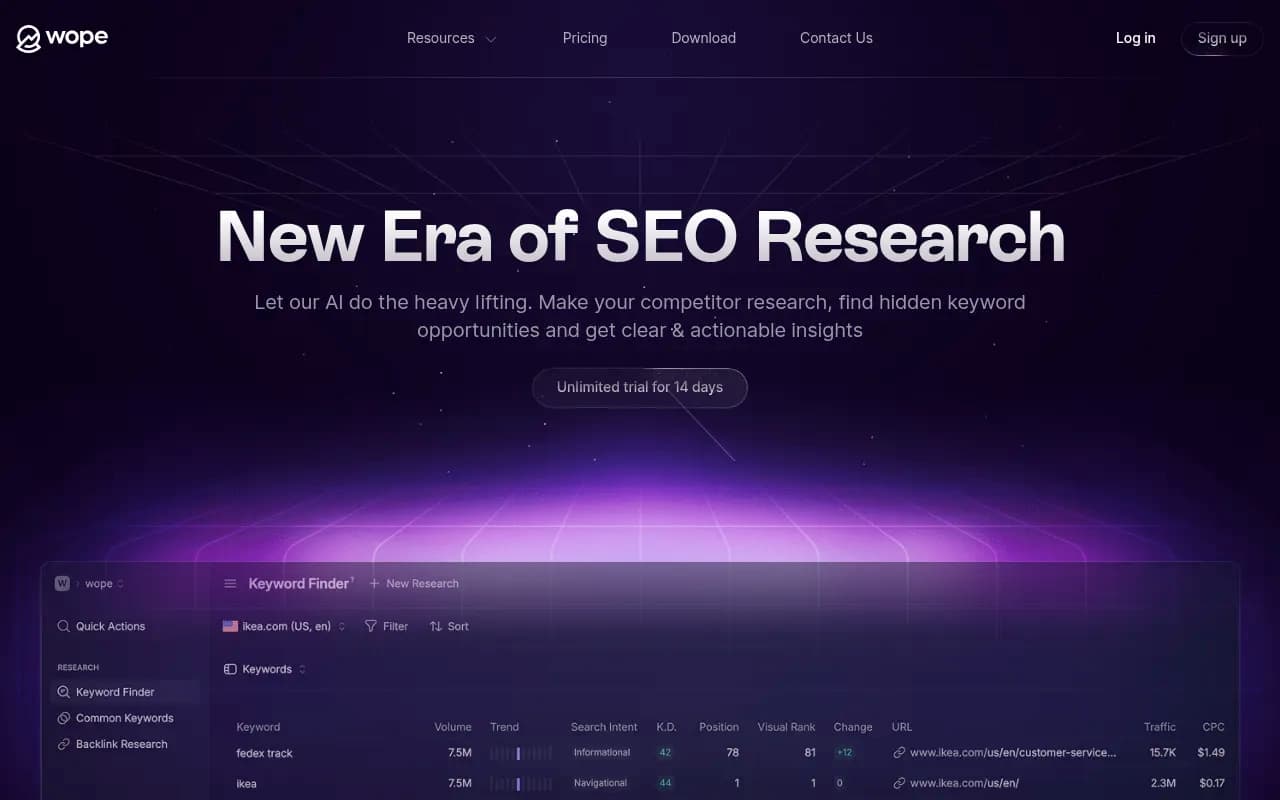
Wope is an AI-driven SEO research platform that helps marketers and agencies analyze backlinks, discover keyword opportunities, and track rankings across competitors. With features like backlink profile analysis, shared keyword discovery, and ranked keyword tracking, it combines traditional SEO data
Key Takeaways:
• AI-powered research platform that combines backlink analysis, keyword tracking, and content generation in one suite • Best for: SEO agencies, growing startups, and marketing teams managing multiple client sites or competitive niches • Standout features: Shared keyword analysis between competitors, detailed backlink profiling, and built-in AI content assistant • Pricing: From $27/mo (Basic) to $897/mo (Elite), with 14-day unlimited trial • Limitations: Newer player in a crowded market dominated by Ahrefs and Semrush; limited information on data freshness and index size
Wope positions itself as a "new-generation SEO research platform" that uses AI to simplify competitor analysis and keyword research. Launched as an alternative to traditional SEO suites, it targets agencies and startups who want actionable insights without drowning in data dashboards. The platform's core promise is straightforward: let AI handle the heavy lifting of research so you can focus on strategy and execution.
The tool is built for three primary audiences. SEO agencies managing 10-20+ client sites will appreciate the competitive analysis features that quickly surface keyword gaps and backlink opportunities. Self-funded startups trying to punch above their weight can use the shared keyword tool to identify exactly where competitors are winning and where gaps exist. Marketing teams at fast-growing companies will find the combination of research and content generation helpful for scaling content production while staying data-driven.
Backlink Profile Analysis is Wope's most detailed research feature. Enter any domain and you get a breakdown of backlink sources, anchor text distribution, and authority scores for linking domains. This goes beyond simple link counts -- you can see the exact pages linking to a competitor, the anchor text they're using (branded vs. keyword-rich), and whether those links come from high-authority sites or low-quality directories. For link builders, this means you can reverse-engineer a competitor's strategy: find their best backlink sources, reach out to the same sites, and replicate what's working. The authority scoring helps you prioritize -- chase links from domains with strong metrics, ignore the rest. Compared to Ahrefs or Majestic, Wope's interface is cleaner and more focused on actionable takeaways rather than overwhelming you with every metric imaginable.
Shared SEO Keywords is where Wope differentiates itself from older tools. Enter two domains (yours and a competitor, or two competitors) and Wope instantly shows overlapping keywords both sites rank for. This is competitive intelligence at its fastest -- instead of manually cross-referencing keyword lists in spreadsheets, you see the overlap in seconds. The use case is clear: if you and a competitor both rank for "project management software" but they're #3 and you're #8, you know exactly where to focus optimization efforts. If they rank for adjacent keywords you're missing entirely, those become content gap opportunities. Agencies running competitive audits for clients will save hours with this feature. It's similar to Semrush's Keyword Gap tool but faster and more visual.
Ranked Keywords Analysis gives you the full picture of what your site (or any site) already ranks for. You get search volume, click-through rate estimates, historical ranking trends, and keyword intent classification (informational, commercial, transactional). The CTR data is particularly useful for prioritizing -- a keyword with 10,000 monthly searches but 2% CTR (because it triggers a featured snippet) is less valuable than one with 5,000 searches and 15% CTR. The intent tagging helps you align content strategy: if you're ranking for informational queries but want to drive conversions, you know you need to target more commercial keywords. The historical trends show whether a keyword is growing, declining, or seasonal, so you're not chasing yesterday's traffic. This is table stakes for any SEO tool, but Wope presents it cleanly without the feature bloat of Ahrefs or Semrush.
AI Content Assistant is Wope's attempt to close the loop from research to execution. After identifying keyword opportunities, the built-in assistant helps you generate content briefs, outlines, or full drafts. The AI is trained on SEO best practices -- it suggests headings, related keywords to include, and content structure based on what's currently ranking. This isn't revolutionary (tools like Surfer SEO and Clearscope do similar things), but having it integrated into the research platform saves time. You don't need to export data to a separate tool. For agencies churning out client content, this speeds up the brief-writing process. For startups with lean teams, it's a way to scale content without hiring a full editorial team. The quality of AI-generated content is what you'd expect in 2026 -- solid first drafts that need human editing, not publish-ready articles.
Integrations & Ecosystem: Wope doesn't advertise extensive integrations, which is a gap compared to enterprise tools. There's no mention of API access, Google Search Console integration, or connectors to tools like Google Analytics, Looker Studio, or Zapier. For teams that need to pull Wope data into custom dashboards or automate workflows, this is a limitation. The platform appears to be a standalone tool -- you work inside Wope's interface, export data manually if needed. There is a desktop download option mentioned, suggesting a native app for Mac or Windows, but details are sparse. No mobile app is advertised. For agencies, the lack of white-label reporting or client portal features may be a dealbreaker if you need to present data directly to clients.
Pricing & Value: Wope offers four pricing tiers. Basic at $27/mo is for small businesses or solo consultants -- likely limited keyword tracking and basic backlink analysis. Starter at $55/mo targets self-funded startups, probably adding more tracked keywords and competitor slots. Growth at $137/mo is for fast-growing companies, likely the sweet spot for small agencies. Elite at $897/mo is for large enterprises or agencies managing many clients, with up to 5,000 daily keyword checks and unlimited exports. All plans include a 14-day unlimited trial, which is generous -- you can test every feature before committing. No credit card required for the trial.
Compared to competitors: Ahrefs starts at $129/mo, Semrush at $139.95/mo, and both require annual commitments for those rates. Wope's $27-$137 range undercuts them significantly, making it accessible for smaller teams. However, Ahrefs and Semrush have much larger backlink indexes (Ahrefs claims 40+ trillion links), more historical data, and deeper feature sets (site audits, rank tracking across hundreds of locations, content optimization, etc.). Wope is betting that most users don't need the full enterprise suite -- they just need fast competitive insights and AI-assisted content creation. For that use case, Wope is better value. For teams that need comprehensive site audits, international rank tracking, or API access, Ahrefs or Semrush are still the safer bet.
Strengths: • Speed and simplicity -- Wope's interface is cleaner and faster than legacy tools. You get insights in seconds, not minutes. • Shared keyword analysis is genuinely useful for competitive research and saves hours of manual work. • AI content assistant integrated into the research workflow means you can go from insight to draft without switching tools. • Aggressive pricing makes it accessible for startups and small agencies who can't justify $1,500+/year for Ahrefs. • 14-day unlimited trial lets you fully evaluate the platform before paying.
Limitations: • Smaller backlink index -- Wope doesn't disclose index size, but as a newer player, it likely can't match Ahrefs' 40 trillion links or Majestic's historical data. For deep link analysis, you may still need a legacy tool. • Limited integrations -- no API, no GSC connector, no white-label reporting. If you need to automate workflows or build custom dashboards, Wope won't cut it. • Newer platform means less historical data, fewer case studies, and a smaller user community compared to established tools. • No site audit or technical SEO features -- Wope is purely research and content. If you need to crawl sites for broken links, speed issues, or schema errors, you'll need a separate tool. • Unclear data freshness -- how often does Wope update backlink data or keyword rankings? Daily? Weekly? This isn't specified, and for time-sensitive campaigns, it matters.
Bottom Line: Wope is best for SEO agencies and startups who need fast competitive insights and AI-assisted content creation without the complexity (or cost) of enterprise SEO suites. If your primary workflow is "analyze competitors, find keyword gaps, create content," Wope delivers that loop efficiently. It's not a replacement for Ahrefs or Semrush if you need comprehensive site audits, international rank tracking, or deep historical data. But for teams who spend more time on competitive research and content strategy than technical SEO, Wope offers a cleaner, faster, cheaper alternative. The 14-day trial is risk-free -- test it against your current tools and see if the simplified workflow saves you time. Best use case in one sentence: Small-to-midsize agencies and startups who want to move fast on competitive keyword research and content creation without paying enterprise prices.
Tags:
Similar and alternative tools to Wope