Zappi Review 2026
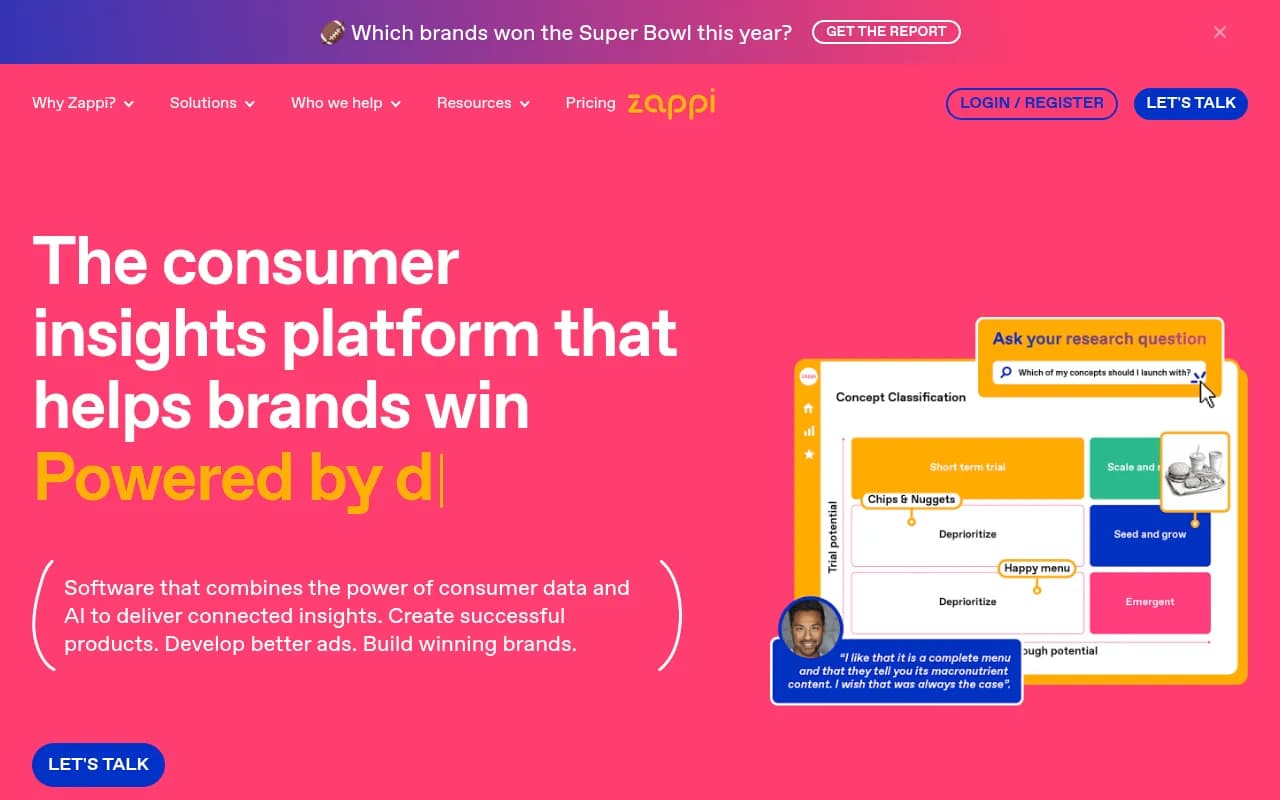
Zappi is an enterprise consumer insights platform that combines AI with real-time consumer feedback to help brands develop winning products, optimize advertising campaigns, and track brand health. Used by Mars, PepsiCo, McDonald's, and other Fortune 500 companies, it replaces traditional research mo
Summary: Key Takeaways
- What it does: Enterprise consumer insights platform that integrates product innovation testing, advertising optimization, and brand health tracking into one AI-powered system
- Best for: Large consumer brands, CPG companies, and marketing teams at Fortune 500 organizations running continuous product development and advertising campaigns
- Standout strength: Transforms past research data into predictive insights -- the more you use it, the smarter it gets. PepsiCo reports 30% improvement in creative effectiveness and hundreds of millions in value gained.
- Pricing: Custom enterprise pricing (no public tiers). Requires sales consultation.
- Key limitation: Built for enterprise scale -- likely overkill and cost-prohibitive for startups, small agencies, or brands running occasional research projects
Zappi is a consumer insights platform built for brands that need to move fast without losing the consumer voice. Founded to replace the slow, fragmented world of traditional market research, Zappi combines real-time consumer feedback with AI to help companies test products, optimize advertising, and track brand health -- all in one connected system. The platform is used by over 400 brands including Mars, PepsiCo, McDonald's, Vodafone, Reckitt, and Haleon. According to a Forrester Total Economic Impact study, brands using Zappi see a 4-7% increase in new product revenue compared to legacy research providers, with creative effectiveness improvements of up to 30%.
The core thesis: traditional research models leave teams playing catch-up. You run a concept test, wait weeks for results, make changes in a vacuum, then hope it works in market. Zappi flips this into a continuous feedback loop where each project builds on past insights, consumer data accumulates into a learning engine, and AI surfaces patterns you'd never catch manually. It's designed for organizations that launch dozens of products and campaigns per year and need a system, not just a survey tool.
Innovation System: Product Development with Consumer-in-the-Loop
Zappi's Innovation System is built around iterative product testing at every stage -- early concepts, prototypes, packaging, claims, pricing. Instead of one-off concept tests that gather dust, the platform tracks performance across your entire innovation pipeline and learns what works for your category and audience over time.
Concept Testing & Optimization: Test early-stage product ideas with customizable methodologies (monadic, sequential monadic, comparison tests). Get diagnostic feedback on appeal, purchase intent, uniqueness, and believability. The platform doesn't just score concepts -- it tells you specifically what's driving or killing interest (e.g. "flavor description is confusing" or "price point feels too premium for this category").
Packaging & Claims Testing: Evaluate packaging designs, label claims, and on-pack messaging with eye-tracking heatmaps and attention metrics. See exactly where consumers look first, what they ignore, and whether your key message is landing. Compare multiple design routes side-by-side.
Historical Learning & Benchmarking: Every test you run feeds into a proprietary database of norms and benchmarks specific to your brand and category. Over time, the platform learns what "good" looks like for your products and can predict which concepts are likely to succeed in market before you invest in production. McDonald's uses this to theme learnings across menu tests and get smarter about which flavor profiles and product formats resonate.
AI-Powered Insights: The platform uses natural language processing to analyze open-ended consumer feedback at scale, surfacing themes and sentiment automatically. Instead of reading through hundreds of verbatims manually, you get instant summaries of what consumers love, hate, and are confused by.
Agile Research System: Advertising Development & Testing
Zappi's Advertising System covers the full creative development cycle -- from early ideas and storylines through to finished ads. It's validated to in-market outcomes, meaning the metrics it tracks (attention, brand linkage, emotional response, message recall) are proven to correlate with actual campaign performance.
Idea & Storyline Testing: Test rough concepts, scripts, and storyboards before you invest in production. Get feedback on clarity, relevance, emotional resonance, and brand fit. The platform helps you kill weak ideas early and double down on winners.
Ad Pre-Testing: Evaluate finished video ads (TV, digital, social) with second-by-second diagnostics. See exactly which moments drive attention, emotion, and brand recall. Zappi tracks facial coding, implicit response, and explicit feedback to give you a complete picture of how the ad performs. PepsiCo credits Zappi with a 30% improvement in creative effectiveness across all advertising, translating to hundreds of millions in value.
In-Flight Optimization: Test ads while campaigns are running to measure brand impact and optimize media spend. Haleon used Zappi to measure brand lift from digital ad campaigns in real-time, allowing them to shift budget toward top performers mid-flight.
Creative Learning Repository: Like the Innovation System, every ad test feeds into a learning engine. Over time, you build a library of what creative approaches, messaging angles, and emotional tones work best for your brand. This isn't generic "best practices" -- it's your brand's creative playbook, grounded in real consumer data.
Brand Health System: Continuous Brand Tracking
Zappi's Brand Health Tracker replaces traditional annual or quarterly brand studies with continuous monitoring. Instead of waiting months to see if your brand perception is shifting, you get real-time pulse checks on awareness, consideration, preference, and key brand attributes.
Continuous Tracking: Monitor brand health metrics on your schedule -- weekly, monthly, or quarterly. Spot shifts early and react before small issues become big problems. The platform tracks both your brand and competitors, so you always know where you stand in the category.
Driver Analysis: Understand what's actually driving brand growth. The platform uses regression modeling and AI to identify which brand attributes, messaging themes, or product experiences have the biggest impact on consideration and purchase intent. Focus your efforts on what moves the needle.
Segmentation & Personas: Slice brand health data by audience segments, demographics, purchase behavior, or custom personas. See how different consumer groups experience your brand and tailor strategies accordingly.
Platform & Integrations
Zappi is a web-based platform (no desktop app required) with a clean, modern interface designed for insights teams, brand managers, and marketers -- not just researchers. The platform emphasizes speed and usability: launch a study in minutes, get results in days, and share insights via interactive dashboards that stakeholders can explore without needing research expertise.
Sample & Panel Quality: Zappi adheres to ESOMAR and ISO standards for sample quality. The platform sources respondents from vetted panel providers and uses quality checks (attention filters, speeders, straight-lining detection) to ensure reliable data. You can target specific demographics, geographies, or custom audiences.
Customization & Flexibility: While Zappi offers standardized methodologies (which enable benchmarking and learning over time), you can customize surveys, add your own questions, adjust sample sizes, and tailor the approach to fit your needs. The platform supports monadic, sequential monadic, and comparison designs.
Data Export & Integrations: Export raw data to Excel, SPSS, or CSV for custom analysis. The platform integrates with common business intelligence tools, though specific integration details (Tableau, Looker, etc.) aren't publicly documented. Zappi also offers an API for enterprise clients who want to embed insights into their own systems.
Consulting & Support: Zappi provides expert support through a consulting team that helps with study design, methodology selection, and insight interpretation. This is particularly valuable for teams new to agile research or those running complex, high-stakes projects. Wendy's used Zappi Consulting to navigate a busy product launch period, ensuring research was set up correctly and insights were actionable.
Who Is Zappi For?
Zappi is built for enterprise consumer brands and large marketing organizations that run continuous innovation and advertising programs. The ideal customer is a Fortune 500 CPG company, major retailer, or global brand launching dozens of products and campaigns per year. Think Mars testing new candy flavors, PepsiCo optimizing Super Bowl ads, or McDonald's evaluating limited-time menu items.
Primary users: Insights teams, brand managers, innovation leads, and creative directors at companies with dedicated consumer research budgets. These are organizations that previously relied on traditional research agencies (Kantar, Ipsos, Nielsen) and are looking for a faster, more integrated approach.
Team size & company stage: Zappi is designed for mid-to-large enterprises with established brands and significant marketing spend. The platform's value comes from accumulating data over time, so it's best suited for companies running 20+ research projects per year. Startups, small agencies, and brands doing occasional ad-hoc research will find it overkill and likely cost-prohibitive.
Industries: Primarily CPG (food, beverage, personal care, household products), but also retail, financial services (SoFi is a customer), telecom (Vodafone), and healthcare (Haleon). Any category where consumer preference drives purchase decisions and brands need to test products or advertising at scale.
Who should NOT use Zappi: Small businesses, startups, or agencies managing clients with limited research budgets. If you're running 5-10 projects per year or need simple survey tools, platforms like SurveyMonkey, Qualtrics, or Attest will be more appropriate and affordable. Zappi's learning engine and AI capabilities only deliver value at scale.
Pricing & Value
Zappi does not publish pricing publicly. The platform operates on custom enterprise contracts based on usage volume, number of users, and specific modules (Innovation, Advertising, Brand Health). Based on industry context and competitor positioning, expect annual contracts starting in the low six figures for mid-sized brands, scaling to seven figures for global enterprises running hundreds of studies.
The pricing model typically includes a base platform fee plus credits for individual studies. Each study (concept test, ad pre-test, brand tracker wave) consumes credits based on sample size and complexity. This allows flexibility -- you're not locked into a fixed number of projects, but you do need to forecast usage to avoid running out of credits mid-year.
Value proposition: Zappi positions itself as a replacement for traditional research agencies, which often charge $15,000-$50,000 per ad test or concept study with 4-6 week turnarounds. Zappi delivers comparable (or better) quality in days, not weeks, at a lower per-project cost once you're running at scale. The Forrester TEI study found that brands see 4-7% revenue lifts on new products and 30% improvements in creative effectiveness -- ROI that justifies the investment for large organizations.
Free trial: Not available. Zappi requires a sales consultation and typically offers a pilot program where you run a few studies to evaluate the platform before committing to a full contract.
Strengths & Limitations
Strengths:
- Connected insights across the funnel: Unlike point solutions that only test ads or only test products, Zappi integrates innovation, advertising, and brand health into one platform. This creates a unified view of how your brand and products are performing.
- Learning over time: The platform's AI and benchmarking capabilities get smarter the more you use it. This is a massive advantage over traditional research where every project starts from scratch.
- Speed: Launch studies in minutes, get results in days. This enables iterative testing and agile decision-making that's impossible with traditional agencies.
- Validated to outcomes: Zappi's methodologies are proven to correlate with in-market performance, giving you confidence that high-scoring concepts and ads will actually succeed.
- Enterprise-grade quality: ESOMAR/ISO standards, vetted panels, rigorous quality checks. The data is reliable enough to bet big product launches and media budgets on.
Limitations:
- Enterprise pricing: No transparency on cost, and likely prohibitively expensive for small brands or agencies. This is a platform for organizations with serious research budgets.
- Learning curve: While the interface is user-friendly, getting the most value requires understanding research methodology, study design, and how to interpret diagnostics. Teams new to consumer insights may need training or consulting support.
- Limited public documentation: Details on integrations, API capabilities, and specific features are sparse. You need to talk to sales to understand what's possible.
- Not for ad-hoc research: If you only need to run a few studies per year, Zappi's subscription model and learning engine won't deliver ROI. You're better off with pay-per-project tools or traditional agencies.
Bottom Line
Zappi is the consumer insights platform for enterprise brands that need to move fast, test continuously, and build a learning engine from their research data. If you're a Fortune 500 CPG company launching dozens of products and campaigns per year, Zappi replaces the slow, fragmented world of traditional research agencies with a connected system that gets smarter over time. PepsiCo's 30% creative effectiveness improvement and McDonald's ability to theme learnings across menu tests show the platform's impact at scale. But if you're a startup, small agency, or brand running occasional research projects, the enterprise pricing and complexity make it a poor fit -- stick with simpler, more affordable tools. Best use case in one sentence: Large consumer brands running 20+ innovation or advertising tests per year who want to replace traditional research agencies with a faster, AI-powered system that learns from every project.
Similar and alternative tools to Zappi