Key Takeaways
- Birdeye is the top all-around alternative with powerful AI agents for review generation, social publishing, and listings management—best for brands managing 10-500 locations who want automation without enterprise complexity
- BrightLocal offers the most affordable entry point at $39/mo for single locations, making it ideal for small businesses and agencies just starting with local SEO
- Yext dominates the enterprise space with AI search optimization (including ChatGPT visibility tracking) and manages 2M+ locations—best for brands with 100+ locations and complex needs
- Promptwatch is the only platform that tracks and optimizes brand visibility specifically in AI search engines like ChatGPT, Claude, and Perplexity—essential if AI-generated recommendations drive your customer acquisition
- Reputation and SOCi compete directly with Chatmeter in the mid-market, offering similar feature sets but with different pricing models and AI capabilities
Multi-location brands looking for alternatives to Chatmeter typically face one of three pain points: pricing that scales too aggressively with location count, limited AI search visibility features as customers increasingly discover businesses through ChatGPT and Perplexity instead of Google, or a platform that's either too basic for enterprise needs or too complex for smaller operations. Chatmeter's $16K-$42K annual pricing puts it squarely in the mid-to-upper market, but competitors now offer everything from $39/mo DIY tools to full white-label agency platforms with built-in CRM.
The reputation management landscape has shifted dramatically in 2026. Traditional local SEO—managing Google Business Profile listings, responding to reviews, tracking local pack rankings—remains essential, but brands now need visibility in AI search engines where customers ask "What's the best pizza place near me?" and ChatGPT recommends three options without showing a map. Platforms that only monitor traditional search are missing half the picture.
Birdeye
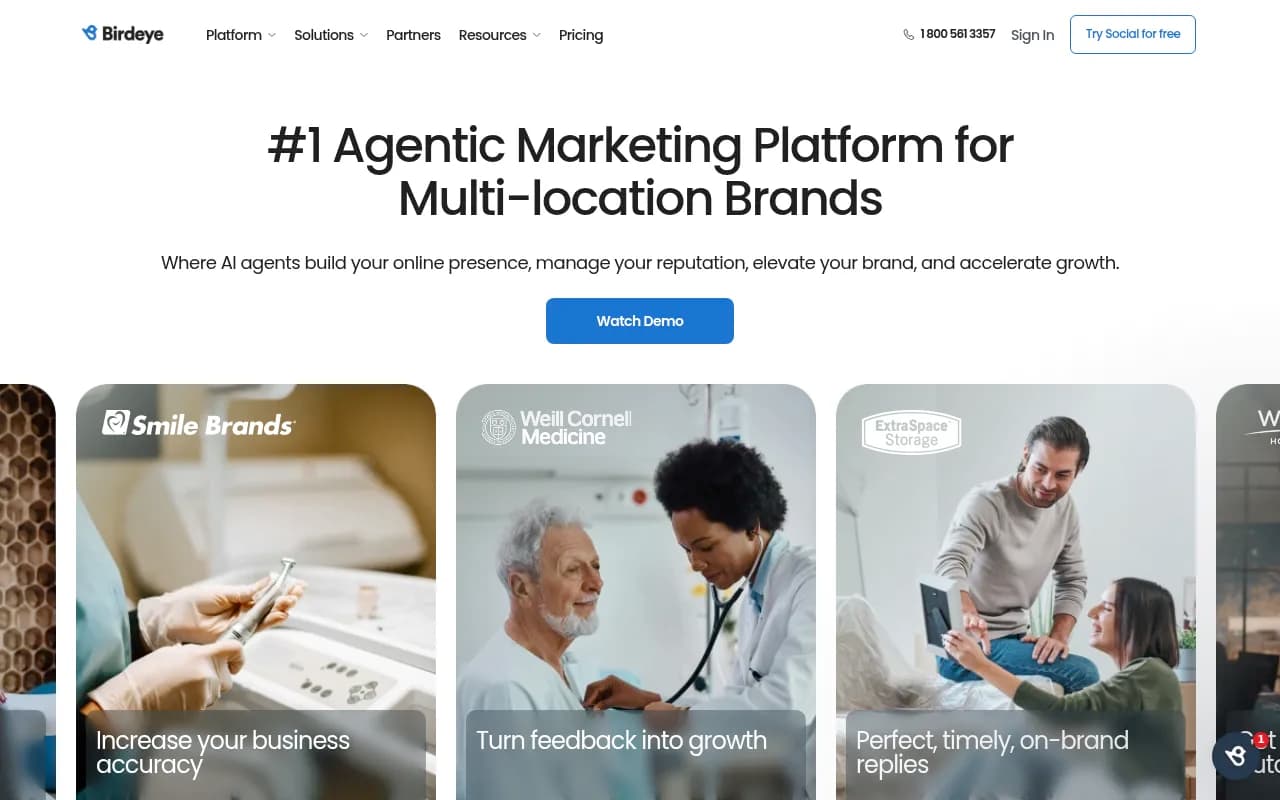
Birdeye positions itself as an "agentic marketing platform" built around AI agents that automate specific tasks: review generation, review responses, social publishing, social engagement, listings optimization, lead generation, and reporting. Instead of manually managing each location's reputation, you deploy agents that handle routine work while flagging issues that need human attention.
The platform covers the full reputation management stack—listings across 200+ directories, review monitoring from 150+ sites, social media scheduling and engagement, SMS and webchat for customer communication, surveys, and local SEO reporting. What sets Birdeye apart from Chatmeter is the depth of automation. The Review Response Agent, for example, doesn't just suggest replies—it writes them in your brand voice, learns from your edits, and can auto-respond to simple reviews without human approval. The Social Publishing Agent generates content ideas based on trending topics, local events, and past performance, then schedules posts across all locations.
Birdeye's Search AI feature tracks brand visibility in AI-generated answers from ChatGPT, Gemini, and Perplexity—a capability Chatmeter lacks entirely. As more customers discover businesses through conversational AI instead of traditional search, this becomes critical. You can see which prompts trigger your brand mentions, which competitors appear instead, and what content gaps prevent AI models from recommending you.
Pricing starts at $299/mo for the Standard plan (basic listings and reviews), $399/mo for Professional (adds social media and surveys), and custom pricing for Premium (full AI agent suite). Pricing scales with location count, but Birdeye tends to be more competitive than Chatmeter for brands managing 10-100 locations. The platform targets mid-market brands—retail chains, restaurant groups, healthcare systems, automotive dealerships—who need enterprise features without enterprise complexity.
Best for: Multi-location brands (10-500 locations) who want aggressive automation and AI-powered workflows. If you're tired of manually responding to reviews or scheduling social posts across dozens of locations, Birdeye's agent-based approach delivers the most time savings.
BrightLocal
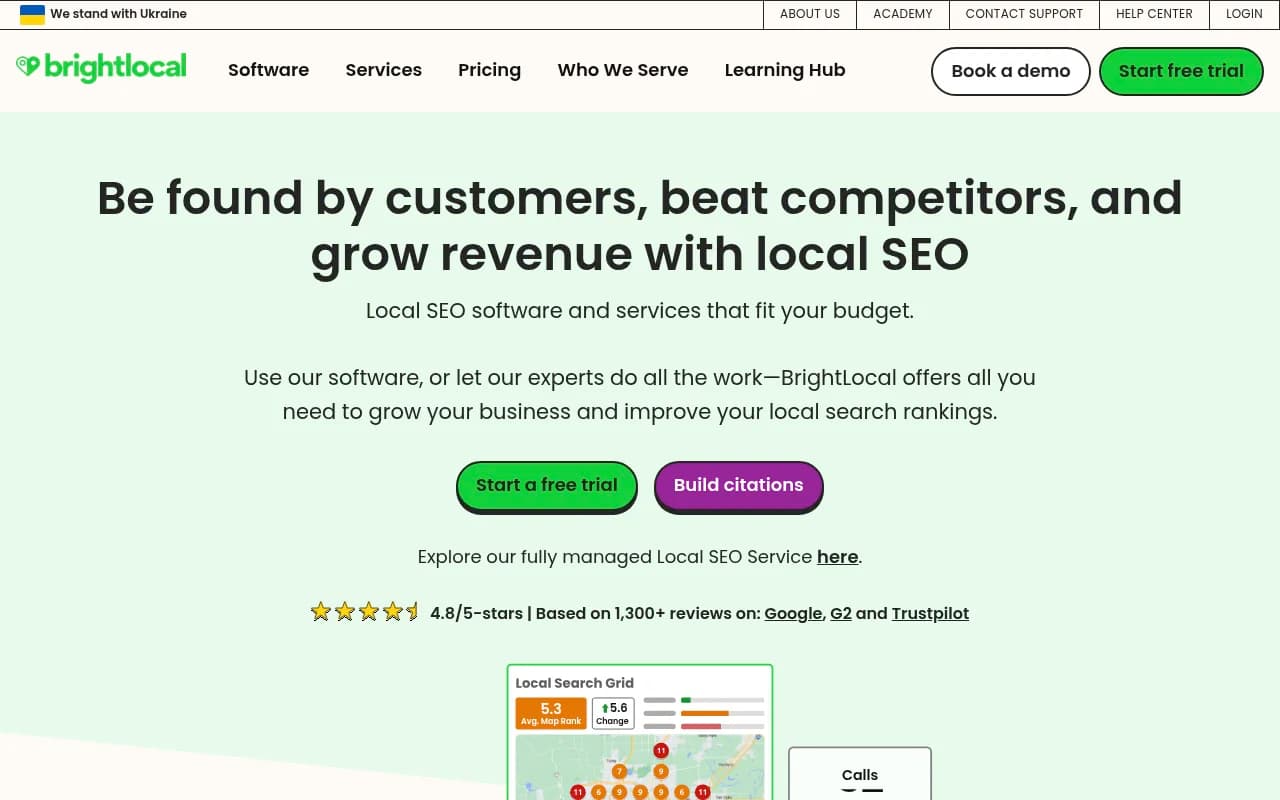
BrightLocal takes the opposite approach from enterprise platforms like Chatmeter—it's built for small businesses, franchisees, and agencies managing 1-40 locations who need local SEO tools without the complexity or cost of enterprise software. The platform offers two paths: DIY software for agencies and businesses who want to manage their own local SEO, or fully managed services where BrightLocal's team handles everything.
The software side includes local rank tracking (monitor where you appear in Google's local pack and organic results for specific keywords and locations), citation building (submit your business to 50+ directories with one click, or pay per listing for premium sites), review monitoring (track reviews from Google, Facebook, Yelp, and 50+ other sites), and reputation management (respond to reviews, generate review requests via SMS/email). The reporting is designed for agencies—white-labeled PDFs and dashboards you can send to clients without BrightLocal branding.
What BrightLocal does better than Chatmeter: pricing transparency and affordability. Plans start at $39/mo for a single location (14-day free trial), $59/mo for 2-5 locations, and scale up to $199/mo for 31-40 locations. Citation building is pay-per-listing ($3-$50 depending on the directory) instead of bundled into a monthly fee. For agencies managing multiple clients, this a la carte model often costs less than Chatmeter's location-based pricing.
What it doesn't do: social media management, AI search visibility tracking, or advanced automation. BrightLocal is a local SEO specialist, not a full reputation management suite. If you need social publishing, surveys, or SMS communication, you'll need additional tools. The platform also lacks the AI-powered content generation and response automation that Birdeye and Chatmeter offer.
The managed service option ($799-$1,299/mo per location) is worth considering if you want BrightLocal's team to handle citation building, listing optimization, and monthly reporting. This competes directly with Chatmeter's service model but at a lower price point for smaller location counts.
Best for: Small businesses with 1-10 locations, franchisees who need basic local SEO without enterprise overhead, and agencies managing 10-50 clients who want white-labeled reporting and pay-per-use citation building.
Promptwatch

Promptwatch solves a problem that Chatmeter and most reputation platforms ignore entirely: visibility in AI search engines. When someone asks ChatGPT "What's the best CRM for startups?" or Perplexity "Where should I eat in Austin?", which brands get recommended? Promptwatch tracks these AI-generated answers across 10 models—ChatGPT, Claude, Gemini, Perplexity, Google AI Overviews, Meta AI, DeepSeek, Grok, Mistral, and Copilot—and shows you exactly when your brand appears, when competitors appear instead, and what content gaps prevent AI models from citing you.
The platform goes beyond monitoring. Answer Gap Analysis shows which prompts competitors rank for but you don't, then identifies the specific content your website is missing—the topics, angles, and questions AI models want answers to but can't find. The built-in AI writing agent generates articles, listicles, and comparison pages grounded in real citation data (880M+ citations analyzed), prompt volumes, and competitor analysis. This isn't generic SEO content—it's engineered to get cited by AI models.
Promptwatch also provides AI Crawler Logs—real-time tracking of when ChatGPT, Claude, Perplexity, and other AI crawlers visit your website, which pages they read, and errors they encounter. Most brands don't realize AI models crawl websites differently than Google. Promptwatch shows you exactly how AI engines discover and index your content, so you can fix issues that prevent citations.
Additional features include prompt intelligence (volume estimates and difficulty scores for each query), citation and source analysis (see which pages, Reddit threads, and YouTube videos AI models cite), Reddit and YouTube insights (surface discussions that influence AI recommendations), ChatGPT Shopping tracking (monitor when your brand appears in product recommendations), competitor heatmaps, multi-language and multi-region monitoring, and Looker Studio integration.
Pricing is transparent: Essential $99/mo (1 site, 50 prompts, 5 AI-generated articles), Professional $249/mo (2 sites, 150 prompts, 15 articles, crawler logs, state/city tracking), Business $579/mo (5 sites, 350 prompts, 30 articles). Agency and enterprise pricing available for larger deployments. Free trial included.
Promptwatch doesn't replace Chatmeter—it complements it. If you're managing traditional reputation (reviews, listings, social media), you still need a platform like Chatmeter, Birdeye, or BrightLocal. But if AI search drives customer acquisition in your industry—software, professional services, e-commerce, hospitality, healthcare—Promptwatch fills a critical gap that traditional reputation platforms miss.
Best for: Brands where AI-generated recommendations directly impact revenue—SaaS companies, professional services, e-commerce brands, hospitality, and any business competing for "best [category]" queries in ChatGPT and Perplexity. Essential if you've noticed traffic from AI search engines in your analytics but have no visibility into what's driving it.
Yext
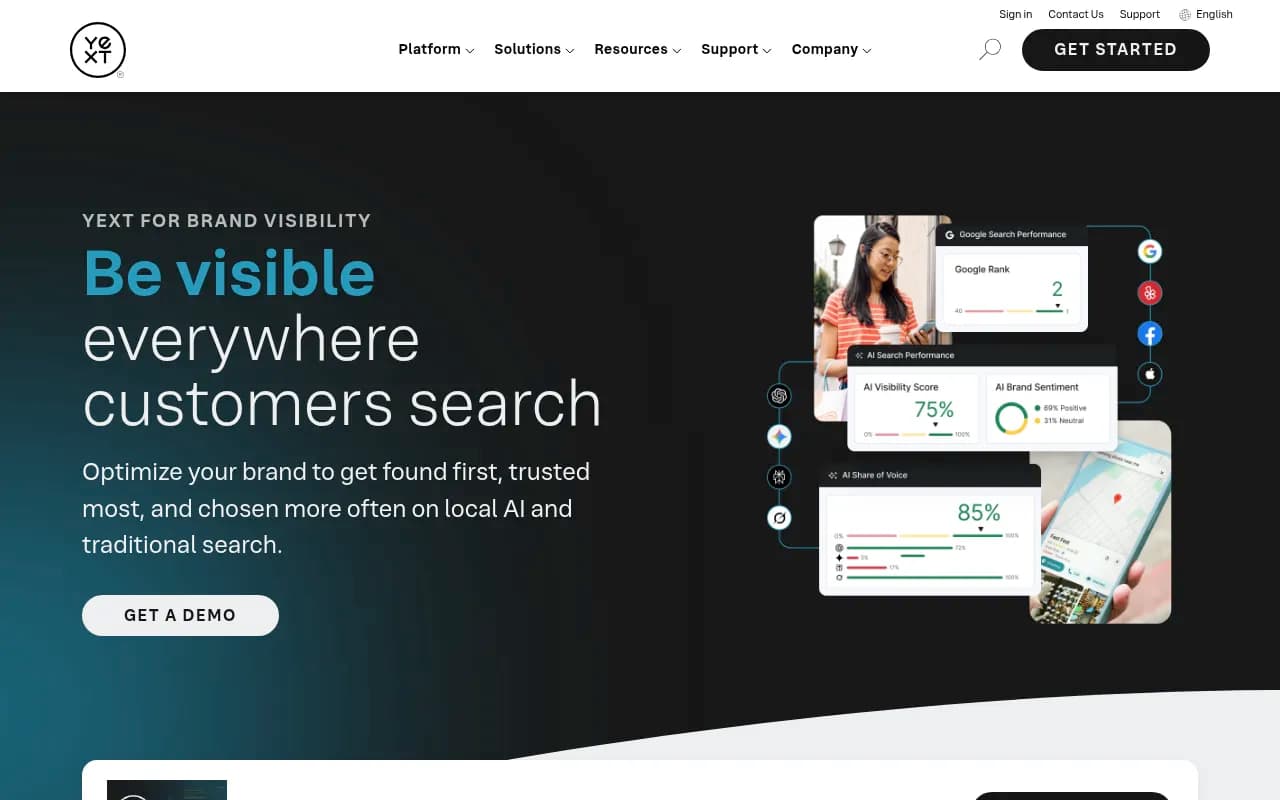
Yext is the enterprise-grade platform managing 2M+ locations for brands like McDonald's, IHG Hotels, Samsung, and FedEx. It's built for companies with 50+ locations (often 500+) who need centralized control over listings, reviews, pages, social content, and now AI search visibility across every location.
The core value proposition: a single "knowledge graph" that stores all your location data—addresses, hours, menus, services, photos, staff bios—and syncs it to 200+ publishers (Google, Apple Maps, Facebook, Yelp, TripAdvisor, etc.) automatically. When you update hours at one location, the change propagates everywhere within minutes. For brands managing hundreds of locations, this eliminates the manual work of logging into dozens of platforms to update information.
Yext's Pages product generates location landing pages at scale—SEO-optimized pages for each location with schema markup, local content, reviews, and CTAs. The platform also handles review monitoring and response management, social media publishing, and local analytics. What sets Yext apart from Chatmeter is the enterprise infrastructure: role-based permissions, multi-brand support, API access for custom integrations, and dedicated account management.
In 2026, Yext launched Scout—an AI agent that monitors competitive intelligence and AI search visibility. Scout tracks when competitors update their listings, change pricing, or get mentioned in AI-generated answers, then recommends actions to maintain competitive advantage. This brings Yext closer to Promptwatch's AI search monitoring, though Scout focuses more on competitive benchmarking than content optimization.
Pricing is custom and typically ranges from $10K to $100K+ annually depending on location count, features, and contract length. Yext targets enterprise brands with complex needs—multi-brand portfolios, international locations, franchise systems with corporate and franchisee access levels. If you're managing fewer than 50 locations, Yext is likely overkill and overpriced compared to Chatmeter or Birdeye.
Best for: Enterprise brands with 100+ locations, multi-brand portfolios, international operations, or franchise systems where corporate needs centralized control but franchisees need local autonomy. If you're spending $50K+ annually on reputation management, Yext's enterprise features justify the cost.
Reputation
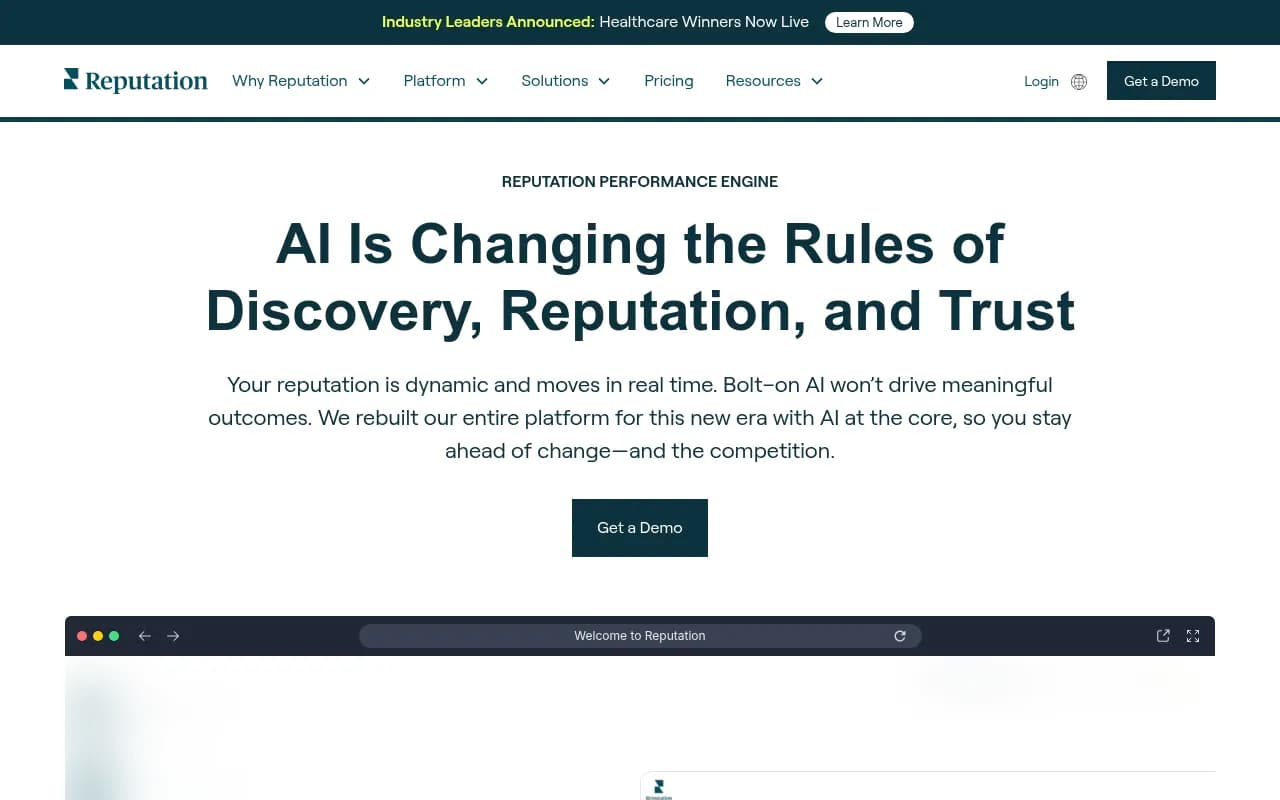
Reputation competes directly with Chatmeter in the mid-to-upper market, targeting multi-location brands in automotive, healthcare, retail, real estate, and hospitality. The platform combines listings management, review monitoring and response, surveys, social media management, and business intelligence in a single interface.
Reputation's differentiator is its focus on customer experience analytics. The platform doesn't just track reviews—it analyzes sentiment across reviews, surveys, and social mentions to identify trends. If multiple locations suddenly see complaints about wait times or staff behavior, Reputation's AI flags the pattern and suggests operational changes. This CX-focused approach appeals to brands that view reputation management as part of broader customer experience strategy, not just marketing.
The review generation workflow is particularly strong. Reputation sends SMS and email requests immediately after a transaction (integrated with POS systems, CRMs, and scheduling software), then routes happy customers to public review sites while directing unhappy customers to private feedback forms. This "review gating" maximizes positive reviews while giving you a chance to resolve issues before they become public complaints.
Pricing is custom and scales with location count. The Core tier (basic listings and reviews) starts around $80/mo per location, Professional (adds social media and surveys) runs $200-500/mo per location, and Enterprise (full analytics and integrations) goes $500-2000+/mo per location. Annual contracts are standard. For brands managing 20-100 locations, Reputation's pricing often exceeds Chatmeter's, but the CX analytics justify the cost if you're using reputation data to drive operational improvements.
What Reputation lacks: AI search visibility tracking (no ChatGPT or Perplexity monitoring), aggressive automation (less AI-powered content generation than Birdeye), and transparent pricing (everything is custom quotes). The platform is also more complex to set up than Chatmeter—expect a 30-60 day implementation with dedicated onboarding.
Best for: Mid-to-large brands (20-500 locations) in automotive, healthcare, retail, or hospitality who want to connect reputation data to operational metrics. If you're measuring NPS, CSAT, or other CX KPIs and want reputation management integrated into that workflow, Reputation delivers more depth than Chatmeter.
SOCi
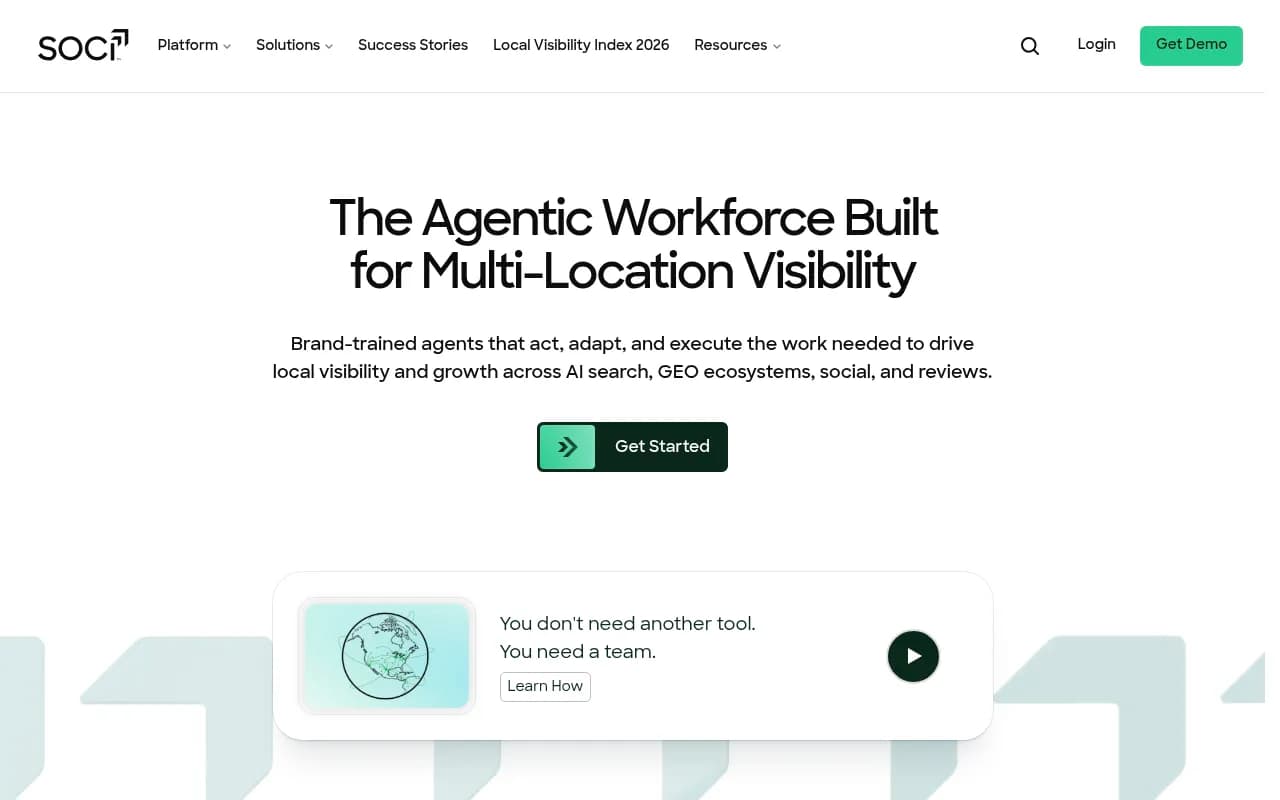
SOCi positions itself as a "local marketing platform" rather than just reputation management, emphasizing social media and content creation alongside listings and reviews. The platform is built for franchises, retail chains, and multi-location brands managing 10-1000+ locations who need localized marketing at scale.
SOCi's strength is its AI-powered content engine. The Social Agent generates localized social media posts for each location—adapting corporate campaigns to local events, holidays, and audience preferences. If your brand runs a national promotion, SOCi creates 500 location-specific versions that mention local landmarks, sports teams, or community events. The platform also handles social listening, engagement, and paid social campaigns (Facebook/Instagram ads) with location-level targeting.
The Search Agent manages listings across 100+ directories and monitors local search rankings. The Reputation Agent handles review monitoring, response generation, and review requests. SOCi also includes Pages (location landing pages), Chat (unified inbox for social messages, reviews, and SMS), Surveys & Forms, and Locator (store locator widget for your website).
What sets SOCi apart from Chatmeter: the emphasis on social media and localized content creation. If your brand relies heavily on social media for customer acquisition—restaurants, retail, fitness, beauty—SOCi's content automation saves significant time. The platform also offers better paid social capabilities than Chatmeter, with campaign management and performance tracking built in.
Pricing starts at $119/mo for the Individual plan (1-5 locations), $1,159/mo for the Advanced plan (more locations and features), and custom enterprise pricing for 500+ locations. SOCi tends to be more expensive than Chatmeter for smaller location counts but more competitive at enterprise scale.
What it lacks: AI search visibility tracking (no ChatGPT or Perplexity monitoring) and the same depth of reputation analytics as Reputation. SOCi is a marketing platform first, reputation platform second—great if you need social media automation, less compelling if reputation management is your primary concern.
Best for: Franchises and retail chains (10-1000 locations) where social media drives customer acquisition and you need localized content at scale. If you're currently managing social media manually across dozens of locations, SOCi's automation delivers immediate ROI.
Uberall
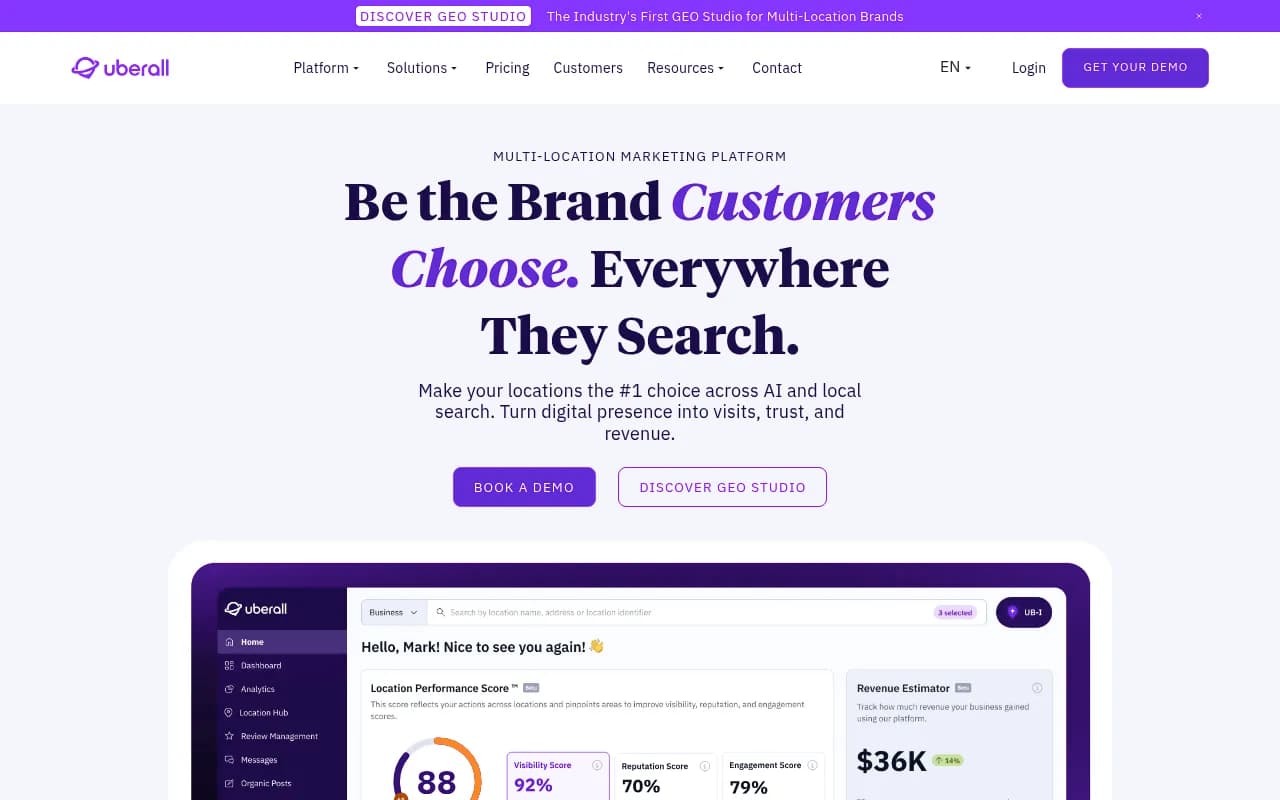
Uberall is a European-based platform (German company) that competes with Yext and SOCi in the multi-location marketing space. It manages listings across 150+ directories, monitors reviews, handles social media publishing, and now includes GEO Studio—a tool for optimizing brand visibility in AI search engines.
GEO Studio is Uberall's answer to Promptwatch, tracking how brands appear in AI-generated answers from ChatGPT, Gemini, and Perplexity. The tool analyzes which prompts trigger your brand mentions, identifies content gaps, and provides recommendations to improve AI visibility. This makes Uberall one of the few traditional reputation platforms adding AI search optimization in 2026.
The platform is particularly strong in Europe, where it has deeper integrations with local directories and search engines than US-based competitors. If you're managing locations across Germany, UK, France, and other European markets, Uberall's directory coverage exceeds Chatmeter's. The platform also handles multi-language content and region-specific compliance (GDPR, local advertising regulations) better than US-focused tools.
Pricing starts at $99/mo for the Show Up tier (basic listings), $399/mo for Stand Out (adds reviews and social media), and custom pricing for the Connect tier (full platform with GEO Studio and API access). Annual discounts available. Uberall's pricing is competitive with Chatmeter for European brands but less compelling for US-only operations.
What it lacks compared to Chatmeter: depth of US directory coverage, integrations with US-specific platforms (Nextdoor, Angi, HomeAdvisor), and market presence in North America. Uberall is a strong choice for European brands or global companies with significant European operations, but US-focused brands have better options.
Best for: Multi-location brands with significant European presence (50+ locations across multiple countries) who need local directory coverage, multi-language support, and GDPR compliance. Also worth considering if AI search visibility (via GEO Studio) is a priority and you want it integrated with traditional reputation management.
Synup
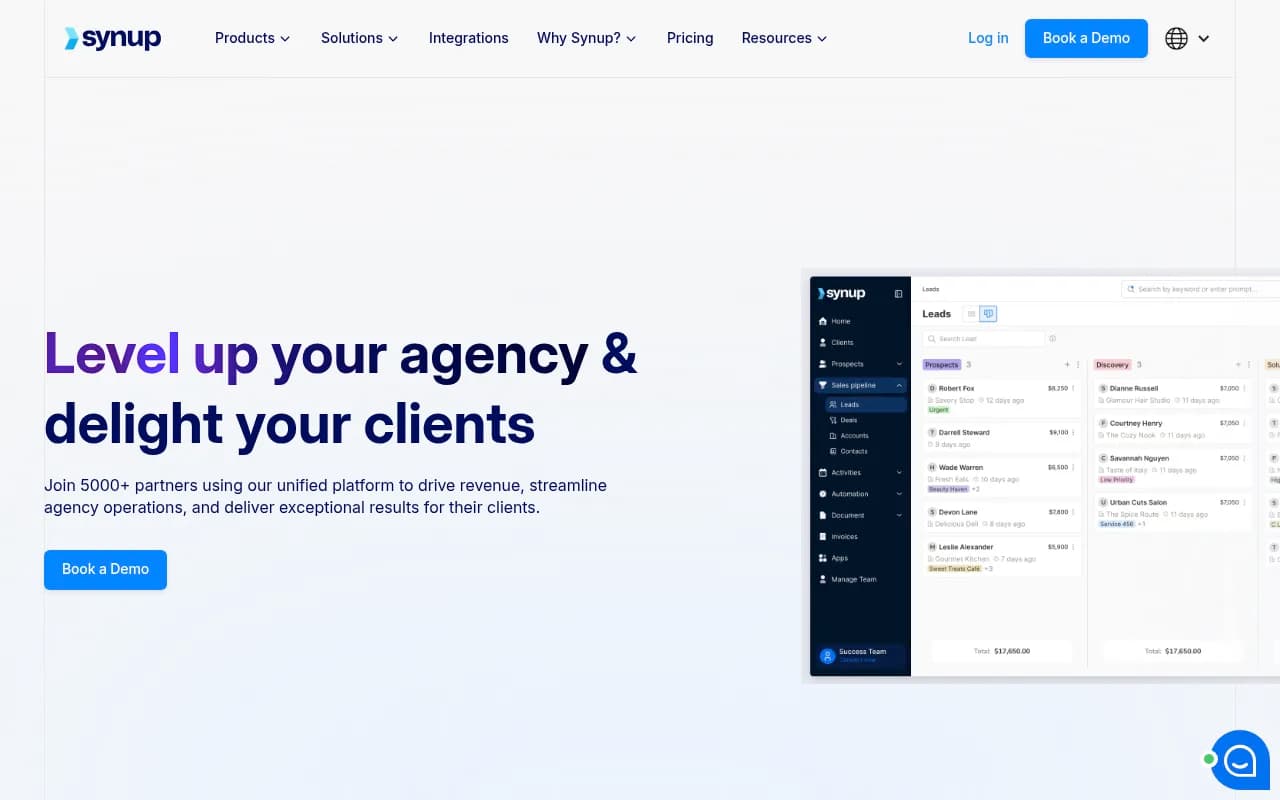
Synup takes a different approach from other Chatmeter alternatives—it's built specifically for digital marketing agencies managing multiple clients. The platform combines CRM, listings management, reputation monitoring, social media scheduling, and SEO tools in a white-labeled interface agencies can rebrand as their own.
The "operating system" concept means Synup handles the full client lifecycle: lead generation (landing pages and forms to capture prospects), sales pipeline management (CRM to track deals and proposals), client onboarding (automated workflows to gather business information), service delivery (listings, reviews, social media, SEO), and reporting (white-labeled dashboards and PDFs). Agencies can manage 10-500+ clients from a single platform without switching between tools.
Synup's listings management covers 70+ directories, review monitoring tracks 50+ sites, and social media scheduling supports Facebook, Instagram, Twitter, LinkedIn, and Google Business Profile. The platform also includes basic SEO tools (keyword tracking, site audits, backlink monitoring) and a content calendar for planning campaigns across clients.
What makes Synup compelling for agencies: the white-label branding and client portal. Your clients log into a dashboard with your agency's logo, colors, and domain—they never see Synup branding. You can also set custom pricing for each client and manage billing through Synup's platform. This eliminates the need for separate tools like HubSpot (CRM), BrightLocal (listings), Hootsuite (social media), and SEMrush (SEO).
Pricing starts at $79/mo for the Base plan (5 clients), $199/mo for the Agency plan (20 clients), and $799/mo for the Scale plan (100 clients). Annual billing saves 20%. Free trial available. For agencies managing 10-50 clients, Synup's all-in-one model often costs less than buying separate tools for each function.
What it lacks: the depth of features in specialized platforms. Synup's review management isn't as sophisticated as Birdeye's, its social media tools aren't as powerful as SOCi's, and it has no AI search visibility tracking. But for agencies who need "good enough" across multiple functions rather than "best in class" for one, Synup's consolidation and white-labeling justify the trade-offs.
Best for: Digital marketing agencies managing 10-100 clients who want a unified platform for CRM, listings, reviews, social media, and SEO with white-label branding. If you're currently using 5+ tools to manage clients and want to consolidate, Synup delivers immediate operational efficiency.
How to Choose the Right Chatmeter Alternative
The best alternative depends on your business model, location count, and primary use case:
If you're a small business or franchisee (1-10 locations): BrightLocal offers the best value at $39-199/mo with transparent pricing and no enterprise complexity. You get local rank tracking, citation building, and review monitoring without paying for features you don't need.
If you're a mid-market brand (10-100 locations) prioritizing automation: Birdeye delivers the most aggressive AI-powered workflows—automated review responses, social content generation, and listings optimization. Pricing is competitive with Chatmeter while offering more automation.
If AI search visibility is critical to your business: Promptwatch is the only platform that tracks and optimizes brand mentions in ChatGPT, Claude, Perplexity, and other AI engines. Use it alongside (not instead of) a traditional reputation platform if AI-generated recommendations drive customer acquisition.
If you're an enterprise brand (100+ locations) with complex needs: Yext provides the infrastructure, integrations, and account management that enterprise operations require. The cost is justified if you're managing multiple brands, international locations, or franchise systems.
If you're an agency managing multiple clients: Synup consolidates CRM, listings, reviews, social media, and SEO in a white-labeled platform. The all-in-one model saves money and operational complexity compared to stitching together separate tools.
If social media and localized content are priorities: SOCi's AI-powered content generation creates location-specific social posts at scale. Best for franchises and retail chains where social media drives foot traffic.
If you need CX analytics and operational insights: Reputation connects review sentiment to operational metrics, helping you identify systemic issues across locations. Worth the premium if you're using reputation data to drive business improvements beyond marketing.
The reputation management landscape has fragmented in 2026—there's no longer a single platform that does everything well for everyone. Chatmeter sits in the middle: not as affordable as BrightLocal, not as automated as Birdeye, not as enterprise-ready as Yext, and missing AI search visibility entirely. The right alternative depends on which of those gaps matters most to your business.