Key Takeaways
- Jasper is the enterprise choice for teams needing brand consistency, 100+ specialized agents, and content pipelines that automate end-to-end workflows
- Surfer SEO wins for SEO-focused content optimization with real-time analysis of top-ranking pages and data-driven recommendations
- Promptwatch is the only platform that tracks and optimizes your content's visibility in AI search engines like ChatGPT, Claude, and Perplexity -- then helps you create content that actually gets cited
- ChatGPT offers the most versatility for general writing tasks, research, and brainstorming at the lowest price point
- Rytr and ContentBot provide budget-friendly options for high-volume content creation with templates and bulk generation features
HubSpot's AI Content Writer sits inside their broader marketing platform, which makes sense if you're already a HubSpot customer. But if you're looking for more specialized AI writing capabilities, deeper SEO optimization, or tools that help you rank in AI search results, there are better options.
The main reasons people look beyond HubSpot: it's part of a larger suite (you're paying for features you might not need), the AI writing feels generic compared to specialized tools, and it doesn't offer the depth of SEO analysis or brand voice training that standalone platforms provide. If you're serious about content that ranks -- in Google or in AI engines -- you need something built specifically for that.
Jasper
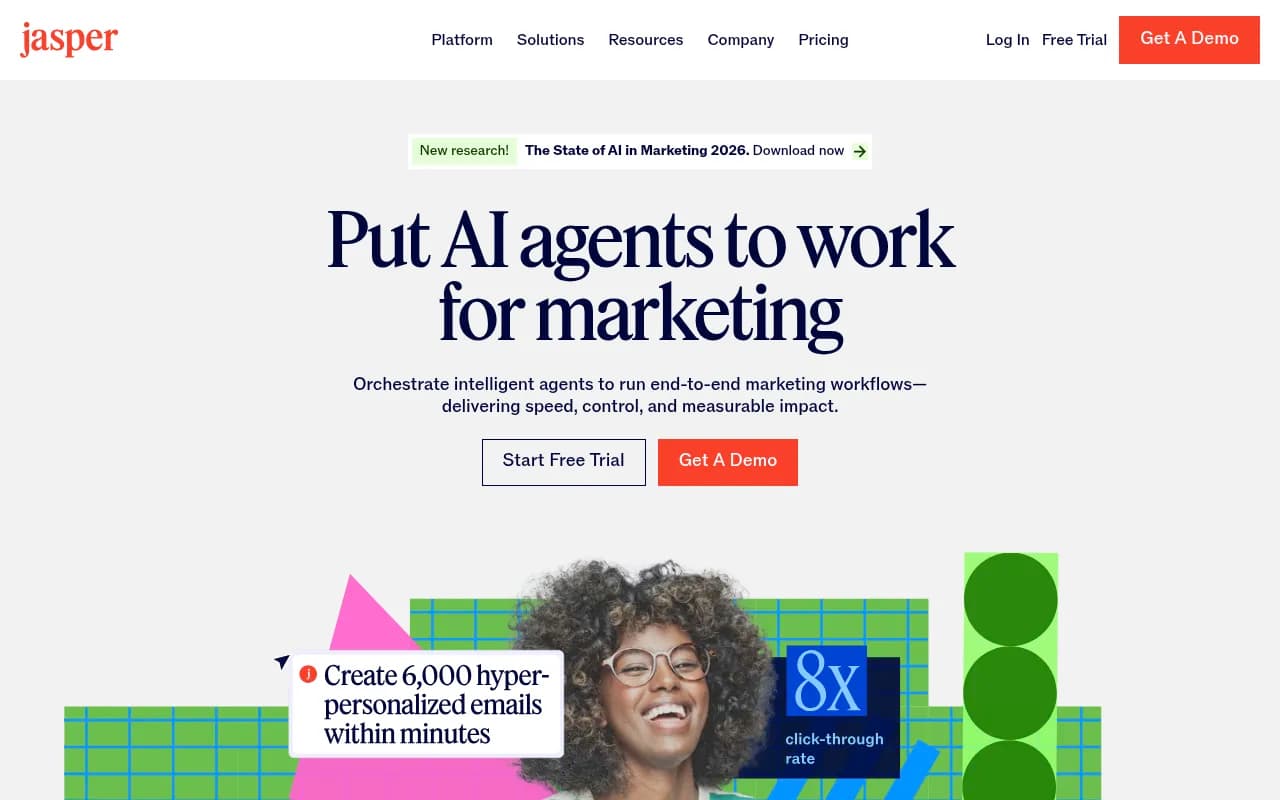
Jasper positions itself as an enterprise AI marketing platform, not just a writing tool. The core difference: it's built around agents and content pipelines that automate entire workflows, not just individual pieces of content.
The platform includes 100+ specialized AI agents trained for specific marketing tasks -- blog posts, ad copy, social media, email campaigns, product descriptions. You can chain these agents together into content pipelines that handle everything from ideation to final output. For example: research agent finds trending topics, outline agent structures the post, writing agent drafts it, editing agent polishes it, SEO agent optimizes it. All automated.
Brand Voice is where Jasper pulls ahead of HubSpot. It analyzes your existing content to learn your tone, style, and messaging, then applies that consistently across everything it generates. You can create multiple brand voices for different products, audiences, or clients. HubSpot's AI doesn't offer this level of brand training.
The Canvas workspace is a modern editor where teams can collaborate on AI-generated content in real-time. Grid mode lets you generate content at scale using spreadsheet-style inputs -- useful for product descriptions, meta tags, or any high-volume content task.
Image Suite includes proprietary vision models for generating on-brand images. Not as powerful as Midjourney or DALL-E for creative work, but faster and more consistent for marketing visuals.
Pricing starts at $59/month for the Creator plan (1 user, 1 brand voice, basic features). Pro plan is $249/month for teams up to 5 users with advanced features and more brand voices. Enterprise pricing is custom. Free trial available.
Best for: Marketing teams at mid-to-large companies that need to produce high volumes of on-brand content across multiple channels. The automation and brand consistency features justify the higher price if you're running serious content operations.
Trade-offs: More expensive than most alternatives. The feature set can feel overwhelming if you just need a simple writing assistant. Not ideal for solo creators or small teams on tight budgets.
Surfer SEO
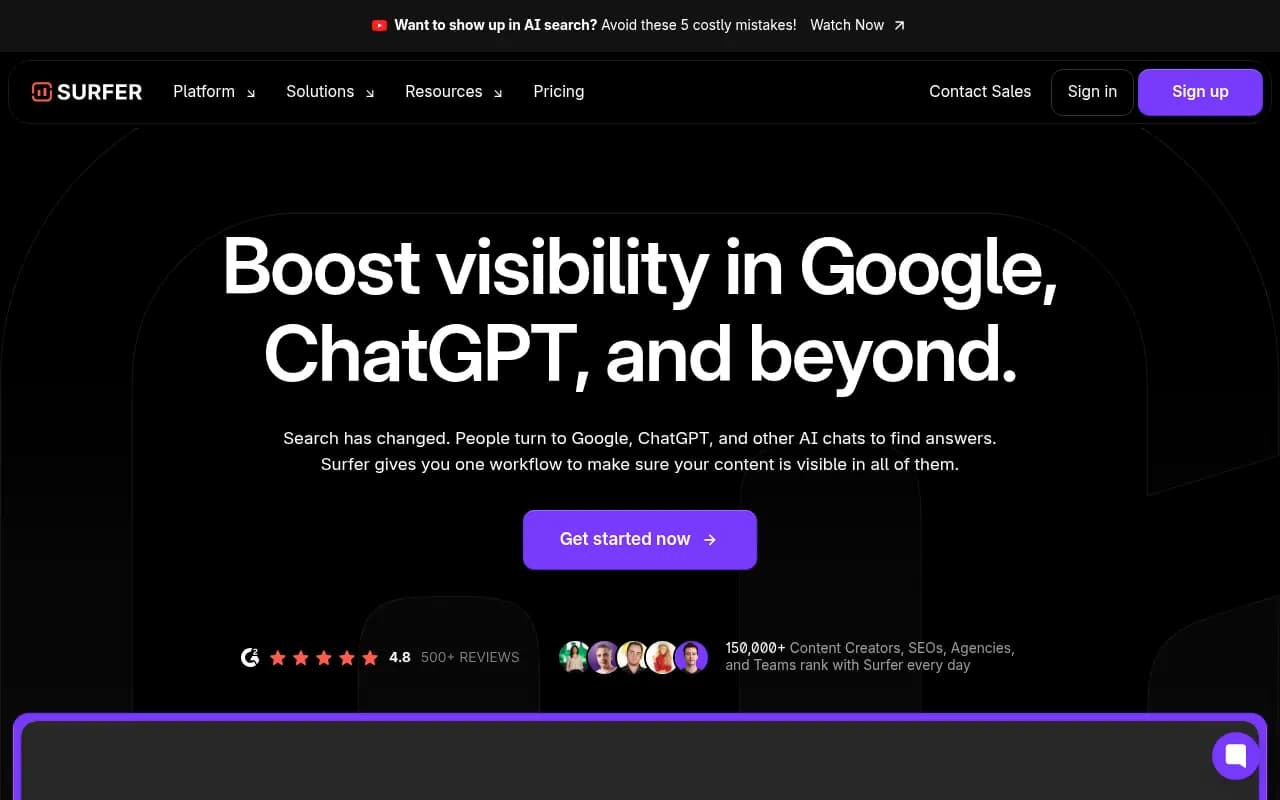
Surfer SEO is the tool you pick when ranking in Google search results is the primary goal. It's not a general-purpose AI writer -- it's an SEO content optimization platform that happens to include AI writing.
The core workflow: enter a target keyword, Surfer analyzes the top-ranking pages for that keyword, then gives you a data-driven content brief with recommended word count, headings, keywords to include, and semantic terms to cover. As you write (or as the AI writes), it scores your content in real-time and shows exactly what's missing.
Surfer AI is the built-in writing agent. It generates articles based on the SEO brief, but you pay per article with credits (not included in base subscription). The AI pulls from Surfer's analysis of top-ranking content, so the output is optimized for search from the start.
Content Editor is where you'll spend most of your time. It's a live editor with an SEO score that updates as you type. Green means you're hitting the targets, red means you're missing key elements. It's more prescriptive than HubSpot's AI -- Surfer tells you exactly what to add, not just general suggestions.
Audit tool analyzes your existing content and shows where it's falling short compared to current top-rankers. Useful for refreshing old posts that have lost rankings.
Pricing starts at $99/month for Essential (billed annually) with 30 articles, 1 user, and basic features. Advanced is $179/month with more articles and users. Max is $299/month. Enterprise is custom. Surfer AI articles cost additional credits on top of your plan. 7-day money-back guarantee.
Best for: SEO specialists, content marketers, and agencies focused on organic search rankings. If your success metric is "does this rank on page 1 of Google," Surfer is the most data-driven option.
Trade-offs: The prescriptive approach can feel restrictive -- you're optimizing for algorithms, not just writing naturally. The AI writing costs extra credits, so budget accordingly. Not useful if you're writing content that isn't targeting search keywords (thought leadership, brand storytelling, etc.).
Promptwatch

This is where things get interesting. Promptwatch isn't a content writing tool -- it's an AI Search Visibility platform that tracks how your brand appears in ChatGPT, Claude, Perplexity, Gemini, and other AI engines, then helps you optimize for those results.
Why this matters: search is shifting. People are asking ChatGPT and Perplexity for recommendations instead of Googling. If your brand isn't showing up in those AI responses, you're invisible to a growing segment of your audience. Traditional SEO tools like Surfer optimize for Google. Promptwatch optimizes for AI search.
The platform monitors 10 AI models and shows you exactly which prompts your brand appears in, which competitors are beating you, and what content gaps are causing you to lose visibility. Answer Gap Analysis is the killer feature -- it shows the specific topics, angles, and questions AI models want answers to but can't find on your site.
Then it helps you fix it. The built-in AI writing agent generates articles, listicles, and comparison pages grounded in real citation data (880M+ citations analyzed), prompt volumes, and competitor analysis. This isn't generic SEO content -- it's engineered to get cited by AI models.
Crawler Logs show real-time activity from AI crawlers (ChatGPT, Claude, Perplexity) hitting your website -- which pages they read, errors they encounter, how often they return. Most competitors don't offer this at all.
Citation & Source Analysis shows exactly which pages, Reddit threads, YouTube videos, and domains AI models cite in their responses. Reddit & YouTube Insights surface discussions that directly influence AI recommendations -- a channel most tools ignore.
ChatGPT Shopping Tracking monitors when your brand appears in ChatGPT's product recommendations and shopping carousels. Competitor Heatmaps compare your AI visibility vs competitors across LLMs.
Pricing: Essential $99/month (1 site, 50 prompts, 5 articles), Professional $249/month (2 sites, 150 prompts, 15 articles, crawler logs), Business $579/month (5 sites, 350 prompts, 30 articles). Agency and Enterprise custom pricing. Free trial available.
Best for: Brands and agencies that want to be visible in AI search results, not just Google. If your customers are using ChatGPT or Perplexity to research products or services, you need this. It's the only platform that closes the loop from tracking to content creation to results.
Trade-offs: This is a specialized tool for AI search optimization, not a general-purpose writing assistant. If you're only focused on traditional SEO, Surfer is a better fit. If you don't care about AI visibility yet, you might not see the value -- but that window is closing fast.
Copy.ai

Copy.ai started as a simple AI copywriting tool but has evolved into a GTM (go-to-market) AI platform. The company was recently acquired by Fullcast, and the product is now positioned as an end-to-end platform for sales and marketing workflows, not just content generation.
The original Copy.ai product offered quick AI-generated copy for emails, social media, ads, and landing pages. It was fast and template-driven -- pick a use case, fill in some inputs, get copy. That's still there, but the platform has expanded significantly.
The new GTM AI platform aims to "infuse AI across your go-to-market engine" with workflow automation, data unification, and team collaboration features. It's trying to be more than a writing tool -- closer to what Jasper is doing with content pipelines and agents.
The challenge: Copy.ai is in transition. The website and messaging focus heavily on the GTM platform vision, but the core product many users signed up for was the simple copywriting tool. If you're looking for a straightforward AI writer, the current positioning might feel confusing.
Pricing information isn't clearly listed on the current website, which suggests they're moving toward custom enterprise pricing for the GTM platform.
Best for: Hard to say right now. The original Copy.ai was great for marketers who needed quick, template-based copy. The new GTM platform is aimed at larger teams looking for end-to-end workflow automation. If you're evaluating Copy.ai today, book a demo to understand what you're actually getting.
Trade-offs: The product direction is unclear. If you want a simple, affordable AI writing tool, look at Rytr or ChatGPT instead. If you want an enterprise GTM platform, Jasper is more established.
ChatGPT
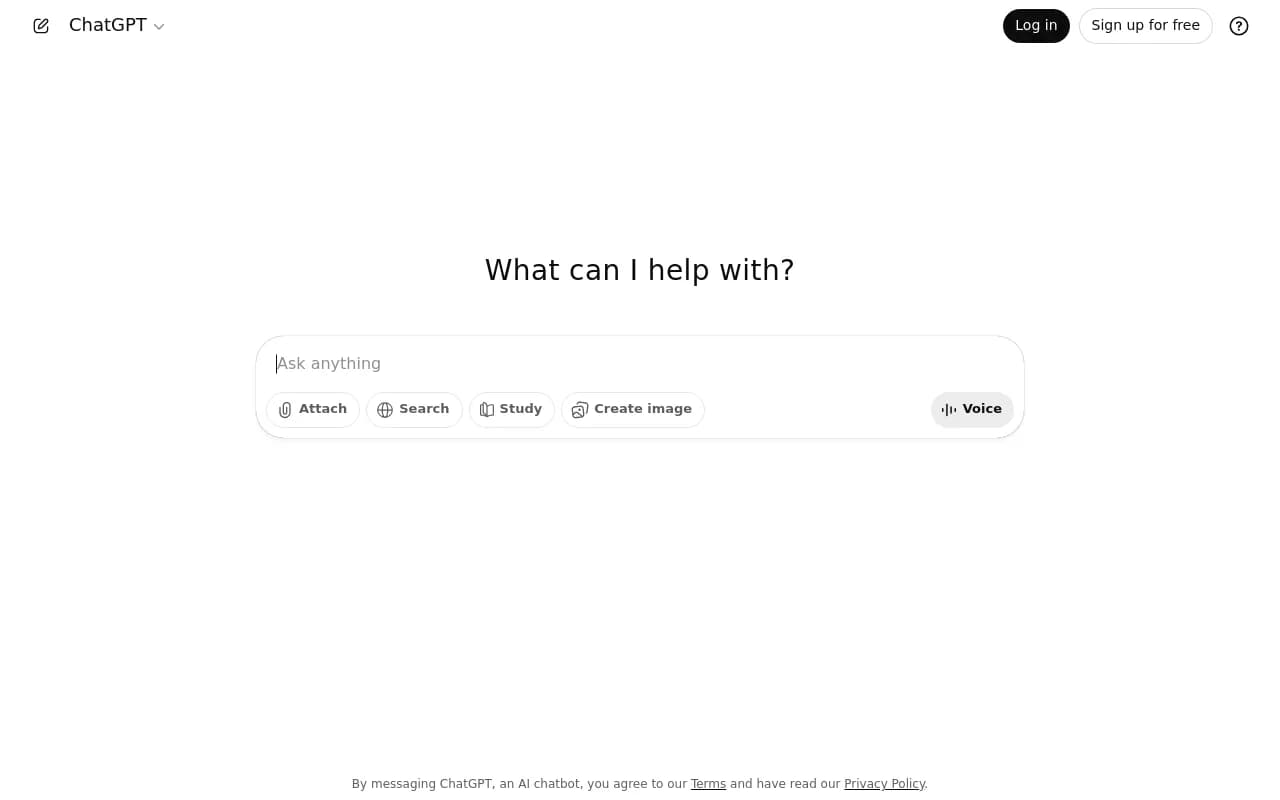
ChatGPT is the most versatile option on this list. It's not a specialized content marketing tool -- it's a general-purpose AI assistant that happens to be excellent at writing.
The advantage: you can use it for anything. Blog posts, social media, emails, research, brainstorming, editing, summarizing, analyzing files, generating images, writing code. One interface, endless use cases. HubSpot's AI is locked into specific marketing workflows. ChatGPT is freeform.
The free tier (GPT-4o mini) is surprisingly capable for basic writing tasks. The paid tiers unlock more powerful models, longer context windows, and advanced features like file analysis, web browsing, and DALL-E image generation.
For content creation, ChatGPT excels at first drafts, outlines, and brainstorming. It's less useful for SEO optimization (no built-in keyword analysis or content scoring like Surfer) and brand consistency (no brand voice training like Jasper). But for raw writing speed and versatility, nothing beats it.
Custom GPTs let you create specialized versions of ChatGPT trained on your instructions, files, and knowledge base. You can build a "Blog Post Writer" GPT with your brand guidelines, style guide, and example posts, then reuse it for consistent output.
Pricing: Free tier available. Plus is $20/month (GPT-4, faster responses, priority access). Pro is $200/month (unlimited access to most powerful models, priority compute). Team is $25/user/month (team workspace, admin controls). Enterprise is custom pricing.
Best for: Anyone who wants maximum flexibility and doesn't need specialized marketing features. Solo creators, small teams, and anyone on a budget should start here. It's also the best option if you're doing more than just content marketing -- research, analysis, coding, etc.
Trade-offs: No built-in SEO tools, no brand voice training, no content scoring or optimization features. You're trading specialized features for versatility and cost. If you need deep SEO analysis or brand consistency at scale, look at Surfer or Jasper.
Rytr
Rytr is the budget-friendly option for high-volume content creation. It's a straightforward AI writing tool with templates, tone controls, and a simple interface.
The platform offers 40+ use cases and templates -- blog posts, social media, emails, product descriptions, ad copy, etc. Pick a template, fill in some inputs, choose a tone, and generate. It's faster and simpler than ChatGPT for repetitive content tasks.
Tone matching is a standout feature. Rytr can analyze a sample of your writing and mirror your tone when generating new content. You can create multiple custom tones for different scenarios, projects, or clients. Not as sophisticated as Jasper's brand voice training, but useful for maintaining consistency.
Plagiarism checker is built-in (limited checks per month depending on plan). Useful for ensuring generated content is unique before publishing.
Chrome Extension lets you use Rytr anywhere you write -- Gmail, Google Docs, social media, CMS platforms. Convenient for quick content generation without switching tools.
Pricing: Free plan generates 10k characters per month with access to 40+ use cases and 20+ tones. Unlimited plan is $7.50/month for unlimited generations and 1 custom tone. Premium plan is $24.16/month for 5 custom tones, increased character limits, and 100 plagiarism checks per month.
Best for: Freelancers, small businesses, and solo creators who need to produce a lot of content quickly without spending much money. The unlimited plan at $7.50/month is hard to beat for value.
Trade-offs: The output quality isn't as high as Jasper or ChatGPT Plus. It's template-driven, so you're limited to predefined use cases. No advanced features like SEO optimization, content scoring, or workflow automation. But for the price, it's a solid workhorse.
Writesonic

Writesonic has pivoted hard into AI search visibility tracking and optimization -- similar to what Promptwatch does. The platform now positions itself as an "AI Search Visibility Tracking & Optimization Platform" rather than just an AI writing tool.
The core offering: track your brand's visibility across ChatGPT and 10+ AI platforms, monitor mentions, fix citation gaps, create and refresh content, and target Reddit and UGC forums. It's a complete GEO (Generative Engine Optimization) platform from tracking to action to results.
This is a significant shift from Writesonic's original positioning as a blog automation and content marketing tool. The AI writing features are still there, but the focus is now on AI search optimization.
The platform tracks how your brand performs in AI search results, identifies content gaps, and helps you create content that gets cited by AI models. It's competing directly with Promptwatch in the AI visibility space.
Pricing information isn't clearly listed on the homepage, which suggests custom pricing or a demo-first sales approach.
Best for: Brands and agencies that want to optimize for AI search visibility. If you're evaluating AI visibility platforms, compare Writesonic and Promptwatch side-by-side. Both are tackling the same problem with different approaches.
Trade-offs: The product positioning has changed significantly. If you're looking for a simple AI blog writer (what Writesonic used to be), you might be confused by the current offering. The AI visibility features are valuable, but the messaging and product focus are in flux.
ContentBot
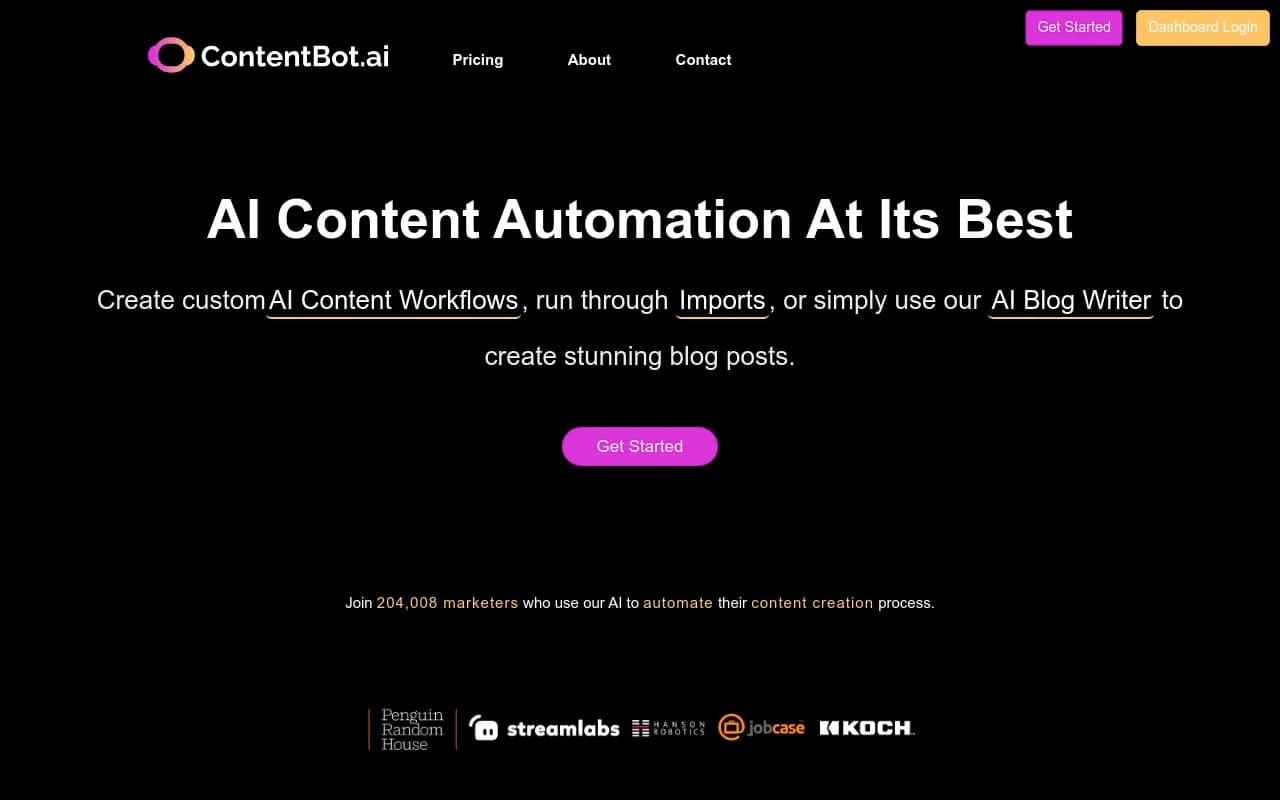
ContentBot is built for content automation at scale. The platform offers custom AI workflow builders, bulk import tools, and an AI blog writer with intelligent linking.
AI Flows is the standout feature. You can create custom workflows that chain together multiple AI tasks -- research, outline, draft, edit, optimize, publish. Similar to what Jasper does with content pipelines, but with a more DIY approach. You build the flow yourself rather than using pre-built agents.
AI Blog Writer includes intelligent linking features that automatically add internal and external links to your content. This is useful for SEO and credibility -- the AI identifies relevant sources and links to them, making your content more authoritative.
Importer tool lets you bulk-generate content from spreadsheets. Upload a CSV with product names, descriptions, or keywords, and ContentBot generates content for each row. Useful for ecommerce product descriptions, meta tags, or any high-volume content task.
The platform is built on GPT-4 and offers 50+ AI writing tools for different content types -- blog posts, social media, emails, ads, landing pages, etc.
Pricing: Freemium model with prepaid credits starting at $0.50/1k words, or subscription plans from $9/month (50k words) to $49/month (400k words). 10k free words on first prepaid purchase.
Best for: Digital marketers, content marketers, and agencies that need to produce high volumes of content across multiple clients or projects. The bulk import and custom workflow features are designed for scale.
Trade-offs: The interface and user experience feel less polished than Jasper or ChatGPT. The workflow builder is powerful but requires more setup and learning. Not ideal if you just need a simple writing assistant for occasional use.
Which alternative should you choose?
If you're leaving HubSpot's AI Content Writer, your choice depends on what you're optimizing for:
For enterprise marketing teams that need brand consistency and automation: Jasper is the clear winner. The brand voice training, content pipelines, and 100+ specialized agents justify the higher price if you're running serious content operations.
For SEO-focused content that ranks in Google: Surfer SEO gives you the most data-driven optimization. The real-time content scoring and analysis of top-ranking pages make it the best tool for organic search visibility.
For visibility in AI search engines (ChatGPT, Claude, Perplexity): Promptwatch is the only platform that tracks your AI visibility, identifies content gaps, and helps you create content that gets cited by AI models. If your customers are using AI search, you need this.
For maximum versatility and budget-friendliness: ChatGPT offers the best combination of capability and cost. The free tier is surprisingly powerful, and the paid tiers unlock advanced features for $20/month.
For high-volume content creation on a tight budget: Rytr's unlimited plan at $7.50/month is hard to beat. The output quality isn't as high as premium tools, but it's a solid workhorse for repetitive content tasks.
For content automation at scale: ContentBot's workflow builder and bulk import tools are designed for agencies and marketers producing content across multiple clients or projects.
The biggest shift happening right now: AI search is becoming as important as Google search. Tools like Promptwatch and Writesonic are betting that brands will need to optimize for how they appear in ChatGPT and Perplexity, not just Google. If you're only focused on traditional SEO, you're missing a growing channel. The brands that figure out AI visibility early will have a significant advantage.