Key Takeaways
- Promptwatch leads for AI search visibility and GEO optimization with crawler logs, content gap analysis, and AI-powered content generation—capabilities OnCrawl lacks entirely
- Botify matches OnCrawl's enterprise scale and adds AI search optimization (GEO/AEO) with agentic workflows, though at significantly higher price points ($10k-$50k+/month)
- Sitebulb offers the most intuitive interface with trademark prioritization and Hints, available in both desktop ($35-$135/mo) and cloud versions for teams needing collaboration
- JetOctopus provides similar enterprise crawling capabilities (up to 100M+ pages) at more accessible pricing, starting around $99/mo vs OnCrawl's $69/mo base
- Screaming Frog remains the budget-friendly choice at $259/year for unlimited crawling, though it lacks cloud infrastructure and log analysis
OnCrawl has built a strong reputation among enterprise SEO teams at brands like L'Oréal, Ticketmaster, and Harrods for handling large, complex websites. Its combination of JavaScript crawling, log file analysis, and AI bot monitoring makes it a solid technical SEO platform. But the landscape has evolved significantly—especially with the rise of AI search engines like ChatGPT, Claude, and Perplexity fundamentally changing how users discover content.
If you're managing a site with 10,000+ pages and need to understand how search engines and AI agents explore your content, you're likely evaluating OnCrawl against other enterprise platforms. Maybe you're hitting crawl volume limits, need better AI visibility tracking, want more intuitive reporting, or simply exploring what else is available before committing to an annual contract.
Here's an honest breakdown of the best OnCrawl alternatives, what they do differently, and who should pick each one.
Promptwatch

Promptwatch takes a fundamentally different approach than OnCrawl—it's built specifically for the AI search era. While OnCrawl focuses on traditional search engine crawling and log analysis, Promptwatch is an end-to-end AI Search Visibility platform used by 6,700+ brands including Booking.com and Center Parcs.
The core difference: OnCrawl shows you how search engines crawl your site. Promptwatch shows you how AI models like ChatGPT, Claude, Perplexity, and Gemini cite your brand—then helps you fix the gaps.
What it does better: Promptwatch is the only platform rated as a "Leader" across all GEO categories in a 2026 comparison of 12 platforms. It monitors 10 AI models, tracks 1.1 billion+ citations, and closes the action loop that most competitors miss. You get Answer Gap Analysis showing exactly which prompts competitors rank for but you don't, an AI writing agent that generates content engineered to get cited by AI models (grounded in 880M+ citations analyzed), and page-level tracking showing which content is working.
The AI Crawler Logs feature gives you real-time visibility into ChatGPT, Claude, and Perplexity bots hitting your site—which pages they read, errors they encounter, how often they return. This is critical data OnCrawl doesn't provide. You also get prompt intelligence with volume estimates and difficulty scores, Reddit and YouTube insights that influence AI recommendations, ChatGPT Shopping tracking, and multi-language/multi-region monitoring.
What OnCrawl does better: Traditional technical SEO depth for large sites. OnCrawl's crawl budget optimization, JavaScript rendering analysis, and segmentation system are more mature for pure technical SEO work. If you're not focused on AI search visibility and just need deep crawl analysis, OnCrawl's core competency is stronger.
Pricing comparison: Promptwatch starts at $99/mo (Essential: 1 site, 50 prompts, 5 articles), $249/mo (Professional: 2 sites, 150 prompts, 15 articles, crawler logs), $579/mo (Business: 5 sites, 350 prompts, 30 articles). OnCrawl starts at $69/mo for 100K URLs but scales up quickly for enterprise features. Promptwatch includes content generation; OnCrawl doesn't.
Best for: Marketing and SEO teams that need to be visible in AI search results, not just traditional Google. If your customers are using ChatGPT, Claude, or Perplexity to research products and services, Promptwatch shows you where you're invisible and helps you fix it. Essential for brands in competitive spaces where AI recommendations drive purchase decisions.
Botify
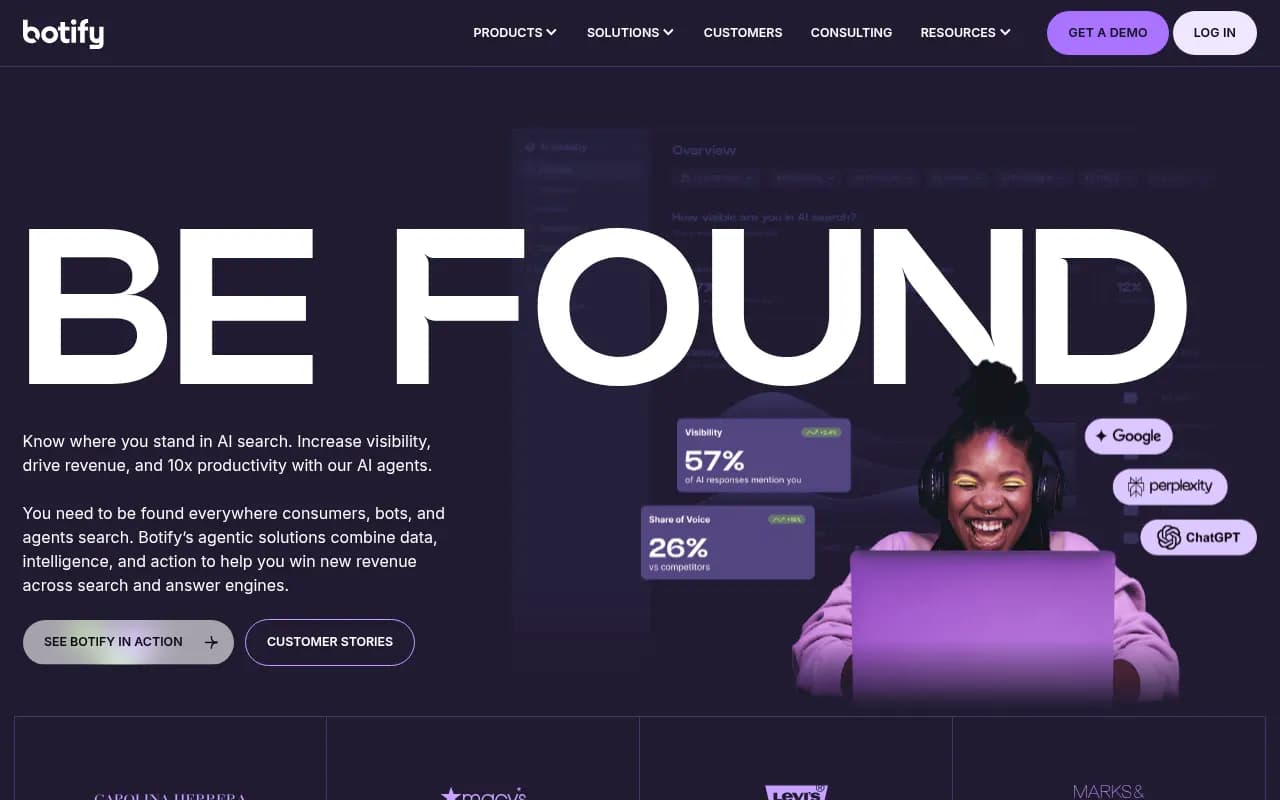
Botify is OnCrawl's most direct enterprise competitor, offering similar scale (handles massive sites) plus AI search optimization capabilities OnCrawl lacks. Used by brands like Carolina Herrera and Ralph Lauren, it's positioned as an "AI search optimization platform" that covers traditional SEO, GEO (Generative Engine Optimization), and AEO (Answer Engine Optimization).
What it does better: Botify combines OnCrawl's technical SEO depth with AI search visibility tracking and agentic workflows. You get full GEO performance visibility—how your brand appears in ChatGPT, Perplexity, and Google AI Overviews—plus AI agents that automate optimization tasks. The platform promises 30-day time-to-value and 5x ROI within 3 years, backed by enterprise-grade analytics and automation.
Botify's agentic approach means the platform doesn't just show you data—it takes action. AI agents help you prioritize fixes, generate optimization recommendations, and track implementation. This is closer to Promptwatch's action loop than OnCrawl's monitoring-focused approach.
What OnCrawl does better: Pricing accessibility and focused technical SEO. OnCrawl starts at $69/mo; Botify's enterprise pricing typically runs $10k-$50k+ per month with annual contracts. OnCrawl's interface is also more straightforward for teams that just need crawling and log analysis without the AI search layer.
Pricing comparison: Botify requires custom enterprise pricing (expect $10k-$50k+/month based on site size). OnCrawl starts at $69/mo with mid-tier and enterprise plans scaling up. Botify is 10-100x more expensive but includes AI search optimization and automation that OnCrawl doesn't offer.
Best for: Enterprise organizations with significant budgets ($100k+/year) that need both traditional SEO and AI search optimization in one platform. If you're a Fortune 500 brand managing multiple large sites and can afford the investment, Botify delivers comprehensive coverage. Smaller teams or those focused purely on technical SEO should look elsewhere.
Sitebulb

Sitebulb is the most user-friendly alternative to OnCrawl, winning "Best Search Software Tool" twice for good reason. Used by Amazon, Mailchimp, and Yahoo, it's built around making technical SEO audits easier and more actionable through intuitive visualizations and trademark "Hints" that explain exactly what's wrong and how to fix it.
What it does better: Interface and usability. Sitebulb's prioritization system automatically surfaces the most critical issues, and every problem comes with detailed explanations and fix suggestions that stakeholders actually understand. The platform offers both desktop ($35-$135/mo) and cloud versions, with the cloud option supporting real-time team collaboration across the same crawl data—something OnCrawl's interface doesn't handle as elegantly.
Sitebulb crawls up to 10 million URLs per audit (cloud version) and checks 300+ SEO issues automatically. The customizable PDF reports are genuinely client-ready without heavy editing. For agencies and consultants who need to explain technical issues to non-technical stakeholders, Sitebulb's visual approach is unmatched.
What OnCrawl does better: Log file analysis depth and AI bot monitoring. OnCrawl's log analyzer is more powerful for understanding Googlebot behavior and tracking AI crawler activity. Sitebulb focuses on crawling and auditing; OnCrawl adds the server-side perspective through log analysis.
Pricing comparison: Sitebulb Desktop ranges from $35/mo (Lite: 1 user, 5k URLs) to $135/mo (Agency: 3 users, 500k URLs). Cloud starts at $125/mo (Mini: 2 users) to $495/mo (Medium: 10 users). OnCrawl starts at $69/mo but scales up for enterprise features. Sitebulb is more affordable for small-to-mid-size sites; OnCrawl is better priced for very large enterprise deployments.
Best for: SEO consultants, agencies, and in-house teams that need to communicate technical issues clearly to developers and stakeholders. If you're tired of tools that dump data without context, Sitebulb's Hints and visualizations make audits actually actionable. The desktop version is perfect for freelancers; cloud is ideal for agency teams collaborating on client sites.
JetOctopus
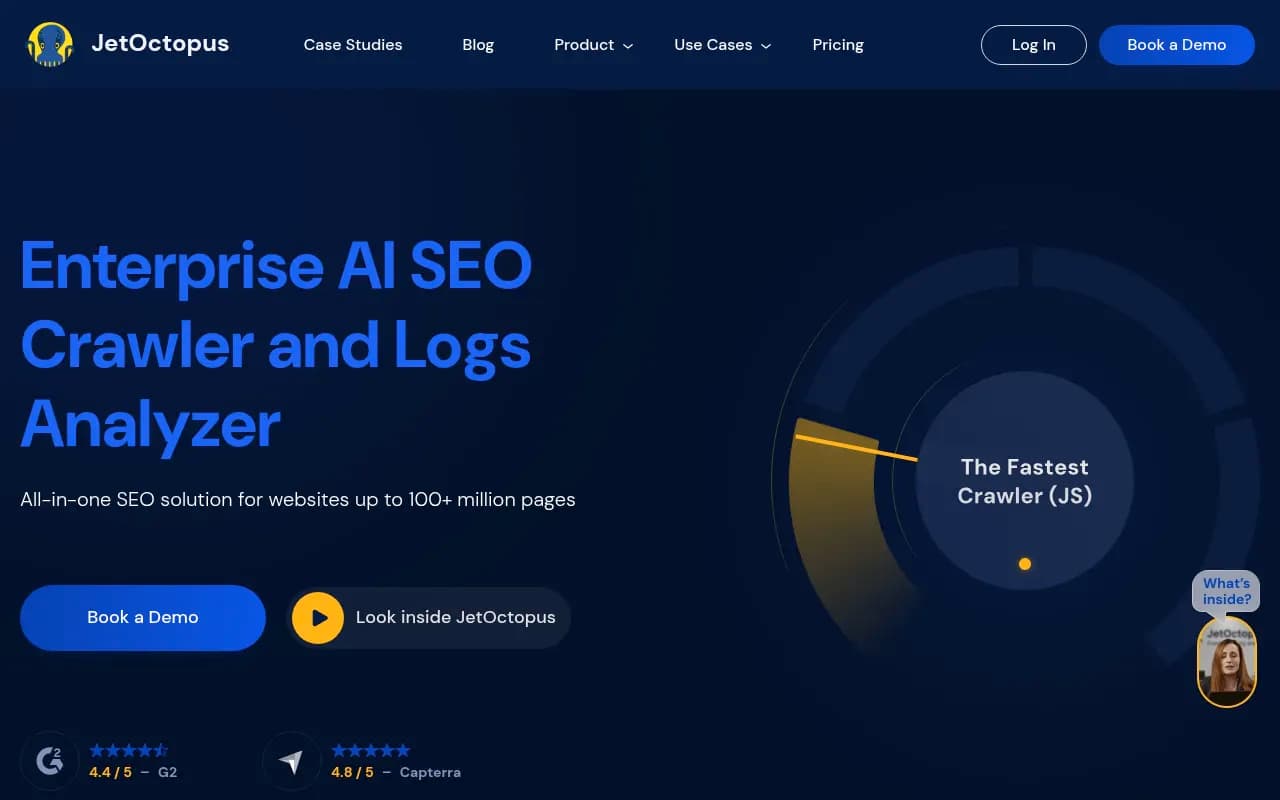
JetOctopus is OnCrawl's closest functional equivalent—a cloud-based enterprise crawler with log analysis, JavaScript rendering, and Google Search Console integration. Used by Fiverr, IHG, and 35,000+ sites, it handles the same scale (10K to 100M+ pages) at similar or better pricing.
What it does better: Preset charts with insights that save significant time. JetOctopus includes ready-made visualizations for common SEO scenarios (crawl budget optimization, indexation issues, ranking analysis) so you're not building every report from scratch. The "join dataset" feature lets you combine crawl data, logs, and GSC data on the fly without limits—more flexible than OnCrawl's segmentation system.
JetOctopus also includes an AI internal linking tool that suggests link placements to improve crawl efficiency and PageRank flow. The alert system covers on-page SEO, Googlebot activity, and SERP efficiency in one place.
What OnCrawl does better: Brand recognition and market maturity. OnCrawl has been around longer and has more enterprise case studies. Some teams find OnCrawl's interface more polished, though this is subjective—JetOctopus fans prefer its data-dense approach.
Pricing comparison: JetOctopus starts around $99/mo for smaller sites with custom pricing for enterprise volumes (25% discount on annual billing). OnCrawl starts at $69/mo. Both scale up based on crawl volume and features, but JetOctopus often comes in slightly cheaper at equivalent tiers.
Best for: Enterprise SEO teams managing large e-commerce sites, job boards, or classified ad platforms (10K+ pages) who want OnCrawl's capabilities without vendor lock-in. If you're evaluating OnCrawl and want a comparable alternative with potentially better pricing, JetOctopus is the most direct swap.
Screaming Frog
Screaming Frog is the desktop-based workhorse that's been around since 2010. It's not a direct OnCrawl competitor (lacks cloud infrastructure and log analysis), but it's worth considering if you're questioning whether you need an enterprise platform at all.
What it does better: Cost and simplicity. Screaming Frog is free up to 500 URLs, then $259/year for unlimited crawling. That's a fraction of OnCrawl's cost. For technical SEO audits and finding on-site issues quickly, it's incredibly powerful. The desktop app is fast, customizable, and doesn't require learning a complex web interface.
What OnCrawl does better: Everything cloud-based and collaborative. OnCrawl handles log file analysis, AI bot monitoring, scheduled crawls, team collaboration, and historical data tracking. Screaming Frog is a single-user desktop tool—you run crawls manually, export data to spreadsheets, and manage everything locally. No log analysis, no crawler tracking, no automated alerts.
Pricing comparison: Screaming Frog is $259/year for unlimited crawling. OnCrawl starts at $69/mo ($828/year). If you only need occasional crawls and don't require log analysis or team features, Screaming Frog is 70% cheaper.
Best for: Freelance SEO consultants, small agencies, and in-house teams with limited budgets who need powerful crawling without enterprise features. If you're comfortable with desktop software and don't need cloud collaboration or log analysis, Screaming Frog delivers exceptional value. Not suitable for teams managing multiple large sites or needing continuous monitoring.
Lumar
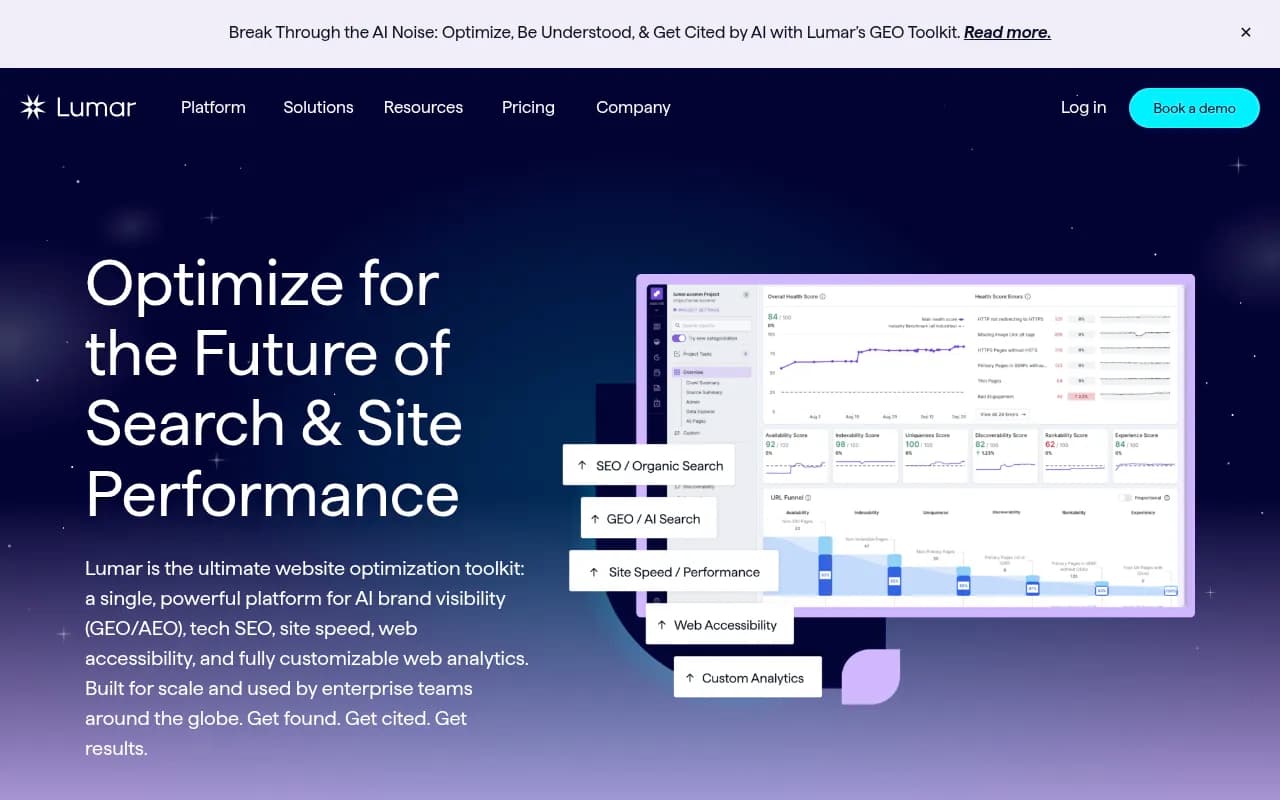
Lumar (formerly Deepcrawl) is an all-in-one website optimization platform that extends beyond pure SEO into site speed, web accessibility, and custom analytics. Used by Adobe, Deloitte, and other enterprise teams, it's positioned as a comprehensive toolkit rather than just a crawler.
What it does better: Breadth of capabilities. Lumar combines technical SEO auditing with GEO/AEO metrics (AI search visibility), site speed monitoring (Lighthouse and Core Web Vitals), web accessibility testing (WCAG 2.2 compliance), and fully customizable analytics dashboards. If you need to monitor multiple aspects of website health beyond SEO, Lumar consolidates tools.
The GEO toolkit tracks AI brand mentions and sentiment across major platforms, with AI-powered suggestions for optimization. The custom analytics builder lets you create tailored metrics for unique optimization questions—useful for enterprise teams with specific reporting needs.
What OnCrawl does better: Focused technical SEO depth. OnCrawl's crawling and log analysis are more mature because that's all they do. Lumar's breadth means each individual feature may not be as deep as a specialized tool. If you only need technical SEO, OnCrawl's focused approach is stronger.
Pricing comparison: Lumar requires custom enterprise pricing (contact for quote). OnCrawl starts at $69/mo with transparent tiered pricing. Lumar is likely more expensive but includes site speed, accessibility, and custom analytics that OnCrawl doesn't offer.
Best for: Enterprise teams managing large sites who need technical SEO, AI visibility, site speed, and accessibility monitoring in one platform. If you're currently using separate tools for each (OnCrawl for SEO, Lighthouse for speed, accessibility checkers), Lumar consolidates the stack. Overkill if you only need technical SEO.
Semrush
Semrush is the all-in-one digital marketing suite used by 10M+ marketers and 35% of Fortune 500 companies. It's not a pure OnCrawl alternative—it's a much broader platform covering SEO, content, PPC, social media, and local search—but it includes technical SEO auditing and newer AI visibility tracking.
What it does better: Breadth and integration. Semrush combines site audits, backlink analysis, keyword research, rank tracking, content creation tools, PPC research, and social media management in one subscription. If you need more than just technical SEO, Semrush delivers an entire marketing toolkit. The AI visibility features track ChatGPT, Perplexity, and Gemini mentions, though they're less mature than specialized GEO platforms like Promptwatch.
What OnCrawl does better: Technical SEO depth and scale. OnCrawl's crawling capabilities, log analysis, and segmentation system are more powerful for large, complex sites. Semrush's site audit is solid for mid-size sites but doesn't match OnCrawl's enterprise-grade crawling. OnCrawl also provides deeper AI bot monitoring through log analysis.
Pricing comparison: Semrush starts at $165/mo (Starter), $290/mo (Pro+), $580/mo (Advanced), with enterprise custom pricing. OnCrawl starts at $69/mo. Semrush is more expensive but includes 8 toolkits beyond technical SEO. If you only need crawling and log analysis, OnCrawl is better value.
Best for: Marketing teams that need an all-in-one platform covering SEO, content, PPC, and social media. If you're currently paying for multiple tools (Ahrefs for SEO, separate content tools, PPC research), Semrush consolidates everything. Not ideal if you only need deep technical SEO for large sites—OnCrawl or JetOctopus are better focused choices.
Ahrefs
Ahrefs is another comprehensive SEO and marketing platform used by 44% of Fortune 500 companies. Like Semrush, it's broader than OnCrawl, combining traditional SEO tools with newer AI search monitoring through Brand Radar.
What it does better: Backlink analysis and keyword research. Ahrefs has the web's largest backlink index and keyword database—its core strength. The site audit feature is solid, and Brand Radar adds AI search tracking across ChatGPT, Perplexity, and other models. If you need backlink analysis, keyword research, and technical SEO in one platform, Ahrefs delivers.
What OnCrawl does better: Enterprise-scale crawling and log analysis. Ahrefs' site audit is good for most sites but doesn't match OnCrawl's capabilities for very large, complex websites. OnCrawl's log file analysis and AI bot monitoring are more detailed. Ahrefs' Brand Radar uses fixed prompts and lacks AI traffic attribution—less flexible than specialized GEO platforms.
Pricing comparison: Ahrefs starts at $83/mo (Lite), $166/mo (Standard), $333/mo (Advanced), with enterprise custom pricing. OnCrawl starts at $69/mo. Ahrefs is more expensive but includes backlink analysis, keyword research, and content tools OnCrawl doesn't offer.
Best for: SEO teams that need backlink analysis and keyword research alongside technical audits. If you're building links, researching competitors' strategies, and need site auditing, Ahrefs is a strong all-in-one choice. For pure technical SEO at enterprise scale, OnCrawl or JetOctopus are better focused options.
ContentKing
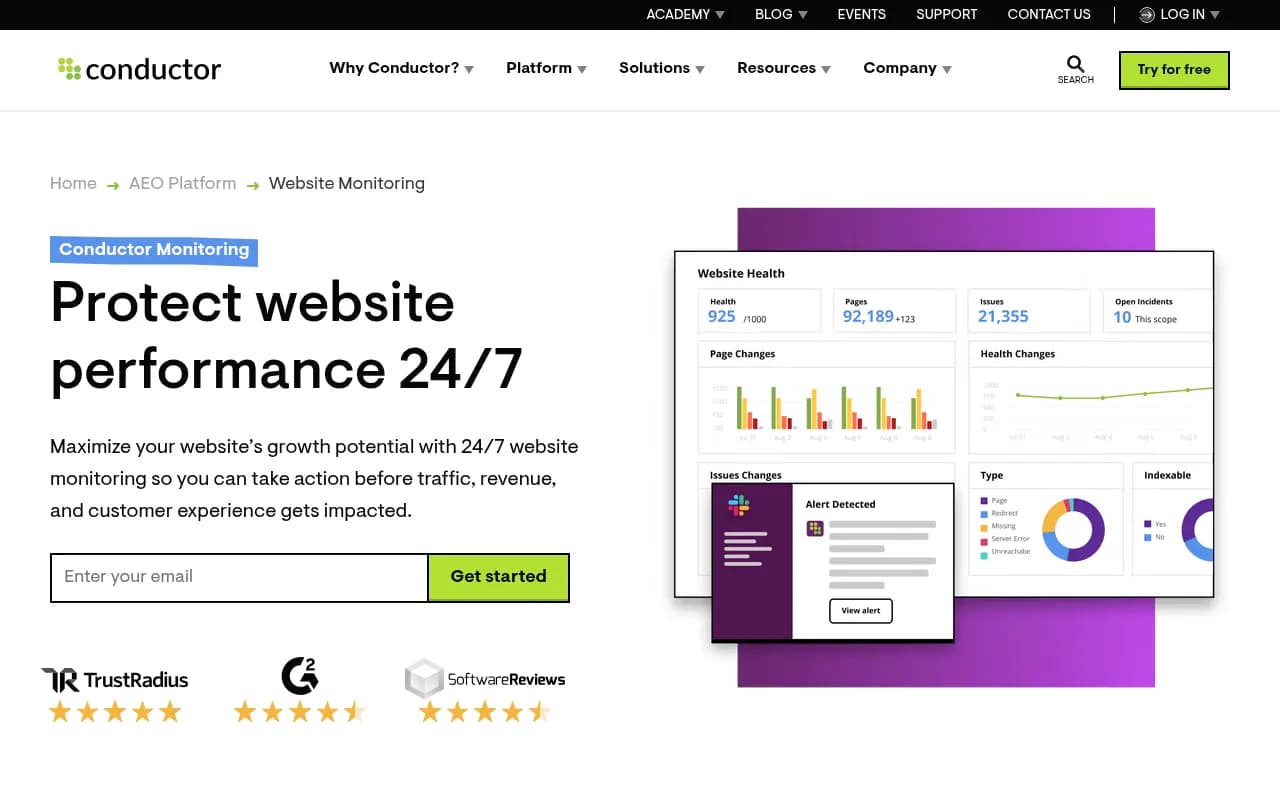
ContentKing (now Conductor Website Monitoring) is a real-time SEO monitoring platform that continuously watches your site for changes and issues. Unlike OnCrawl's scheduled crawls, ContentKing monitors 24/7 and sends instant alerts when problems occur.
What it does better: Real-time change detection. ContentKing alerts you immediately when pages change, issues appear, or compliance problems arise—you don't wait for the next crawl. This is valuable for large sites with frequent updates where issues can impact traffic quickly. The custom element monitoring feature tracks specific page elements (product prices, legal disclaimers, brand standards) across your entire site.
What OnCrawl does better: Depth of crawl analysis and log file insights. OnCrawl's segmentation system, JavaScript rendering analysis, and log file analysis are more powerful for understanding how search engines explore your site. ContentKing focuses on change detection; OnCrawl focuses on crawl optimization.
Pricing comparison: ContentKing (Conductor Monitoring) ranges from $139/mo (Basic) to $1,279/mo (Enterprise). OnCrawl starts at $69/mo. ContentKing is more expensive but provides 24/7 monitoring vs scheduled crawls.
Best for: Enterprise teams managing sites where changes happen frequently and issues need to be caught immediately. If you're in e-commerce with daily product updates, publishing with constant content changes, or managing compliance-sensitive content, ContentKing's real-time alerts prevent problems before traffic drops. Less useful if you only need periodic technical audits.
Summary: Which OnCrawl Alternative Should You Choose?
Choose Promptwatch if you need to be visible in AI search engines like ChatGPT, Claude, and Perplexity. It's the only platform that shows you where you're invisible in AI results, then helps you fix it with content gap analysis and AI-powered content generation. Essential for brands where AI recommendations drive purchase decisions. Starts at $99/mo.
Choose Botify if you're a large enterprise ($100k+ annual budget) that needs both traditional SEO and AI search optimization with agentic workflows. Combines OnCrawl's scale with AI visibility tracking and automation. Expect $10k-$50k+/month.
Choose Sitebulb if you need the most intuitive interface with clear explanations and stakeholder-friendly reports. Perfect for agencies and consultants who need to communicate technical issues to non-technical clients. Desktop from $35/mo, Cloud from $125/mo.
Choose JetOctopus if you want OnCrawl's capabilities at similar or better pricing. Handles 10K to 100M+ pages with preset insights, flexible data joining, and AI internal linking. Most direct OnCrawl swap. Starts around $99/mo.
Choose Screaming Frog if you're on a tight budget and only need occasional crawls without cloud features or log analysis. Desktop tool at $259/year for unlimited crawling. Best for freelancers and small teams.
Choose Lumar if you need technical SEO, AI visibility, site speed, and web accessibility monitoring in one platform. Consolidates multiple tools for enterprise teams with broad optimization needs. Custom enterprise pricing.
Choose Semrush if you need an all-in-one marketing platform covering SEO, content, PPC, and social media. Good for teams consolidating multiple tools, though technical SEO depth is less than specialized crawlers. From $165/mo.
Choose Ahrefs if backlink analysis and keyword research are priorities alongside technical audits. Strong all-in-one platform with Brand Radar for AI search tracking. From $83/mo.
Choose ContentKing if you need 24/7 real-time monitoring with instant alerts for changes and issues. Best for high-frequency update sites where problems need immediate detection. From $139/mo.
The right choice depends on your specific needs: AI search visibility (Promptwatch), enterprise scale with AI optimization (Botify), intuitive auditing (Sitebulb), direct OnCrawl replacement (JetOctopus), budget crawling (Screaming Frog), comprehensive optimization (Lumar), all-in-one marketing (Semrush/Ahrefs), or real-time monitoring (ContentKing). Most teams will find better value in a specialized tool than trying to make OnCrawl do everything.