Key takeaways
- Promptwatch is the top pick for teams that want to do more than monitor -- it finds content gaps, generates AI-optimized content, and tracks results across 10+ LLMs. Best for marketing teams and agencies serious about GEO.
- Semrush is worth considering if you're already paying for its traditional SEO suite and want basic AI visibility layered in -- but its AI features use fixed prompts and lack traffic attribution, so it's a monitoring add-on, not a GEO strategy.
- Profound is a strong enterprise option with solid prompt volume data and content agents, but it starts at $499/month and has no free trial -- a real barrier for smaller teams.
- Peec AI and Otterly.AI are good entry-level monitors. Affordable, easy to set up, but both stop at the data layer -- no content generation, no crawler logs, no traffic attribution.
- SE Ranking is the right call if you need a full traditional SEO platform with AI visibility as a bolt-on, especially for agencies managing multiple clients.
- LLMrefs offers a keyword-centric approach at a flat $79/month -- unusually simple pricing for this space, and good for teams that think in keywords rather than prompts.
- Rankscale covers 17+ AI engines (more than most) and has strong technical auditing, but it's newer and less proven at scale.
- AthenaHQ has a polished interface and good enterprise clients, but at $295/month for self-serve it's priced high for what's still largely a monitoring tool.
- Scrunch AI has a genuinely interesting "Agent Experience Platform" angle -- helping AI bots read your site better -- that most competitors don't touch.
Most people looking at Semrush alternatives for AI search visibility fall into one of two camps. Either they're already Semrush customers who've realized the AI Visibility Toolkit doesn't go deep enough, or they're starting fresh and want a tool built specifically for GEO rather than one that bolted it on.
Semrush's traditional SEO capabilities are genuinely excellent. Keyword research, backlink analysis, site audits -- it's a mature platform with 10+ years of data behind it. But its AI visibility features are a different story. The prompts are fixed (you can't customize them to your actual use case), there's no traffic attribution connecting AI visibility to revenue, and there's no content generation to help you act on what you find. For a lot of teams, that's not enough.
Here's a clear-eyed look at the best alternatives.
The alternatives
Promptwatch

Promptwatch is the most complete GEO platform available right now, and the only one that closes the full loop from gap identification to content creation to traffic attribution. That's not marketing copy -- it's a structural difference from every other tool on this list.
Most AI visibility platforms show you a dashboard. Promptwatch shows you a dashboard and then asks: "Now what?" The Answer Gap Analysis identifies specific prompts where competitors appear but you don't -- not just "you're missing visibility" but "here are the exact topics and questions AI models want to answer that your site doesn't cover." The built-in AI writing agent then generates articles, listicles, and comparison pages grounded in 880M+ real citations. After publishing, you track whether AI models start citing your new content, and you connect that visibility to actual traffic via a code snippet, GSC integration, or server log analysis.
That cycle -- find gaps, create content, measure results -- is what separates Promptwatch from monitoring-only tools. Semrush doesn't have it. Neither does Peec AI, Otterly, or AthenaHQ.
A few other things worth knowing: Promptwatch has real-time AI crawler logs (see exactly when ChatGPT, Claude, or Perplexity crawls your pages and what errors they hit), Reddit and YouTube citation tracking (most competitors ignore these entirely), ChatGPT Shopping monitoring, prompt volume and difficulty scoring, and query fan-outs that show how one prompt branches into sub-queries. It monitors 10 AI models including Google AI Mode, DeepSeek, Grok, and Mistral -- not just the obvious three.
Pricing starts at $99/month for the Essential plan (1 site, 50 prompts, 5 articles), $249/month for Professional (2 sites, 150 prompts, crawler logs, city-level tracking), and $579/month for Business (5 sites, 350 prompts). There's a 7-day free trial. Compared to Semrush's $165+ starting price for a platform where AI visibility is one of eight toolkits, Promptwatch is actually more focused value if AI search is your priority.
Rated 4.7/5 on G2, used by Booking.com, Center Parcs, Yelp, Typeform, and WPP. It's the only platform rated "Leader" across all categories in a 2026 comparison of 12 GEO tools.
Best for: Marketing teams, SEO teams, and agencies that want to actually improve AI visibility -- not just measure it.
Semrush
Semrush is the incumbent. If you're reading this page, you probably already know what it does: keyword research, backlink analysis, site audits, competitive intelligence, content tools, local SEO, social media tracking. It's a genuinely comprehensive platform used by 10M+ marketers.
The AI Visibility Toolkit is a newer addition. It tracks brand mentions across ChatGPT, Perplexity, and Gemini, shows share of voice against competitors, and surfaces which sources AI models cite. The data is real and the interface is clean.
The limitations are specific. Prompts are fixed -- Semrush decides which queries to track, not you. That's a significant constraint if your brand operates in a niche or if you want to track the exact questions your customers are actually asking. There's no traffic attribution connecting AI visibility to revenue. There's no content generation to help you act on gaps. And there's no crawler log visibility to understand how AI bots interact with your site.
Pricing: $165/month (Starter), $290/month (Pro+), $580/month (Advanced). The AI Visibility Toolkit is included in these plans, but you're paying for the whole platform. If you only care about AI search, you're paying for a lot of features you won't use.
Where Semrush genuinely wins: if you're already a subscriber and want AI visibility as a secondary signal alongside your traditional SEO workflow, it's convenient. The data integrates naturally with everything else you're already tracking. For teams that live in Semrush, adding AI visibility there makes sense. For teams building a GEO strategy from scratch, a dedicated platform will go deeper.
Best for: Existing Semrush customers who want basic AI visibility monitoring without adding another tool to their stack.
Profound
Profound

Profound is the most enterprise-grade option in this space. Used by MongoDB, Ramp, and Mercury, it covers the full monitoring stack: brand mentions across 9+ AI engines, AI crawler behavior (they call it "Agent Analytics"), prompt volume data, and content generation agents. The feature set is genuinely strong.
The prompt volume data is particularly good -- Profound shows you what millions of people are asking AI, which lets you align your content strategy with actual demand rather than guessing. The content agents can generate AEO-optimized FAQs and other content formats directly from the platform.
The catch is price and access. Profound starts at $499/month for the Lite tier (3 seats, 24k responses/month, 2-month history). There's no free trial. That's a real barrier for smaller teams or agencies that want to evaluate before committing. Enterprise pricing is custom and almost certainly higher.
Compared to Promptwatch, Profound has comparable monitoring depth and similar content generation capabilities. The differences come down to: Promptwatch has Reddit and YouTube citation tracking (Profound doesn't), Promptwatch has ChatGPT Shopping monitoring, and Promptwatch's pricing is more accessible starting at $99/month with a free trial. Profound has SOC 2 compliance and a more enterprise-oriented sales process, which matters for larger organizations with procurement requirements.
Best for: Enterprise marketing teams at well-funded companies that need SOC 2 compliance and have budget to match.
Peec AI

Peec AI is a clean, focused monitoring tool. It tracks visibility, position, and sentiment across ChatGPT, Perplexity, Claude, and Gemini, lets you benchmark competitors, and shows which sources AI models cite. The interface is well-designed and the onboarding is fast.
What it doesn't do: there's no content generation, no crawler logs, no traffic attribution, no Reddit/YouTube tracking, no ChatGPT Shopping monitoring. It's a monitoring dashboard, full stop. That's not a criticism -- it's just what it is. For teams that want data and are happy to act on it themselves, Peec AI is a reasonable starting point.
Pricing is competitive: €89/month (~$103) for the Starter plan (50 prompts, 10 models), €199/month for Growth (150 prompts, 2 workspaces). There's a free trial. That's cheaper than Semrush for AI-only use cases, though you're getting less breadth.
The 10-model coverage on the Starter plan is actually better than some more expensive tools. And the workspace structure on Growth makes it usable for agencies managing multiple clients.
Best for: Small marketing teams or early-stage companies that want to start tracking AI visibility without a big budget or complex setup.
Otterly.AI
Otterly.AI

Otterly.AI monitors six AI search engines: ChatGPT, Perplexity, Google AI Overviews, Google AI Mode, Gemini, and Copilot. It tracks brand mentions, website citations, and share of voice, and includes a GEO Audit tool that analyzes 25+ on-page factors.
The GEO Audit is the most interesting differentiator here. It goes beyond "here's your visibility score" to tell you what's holding your site back from earning more citations -- structural issues, content gaps, authority signals. That's more actionable than a raw visibility number.
What's missing compared to Promptwatch: no crawler logs, no traffic attribution, no content generation, no Reddit/YouTube tracking, no prompt volume data. The AI keyword research feature helps you discover relevant prompts, but it's not the same as seeing actual volume estimates.
Pricing is the most accessible on this list: $29/month for Lite (15 prompts), $189/month for Standard (100 prompts). The 14-day free trial requires no credit card. For teams that want to dip their toes in without committing, that's a low-friction starting point.
Best for: Budget-conscious teams that want basic monitoring plus some on-page optimization guidance, without needing the full GEO stack.
SE Ranking
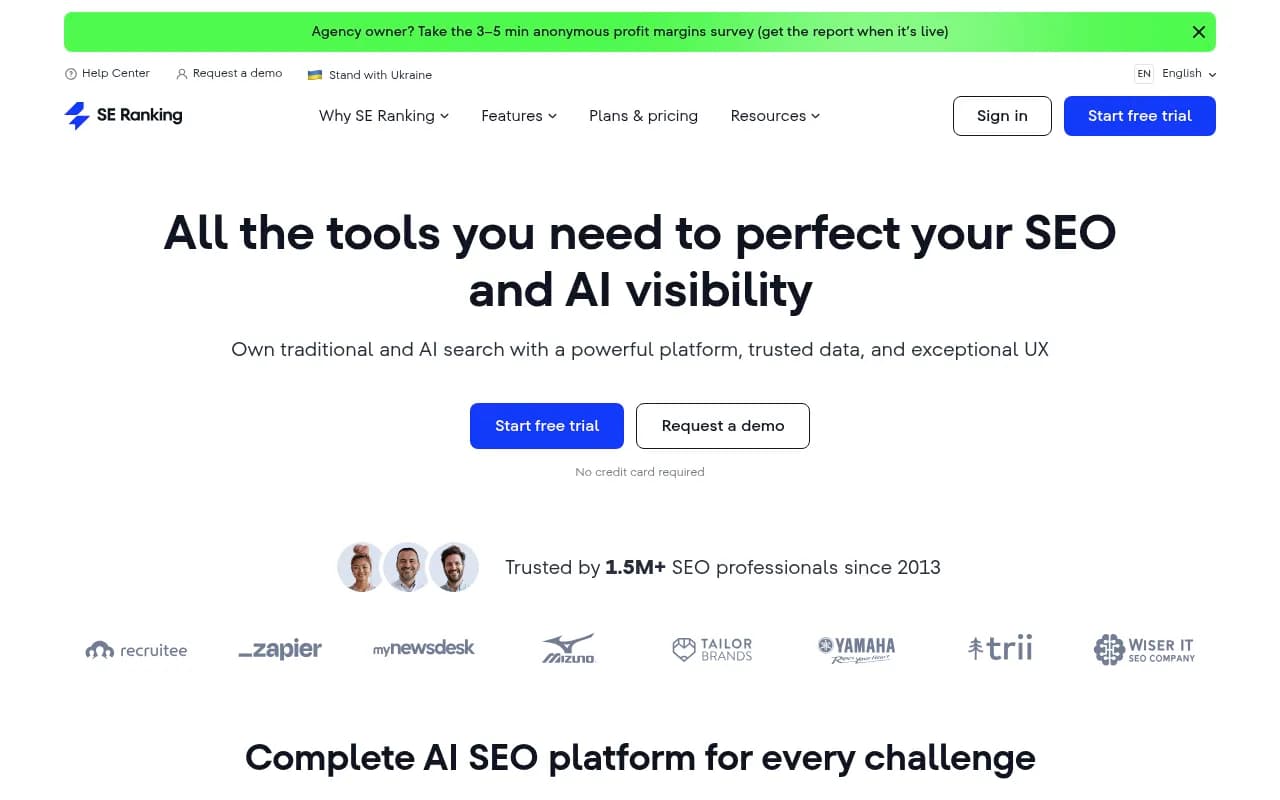
SE Ranking is primarily a traditional SEO platform -- rank tracking, keyword research, site audits, backlink monitoring, white-label reporting -- that has added AI search visibility as a module. The AI Search add-on costs $71.20/month on top of the base plan, which starts at $103.20/month.
The traditional SEO capabilities are strong. SE Ranking has a 5.4B keyword database, covers 188 countries, and has particularly good white-label reporting for agencies. If you're managing multiple clients and need to produce branded reports, SE Ranking is one of the better options in this price range.
The AI visibility features are more limited. It tracks brand mentions and citations across major LLMs, but like Semrush, it's an add-on to a traditional SEO platform rather than a purpose-built GEO tool. No content generation, no crawler logs, no traffic attribution.
Where SE Ranking beats Semrush: price. The combined cost of SE Ranking's base plan plus the AI Search add-on is around $175/month -- less than Semrush's starting price for a comparable feature set. For agencies that need both traditional SEO and basic AI visibility, SE Ranking is the more cost-efficient bundle.
Best for: SEO agencies that need strong traditional SEO tools with AI visibility as a secondary feature, and want white-label reporting without paying Semrush prices.
LLMrefs
LLMrefs
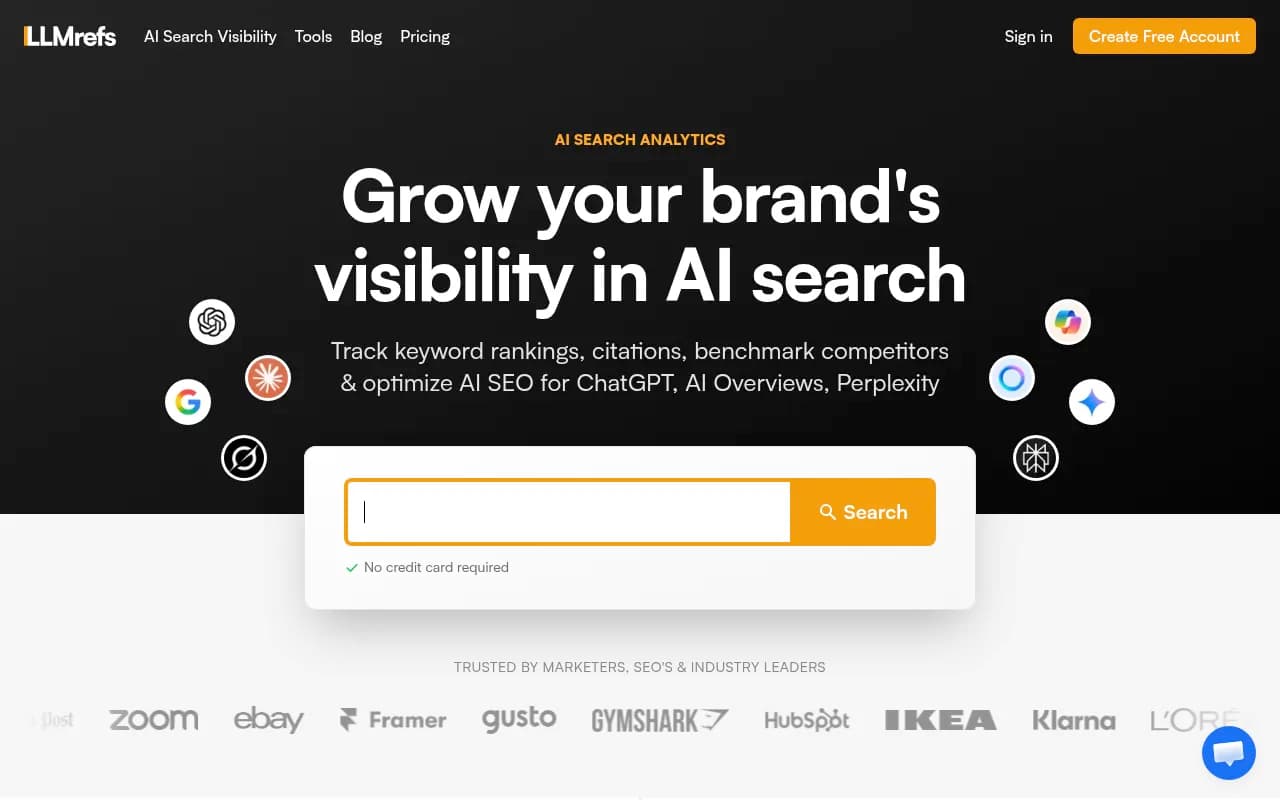
LLMrefs takes a different approach to the prompt-vs-keyword debate that runs through this whole space. Most GEO tools ask you to define specific prompts to track. LLMrefs lets you enter keywords and automatically generates relevant prompts from them -- which is more familiar to SEO teams that think in keywords rather than conversational queries.
It covers 11 AI engines including ChatGPT, Google AI Overviews, Perplexity, Claude, Gemini, Grok, Copilot, and Meta AI. The citation analysis shows which pages, domains, and sources AI models reference. Competitor benchmarking is included. It works across 50+ countries.
The pricing model is unusually simple: $79/month flat, with 500 prompts, unlimited projects, unlimited domains, and unlimited team seats. No per-seat pricing, no tiered feature gates. For agencies managing many clients, that unlimited seats model is genuinely valuable.
What it doesn't have: content generation, crawler logs, traffic attribution, Reddit/YouTube tracking. It's a monitoring and analysis tool.
The keyword-centric approach is a real differentiator for teams coming from traditional SEO backgrounds. It lowers the learning curve considerably. The trade-off is that you might miss some of the nuance that comes from tracking specific conversational prompts.
Best for: SEO teams that want to apply familiar keyword-based thinking to AI visibility tracking, especially agencies managing multiple clients at a flat rate.
Rankscale
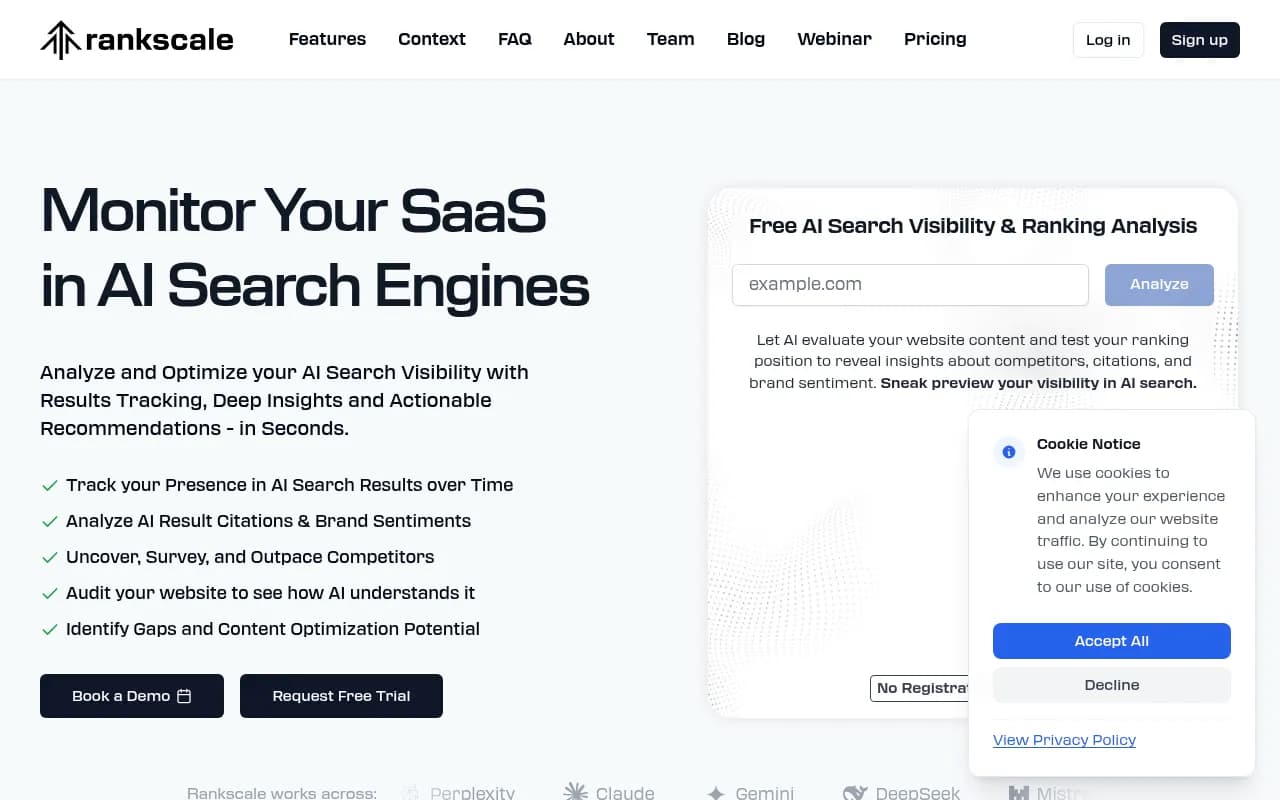
Rankscale covers more AI engines than any other tool on this list -- 17+, including some less common ones. It also runs across 240+ countries and languages, which is relevant for global brands that need visibility data beyond the US/UK/EU core markets.
The technical auditing is a standout feature: 94 checkpoints analyzing the structural and authority signals AI engines use to verify and cite content. That's more thorough than the GEO audits most competitors offer. The prompt research tool estimates search volume through "semantic reconstruction" -- a methodology that's interesting but less transparent than Profound's or Promptwatch's volume data.
Rankscale is newer and has a smaller user base (1,000+ active users vs. Promptwatch's 6,900+). That matters for data quality -- platforms with more users and more prompts processed tend to have more reliable citation and volume data. The pricing is credit-based, starting around $75-150/month, which can make costs harder to predict than flat-rate plans.
No content generation, no traffic attribution, no Reddit/YouTube tracking.
Best for: Global brands or agencies that need AI visibility data across many countries and languages, and want thorough technical auditing.
AthenaHQ

AthenaHQ has a polished product and a solid client list -- Coinbase, ZoomInfo, SoFi, PagerDuty. It's Y Combinator-backed and has been featured in the Wall Street Journal and Forbes. The platform covers 8+ LLMs, tracks citations, and provides content optimization recommendations.
The interface is genuinely well-designed. The "GEO workflow management" framing -- treating AI visibility as an ongoing operational process rather than a one-time audit -- is the right way to think about it. The executive dashboard is useful for teams that need to report upward on AI search ROI.
The limitation is that AthenaHQ is still primarily a monitoring and recommendation tool. The content optimization recommendations tell you what to do; they don't generate the content for you. There's no crawler log visibility, no Reddit/YouTube tracking, no ChatGPT Shopping monitoring.
Pricing: $295/month for self-serve (with a $95 first-month discount), enterprise custom. That's expensive for a monitoring tool without content generation. Promptwatch's Professional plan at $249/month includes content generation, crawler logs, and more models tracked.
Best for: Enterprise marketing teams at tech companies that want a polished GEO platform with strong reporting and are comfortable acting on recommendations without built-in content generation.
Scrunch AI
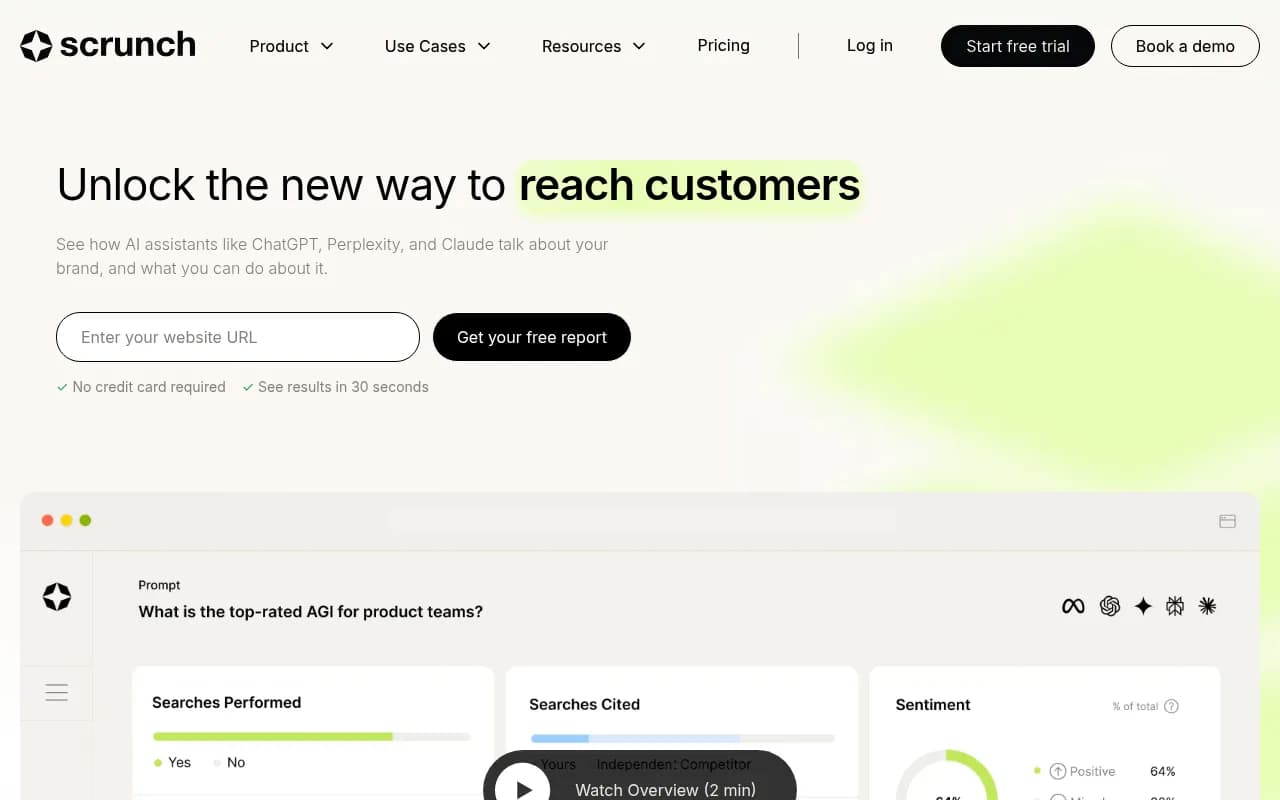
Scrunch AI has one genuinely unique angle: the Agent Experience Platform (AXP). The idea is that AI bots are visitors to your website, and you should optimize for them specifically -- translating your site's content into formats that AI agents can parse more easily, without disrupting the human user experience. It's a different framing from "track your visibility" and closer to "make your site AI-readable."
The monitoring side covers ChatGPT, Perplexity, Claude, and other major LLMs. It includes crawler logs (one of the few tools besides Promptwatch that does this), citation analysis, and competitor tracking. The error detection feature -- spotting when AI bots can't crawl your site -- is practical and underrated.
Pricing starts at $83/month (billed annually) for the Explorer plan, with Growth at $417/month. The jump between tiers is steep.
The AXP angle is interesting but also somewhat unproven. The idea that you can serve different content to AI bots vs. human visitors raises some questions about how AI models would actually respond to that, and whether it creates any risks with search engine guidelines. Worth watching, but worth being thoughtful about.
Best for: Technical teams that want to go beyond visibility tracking and actively optimize how AI bots interact with their site's content.
Which tool should you pick?
Here's the honest summary:
If AI search visibility is a strategic priority and you want to actually move the needle -- not just watch a dashboard -- Promptwatch is the right choice. It's the only platform that combines monitoring, gap analysis, content generation, and traffic attribution in one place. The $99/month entry point and 7-day free trial make it easy to evaluate.
If you're already deep in Semrush for traditional SEO and just want a basic AI visibility signal without adding another tool, stay there. Just know you're getting monitoring, not optimization.
If you're at a large enterprise with procurement requirements and a budget to match, Profound is worth a serious look -- especially if SOC 2 compliance matters.
If budget is the primary constraint and you just want to start tracking, Otterly.AI at $29/month or Peec AI at €89/month are reasonable starting points.
If you're an SEO agency that thinks in keywords and manages many clients, LLMrefs at $79/month with unlimited seats is hard to beat on value.
If you need global coverage across 17+ AI engines and 240+ countries, Rankscale has the broadest reach.
The common thread across all the monitoring-only tools: they'll tell you where you stand. What they won't tell you is what to do about it, or whether what you did worked. That gap is where the real difference lies.