Key Takeaways
- Promptwatch is the best alternative if you need deep AI search optimization with content gap analysis, AI content generation, and crawler logs — capabilities Semrush's AI features lack
- Ahrefs offers the most comprehensive traditional SEO toolkit with the largest backlink index, but its Brand Radar AI tracking uses fixed prompts and lacks traffic attribution
- SE Ranking provides the best value for agencies with white-label reporting, covering 188 countries at a lower price point than Semrush
- Moz Pro excels at finding missed link opportunities with proprietary metrics, though its keyword database is smaller than competitors
- Ubersuggest is the budget-friendly option with lifetime plans starting at $290, ideal for solopreneurs and small businesses
Semrush has long dominated the SEO software market with its comprehensive toolkit covering everything from keyword research to PPC analysis. But as the digital landscape shifts toward AI search engines like ChatGPT, Claude, and Perplexity, many marketers are discovering that Semrush's AI visibility features feel like an afterthought bolted onto a traditional SEO platform. The AI Search tracking uses fixed prompts you can't customize, there's no way to see which pages AI models actually cite, and you're left guessing at how to improve your visibility in AI-generated responses.
Beyond AI limitations, Semrush's pricing has climbed steadily — the Pro+ plan now costs $290/month, and you'll need the Advanced plan at $580/month to get API access and extended limits. For agencies managing multiple clients or brands focused on AI search visibility, specialized alternatives often deliver better results at lower costs.
Here's how the leading Semrush alternatives stack up in 2026.
Promptwatch

Promptwatch takes a fundamentally different approach than Semrush: instead of treating AI search as a side feature, it's built from the ground up as an AI visibility optimization platform. Where Semrush shows you fixed AI responses you can't customize, Promptwatch lets you track any prompt that matters to your business — then actually helps you fix the gaps.
The core difference is the action loop. Promptwatch's Answer Gap Analysis shows exactly which prompts your competitors rank for but you don't, revealing the specific content topics and angles your website is missing. Then the built-in AI writing agent generates articles, comparisons, and listicles grounded in 880M+ real citations analyzed across ChatGPT, Claude, Perplexity, and other models. This isn't generic SEO content — it's engineered to get cited by AI engines based on what actually works.
You also get capabilities Semrush doesn't offer at all: real-time AI crawler logs showing exactly when ChatGPT, Claude, and Perplexity crawl your site (and what errors they hit), Reddit and YouTube citation tracking, ChatGPT Shopping monitoring, and page-level traffic attribution connecting AI visibility to actual revenue. The platform tracks 10 AI models with customizable personas, multi-language support, and query fan-outs that show how prompts branch into sub-queries.
In a 2026 comparison of 12 GEO platforms, Promptwatch was the only tool rated as a "Leader" across all categories. Most competitors (Otterly.AI, Peec.ai, AthenaHQ, Search Party) are monitoring-only dashboards that show data but leave you stuck. Promptwatch closes the loop: find gaps, generate content, track results.
Pricing: Essential $99/mo (1 site, 50 prompts, 5 articles), Professional $249/mo (2 sites, 150 prompts, 15 articles, crawler logs), Business $579/mo (5 sites, 350 prompts, 30 articles). Free trial available.
Best for: Brands and agencies serious about AI search visibility who want optimization tools, not just monitoring. If you need to actually improve your rankings in ChatGPT and Claude — not just track them — Promptwatch is the clear choice.
Ahrefs
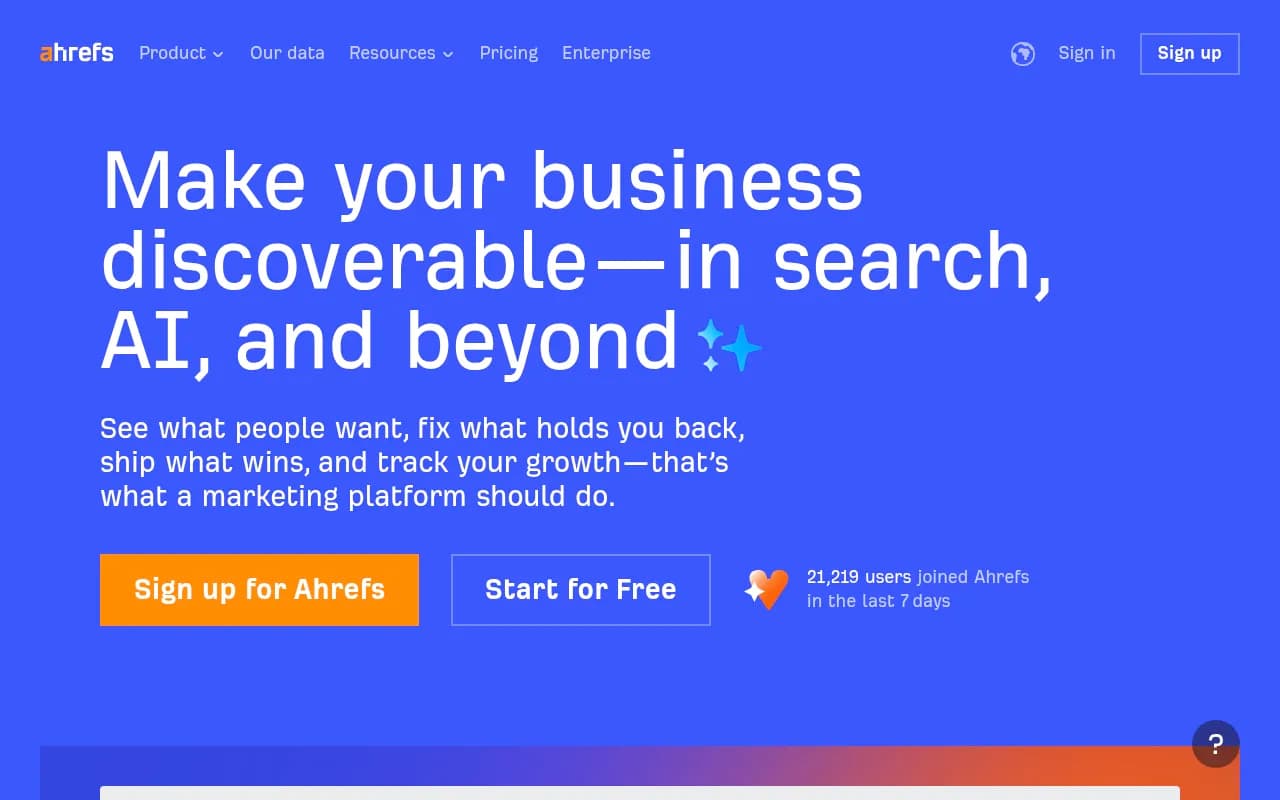
Ahrefs built its reputation on having the web's largest backlink index (over 40 trillion links) and remains the gold standard for link analysis and content research. The platform covers traditional SEO comprehensively: Site Audit finds technical issues, Keywords Explorer surfaces opportunities across 10 search engines, Content Explorer reveals what's working in your niche, and Rank Tracker monitors your positions.
In 2025, Ahrefs added Brand Radar for AI search monitoring, but it's more limited than specialized GEO platforms. You can track how ChatGPT, Perplexity, and Gemini mention your brand, but the prompts are fixed (you can't customize them), there's no content gap analysis showing what you're missing, and no traffic attribution connecting AI visibility to actual site visits. It's useful for basic brand monitoring but doesn't help you optimize.
Where Ahrefs excels is traditional SEO depth. The backlink data is unmatched — you can see every link pointing to any domain, analyze anchor text distribution, and find link-building opportunities competitors are using. Content Explorer lets you search 16 billion pages to find what's ranking and getting shares in your space. The keyword database covers 11.8 billion terms across 243 countries.
The interface is clean and the data updates frequently (backlinks refresh every 15 minutes for top sites). But you're paying for that scale: the Lite plan at $83/month is barebones (500 credits/month, 1 user), and most teams need Standard at $166/month or Advanced at $333/month.
Pricing: Starter $29/mo (very limited), Lite $83/mo, Standard $166/mo, Advanced $333/mo, Enterprise custom. Annual billing saves 20%. 7-day free trial.
Best for: SEO teams that prioritize backlink analysis and content research over AI search optimization. If you need the deepest link data available and can live with basic AI monitoring, Ahrefs delivers. But if AI visibility is a priority, look at Promptwatch instead.
SE Ranking
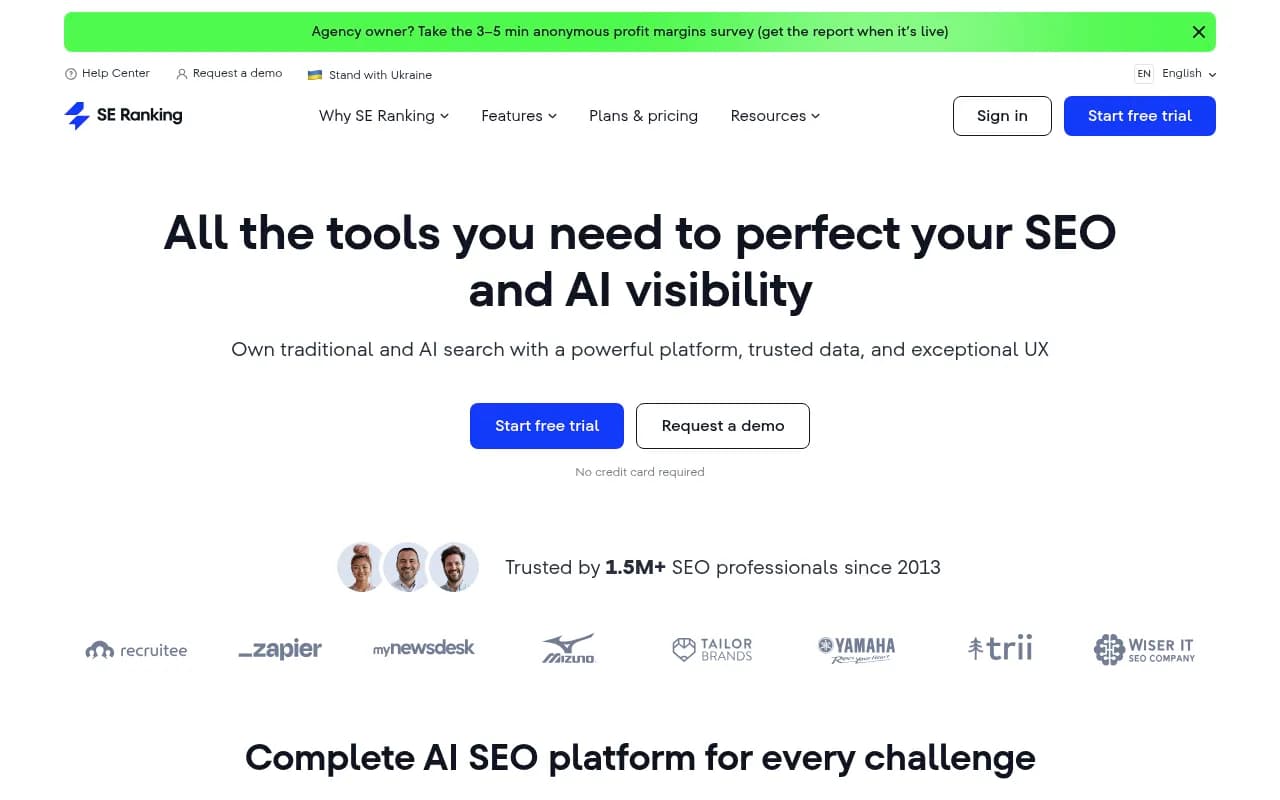
SE Ranking positions itself as the comprehensive SEO platform for agencies and in-house teams managing multiple sites. It covers the full SEO workflow — rank tracking across 188 countries, keyword research with a 5.4B keyword database, site audits, backlink monitoring, competitor analysis, and content optimization tools — all with white-label reporting that lets agencies brand everything as their own.
The platform added an AI Search add-on in 2025 that tracks brand mentions in ChatGPT, Perplexity, and Gemini for an additional $71.20/month. It's functional but limited compared to dedicated GEO platforms: you can monitor AI responses and see sentiment analysis, but there's no content gap analysis, no crawler logs, and no help actually improving your AI visibility. It's monitoring-only.
Where SE Ranking shines is agency features and pricing. The white-label reporting is genuinely good — you can customize dashboards, automate client reports, and remove all SE Ranking branding. The Agency Pack add-on ($69/mo) adds lead generation tools and CRM features. And the pricing is more accessible than Semrush or Ahrefs: the Core plan starts at $103.20/month (annual billing) for 500 keywords and 5 projects, versus $290/month for Semrush Pro+.
The keyword research and rank tracking are solid, though the data isn't quite as fresh as Ahrefs or Semrush. Site Audit catches most technical issues. The Content Editor provides real-time optimization suggestions as you write. For agencies managing 5-10 clients on a budget, it's a practical choice.
Pricing: Core $103.20/mo (annual), Growth $223.20/mo. Add-ons: Agency Pack $69/mo, AI Search $71.20/mo. 14-day free trial, no credit card required. 20% discount on annual billing.
Best for: Agencies and consultants who need white-label reporting and multi-client management at a lower price than Semrush. Good traditional SEO coverage, but the AI features are an expensive add-on with limited functionality.
Moz Pro
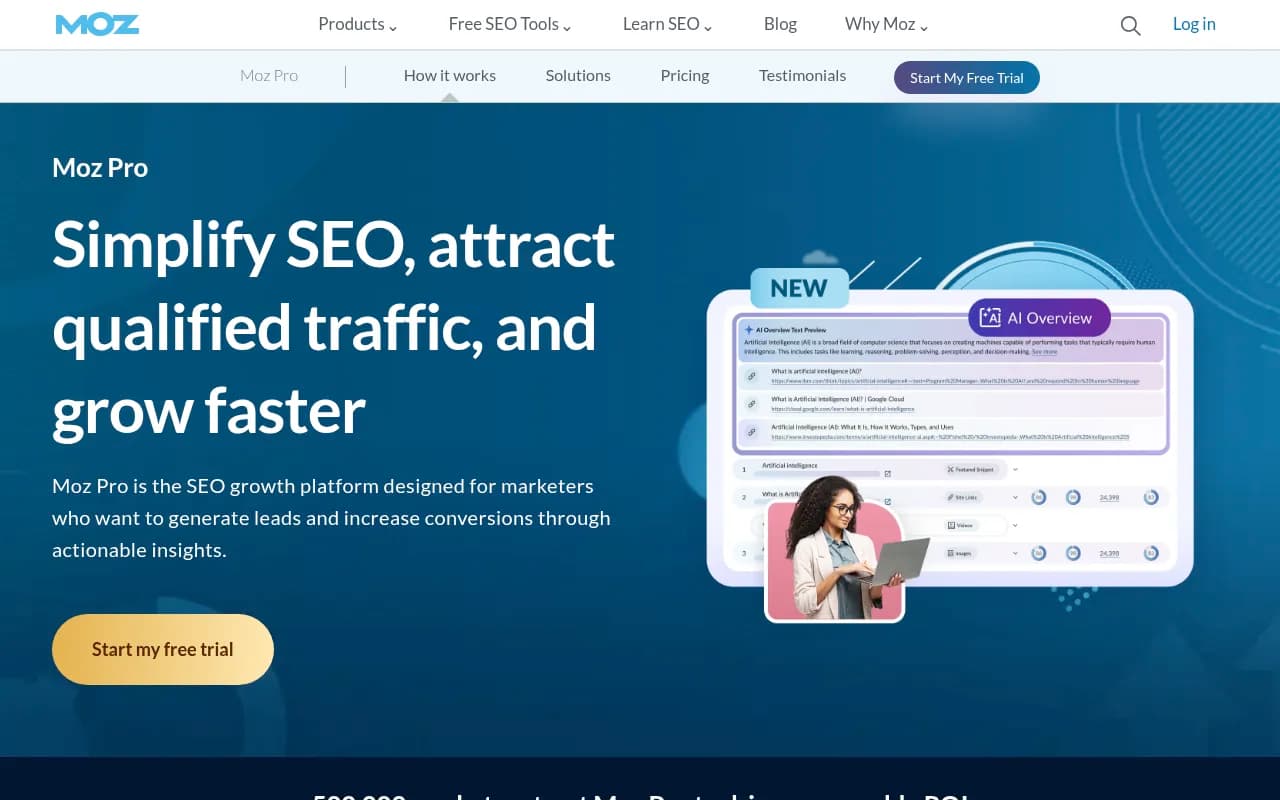
Moz Pro is the veteran SEO platform that pioneered many concepts the industry now takes for granted (Domain Authority, the MozBar browser extension). In 2026, it remains a solid all-in-one toolkit with some unique strengths, particularly around link opportunity discovery.
The standout feature is Moz's proprietary metrics: Domain Authority (DA) and Page Authority (PA) are still widely used as shorthand for site quality, and Spam Score helps you avoid toxic backlinks. Link Explorer uses these metrics to surface link-building opportunities competitors might have missed — sites with high DA that are linking to competitors but not you. Keyword Explorer provides search volume, difficulty scores, and SERP analysis, though the keyword database (1.25 billion terms) is smaller than Ahrefs or Semrush.
Moz added basic AI search monitoring in 2025, but it's extremely limited: you can see if your brand appears in ChatGPT responses for a handful of fixed queries, with no customization, no citation analysis, and no optimization recommendations. It's a checkbox feature, not a real tool.
The platform's biggest weakness is data freshness. Backlink data updates monthly (versus daily or weekly for Ahrefs/Semrush), and the keyword database is smaller. The interface feels dated compared to newer tools. But the proprietary metrics are valuable for link prospecting, and the On-Page Grader provides specific optimization recommendations.
Moz is currently running a promotion: Starter plan is $39/month (normally $49), Standard $99/mo, Medium $179/mo, Large $299/mo. Annual billing saves 20%.
Pricing: Starter $49/mo (currently $39/mo), Standard $99/mo, Medium $179/mo, Large $299/mo. 30-day free trial. Annual billing saves 20%.
Best for: SEO teams that value Moz's proprietary metrics (DA, PA, Spam Score) for link prospecting and already have workflows built around them. The link opportunity discovery is genuinely useful, but the AI features are negligible and data freshness lags competitors.
Ubersuggest
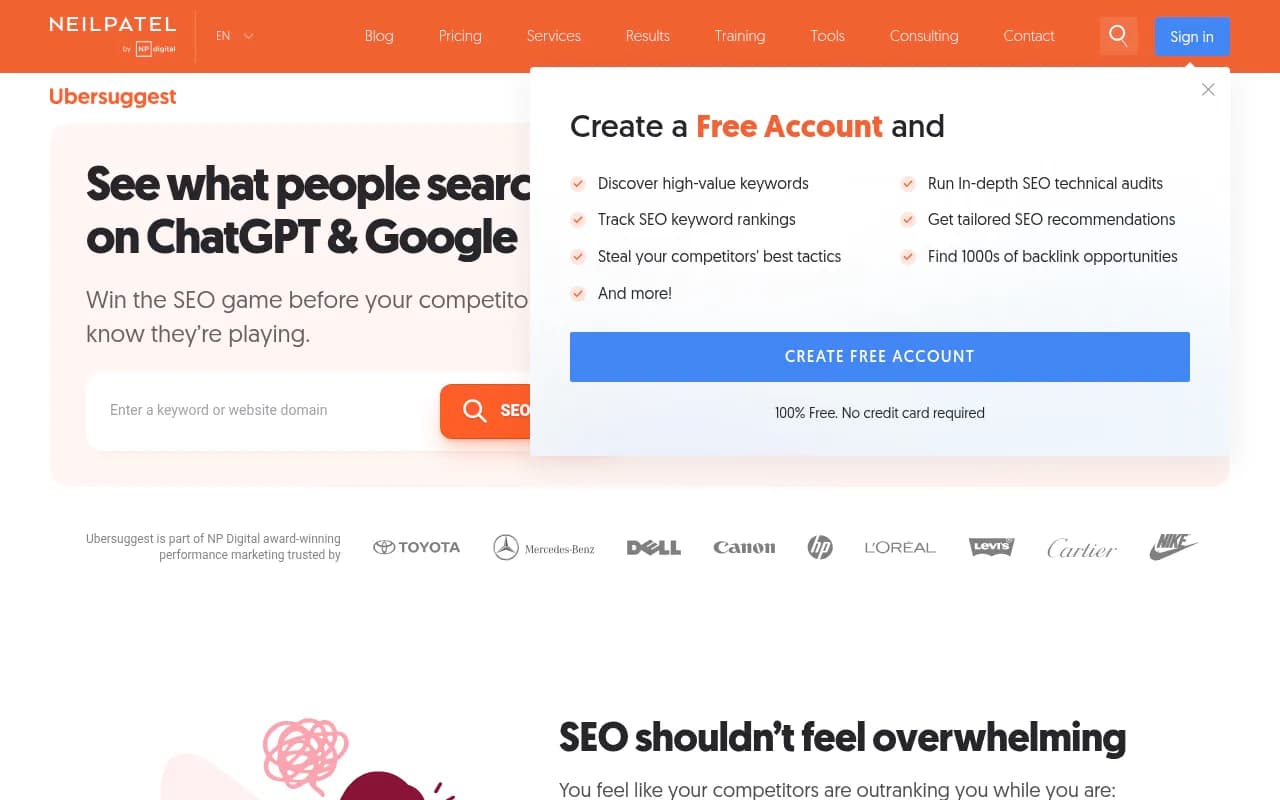
Ubersuggest is Neil Patel's answer to expensive SEO tools: a simplified platform that covers the basics at a fraction of the cost. It provides keyword research, site audits, rank tracking, backlink analysis, and content ideas with a clean interface that doesn't overwhelm beginners.
The unique selling point is pricing: Ubersuggest offers lifetime plans starting at $290 (Individual), $490 (Business), or $990 (Enterprise) — pay once, use forever. For solopreneurs and small businesses that can't justify $200+/month subscriptions, this is compelling. There's also a free tier with 3 searches per day and a monthly subscription option starting at $29/month.
The trade-off is depth. Keyword data comes from Google Keyword Planner and isn't as comprehensive as Ahrefs or Semrush. Backlink data is decent but updates less frequently. Site Audit catches major issues but misses some technical problems more advanced tools find. Rank tracking works but lacks advanced features like SERP feature tracking or local rank variations.
Ubersuggest added basic AI keyword research in 2025 — it shows which keywords AI models are mentioning and generates AI-powered content ideas. But there's no AI search monitoring, no way to track your brand in ChatGPT or Claude, and no optimization tools. It's a traditional SEO tool with light AI features sprinkled on top.
For the price, Ubersuggest delivers solid value if you're just starting with SEO or running a small site. The lifetime plans make sense for bootstrapped businesses. But if you're competing in a serious market or need AI search visibility, you'll outgrow it quickly.
Pricing: Free tier (3 searches/day). Lifetime plans: Individual $290, Business $490, Enterprise $990. Monthly subscriptions from $29/mo. No free trial on paid plans.
Best for: Solopreneurs, bloggers, and small businesses on tight budgets who need basic SEO tools without recurring costs. The lifetime plans are the best deal in SEO software, but expect limited depth and minimal AI features.
SpyFu
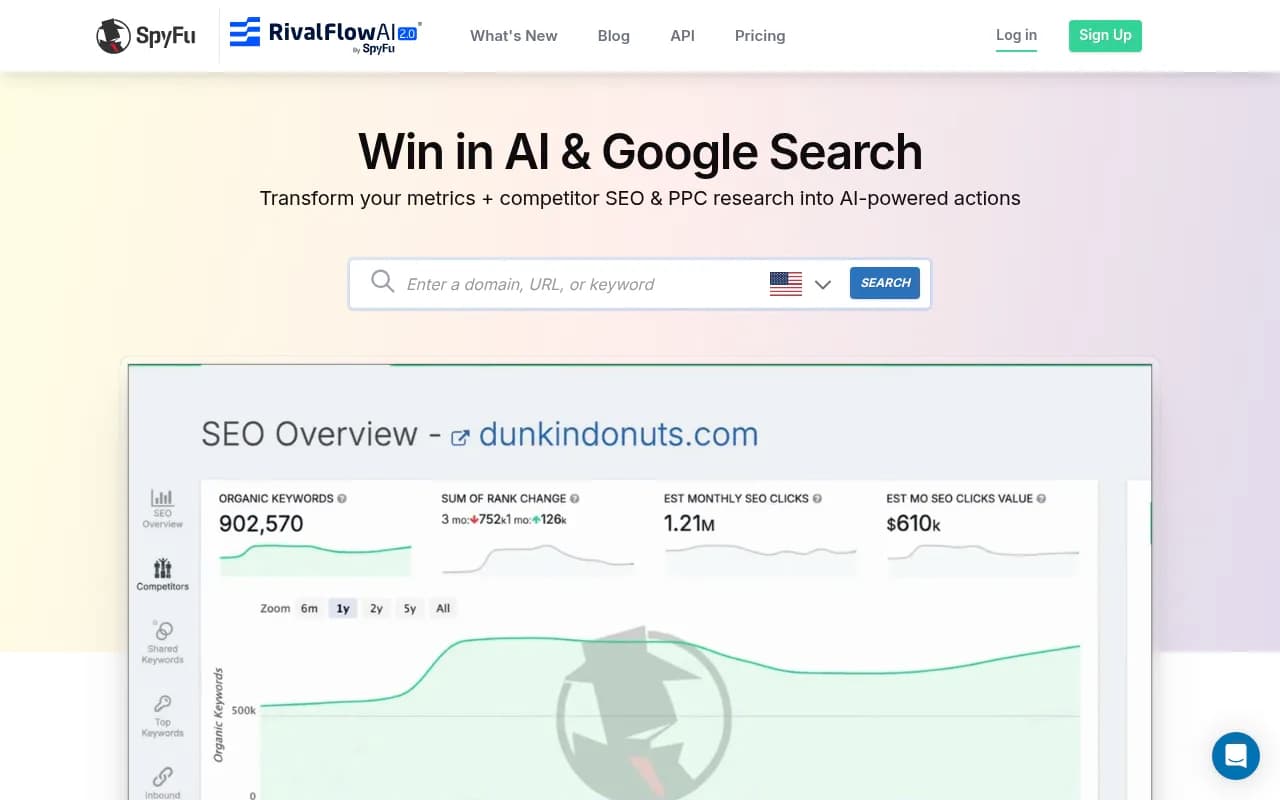
SpyFu takes a different angle than most SEO tools: it's built specifically for competitive intelligence. The core feature is downloading every keyword a competitor ranks for and every ad they've ever run — going back 17 years of PPC history. If you need to reverse-engineer a competitor's strategy, SpyFu delivers.
You can see a competitor's top organic keywords, their estimated traffic, which keywords they're buying in Google Ads, their ad copy variations, and how their strategy has changed over time. The PPC Advisor suggests keywords to bid on based on what's working for competitors. Backlink data shows who's linking to them. Rank tracking monitors your positions and compares them to competitors.
In 2025, SpyFu added RivalFlow, an AI-powered content optimizer that analyzes why competitors outrank you and suggests specific content improvements. It's useful but limited compared to dedicated content optimization tools. There's no AI search monitoring — no way to track ChatGPT, Claude, or Perplexity mentions.
SpyFu's strength is competitive PPC research. If you're running Google Ads and want to see exactly what competitors are bidding on, their ad copy, and their landing pages, it's invaluable. The historical data (17 years) is unique. But for organic SEO, the keyword database is smaller than Ahrefs or Semrush, and the backlink data isn't as comprehensive.
Pricing is competitive: Basic plan is $33/month (annual) or $39/month (monthly), Professional $58/month annual, Team/Agency $199/month annual. All plans include unlimited searches and downloads, which is generous compared to credit-based competitors.
Pricing: Basic $33/mo (annual) or $39/mo (monthly), Professional $58/mo annual, Team/Agency $199/mo annual. 30-day money-back guarantee.
Best for: PPC managers and agencies that need deep competitive intelligence on Google Ads campaigns. The historical ad data and keyword spy features are unmatched. But for organic SEO and AI search, other tools offer more depth.
Similarweb
Similarweb is a market intelligence platform that goes beyond SEO to analyze traffic across all digital channels: websites, apps, social media, display ads, and more. It's used by enterprise teams for competitive benchmarking, market research, and audience analysis — think strategic planning rather than day-to-day SEO work.
You can see traffic estimates for any website (total visits, traffic sources, geographic distribution, audience demographics), benchmark your performance against competitors or industry averages, and analyze market trends. The data covers 100M+ websites and 5M+ apps globally. It's particularly strong for understanding traffic sources: how much comes from search vs. social vs. direct vs. referrals.
Similarweb launched an AEO (AI Engine Optimization) Suite in 2025 to track brand visibility in AI search engines. You can monitor how ChatGPT, Perplexity, and other models mention your brand, see AI traffic trends, and get recommendations to improve visibility. But the AI features are expensive add-ons to an already pricey platform, and they lack the depth of specialized GEO tools like Promptwatch (no content gap analysis, no crawler logs, no AI content generation).
The platform is overkill for most SEO teams. If you need traditional SEO tools (keyword research, rank tracking, site audits), Ahrefs or Semrush are better fits. Similarweb is for enterprise marketing teams doing market sizing, competitive intelligence across channels, and strategic planning. The entry-level Competitive Intelligence plan starts at $125/month, but most teams need Enterprise plans at $1,000-$5,000+/month.
Pricing: Competitive Intelligence from $125/mo. Enterprise plans $1,000-$5,000+/mo. Free tier with limited data. 7-day free trial.
Best for: Enterprise marketing and strategy teams that need cross-channel market intelligence and competitive benchmarking. The traffic estimates and market analysis are valuable for strategic planning, but it's expensive and not purpose-built for SEO or AI search optimization.
How to Choose the Right Semrush Alternative
The best alternative depends on what you're actually trying to accomplish:
If AI search visibility is your priority, Promptwatch is the only platform that goes beyond monitoring to actually help you optimize. You get content gap analysis showing exactly what's missing, AI content generation grounded in real citation data, crawler logs, and traffic attribution. Semrush's AI features are monitoring-only with fixed prompts you can't customize.
If you need the deepest backlink data and content research, Ahrefs wins with 40 trillion links indexed and 16 billion pages in Content Explorer. The Brand Radar AI tracking is basic, but the traditional SEO tools are best-in-class.
If you're an agency managing multiple clients on a budget, SE Ranking delivers white-label reporting and solid SEO coverage at $103/month versus $290 for Semrush Pro+. The AI Search add-on is limited but functional.
If you're bootstrapped or just starting out, Ubersuggest's lifetime plans ($290-$990 one-time) eliminate recurring costs. You get basic SEO tools that cover the essentials without the depth of premium platforms.
If competitive PPC intelligence is critical, SpyFu's 17 years of ad history and unlimited competitor downloads are unmatched. But for organic SEO, other tools offer more.
If you need enterprise market intelligence across channels, Similarweb provides traffic estimates and competitive benchmarking beyond SEO. But it's expensive and not purpose-built for SEO work.
The market has shifted. Traditional SEO tools like Semrush are adding AI features as afterthoughts, while specialized platforms like Promptwatch are built from the ground up for AI search optimization. If you're serious about visibility in ChatGPT, Claude, and Perplexity — not just Google — the choice is clear: you need a platform that helps you optimize, not just monitor.