Key Takeaways
- Promptwatch is the top choice if you need AI search visibility tracking alongside traditional SEO—it's the only platform that helps you find content gaps, generate AI-optimized content, and track citations across ChatGPT, Claude, Perplexity, and 7 other AI models
- Semrush offers the most comprehensive all-in-one marketing suite with 8 toolkits covering SEO, content, PPC, and social—but its AI search features use fixed prompts and lack the depth of specialized GEO platforms
- Screaming Frog remains unbeatable for technical SEO audits if you need a powerful desktop crawler that's free up to 500 URLs and only $259/year for unlimited crawling
- SE Ranking delivers the best value for small teams and agencies with white-label reporting, 5.4B keywords across 188 countries, and AI-powered insights starting at $103/mo
- Sitebulb is the technical SEO specialist's choice with 300+ automated issue checks, visual data representations, and prioritized recommendations that make complex audits actionable
SEOmator is a solid automated SEO audit platform, but it's far from the only option. Whether you're looking for more comprehensive features, better pricing, specialized technical crawling, or AI search visibility tracking, there are several strong alternatives worth considering. Here's an honest comparison of the top SEOmator competitors in 2026.
Promptwatch

Promptwatch is fundamentally different from SEOmator—it's not just an SEO audit tool, it's an end-to-end AI Search Visibility platform. While SEOmator focuses on traditional technical SEO issues, Promptwatch addresses the bigger shift happening in search: AI models like ChatGPT, Claude, Perplexity, and Gemini are increasingly where people discover brands and products.
The core difference is the action loop. Most SEO tools (including SEOmator) show you problems but leave you to figure out solutions. Promptwatch shows you exactly which prompts competitors rank for but you don't, then helps you create content that gets cited by AI models. The built-in AI writing agent generates articles grounded in 880M+ citations analyzed, prompt volumes, and competitor data—content engineered to rank in AI search, not generic SEO filler.
Promptwatch tracks 10 AI models (ChatGPT, Perplexity, Google AI Overviews, Claude, Gemini, Meta AI, DeepSeek, Grok, Mistral, Copilot) and provides capabilities SEOmator doesn't touch: AI crawler logs showing which pages ChatGPT and Claude actually read, citation analysis revealing which Reddit threads and YouTube videos influence AI recommendations, ChatGPT Shopping tracking, and prompt intelligence with volume estimates and difficulty scores.
For traditional SEO monitoring, Promptwatch includes page-level tracking showing which pages get cited and by which models, plus traffic attribution via code snippet, GSC integration, or server log analysis. You can track results in any language, from any country, with customizable personas matching how your actual customers prompt.
Pricing: Essential $99/mo (1 site, 50 prompts, 5 articles), Professional $249/mo (2 sites, 150 prompts, 15 articles, crawler logs), Business $579/mo (5 sites, 350 prompts, 30 articles). Free trial available.
Best for: Marketing teams, SEO teams, and agencies that want to be visible in AI search results—not just traditional Google. If you're only concerned with technical SEO issues and don't care about AI visibility, stick with a traditional audit tool. But if you want to understand and optimize for how AI models discover and cite your content, Promptwatch is the only platform that closes the loop from finding gaps to creating content to tracking results.
Semrush
Semrush is the 800-pound gorilla of SEO platforms—a comprehensive digital marketing suite used by 10M+ marketers and 35% of Fortune 500 companies. Where SEOmator focuses narrowly on automated audits, Semrush offers 8 complete toolkits covering SEO, content, PPC, social media, local search, competitive research, and AI visibility.
The SEO toolkit includes everything SEOmator does (site audits, technical issue detection, monitoring) plus significantly more depth: a 25B keyword database, backlink analysis with the web's second-largest index, rank tracking across 230 countries, and on-page SEO recommendations. The Site Audit tool checks 140+ technical issues and provides prioritized fix recommendations similar to SEOmator's approach.
Semrush recently added AI visibility tracking across ChatGPT, Perplexity, and Gemini, but this is where it falls short compared to specialized platforms. The AI search features use fixed prompts rather than letting you track custom queries, there's no AI traffic attribution, no crawler logs, and no content generation capabilities. It's monitoring-only—you see where you appear in AI responses but get no help fixing gaps or creating content that ranks.
The Content Marketing toolkit includes an AI writing assistant, topic research, SEO content templates, and a content audit tool. The Advertising toolkit covers Google Ads and Meta ads planning and optimization. Local SEO tools help manage Google Business Profiles and directory listings. Social media management rounds out the suite.
Pricing: Starter $165/mo (limited features), Pro+ $290/mo (most popular), Advanced $580/mo. Enterprise custom pricing. 7-day free trial. This is 3-6x more expensive than SEOmator.
Best for: Enterprise teams and agencies that need an all-in-one platform and have the budget for it. The breadth is impressive, but you're paying for features you might not use. If you only need technical SEO audits, SEOmator or a specialized crawler is more cost-effective. If you need AI search optimization specifically, Promptwatch offers far more depth in that area.
SE Ranking
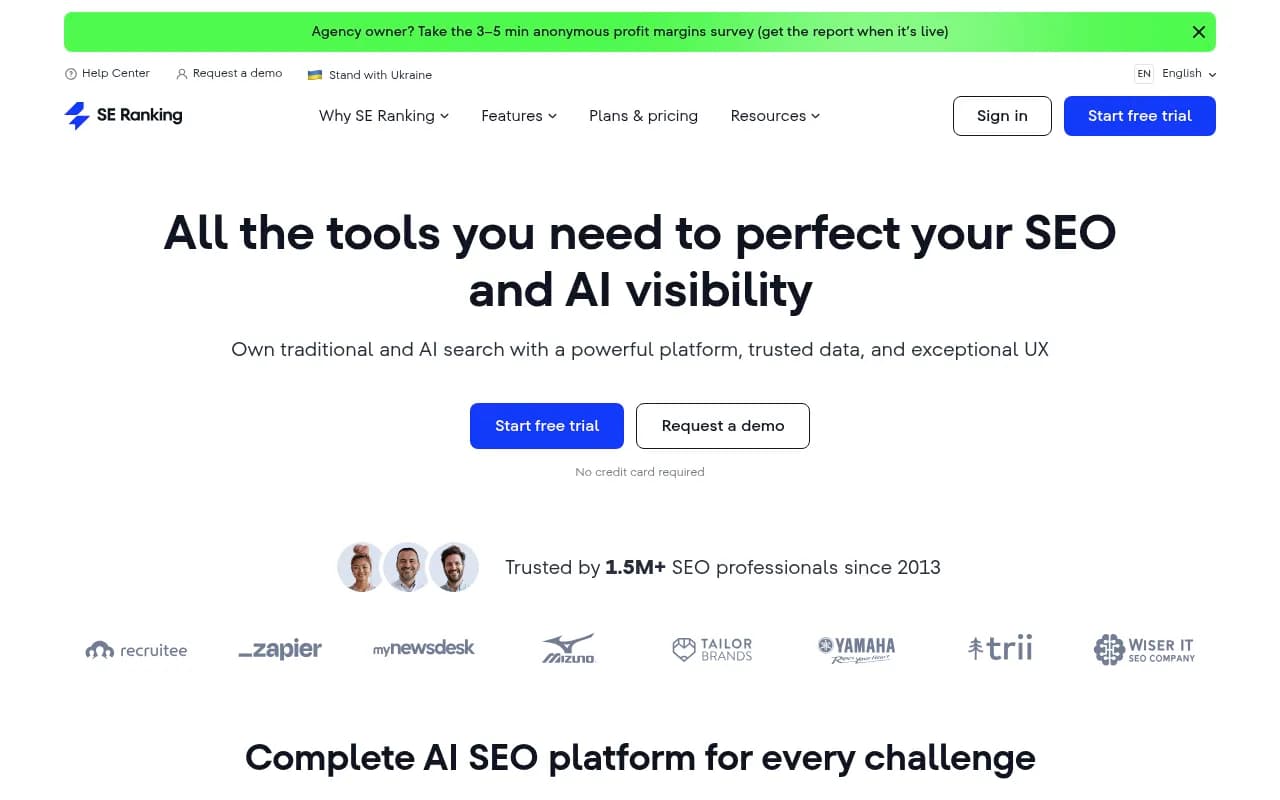
SE Ranking is the value play—a comprehensive SEO platform that costs significantly less than Semrush while covering most of the same ground. It's been around since 2013, trusted by 1.5M+ professionals, and offers a genuinely complete SEO toolkit without the enterprise price tag.
The platform includes rank tracking across 188 countries (vs SEOmator's monitoring focus), keyword research with a 5.4B keyword database, site audits that check technical issues similar to SEOmator, backlink monitoring, competitor analysis, and content optimization tools. The site audit runs automatically on a schedule you set and provides prioritized recommendations for fixing issues.
What sets SE Ranking apart for agencies is white-label reporting—you can brand all reports and dashboards with your agency's logo and colors. The platform also includes local SEO tools for managing Google Business Profiles and tracking local rankings, plus an AI writing assistant for content creation (though not as sophisticated as Promptwatch's citation-grounded approach).
SE Ranking recently added an AI Search add-on ($71.20/mo extra) that tracks visibility in ChatGPT, Perplexity, and Google AI Overviews. Like Semrush, this is monitoring-only without the content gap analysis, crawler logs, or optimization capabilities that make Promptwatch actionable.
The interface is cleaner and more intuitive than Semrush's sprawling dashboard, making it easier for smaller teams to get up to speed quickly. Data accuracy is solid—not quite at Semrush or Ahrefs level for backlinks, but more than adequate for most use cases.
Pricing: Core $103.20/mo (annual billing), Growth $223.20/mo. Agency Pack add-on $69/mo for white-label features. AI Search add-on $71.20/mo. 14-day free trial, no credit card required. 20% discount on annual billing.
Best for: Small to mid-size agencies and in-house teams that need comprehensive SEO tools without enterprise pricing. The white-label reporting makes it particularly attractive for agencies managing multiple clients. If you're a solo consultant or small business just needing basic technical audits, SEOmator's simpler approach and lower price point ($49.99/mo) might be sufficient.
Ahrefs

Ahrefs is the other major all-in-one SEO platform, used by 44% of Fortune 500 companies. It's known for having the web's largest and most frequently updated backlink index—a significant advantage over SEOmator, which doesn't focus on backlink analysis at all.
The platform includes site audits similar to SEOmator (checking 100+ technical issues), rank tracking, keyword research with a massive database, content explorer for finding top-performing content, and competitor analysis. The Site Audit tool runs on a schedule and provides prioritized recommendations, though the interface is less visual than Sitebulb's approach.
Ahrefs recently launched Brand Radar for AI search monitoring, tracking mentions across ChatGPT, Perplexity, and other AI models. However, like Semrush, this uses fixed prompts and lacks traffic attribution, crawler logs, or content optimization features. You can see where you're mentioned but not why or how to improve it.
The platform also includes Ahrefs Webmaster Tools (free), which provides basic site audit and backlink data for your own websites. This is useful for small businesses that can't afford the full platform but need basic technical SEO insights.
One weakness: Ahrefs has historically been slower to add new features compared to Semrush. The AI search tools feel bolted-on rather than integrated. The content creation features are basic compared to Semrush's Content Marketing toolkit or Promptwatch's citation-grounded AI writer.
Pricing: Lite $83/mo (limited), Standard $166/mo, Advanced $333/mo, Enterprise custom. Annual billing saves 20%. Free trial available. Starter plan at $29/mo is extremely limited (1 user, 5 projects).
Best for: SEO professionals and agencies that prioritize backlink analysis and competitive research. If you're doing serious link building or need to understand your backlink profile in depth, Ahrefs is worth the premium over SEOmator. For pure technical site audits without backlink focus, you're paying for features you won't use.
Screaming Frog
Screaming Frog is the technical SEO specialist's weapon of choice—a powerful desktop crawler that does one thing exceptionally well: crawling websites and finding technical issues. Unlike SEOmator's cloud-based automated approach, Screaming Frog is a tool you run manually when you need deep technical analysis.
The crawler analyzes page titles, meta descriptions, headings, response codes, redirects, duplicate content, broken links, XML sitemaps, robots.txt, structured data, hreflang, canonical tags, and dozens of other technical elements. It can crawl JavaScript-rendered sites, extract data with XPath or CSS selectors, and integrate with Google Analytics, Search Console, and PageSpeed Insights.
The free version crawls up to 500 URLs, making it perfect for small sites or spot-checking specific issues. The paid license ($259/year) removes all limits and adds features like scheduling, saving crawls, and advanced configuration options. This is significantly cheaper than SEOmator's $49.99/mo ($599.88/year).
The trade-off: Screaming Frog requires more technical knowledge to use effectively. There's no automated monitoring, no scheduled crawls (in the free version), and no pretty dashboards for clients. You export data to Excel or use the built-in reporting, but it's not as polished as SEOmator's white-label reports. It's a power tool for SEO professionals, not a managed service for clients.
Screaming Frog also offers a cloud-based version (Screaming Frog Cloud) for crawling large sites without tying up your desktop, but pricing is custom and aimed at enterprise users.
Pricing: Free up to 500 URLs. Paid license $259/year for unlimited crawling. One-time payment, no monthly subscription.
Best for: Technical SEO specialists and agencies that need deep, on-demand technical analysis and don't mind a steeper learning curve. The free version is perfect for freelancers and small businesses with sites under 500 pages. If you need automated monitoring and client-friendly reports, SEOmator or ContentKing are better fits.
Moz Pro
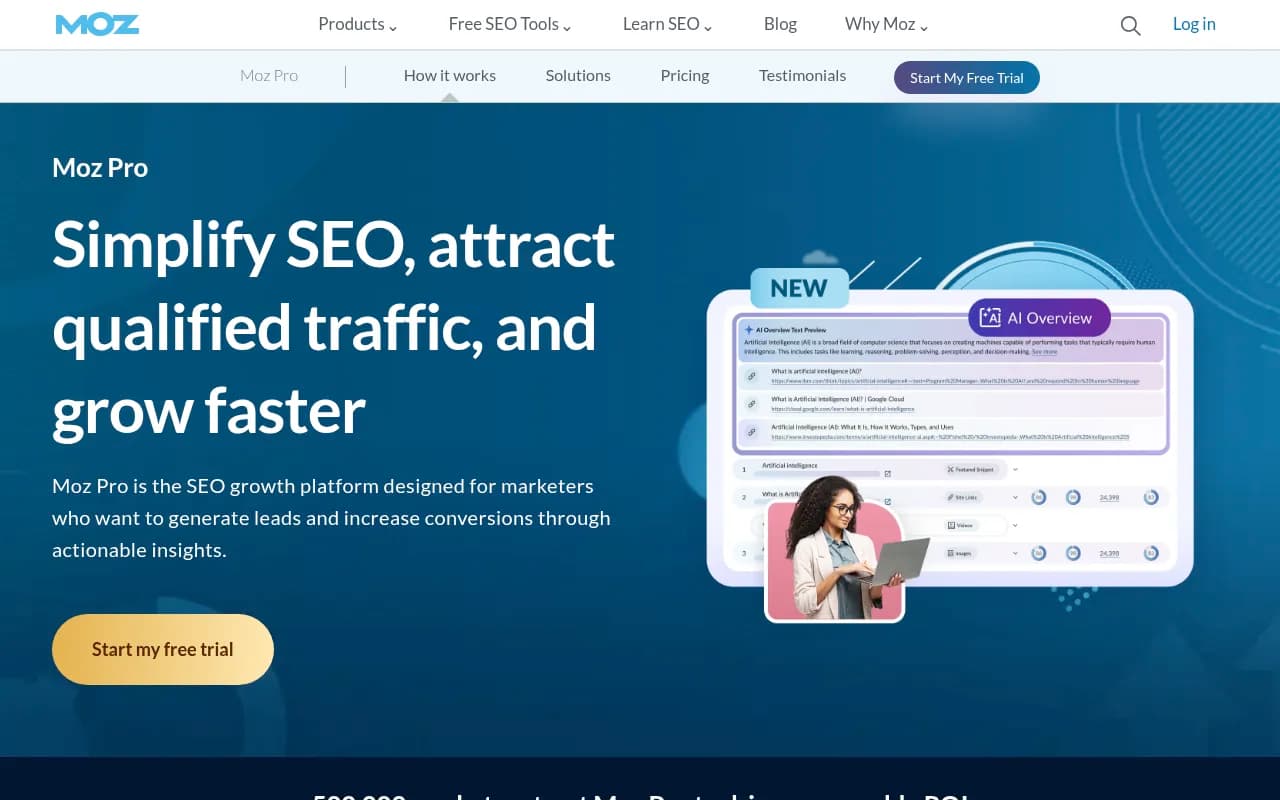
Moz Pro is one of the original SEO platforms, known for creating Domain Authority (DA) and Page Authority (PA) metrics that became industry standards. It offers a complete SEO toolkit including site audits, rank tracking, keyword research, backlink analysis, and on-page optimization—similar scope to SEOmator but with more depth.
The Site Crawl feature checks for technical issues and provides prioritized recommendations similar to SEOmator's approach. Moz's strength is in link opportunity discovery—the platform identifies potential backlink sources based on competitor analysis and your existing link profile, something SEOmator doesn't address.
Keyword Explorer includes search volume, difficulty scores, and SERP analysis. The On-Page Grader analyzes individual pages and provides specific optimization recommendations. Rank Tracker monitors your positions across search engines and locations.
Moz recently added AI-powered insights and a beta AI Visibility feature, but like Semrush and Ahrefs, this is early-stage and monitoring-focused. The platform feels less modern than competitors—the interface hasn't evolved as quickly as Semrush or Ahrefs, and some features feel dated.
The proprietary metrics (DA, PA, Spam Score) are useful for quick assessments, but they're Moz-specific rather than Google metrics. Some SEO professionals swear by them; others prefer Ahrefs' URL Rating or Semrush's Authority Score.
Pricing: Currently on promotion—Starter $39/mo (normally $49/mo), Standard $99/mo, Medium $179/mo, Large $299/mo. 30-day free trial. Annual billing saves 20%.
Best for: SEO professionals who value Moz's proprietary metrics and link opportunity discovery. The mid-tier pricing makes it competitive with SE Ranking but more expensive than SEOmator for basic audits. If you're primarily focused on technical site audits without link building, you're paying for features you won't use.
Serpstat
Serpstat is the budget-friendly all-in-one platform, offering comprehensive SEO tools at prices significantly lower than Semrush or Ahrefs. It includes keyword research across 230 countries, site audits, rank tracking, backlink analysis, and competitor intelligence—covering similar ground to SEOmator but with more features.
The site audit checks technical issues and provides prioritized recommendations similar to SEOmator's approach. The keyword database includes 8.62B keywords with search volume, difficulty, and CPC data. Rank tracking monitors positions across Google and Bing in 230 countries.
Serpstat's competitive analysis tools show competitors' top keywords, ad copy, and backlink profiles. The platform also includes a content marketing tool for finding topic ideas and analyzing top-performing content.
The trade-off for the lower price: data accuracy isn't quite at Semrush or Ahrefs level, particularly for backlinks. The interface feels less polished, and some features are less intuitive. Customer support is slower than premium platforms. For many use cases, though, the data is accurate enough and the savings are substantial.
Serpstat occasionally offers lifetime deals (one-time payment for permanent access), which can be extremely cost-effective for agencies and freelancers with long-term needs.
Pricing: Lite $69/mo, Standard $149/mo, Advanced $299/mo, Enterprise $499/mo. 7-day free trial. Lifetime deals occasionally available.
Best for: Budget-conscious agencies, freelancers, and small businesses that need comprehensive SEO tools but can't justify Semrush or Ahrefs pricing. If you're comparing to SEOmator, Serpstat offers significantly more features for $20-30/mo more. The data accuracy gap matters more for enterprise users than small businesses.
Sitebulb

Sitebulb is the technical SEO crawler that makes complex audits actually understandable. Unlike SEOmator's automated approach, Sitebulb is designed for SEO professionals who need deep technical analysis with visual data representations that make it easy to explain issues to clients and stakeholders.
The platform automatically checks 300+ SEO issues—significantly more than SEOmator—and uses a unique Hints system that provides specific, actionable recommendations for each issue found. The visual reports include interactive charts, graphs, and diagrams that show how issues relate to each other and which pages are affected.
Sitebulb offers both Desktop and Cloud versions. Desktop crawls up to 500,000 URLs per audit and runs on your machine. Cloud crawls up to 10 million URLs and runs in the browser, enabling real-time team collaboration across the same crawl data. Both versions include JavaScript crawling at no extra cost.
The prioritization system automatically ranks issues by impact, helping you focus on what matters most. The customizable PDF reports are designed for client presentations—they look professional and explain technical issues in plain language.
Sitebulb integrates with Google Analytics, Search Console, and other tools to correlate technical issues with traffic and ranking data. The changelog tracks every website update so you can see exactly what changed and when.
Pricing: Desktop from $35/mo (Lite, 5k URLs) to $135/mo (Agency, 500k URLs). Cloud from $125/mo (Mini, 2 users) to $495/mo (Medium, 10 users) plus custom Enterprise. 14-day free trial. Annual discounts available.
Best for: Technical SEO specialists and agencies that need deep, detailed audits with client-friendly visualizations. The Desktop Lite plan at $35/mo is competitive with SEOmator for small sites. The visual reporting and prioritization make it worth the premium for agencies that need to explain technical issues to non-technical clients. If you just need basic automated monitoring, SEOmator's simpler approach is sufficient.
ContentKing
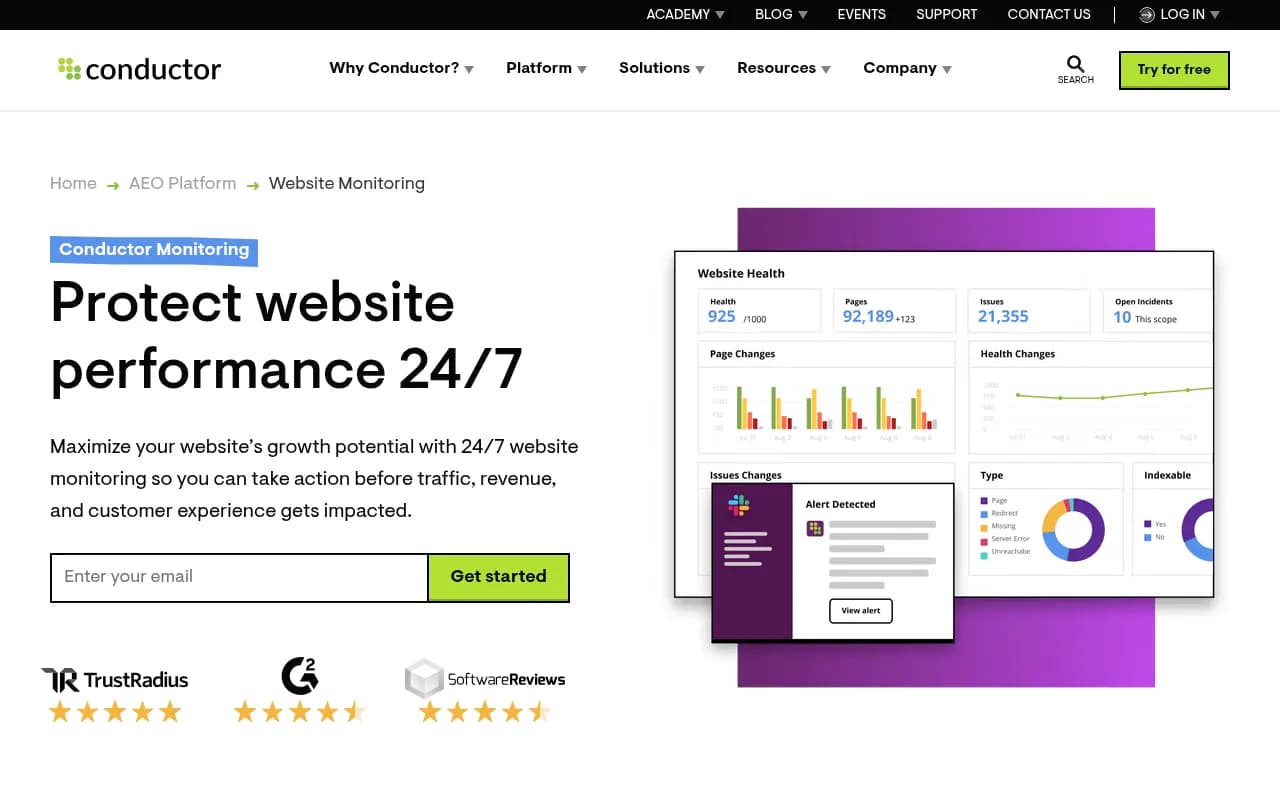
ContentKing (now Conductor Website Monitoring) is the real-time monitoring specialist—it continuously watches your website 24/7 and alerts you instantly when issues occur. This is fundamentally different from SEOmator's scheduled audit approach or Screaming Frog's on-demand crawling.
The platform monitors technical SEO issues, content changes, and compliance across your entire website. When something changes—a meta tag gets removed, a page returns a 404, a canonical tag breaks—you get an alert immediately, not when the next scheduled crawl runs. This is critical for large enterprise sites where unintended changes can cost thousands in lost traffic.
ContentKing tracks every change with a complete changelog showing what changed, when, and on which pages. You can set up custom alerts for specific elements (like tracking if a particular legal disclaimer appears on all product pages) and get notified if it disappears.
The platform includes intelligent prioritization that focuses on issues affecting high-traffic pages first. Automated enterprise reporting keeps stakeholders informed without manual work. The real-time collaboration features let teams work together on the same data.
The trade-off: ContentKing is significantly more expensive than SEOmator, starting at $139/mo vs $49.99/mo. For small sites with infrequent changes, the real-time monitoring is overkill. For large enterprise sites with frequent updates and multiple teams making changes, it's essential insurance.
Pricing: Basic $139/mo to Enterprise $1,279/mo. Tiered pricing based on site size and features. Free trial available. No free tier.
Best for: Enterprise websites with frequent changes, multiple teams, and high stakes where undetected issues can cause significant revenue loss. E-commerce sites, large publishers, and SaaS companies with complex sites benefit most. For small businesses and simple sites, SEOmator's scheduled audits are sufficient and much more affordable.
How to Choose the Right SEOmator Alternative
If you need AI search visibility tracking: Promptwatch is the only platform that helps you find gaps, create content, and track results across ChatGPT, Claude, Perplexity, and other AI models. Traditional SEO tools (including SEOmator) don't address this channel at all.
If you need comprehensive all-in-one SEO: Semrush offers the most features but costs 3-6x more than SEOmator. SE Ranking provides similar breadth at half the price. Ahrefs is best if backlink analysis is your priority.
If you need technical SEO depth: Screaming Frog (free up to 500 URLs, $259/year unlimited) and Sitebulb ($35-135/mo Desktop, $125-495/mo Cloud) offer more detailed technical analysis than SEOmator. Screaming Frog is the budget choice; Sitebulb provides better visualizations and client reporting.
If you need real-time monitoring: ContentKing ($139-1,279/mo) is the only platform that watches your site 24/7 and alerts you instantly when issues occur. Essential for enterprise sites; overkill for small businesses.
If you're on a tight budget: Serpstat ($69-499/mo) offers comprehensive features at the lowest price point. Screaming Frog's free version (up to 500 URLs) is perfect for small sites. SEOmator at $49.99/mo remains competitive for basic automated audits.
If you're an agency: SE Ranking ($103-223/mo + $69/mo Agency Pack) offers the best value with white-label reporting. Sitebulb ($35-135/mo Desktop) provides the best client-facing reports. Semrush ($290-580/mo) is the premium choice if budget isn't a constraint.
The right choice depends on your specific needs, budget, and whether you're optimizing for traditional search, AI search, or both. SEOmator remains a solid option for basic automated technical audits, but these alternatives offer significantly more depth in specific areas.