Key Takeaways
- Promptwatch — Best for AI search visibility and GEO optimization. Unlike monitoring-only tools, it shows you content gaps, generates AI-optimized articles, and tracks results across ChatGPT, Perplexity, Claude, and 10+ AI platforms. Includes crawler logs, citation analysis, and Reddit/YouTube tracking.
- Frase — Strong SEO content research and optimization with AI writing capabilities. Good for traditional search but recently added AI search tracking. More affordable than Writesonic for small teams.
- Scalenut — Comprehensive SEO and AI visibility platform with managed GEO services. Combines content creation, optimization, and AI search tracking in one tool.
- Junia AI — Best for automated, long-form SEO content that ranks on Google and gets cited by ChatGPT. Includes auto-publishing to WordPress and competitive intelligence.
- Jasper — Enterprise-grade AI marketing platform with 100+ specialized agents and content pipelines. Best for large teams needing brand consistency and compliance controls.
Writesonic has established itself as a popular AI content creation tool for blog automation and content marketing. But as AI search engines like ChatGPT, Perplexity, and Claude reshape how people find information, many marketers are looking for alternatives that go beyond basic content generation. Some need better SEO optimization, others want AI search visibility tracking, and many are seeking tools that actually help them rank in both traditional and AI-powered search results.
The biggest limitation with Writesonic and similar AI writers is that they focus on content creation but leave you guessing about whether that content will actually perform. You write articles, publish them, and hope they rank — but you don't know which topics AI models are looking for, which content gaps exist on your site, or how to optimize for AI citations. That's where these alternatives come in.
Promptwatch

Promptwatch is an AI Search Visibility platform that tracks and optimizes how your brand appears in ChatGPT, Claude, Perplexity, Gemini, and 10+ other AI models. Unlike Writesonic, which stops at content creation, Promptwatch shows you exactly what's missing from your content strategy, then helps you fix it.
The core difference is the action loop: Promptwatch's Answer Gap Analysis reveals which prompts competitors are visible for but you're not — the specific topics, angles, and questions AI models want answers to but can't find on your site. Then the built-in AI writing agent generates articles grounded in real citation data (880M+ citations analyzed), prompt volumes, and competitor analysis. Finally, page-level tracking shows your visibility scores improve as AI models start citing your new content.
Key features Writesonic lacks:
- AI Crawler Logs: Real-time logs of ChatGPT, Claude, and Perplexity crawlers hitting your website — which pages they read, errors they encounter, how often they return
- Citation & Source Analysis: See exactly which pages, Reddit threads, YouTube videos, and domains AI models cite in responses
- Prompt Intelligence: Volume estimates and difficulty scores for each prompt, plus query fan-outs showing how one prompt branches into sub-queries
- ChatGPT Shopping Tracking: Monitor when your brand appears in ChatGPT's product recommendations
- Traffic Attribution: Code snippet, GSC integration, or server log analysis to connect visibility to actual revenue
Promptwatch monitors 10 AI models (OpenAI/ChatGPT, Perplexity, Google AI Overviews, Claude, Gemini, Meta/Llama, DeepSeek, Grok, Mistral, Copilot) and supports multi-language, multi-region tracking with customizable personas. Pricing starts at $99/mo (Essential: 1 site, 50 prompts, 5 articles), $249/mo (Professional: 2 sites, 150 prompts, 15 articles, crawler logs), $579/mo (Business: 5 sites, 350 prompts, 30 articles). Free trial available.
Best for: Marketing teams, SEO teams, and agencies that want to be visible in AI search results, not just create content and hope it works. If you need to understand how AI engines discover and cite your content, then take action to improve it, Promptwatch is the only platform that closes the full loop from tracking to optimization to results.
Frase
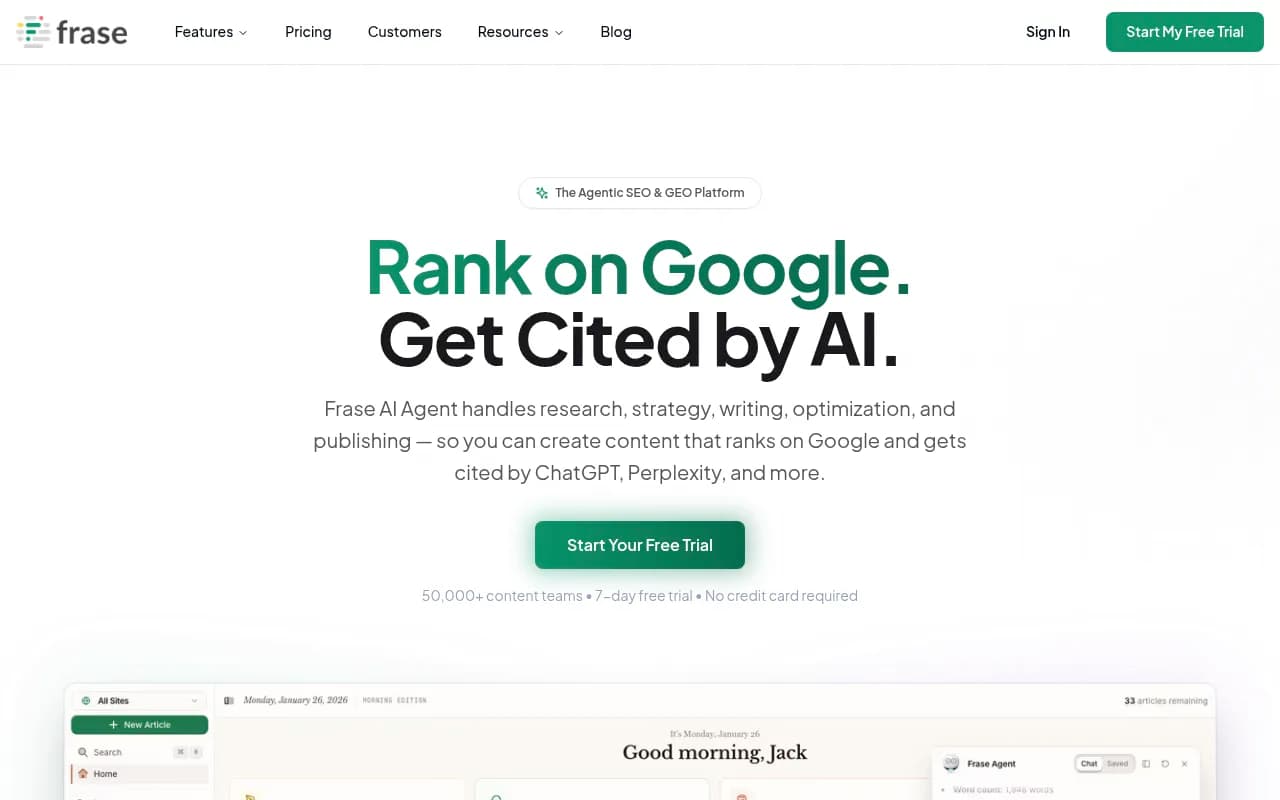
Frase is an SEO content tool that combines research, outlining, writing, and optimization. It analyzes top-ranking pages for your target keywords and provides data-driven recommendations to improve your content's search visibility. Recently, Frase added AI search tracking capabilities, positioning itself as both an SEO and GEO (Generative Engine Optimization) platform.
Compared to Writesonic, Frase is more research-focused. Writesonic emphasizes speed and automation for blog content, while Frase emphasizes understanding what's already ranking and building content that competes. Frase's AI Agent handles research, strategy, writing, optimization, and publishing in one workflow.
Key differences:
- SEO-first approach: Frase analyzes SERP competitors and provides content briefs with topic clusters, questions, and keywords to target
- AI search tracking: Monitors 8 AI platforms (ChatGPT, Perplexity, etc.) and shows brand mentions, though not as comprehensive as Promptwatch's crawler logs or citation analysis
- Content optimization: Real-time scoring as you write, with suggestions to improve topical coverage and keyword usage
- 80+ AI tools: Specialized templates for different content types beyond just blog posts
Frase is more affordable than Writesonic for small teams. Pricing starts at $39/mo (Starter: 1 user, 4 articles), $103/mo (Professional: 1 user, 30 articles), $239/mo (Scale: 3 users, unlimited articles). All plans include a 7-day free trial.
Trade-offs: Frase's AI search tracking is newer and less mature than dedicated GEO platforms like Promptwatch. It doesn't include crawler logs, prompt volume estimates, or Reddit/YouTube tracking. The writing quality is solid but not as fast or automated as Writesonic for high-volume blog production.
Best for: SEO-focused content teams that want research-driven content creation with AI search visibility as a secondary feature. Good for small teams on a budget who need traditional SEO optimization more than advanced GEO capabilities.
Scalenut

Scalenut is a comprehensive SEO and AI visibility platform that combines content creation, optimization, and AI search tracking. It positions itself as an end-to-end solution for both traditional search (Google) and AI search (ChatGPT, Perplexity, AI Overviews).
Compared to Writesonic, Scalenut offers more strategic depth. Writesonic focuses on fast content generation, while Scalenut provides a full workflow from keyword research to content creation to performance tracking across both traditional and AI search engines.
Key features:
- Real AI Visibility Tracking: Brand mentions, historical trends, prompt coverage, and competitor share across AI platforms
- Actionable Recommendations: Content gaps, prompt opportunities, competitive analysis, and citation insights
- Built-in GEO Engine: Article writer, content optimizer, content audit tools, and GEO scoring
- Backlinks Marketplace: High-trust backlinks without outreach hassle
- Managed GEO Services: Optional fully-managed services starting around $3,000/mo for hands-off optimization
Scalenut's AI search tracking shows exactly how AI represents your brand, then provides recommendations on what's missing and what to fix first. The built-in GEO engine executes those recommendations into real action — similar to Promptwatch's approach but with less granular data on crawler behavior and citation sources.
Pricing is usage-based, starting around $39-$79/mo for basic plans, $149-$499/mo for full platform access. Managed GEO services are priced separately. 7-day free trial included.
Trade-offs: Scalenut is more expensive than Writesonic for similar content volume. The AI search tracking is solid but doesn't include the depth of Promptwatch's crawler logs, Reddit/YouTube insights, or ChatGPT Shopping tracking. The managed services option is a plus for teams that want hands-off optimization.
Best for: Mid-sized marketing teams that want an all-in-one SEO and GEO platform with optional managed services. Good if you need both content creation and AI visibility tracking but don't want to manage multiple tools.
Copy.ai

Copy.ai started as a fast, versatile AI copywriting tool for marketing content. It has since evolved into a GTM (Go-To-Market) AI platform that automates workflows across sales, marketing, and operations. Copy.ai was recently acquired by Fullcast and now positions itself as an "AI-native GTM platform" rather than just a writing tool.
Compared to Writesonic, Copy.ai is broader in scope but less focused on blog automation. Writesonic is purpose-built for content marketing and blog production, while Copy.ai aims to "infuse AI across your go-to-market engine" with workflows, agents, and integrations beyond just content creation.
Key differences:
- GTM platform focus: Copy.ai now emphasizes sales workflows, CRM integrations, and cross-functional automation, not just content writing
- Free writing generators: Still offers free tools for emails, social media, and short-form copy
- 17 million users: Large user base across marketing, sales, and operations teams
- Less SEO-focused: No built-in SEO optimization, keyword research, or AI search visibility tracking
Copy.ai is best for short-form marketing copy (emails, ads, social posts) and GTM automation workflows. It's not designed for long-form blog content or SEO optimization like Writesonic. Pricing details are not publicly listed on their site.
Trade-offs: Copy.ai has shifted away from being a direct Writesonic competitor. If you need blog automation and SEO content, Writesonic is more focused. If you need a broader GTM platform with AI-powered sales and marketing workflows, Copy.ai is worth exploring.
Best for: Marketing and sales teams that need AI-powered workflows across the entire go-to-market motion, not just content creation. Not ideal if your primary need is blog automation or SEO content.
Jasper
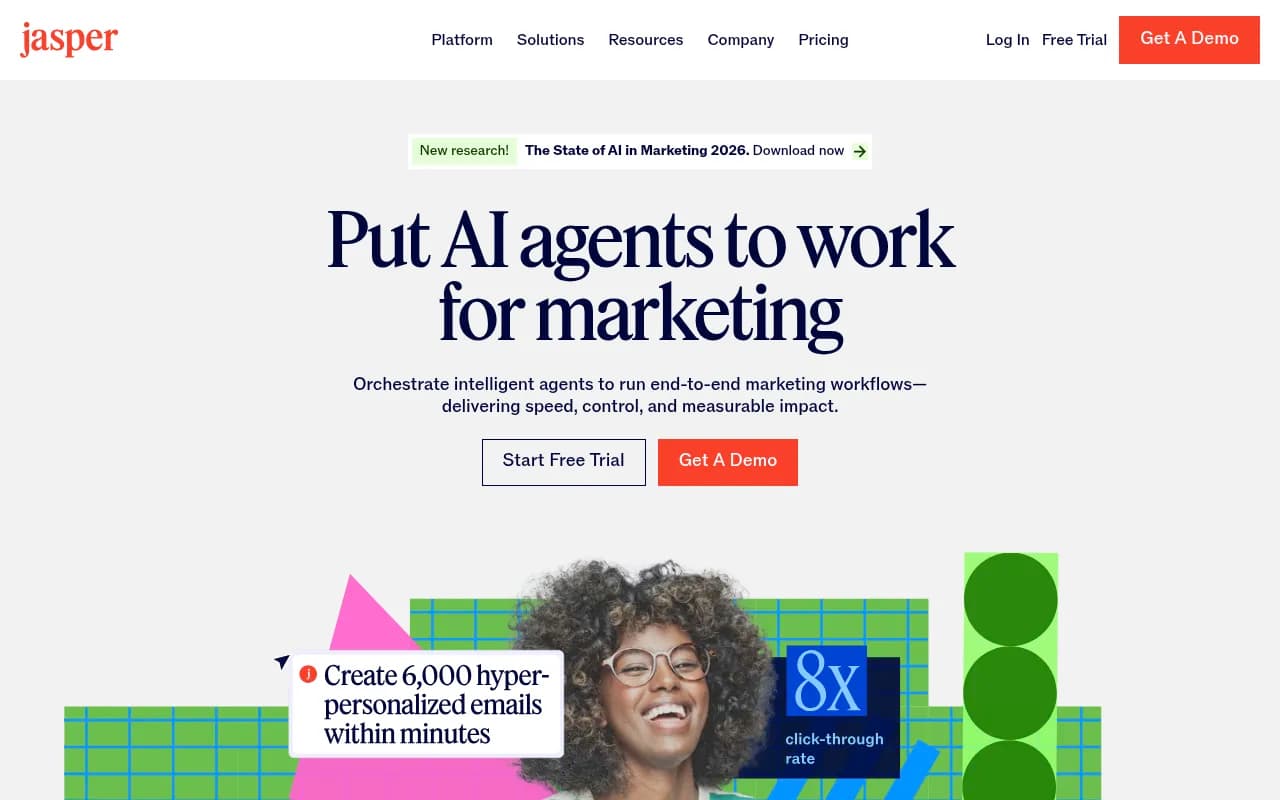
Jasper is an enterprise AI marketing platform with 100+ specialized AI agents, content pipelines, and brand intelligence features. It's designed for marketing teams at mid-to-large companies that need to automate content creation while maintaining strict brand consistency and compliance controls.
Compared to Writesonic, Jasper is more enterprise-focused and expensive. Writesonic is accessible for small teams and solopreneurs, while Jasper targets larger organizations with complex brand guidelines, multiple stakeholders, and high content volume across channels.
Key features:
- 100+ AI Agents: Specialized agents for different content types, channels, and use cases
- Content Pipelines: Automate the entire content lifecycle from data to creativity to distribution
- Jasper IQ: Proprietary context hub of brand, marketing, and company knowledge
- Brand Voice & Visual Guidelines: Built-in guardrails for brand consistency and compliance
- Canvas & Grid: Modern workspace for planning, creating, and collaborating at scale
- Image Suite: Proprietary vision models for on-brand images
- APIs: Flexible tooling for custom workflows
Jasper's strength is brand control and enterprise-grade governance. If you have strict brand guidelines, legal review processes, or need role-based permissions, Jasper handles that complexity. Writesonic is faster and simpler but doesn't offer the same level of brand intelligence or compliance features.
Pricing starts at $59/mo (Creator plan) to $249/mo (Pro plan for teams up to 5 users), with custom enterprise pricing. Free trial available.
Trade-offs: Jasper is significantly more expensive than Writesonic. The learning curve is steeper due to the breadth of features. It's overkill for small teams or solopreneurs who just need blog automation. No built-in SEO optimization or AI search visibility tracking — it's focused on brand consistency and content production, not search performance.
Best for: Enterprise marketing teams that need to produce high volumes of on-brand content across channels with strict compliance and governance controls. Not ideal for small teams or SEO-focused content strategies.
Rytr
Rytr is a structured AI writing assistant that provides guided, template-based content creation. It's designed to help content writers overcome writer's block and create faster with AI-powered suggestions. Rytr emphasizes simplicity and accessibility — it's one of the most beginner-friendly AI writing tools available.
Compared to Writesonic, Rytr is more basic and affordable. Writesonic offers more advanced features like blog automation, SEO optimization, and bulk content generation, while Rytr focuses on short-form content and guided templates.
Key features:
- 40+ use cases and templates: Email responses, blog posts, social media ads, product descriptions, etc.
- Structured writing assistance: Step-by-step guidance for each content type
- 8 million+ users: Large user base, primarily individual creators and small businesses
- Accessible anywhere: Browser extension and integrations for writing wherever you work
Rytr is best for short-form content and quick copywriting tasks. It's not designed for long-form blog automation or SEO-optimized articles like Writesonic. Pricing details are not listed on their site, but Rytr historically offers a free plan with limited credits and affordable paid plans.
Trade-offs: Rytr lacks advanced SEO features, bulk content generation, and AI search visibility tracking. The templates are helpful for beginners but can feel restrictive for experienced writers. Content quality is decent but not as polished as Writesonic or Jasper for long-form articles.
Best for: Beginner content creators and small businesses that need simple, template-based AI writing assistance for short-form content. Not ideal for SEO-focused blog automation or high-volume content production.
Surfer SEO
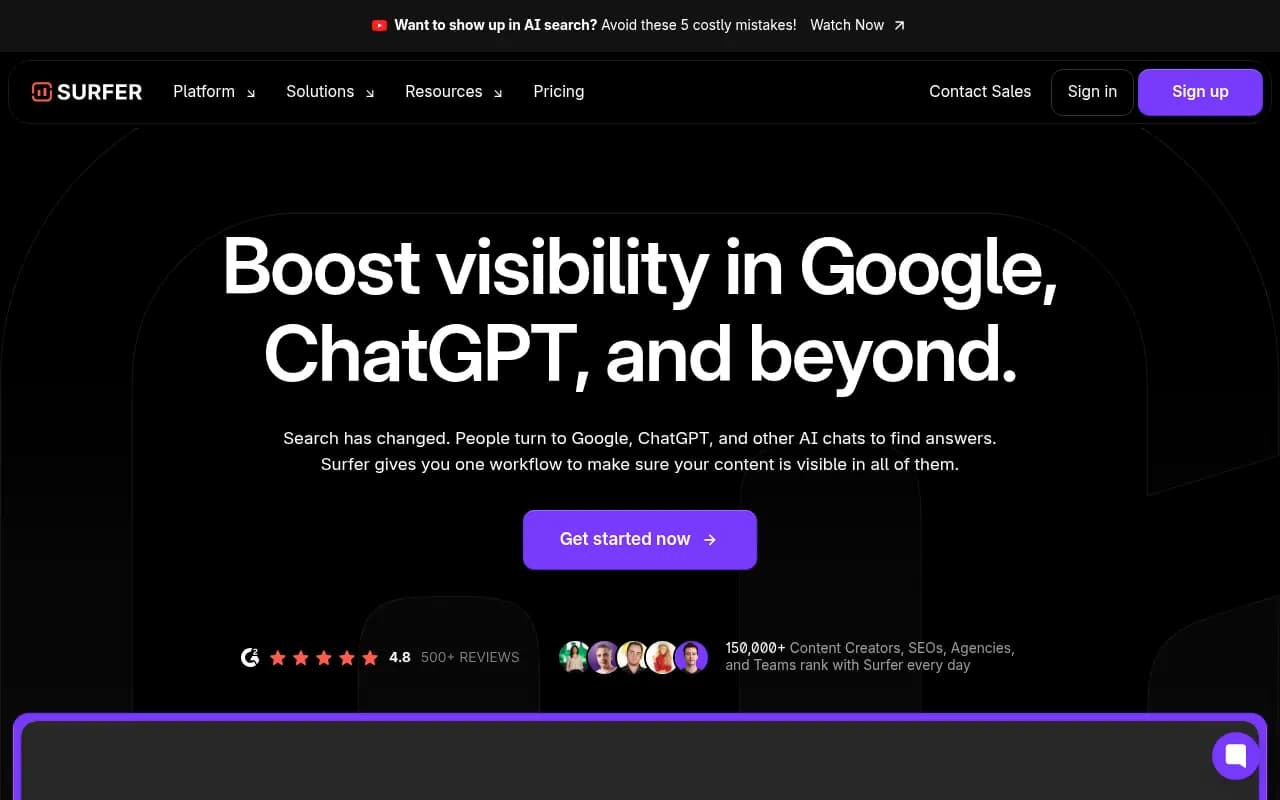
Surfer SEO is a content optimization platform that analyzes top-ranking pages and provides data-driven recommendations to improve your content's search visibility. It's one of the most popular SEO tools for content creators, with a strong focus on on-page optimization and competitive analysis.
Compared to Writesonic, Surfer SEO is optimization-first, not creation-first. Writesonic emphasizes fast content generation, while Surfer emphasizes understanding what's already ranking and optimizing your content to compete. Surfer recently added AI writing capabilities (Surfer AI) and AI search visibility tracking, but its core strength remains traditional SEO.
Key features:
- Content optimization: Real-time scoring as you write, with suggestions to improve keyword usage, content structure, and topical coverage
- SERP analysis: Analyze top-ranking pages for your target keywords and see what they're doing right
- Surfer AI: AI-powered article generation with built-in SEO optimization (costs additional credits)
- AI search visibility: Track how your content appears in ChatGPT, Perplexity, and other AI platforms
- Audit & refresh: Identify underperforming content and get recommendations to improve it
Surfer's AI search visibility tracking is newer and less comprehensive than dedicated GEO platforms like Promptwatch. It shows basic brand mentions but doesn't include crawler logs, citation analysis, or prompt intelligence.
Pricing starts at $99/mo (Essential), $179/mo (Advanced), $299/mo (Max), with custom enterprise pricing. 7-day money-back guarantee. Surfer AI articles cost additional credits.
Trade-offs: Surfer SEO is more expensive than Writesonic for similar content volume. The AI writing feature (Surfer AI) is an add-on, not the core product. The AI search tracking is basic compared to Promptwatch or Scalenut. Surfer's strength is traditional SEO optimization, not AI search visibility or content automation.
Best for: SEO-focused content teams that want data-driven optimization for traditional search engines. Good if you already have a content creation workflow and need better optimization tools. Not ideal if your primary need is AI search visibility or high-volume blog automation.
Junia AI
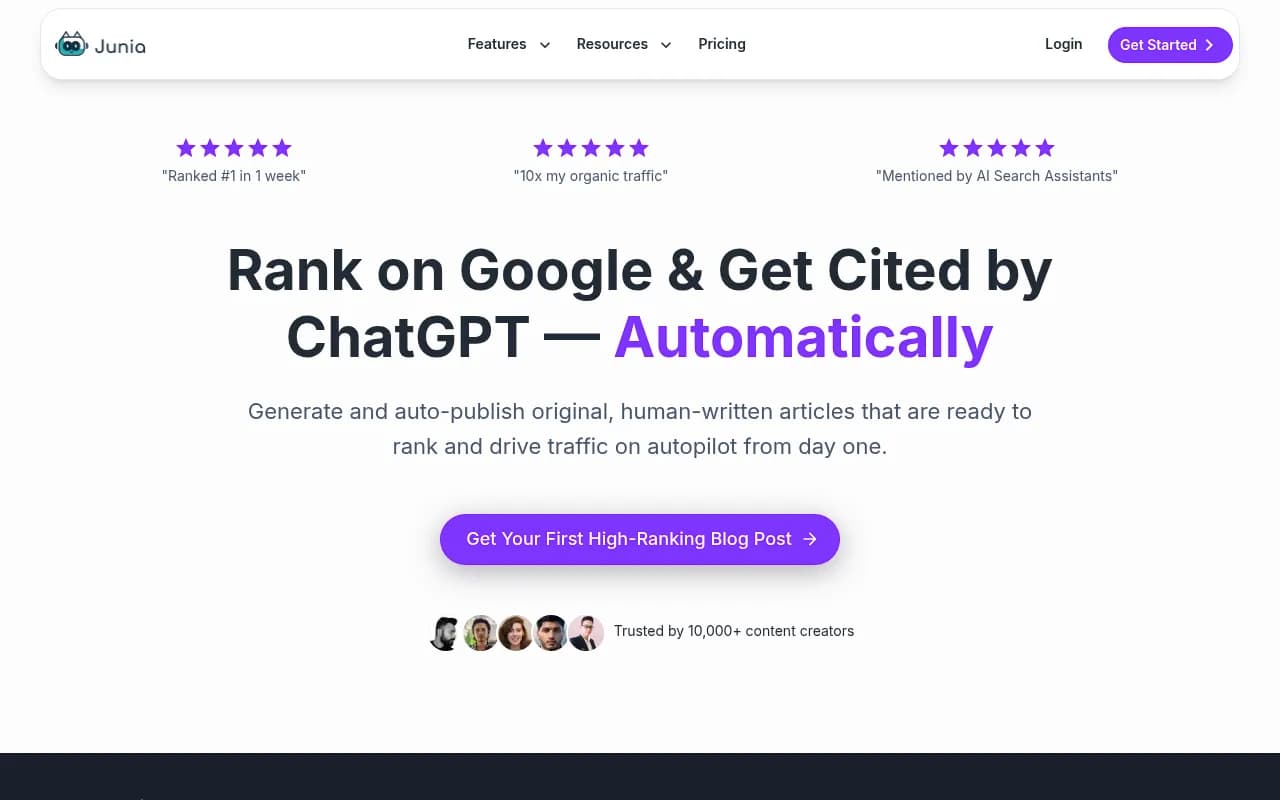
Junia AI is an end-to-end AI SEO content platform that generates original, long-form articles optimized for both traditional search engines and AI assistants. It handles keyword research, content creation, internal linking, image generation, and automated publishing to WordPress — all in one workflow.
Compared to Writesonic, Junia AI is more SEO-focused and automation-heavy. Writesonic emphasizes versatility and speed, while Junia emphasizes ranking on Google and getting cited by ChatGPT with minimal manual work.
Key features:
- Auto-publish to WordPress: Generate articles and publish them automatically without manual copy-pasting
- SEO optimization: Competitive intelligence, keyword analysis, and on-page optimization built into every article
- AI search citations: Content is optimized to get cited by ChatGPT, Perplexity, and other AI assistants
- Relevant images: Every article includes AI-generated images throughout
- Clean formatting: Headings, lists, tables, and structured content for easy reading
- 99% human-like content: Designed to pass AI detection tools
Junia AI is used by 10,000+ creators and emphasizes results: "Ranked #1 in 1 week," "10x my organic traffic," "Mentioned by AI Search Assistants." The platform is designed for bloggers and niche site owners who want to automate content production and focus on scaling traffic.
Pricing is freemium: Free plan available, paid plans from $34/mo (Creator) and $59/mo (Pro). More affordable than Writesonic for similar content volume.
Trade-offs: Junia AI is narrowly focused on blog automation and SEO. It doesn't offer the versatility of Writesonic for other content types (emails, social media, ads). The AI search optimization is built into the content generation but doesn't include visibility tracking or analytics like Promptwatch or Scalenut.
Best for: Bloggers, niche site owners, and content creators who want automated, long-form SEO content that ranks on Google and gets cited by AI assistants. Good if you need WordPress auto-publishing and want to scale traffic with minimal manual work.
How to Choose the Right Writesonic Alternative
The best alternative depends on what you're trying to accomplish:
If you need AI search visibility and optimization (not just content creation), Promptwatch is the only platform that shows you content gaps, generates AI-optimized articles, and tracks results across 10+ AI platforms. It includes crawler logs, citation analysis, and Reddit/YouTube tracking that other tools lack.
If you need SEO-focused content research and optimization, Frase and Surfer SEO are strong choices. Frase is more affordable and includes AI writing, while Surfer is more mature for traditional SEO but costs more.
If you need an all-in-one SEO and GEO platform with managed services, Scalenut offers comprehensive tracking, content creation, and optional hands-off optimization.
If you need enterprise-grade brand control and compliance, Jasper is the most robust option with 100+ agents, content pipelines, and brand intelligence features.
If you need automated blog production with WordPress publishing, Junia AI is the most focused and affordable option for scaling traffic.
If you need short-form copywriting and GTM workflows, Copy.ai (now part of Fullcast) is broader in scope but less focused on blog automation.
If you're a beginner looking for simple, template-based writing assistance, Rytr is the most accessible and affordable option.
The biggest shift in 2026 is that content creation alone isn't enough. AI search engines like ChatGPT, Perplexity, and Claude are reshaping how people find information, and traditional AI writers like Writesonic don't help you understand or optimize for that new reality. Tools like Promptwatch, Scalenut, and Junia AI are built around the new paradigm: create content that ranks in both traditional and AI search, then track and optimize your visibility across all platforms.
If you're still just writing articles and hoping they rank, you're missing the bigger picture. The best Writesonic alternatives help you understand what's missing, create content that fills those gaps, and track the results across every platform where your audience is searching.