Key Takeaways
- Promptwatch is the best choice if you need AI search visibility tracking alongside traditional rank monitoring—it's the only platform that helps you create content to improve AI citations, not just track them
- SE Ranking offers the best value for agencies managing multiple clients with comprehensive SEO tools, white-label reporting, and competitive pricing starting at $103/mo
- Ahrefs and Semrush are ideal if you want an all-in-one marketing platform beyond rank tracking, though their AI search features lag behind specialized tools
- Nightwatch delivers the fastest updates and most precise localization (107,000+ locations) for teams obsessed with real-time ranking data
- AccuRanker remains strong for pure speed and on-demand updates, but lacks the content optimization and AI visibility features competitors now offer
AccuRanker built its reputation on speed—real-time rank tracking with on-demand updates that agencies and enterprises rely on for client reporting. But in 2026, speed alone isn't enough. The SEO landscape has shifted dramatically with AI search engines like ChatGPT, Perplexity, Claude, and Google AI Overviews fundamentally changing how people discover brands. If you're only tracking traditional Google rankings, you're missing where a growing portion of your audience is actually searching.
Many teams are reconsidering AccuRanker for several reasons: the pricing can get steep as you scale keywords ($1,929/mo for 50,000 keywords on Enterprise), the platform focuses almost entirely on rank tracking without broader SEO capabilities like content optimization or technical audits, and while AccuLLM adds AI search monitoring, it's a monitoring-only feature that shows you the data but leaves you stuck on what to do about it. You see that competitors are getting cited in ChatGPT responses, but you don't get guidance on how to fix it.
If you're evaluating alternatives, you're likely looking for one of these: better value for money as you scale, a more complete SEO toolkit that goes beyond rank tracking, deeper AI search visibility with actionable optimization recommendations, more flexible reporting for agency workflows, or simply a different approach to how rank tracking fits into your overall SEO strategy.
Here are the best AccuRanker alternatives in 2026, compared honestly on features, pricing, and what they actually do differently.
Promptwatch

Promptwatch is the market-leading AI Search Visibility platform used by 6,700+ brands and agencies including Booking.com, Center Parcs, and Google. Unlike monitoring-only tools, Promptwatch is built around an action loop: find content gaps, generate optimized content, track results. It's the only platform rated as a "Leader" across all categories in a 2026 comparison of 12 GEO platforms.
What makes it different from AccuRanker: AccuRanker tracks where you rank in traditional search. Promptwatch tracks where you appear in AI search engines (ChatGPT, Claude, Perplexity, Gemini, Grok, DeepSeek, Mistral, Meta AI, Copilot, Google AI Overviews) and then helps you improve those results. The core difference is the action loop—Answer Gap Analysis shows exactly which prompts competitors are visible for but you're not, the built-in AI writing agent generates content grounded in 880M+ citations analyzed, and page-level tracking shows which content is actually getting cited.
Key capabilities AccuRanker lacks:
- AI Crawler Logs: Real-time logs of ChatGPT, Claude, and Perplexity crawlers hitting your site—which pages they read, errors they encounter, how often they return
- Citation & Source Analysis: See exactly which pages, Reddit threads, YouTube videos, and domains AI models cite in responses
- Reddit & YouTube Insights: Surface discussions that directly influence AI recommendations
- ChatGPT Shopping Tracking: Monitor when your brand appears in product recommendations and shopping carousels
- Content generation: Create articles engineered to get cited by AI models, not just track rankings
- Prompt Intelligence: Volume estimates and difficulty scores for each prompt, plus query fan-outs showing how one prompt branches into sub-queries
Pricing comparison: Essential $99/mo (1 site, 50 prompts, 5 articles), Professional $249/mo (2 sites, 150 prompts, 15 articles, crawler logs), Business $579/mo (5 sites, 350 prompts, 30 articles). Compared to AccuRanker's $579/mo Expert plan (10,000 keywords), Promptwatch's Business plan costs the same but includes AI search monitoring across 10 models, content generation, and optimization tools—not just rank tracking.
Best for: Marketing teams and agencies that want to be visible in AI search results and need tools to actually improve their visibility, not just monitor it. If you're only tracking traditional Google rankings, stick with AccuRanker. If you're serious about AI search visibility and want a platform that helps you take action, Promptwatch is the clear choice.
SE Ranking
SE Ranking is a comprehensive SEO platform trusted by 1.5M+ professionals since 2013. It combines rank tracking, keyword research, site audits, backlink monitoring, and content optimization tools with white-label reporting designed specifically for agencies managing multiple clients.
What makes it different from AccuRanker: SE Ranking is a full SEO suite, not just a rank tracker. You get site audits that crawl your pages for technical issues, backlink monitoring with competitor analysis, keyword research across 188 countries with a 5.4B keyword database, on-page SEO checker, and content optimization tools with AI-powered insights. AccuRanker is faster for pure rank tracking, but SE Ranking gives you the complete toolkit to actually improve those rankings.
Key feature comparison:
- Site audits: SE Ranking crawls your site and identifies technical SEO issues. AccuRanker doesn't offer this.
- Backlink analysis: SE Ranking monitors your backlink profile and competitors. AccuRanker focuses only on rankings.
- White-label reporting: Both offer it, but SE Ranking's agency-focused features (client management, team collaboration, custom branding) are more developed.
- AI search tracking: SE Ranking offers an AI Search add-on ($71.20/mo) for ChatGPT, Perplexity, and Gemini monitoring. AccuRanker has AccuLLM built in.
- Rank tracking speed: AccuRanker is faster with on-demand updates. SE Ranking updates daily.
Pricing comparison: SE Ranking starts at $103.20/mo (Core plan, annual billing) vs AccuRanker's $109/mo for 1,000 keywords. SE Ranking's Growth plan ($223.20/mo) includes significantly more SEO tools than AccuRanker's comparable tier. The Agency Pack add-on ($69/mo) adds client management features. For agencies, SE Ranking delivers better value—you get rank tracking plus all the other SEO tools you need.
Trade-offs: AccuRanker is faster for rank updates and has a cleaner interface focused purely on rankings. SE Ranking has more features but can feel overwhelming if you only need rank tracking. If you want a complete SEO platform, SE Ranking wins. If you want the fastest rank tracker and nothing else, AccuRanker is better.
Best for: Agencies managing multiple clients who need a complete SEO toolkit with white-label reporting, not just rank tracking. SE Ranking gives you everything in one platform at a better price point than buying separate tools.
Ahrefs
Ahrefs is a comprehensive SEO and marketing intelligence platform used by 44% of Fortune 500 companies. It combines traditional SEO tools with newer AI search monitoring through Brand Radar, powered by the web's largest backlink index (over 40 trillion links) and keyword database.
What makes it different from AccuRanker: Ahrefs is a full marketing platform, not a specialized rank tracker. You get industry-leading backlink analysis (their core strength), site audits, content explorer for finding top-performing content in your niche, keyword research with accurate search volumes, and rank tracking. Brand Radar adds AI search monitoring for ChatGPT, Perplexity, and Google AI Overviews, though it uses fixed prompts and lacks the depth of specialized GEO platforms.
Key feature comparison:
- Backlink analysis: Ahrefs is the gold standard. AccuRanker doesn't offer this.
- Keyword research: Ahrefs has a massive database with accurate volumes and keyword difficulty scores. AccuRanker focuses on tracking, not research.
- Content tools: Ahrefs includes Content Explorer and SEO Writing Assistant. AccuRanker has none.
- Rank tracking: AccuRanker is faster with on-demand updates. Ahrefs updates daily.
- AI search monitoring: Ahrefs Brand Radar tracks fixed prompts only and lacks traffic attribution. AccuRanker's AccuLLM is more flexible.
Pricing comparison: Ahrefs Lite starts at $83/mo (annual billing) vs AccuRanker's $109/mo. But Ahrefs Lite is extremely limited—500 keywords tracked, 5 projects. For comparable features, you need Ahrefs Standard ($166/mo) or Advanced ($333/mo). AccuRanker's Expert plan ($579/mo for 10,000 keywords) is cheaper than Ahrefs Advanced for pure rank tracking, but Ahrefs includes the full SEO suite.
Trade-offs: Ahrefs excels at backlink analysis and competitive research but is expensive for what you get in rank tracking alone. AccuRanker is faster and more cost-effective if rank tracking is your primary need. Ahrefs' AI search monitoring (Brand Radar) is basic compared to specialized tools—it uses fixed prompts, lacks crawler logs, and doesn't help you optimize content for AI visibility.
Best for: Teams that need a complete SEO platform with best-in-class backlink analysis and competitive intelligence. If you're already using Ahrefs for backlinks and keyword research, the rank tracking is a solid addition. If you only need rank tracking, AccuRanker or SE Ranking are better value.
Semrush
Semrush is a comprehensive digital marketing suite used by 10M+ marketers and 35% of Fortune 500 companies. It offers 8 toolkits covering SEO, content, PPC, social media, local search, and AI search optimization—though its AI features lag behind specialized GEO platforms.
What makes it different from AccuRanker: Semrush is an all-in-one marketing platform, not a specialized rank tracker. You get traditional SEO tools (keyword research, site audits, backlink analysis, rank tracking), PPC research and management, social media scheduling, content marketing tools, and local SEO features. The AI Visibility toolkit tracks ChatGPT, Perplexity, and Gemini mentions, but like Ahrefs, it uses fixed prompts and lacks optimization capabilities.
Key feature comparison:
- Rank tracking: AccuRanker is faster with on-demand updates and unlimited keywords on higher plans. Semrush has daily updates and keyword limits per plan.
- Site audits: Semrush includes comprehensive technical SEO audits. AccuRanker doesn't.
- PPC tools: Semrush has extensive PPC research and ad management. AccuRanker has none.
- Content tools: Semrush includes SEO Writing Assistant, Content Marketplace, and topic research. AccuRanker focuses only on rankings.
- AI search monitoring: Semrush's AI Visibility uses fixed prompts and lacks traffic attribution. AccuRanker's AccuLLM is more flexible.
Pricing comparison: Semrush starts at $165/mo (Starter) vs AccuRanker's $109/mo. Semrush Pro+ ($290/mo) and Advanced ($580/mo) are significantly more expensive than AccuRanker's comparable tiers. You're paying for the full marketing suite, not just rank tracking. If you need all the tools, Semrush is worth it. If you only need rank tracking, AccuRanker is better value.
Trade-offs: Semrush is powerful but expensive and overwhelming if you only need rank tracking. AccuRanker is faster, simpler, and cheaper for pure ranking data. Semrush's AI search monitoring is basic—fixed prompts, no content optimization, no crawler logs. For serious AI visibility work, specialized tools like Promptwatch are far ahead.
Best for: Large marketing teams that need an all-in-one platform covering SEO, PPC, content, and social media. If you're already using Semrush for keyword research and site audits, the rank tracking is solid. If rank tracking is your primary need, AccuRanker or SE Ranking offer better value.
Nightwatch
Nightwatch is an AI-ready SEO monitoring platform built for data-obsessed teams and fast-growing businesses. It combines high-frequency rank tracking with AI search visibility monitoring across ChatGPT, Gemini, Claude, and Perplexity.
What makes it different from AccuRanker: Nightwatch emphasizes precision and real-time updates. It offers on-demand rank refreshes (like AccuRanker), but adds more granular localization—107,000+ locations down to zip code level vs AccuRanker's city-level tracking. The platform also includes an SEO Agent that automates workflow tasks and provides AI-driven optimization recommendations.
Key feature comparison:
- Localization: Nightwatch tracks 107,000+ locations to zip code level. AccuRanker offers city-level tracking.
- Update frequency: Both offer on-demand updates. Nightwatch emphasizes "real-time" positioning.
- AI search monitoring: Both track ChatGPT, Gemini, Perplexity. Nightwatch adds Claude. Neither offers content optimization.
- SEO Agent: Nightwatch includes automated workflow and recommendations. AccuRanker doesn't.
- Pricing: Nightwatch starts at $24/mo (Starter) vs AccuRanker's $109/mo, but feature sets differ significantly at entry tiers.
Pricing comparison: Nightwatch Starter ($24/mo) is much cheaper than AccuRanker's entry plan ($109/mo), but includes fewer keywords and features. Nightwatch Optimize ($59/mo) is still cheaper than AccuRanker's base tier. For comparable enterprise features, pricing becomes more similar. Nightwatch offers better value at lower tiers; AccuRanker may be more cost-effective at scale.
Trade-offs: Nightwatch's hyper-local tracking (zip code level) is valuable for local SEO but overkill for most use cases. AccuRanker's interface is cleaner and more established. Nightwatch's SEO Agent automation is useful but not as comprehensive as full SEO suites like SE Ranking. Both lack content optimization tools for AI search.
Best for: Teams that need hyper-precise local rank tracking or want real-time updates at a lower price point than AccuRanker. The SEO Agent automation is a nice bonus for workflow efficiency.
Moz Pro
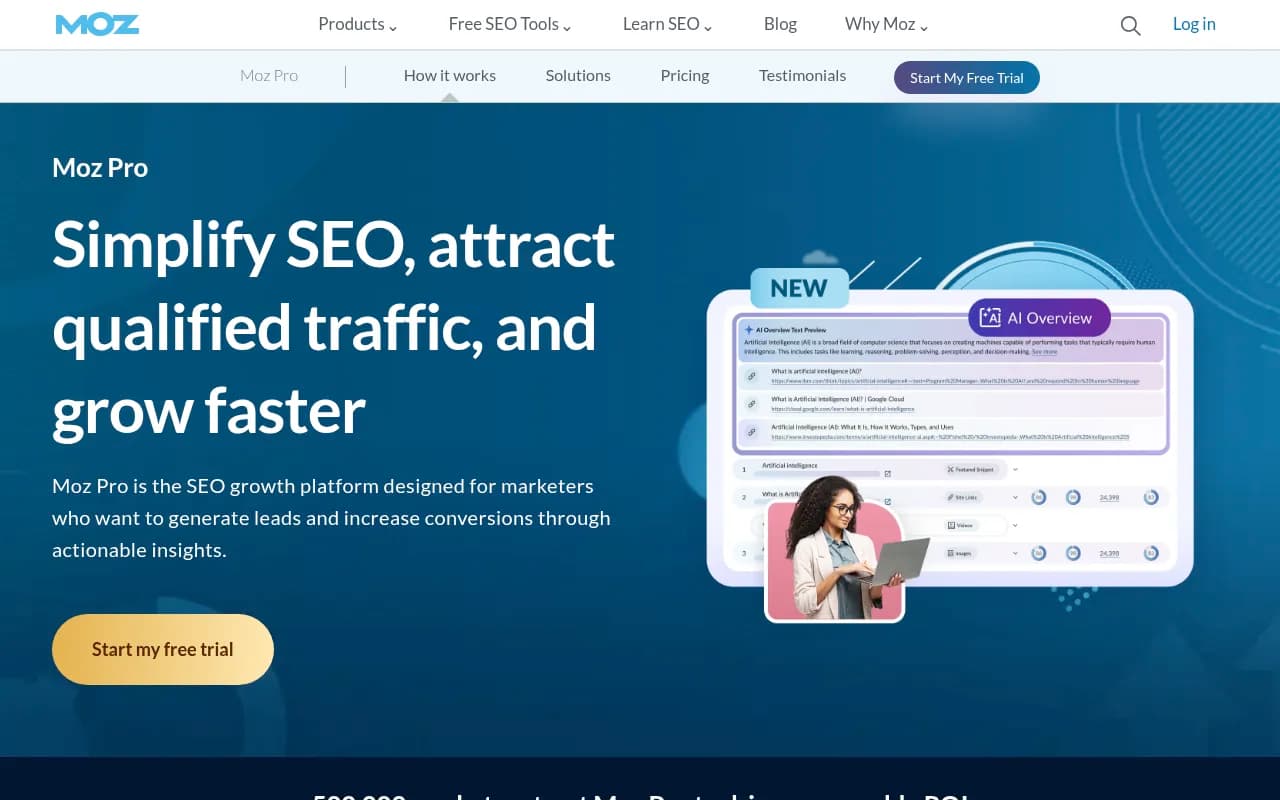
Moz Pro is a complete SEO toolkit featuring Keyword Explorer, On-Page Grader, site audits, and proprietary metrics (Domain Authority, Page Authority) for finding missed link-building opportunities. It's been a trusted name in SEO since 2004.
What makes it different from AccuRanker: Moz Pro is an all-in-one SEO platform focused on helping you improve rankings, not just track them. The standout features are link opportunity discovery (using proprietary metrics to find winnable backlinks) and the On-Page Grader that provides specific optimization recommendations. Rank tracking is included but not the primary focus.
Key feature comparison:
- Rank tracking: AccuRanker is faster with on-demand updates and unlimited keywords. Moz Pro has daily updates with keyword limits per plan.
- Link analysis: Moz Pro's proprietary metrics (DA/PA) are widely used for link building. AccuRanker doesn't offer backlink analysis.
- On-page optimization: Moz Pro's On-Page Grader provides specific recommendations. AccuRanker has none.
- Keyword research: Moz Pro includes Keyword Explorer with search intent analysis. AccuRanker focuses on tracking.
- AI search monitoring: Neither platform offers comprehensive AI search tracking.
Pricing comparison: Moz Pro starts at $49/mo (currently $39/mo with promotion) vs AccuRanker's $109/mo. Moz Pro Standard ($99/mo) and Medium ($179/mo) are cheaper than AccuRanker's comparable tiers. However, Moz Pro's keyword tracking limits are tighter—Standard includes 1,500 tracked keywords vs AccuRanker's 1,000+ at similar price points.
Trade-offs: Moz Pro's proprietary metrics (DA/PA) are valuable for link building but not as comprehensive as Ahrefs' backlink data. AccuRanker is faster and more focused on rank tracking. Moz Pro's interface feels dated compared to newer tools. Neither platform offers AI search monitoring, which is a significant gap in 2026.
Best for: Teams that prioritize link building and want a trusted, established SEO platform with good educational resources. If rank tracking is your primary need, AccuRanker is better. If you need link opportunity discovery, Moz Pro's proprietary metrics are valuable.
Advanced Web Ranking
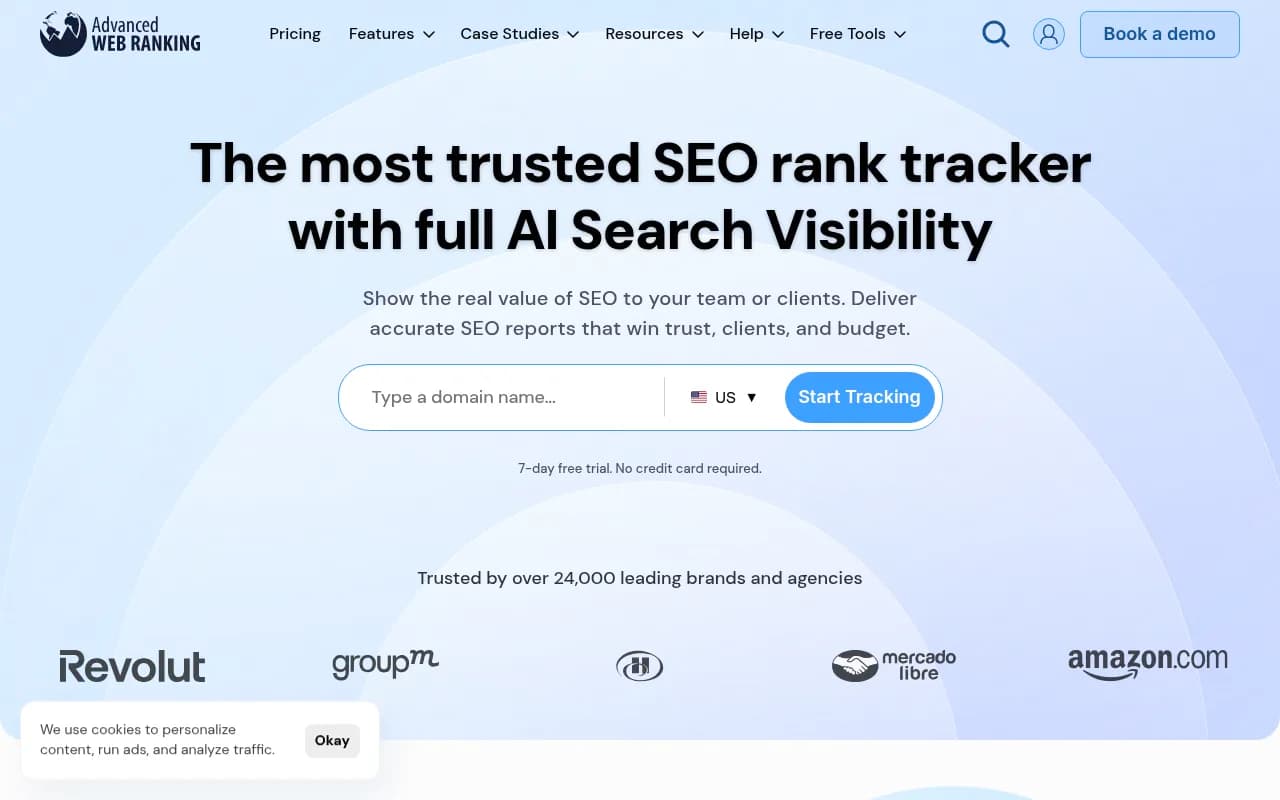
Advanced Web Ranking (AWR) is an enterprise-grade rank tracking platform with 20+ years of proven SERP accuracy. It's trusted by 24,000+ brands and agencies worldwide for tracking rankings across Google, YouTube, Amazon, and AI platforms like ChatGPT and Perplexity.
What makes it different from AccuRanker: AWR emphasizes data accuracy and depth over speed. It offers pixel-level SERP analysis (tracking the exact pixel position of your results, not just rank number), market share insights, and comprehensive reporting. The platform tracks rankings on YouTube and Amazon in addition to traditional search engines, which AccuRanker doesn't offer.
Key feature comparison:
- SERP accuracy: AWR claims superior accuracy with pixel-level tracking. AccuRanker emphasizes speed.
- Platform coverage: AWR tracks Google, YouTube, Amazon, plus AI search. AccuRanker focuses on Google and AI search.
- Update frequency: AccuRanker offers on-demand updates. AWR has scheduled updates (daily, weekly, or on-demand).
- Market share analysis: AWR provides detailed market share insights. AccuRanker's competitor analysis is less developed.
- Reporting: Both offer white-label reporting. AWR's reports are more customizable.
Pricing comparison: AWR starts at $39/mo (annual billing, Starter: 250 keywords) vs AccuRanker's $109/mo (1,000 keywords). AWR Pro ($99/mo, 1,500 keywords) and Agency ($199/mo, 4,500 keywords) are cheaper than AccuRanker's comparable tiers. For enterprise needs, both offer custom pricing.
Trade-offs: AWR is more affordable at most tiers and offers broader platform coverage (YouTube, Amazon). AccuRanker is faster with on-demand updates and has a more modern interface. AWR's pixel-level tracking is valuable for understanding SERP visibility beyond just rank position, but most teams don't need that level of detail.
Best for: Agencies and enterprises that need accurate, detailed rank tracking across multiple platforms (Google, YouTube, Amazon) at a lower price point than AccuRanker. The 20-year track record and pixel-level accuracy are valuable for teams that prioritize data precision over speed.
Serpstat
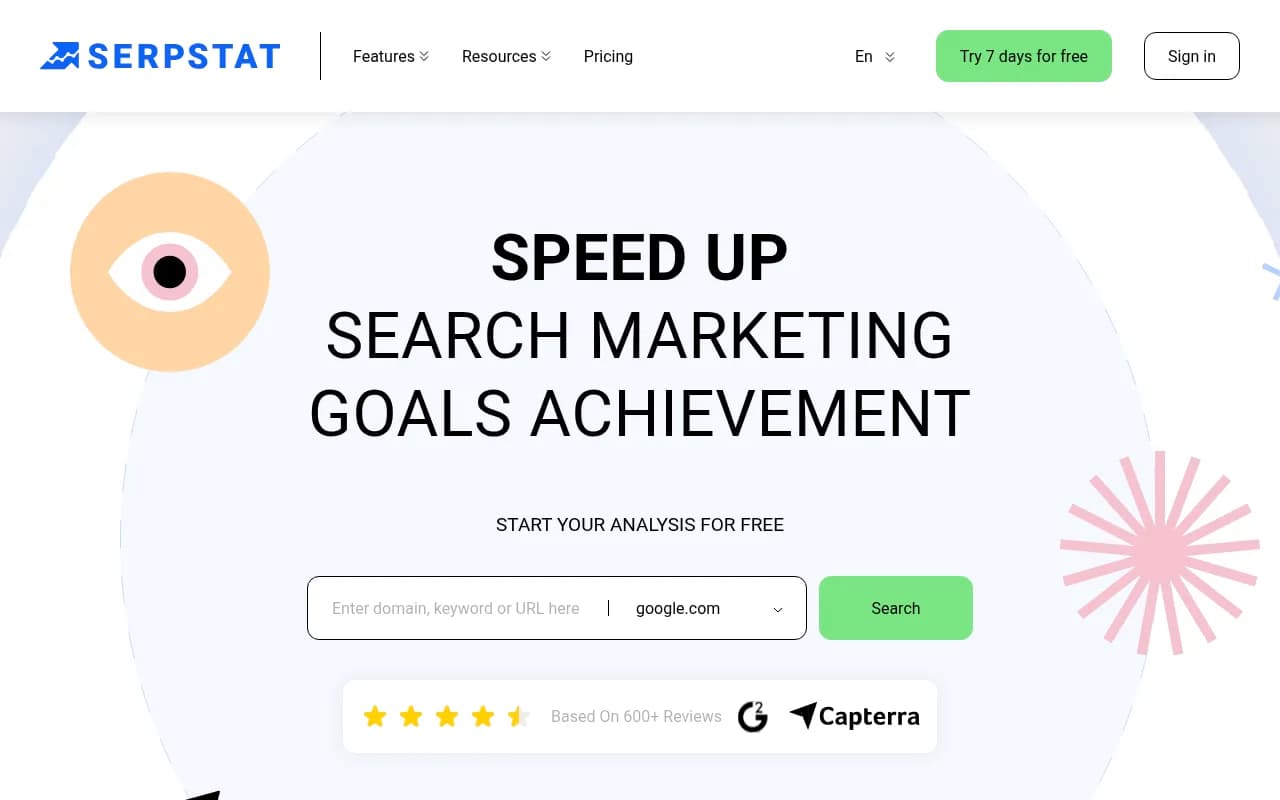
Serpstat is an all-in-one SEO platform offering keyword research across 230 countries, site auditing, rank tracking, backlink analysis, and competitor intelligence. It's designed for agencies, in-house teams, and freelancers managing multiple clients, combining affordability with depth.
What makes it different from AccuRanker: Serpstat is a full SEO suite at a budget-friendly price point. It tracks 8.62B keywords across 230 countries and offers comprehensive competitor analysis, backlink monitoring, and site audits. The platform is more affordable than AccuRanker while providing broader SEO capabilities, though rank tracking isn't as fast.
Key feature comparison:
- Rank tracking: AccuRanker is faster with on-demand updates. Serpstat has daily updates.
- Keyword database: Serpstat tracks 8.62B keywords across 230 countries. AccuRanker focuses on tracking, not research.
- Site audits: Serpstat includes technical SEO audits. AccuRanker doesn't.
- Backlink analysis: Serpstat offers backlink monitoring. AccuRanker doesn't.
- Pricing: Serpstat is significantly cheaper at most tiers.
Pricing comparison: Serpstat starts at $69/mo (Lite) vs AccuRanker's $109/mo. Serpstat's higher tiers ($179/mo Standard, $499/mo Enterprise) are cheaper than AccuRanker's comparable plans while including more SEO tools. Serpstat occasionally offers lifetime deals, which AccuRanker doesn't.
Trade-offs: Serpstat is more affordable and offers a complete SEO toolkit, but rank tracking is slower than AccuRanker. The interface is less polished. Serpstat doesn't offer AI search monitoring, which is a gap in 2026. For budget-conscious teams that need a full SEO suite, Serpstat delivers good value.
Best for: Freelancers, small agencies, and in-house teams on a budget who need a complete SEO platform. If you need the fastest rank tracking, AccuRanker is better. If you want a full SEO toolkit at an affordable price, Serpstat is a solid choice.
How to Choose the Right AccuRanker Alternative
Choose Promptwatch if: You need to track and improve your visibility in AI search engines (ChatGPT, Claude, Perplexity, Gemini). It's the only platform that helps you create content to boost AI citations, not just monitor them. Essential for brands serious about AI search visibility in 2026.
Choose SE Ranking if: You're an agency managing multiple clients and need a complete SEO toolkit with white-label reporting at a better price point than buying separate tools. Best value for comprehensive SEO work.
Choose Ahrefs if: You need best-in-class backlink analysis and competitive intelligence alongside rank tracking. Worth the premium price if you're doing serious link building and competitor research.
Choose Semrush if: You need an all-in-one marketing platform covering SEO, PPC, content, and social media. Best for large marketing teams managing multiple channels.
Choose Nightwatch if: You need hyper-precise local rank tracking (zip code level) or want real-time updates at a lower price point than AccuRanker.
Choose Moz Pro if: You prioritize link building and want a trusted platform with proprietary metrics (DA/PA) for finding link opportunities. Good educational resources included.
Choose Advanced Web Ranking if: You need accurate rank tracking across Google, YouTube, and Amazon at an affordable price. The 20-year track record and pixel-level accuracy are valuable for data precision.
Choose Serpstat if: You're on a budget and need a complete SEO toolkit. Best value for freelancers and small agencies.
Stick with AccuRanker if: You only need fast, accurate rank tracking with on-demand updates and don't need broader SEO tools or AI search optimization. AccuRanker remains the speed leader for pure rank tracking.
The biggest shift in 2026 is that rank tracking alone isn't enough. AI search engines are changing how people discover brands, and monitoring-only tools leave you stuck. Platforms like Promptwatch that help you take action—find gaps, create optimized content, track results—are where the market is heading. If you're only tracking traditional Google rankings, you're missing a growing portion of your audience.