Key Takeaways
- Ahrefs: Best for enterprise teams needing the largest backlink index and comprehensive competitor analysis, though pricier than SE Ranking at $83+/mo
- Semrush: Most comprehensive all-in-one platform with 8 toolkits including basic AI search tracking, but costs $165+/mo and AI features lag specialized platforms
- Promptwatch: Only platform focused on AI search optimization with content generation, crawler logs, and citation analysis across 10 LLMs—essential if AI visibility matters
- Ubersuggest: Best budget option at $29/mo with lifetime deals available, though limited compared to SE Ranking's depth
- Mangools: Simplest interface for beginners at $29/mo with solid keyword research, but lacks advanced features for agencies
SE Ranking has built a loyal following among agencies and in-house teams since 2013 with its comprehensive feature set, white-label reporting, and competitive pricing starting at $103.20/mo. But it's not the only option—and depending on your specific needs, budget, or whether you're prioritizing traditional SEO vs emerging AI search visibility, another platform might serve you better.
Common reasons teams look beyond SE Ranking: needing deeper backlink data for enterprise competitor analysis, wanting simpler tools for small budgets, requiring specialized AI search optimization that goes beyond basic monitoring, or seeking more intuitive interfaces for non-technical users. Some teams also find SE Ranking's learning curve steep or want tools with stronger integrations for their existing workflows.
Ahrefs
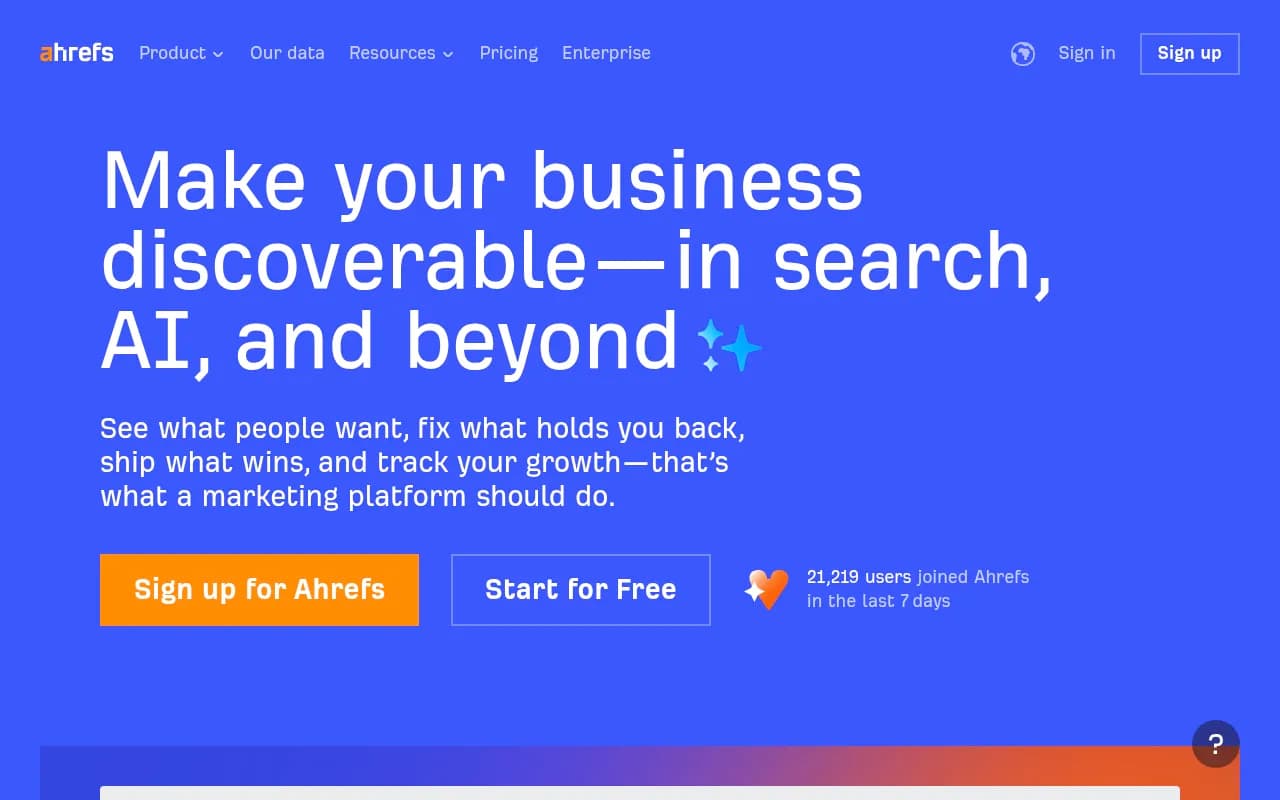
Ahrefs operates the web's largest backlink index—over 36 trillion links crawled—which makes it the gold standard for competitor backlink analysis and link-building research. If you're doing serious competitive intelligence or need to reverse-engineer how competitors built their domain authority, Ahrefs delivers data SE Ranking can't match in depth.
The platform covers traditional SEO comprehensively: keyword research across 171 countries, site audits that crawl up to 500,000 pages, rank tracking with SERP feature analysis, and content gap analysis showing exactly which keywords competitors rank for that you don't. The Content Explorer tool indexes 15.5B pages and lets you find link-worthy content in any niche by filtering by social shares, referring domains, and organic traffic.
Where Ahrefs differs from SE Ranking: the backlink data is significantly fresher (updated every 15 minutes vs SE Ranking's weekly updates), the keyword database is larger (8.9B keywords vs SE Ranking's 5.4B), and the interface prioritizes power users over simplicity. You'll find more granular filtering options and export capabilities, but the learning curve is steeper.
Ahrefs recently added Brand Radar for AI search monitoring, but it's limited—fixed prompts only, no custom tracking, and no traffic attribution or content optimization features. If AI visibility matters, you'll need a specialized platform alongside Ahrefs.
Pricing starts at $83/mo (Lite plan with very limited features), with most teams needing the Standard plan at $166/mo or Advanced at $333/mo. That's 60-220% more expensive than SE Ranking's comparable plans. The trade-off: you're paying for the most trusted backlink data in the industry and tools built for enterprise-scale analysis.
Best for: Enterprise SEO teams, link-building specialists, and agencies managing Fortune 500 clients who need the deepest backlink intelligence and can justify the premium pricing.
Semrush
Semrush positions itself as the all-in-one digital marketing suite—not just SEO, but PPC, content, social media, local search, and now AI visibility tracking. If you want one platform that covers every digital channel instead of stitching together multiple tools, Semrush delivers breadth that SE Ranking doesn't attempt.
The SEO toolkit matches SE Ranking feature-for-feature: keyword research with 26.1B keywords, position tracking, site audits, backlink analysis, and on-page SEO recommendations. Where Semrush pulls ahead: the Keyword Magic Tool groups keywords by topic clusters automatically, the Content Marketing Platform includes an AI writing assistant, and the PPC Keyword Tool analyzes Google Ads and Shopping campaigns in depth.
Semrush added AI search tracking in 2025 across ChatGPT, Perplexity, and Gemini, but it's monitoring-only with fixed prompts—you can't customize queries, track your own prompt sets, or get actionable optimization recommendations. There's no crawler log analysis, no content gap analysis for AI, and no traffic attribution. If AI visibility is a priority, you'll hit limitations quickly.
The platform is used by 10M+ marketers and 35% of Fortune 500 companies, which means extensive documentation, integrations, and third-party support. The interface is busier than SE Ranking's—more features means more navigation complexity—but power users appreciate the depth once they learn the layout.
Pricing starts at $165/mo (Starter plan), with most teams needing Pro+ at $290/mo or Advanced at $580/mo. That's 60-180% more than SE Ranking. You're paying for the breadth of non-SEO features (PPC, social, local) and the brand recognition, but if you only need core SEO tools, it's overkill.
Best for: Marketing teams managing multiple channels (SEO, PPC, social, content) who want one platform instead of separate tools, and can justify the premium for breadth over specialized depth.
Promptwatch

Promptwatch is the only platform on this list built specifically for AI search optimization—not traditional SEO. If your concern is how ChatGPT, Claude, Perplexity, Gemini, and other LLMs mention (or don't mention) your brand, this is the tool that actually helps you fix it, not just monitor it.
Here's the difference: most SEO platforms (including SE Ranking) added basic AI monitoring as a checkbox feature—fixed prompts, surface-level tracking, no actionable insights. Promptwatch is built around the action loop: find content gaps (Answer Gap Analysis shows exactly which prompts competitors are visible for but you're not), generate optimized content (AI writing agent creates articles grounded in 880M+ citations analyzed), and track results (page-level visibility scores, traffic attribution via GSC integration or server logs).
The platform monitors 10 AI models: ChatGPT, Perplexity, Google AI Overviews, Claude, Gemini, Meta AI, DeepSeek, Grok, Mistral, and Copilot. You get real-time AI crawler logs showing which pages LLMs are reading, prompt volume estimates and difficulty scores, citation and source analysis (see exactly which Reddit threads, YouTube videos, and domains AI models cite), and competitor heatmaps comparing your visibility vs competitors across every LLM.
Unique features no other platform offers: Reddit and YouTube insights surfacing discussions that influence AI recommendations, ChatGPT Shopping tracking for product mentions, query fan-outs showing how one prompt branches into sub-queries, and multi-language/multi-region tracking with customizable personas.
Promptwatch doesn't replace SE Ranking—it complements it. You still need traditional SEO tools for keyword research, backlinks, and site audits. But if AI search is driving traffic in your industry (and it is—ChatGPT alone has 300M+ weekly active users), Promptwatch is the only platform that helps you capture that traffic instead of just watching competitors win it.
Pricing: Essential $99/mo (1 site, 50 prompts, 5 articles), Professional $249/mo (2 sites, 150 prompts, 15 articles, crawler logs), Business $579/mo (5 sites, 350 prompts, 30 articles). Free trial available. Used by 6,700+ brands including Booking.com, Center Parcs, and agencies like Elaboratum.
Best for: Brands and agencies serious about AI search visibility who want to optimize content for LLMs, not just track mentions—especially B2B SaaS, e-commerce, and service businesses where AI recommendations directly impact buying decisions.
Ubersuggest
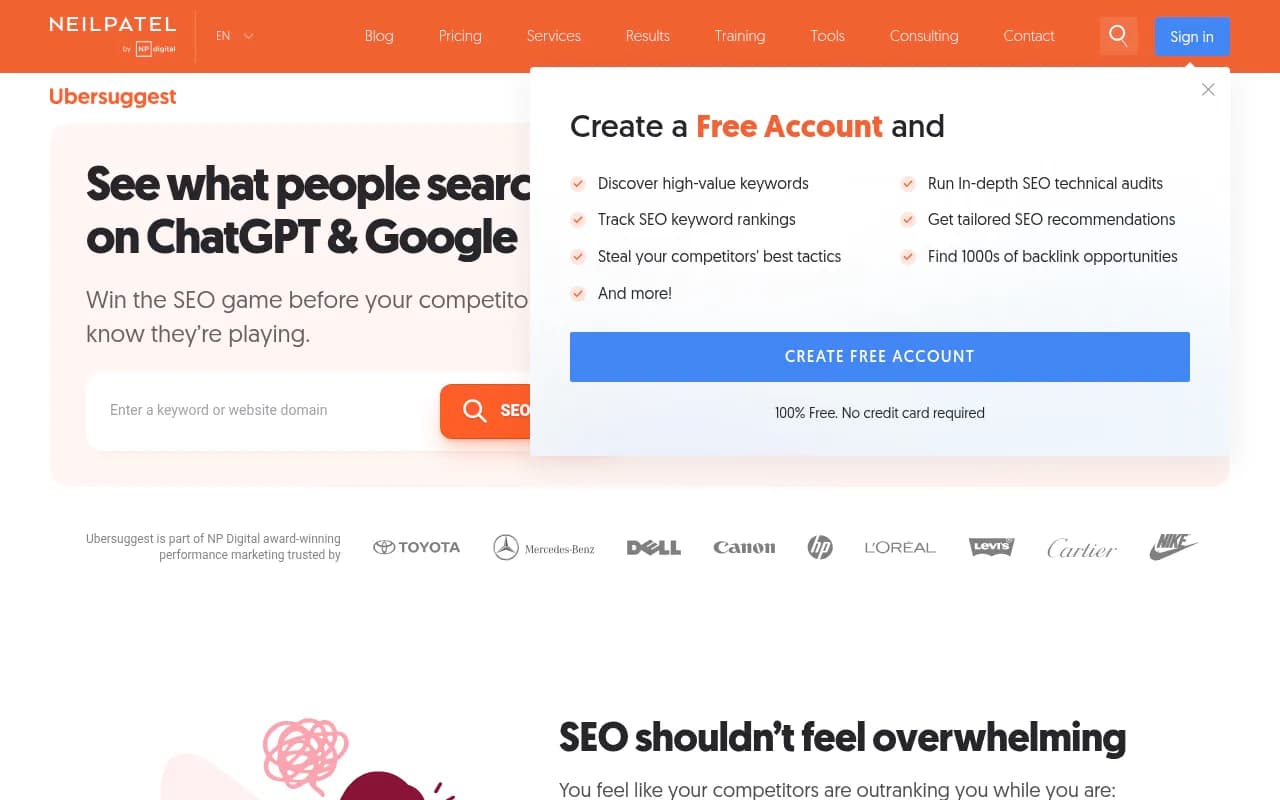
Ubersuggest is Neil Patel's answer to expensive SEO tools—simplified keyword research, site audits, and rank tracking at a fraction of SE Ranking's cost. If you're a solopreneur, freelancer, or small business owner who needs basic SEO insights without the complexity or price tag, Ubersuggest delivers surprising value.
The core features work well: keyword research with search volume and competition data, domain overview showing traffic estimates and top pages, site audits identifying technical SEO issues, and backlink analysis. The interface is cleaner and more beginner-friendly than SE Ranking—fewer options means less confusion for non-technical users.
Where Ubersuggest falls short: the keyword database is smaller (4B keywords vs SE Ranking's 5.4B), backlink data updates less frequently, and advanced features like white-label reporting, API access, and team collaboration tools don't exist. The AI writing assistant is basic compared to SE Ranking's content editor, and there's no AI search tracking at all.
The unique selling point: lifetime pricing. Instead of monthly subscriptions, Ubersuggest offers one-time payments—$290 (Individual), $490 (Business), $990 (Enterprise)—that grant permanent access. If you plan to use the tool for years, the math favors lifetime deals over SE Ranking's recurring costs. Monthly subscriptions start at $29/mo if you prefer that model.
Recent additions include ChatGPT and Google search tracking, but it's surface-level—you can see if your brand appears in AI responses, but there's no optimization guidance, no content gap analysis, and no crawler insights.
Best for: Freelancers, bloggers, and small business owners on tight budgets who need basic keyword research and site audits without paying $100+/mo for features they won't use.
Moz Pro
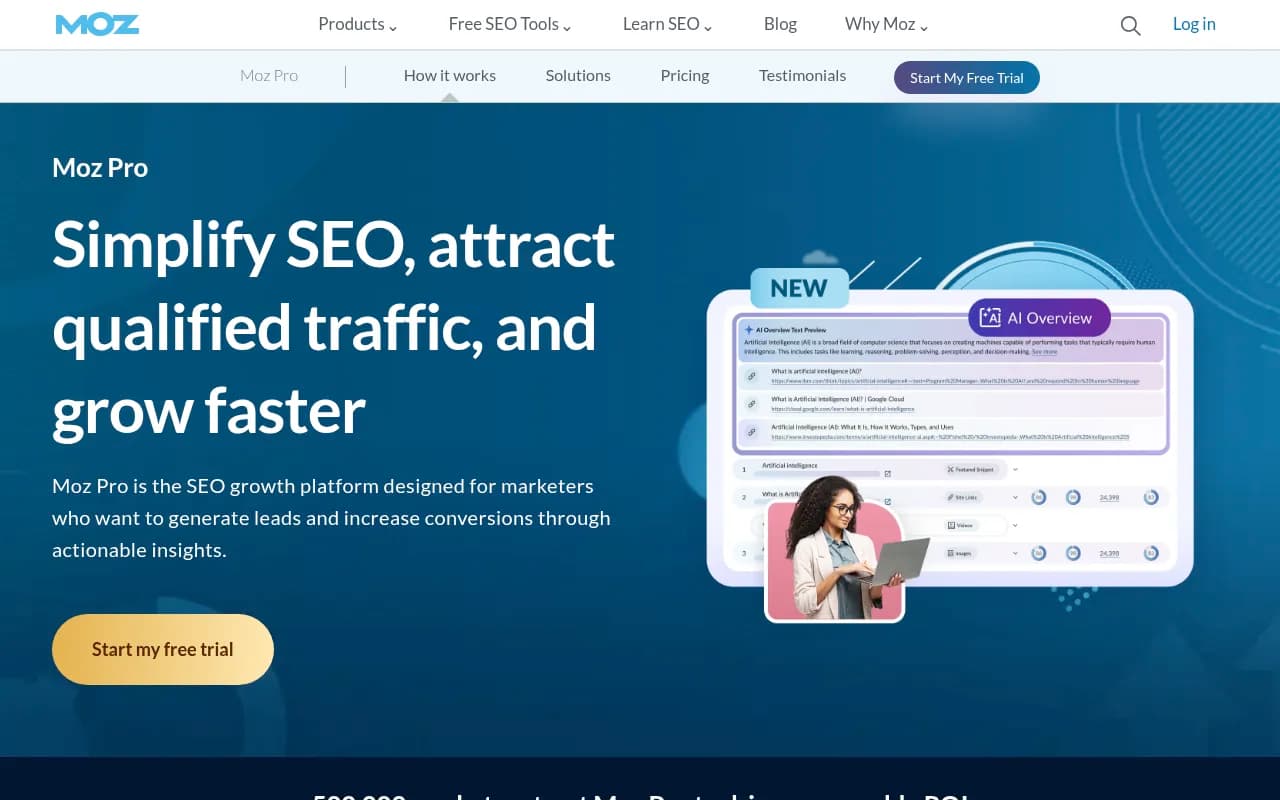
Moz Pro is the OG SEO platform—founded in 2004, it pioneered many features (Domain Authority, Page Authority) that became industry standards. If you value brand trust, educational resources, and a tool that prioritizes teaching SEO fundamentals over feature bloat, Moz delivers a more thoughtful experience than SE Ranking's kitchen-sink approach.
The core toolkit covers essentials: Keyword Explorer with SERP analysis and difficulty scoring, Rank Tracker monitoring desktop and mobile rankings, Site Crawl auditing technical issues, and Link Explorer analyzing backlinks with proprietary metrics (Domain Authority, Spam Score). The On-Page Grader provides actionable recommendations for optimizing individual pages—more prescriptive than SE Ranking's content editor.
Where Moz differentiates: the focus on link opportunity discovery. The Link Intersect tool shows which sites link to multiple competitors but not you—a goldmine for outreach campaigns. The Spam Score metric helps you avoid toxic backlinks that could trigger penalties. And the MozBar browser extension gives you instant SEO metrics on any page you visit.
The trade-offs: Moz's keyword database (1.25B keywords) is significantly smaller than SE Ranking's (5.4B), backlink data updates slower, and the interface feels dated compared to newer platforms. There's no AI search tracking, no content writing assistant, and limited white-label reporting for agencies.
Pricing starts at $49/mo (Starter plan, currently $39/mo with promotion), with Standard at $99/mo, Medium at $179/mo, and Large at $299/mo. That's 50-190% cheaper than SE Ranking for comparable features, though you're getting less breadth.
Moz's strength is education—the blog, Whiteboard Friday videos, and Beginner's Guide to SEO are industry-leading resources. If you're learning SEO or building an in-house team, Moz teaches you why you're doing things, not just what buttons to click.
Best for: In-house SEO teams and consultants who value link-building intelligence, educational resources, and a platform that prioritizes quality over quantity—especially if you're working with smaller budgets.
Similarweb
Similarweb isn't a direct SE Ranking competitor—it's a market intelligence platform that happens to include SEO features. If your goal is understanding broader digital strategy (traffic sources, audience demographics, market share, app analytics) rather than just optimizing keywords and rankings, Similarweb provides context SE Ranking can't.
The platform excels at competitive benchmarking: see any website's total traffic, traffic sources breakdown (direct, referral, search, social, paid), audience demographics, engagement metrics, and top referring sites. The Industry Analysis tool shows market share across entire verticals, helping you identify emerging competitors before they show up in keyword rankings.
SEO features exist but are secondary: keyword research, rank tracking, and SERP analysis are available, but the databases are smaller and updates less frequent than dedicated SEO platforms. Where Similarweb adds value: understanding how SEO fits into a competitor's overall traffic strategy. If a competitor gets 60% traffic from paid ads and 15% from organic search, you know SEO isn't their priority—adjust your strategy accordingly.
Similarweb recently added AI search tracking through their AEO Suite, monitoring brand visibility across ChatGPT, Perplexity, and other LLMs. It's monitoring-focused (not optimization-focused), but the integration with broader traffic data helps you understand AI's impact on overall digital strategy.
Pricing starts at $125/mo (Competitive Intelligence plan), with Enterprise plans ranging $1,000-$5,000+/mo depending on data access. That's 20-4,800% more expensive than SE Ranking. You're paying for market intelligence and traffic estimation across millions of websites, not just SEO tools.
Best for: Marketing strategists, investors, and business development teams who need competitive intelligence and market analysis beyond SEO—especially if you're evaluating acquisition targets, entering new markets, or building board-level reports.
Mangools
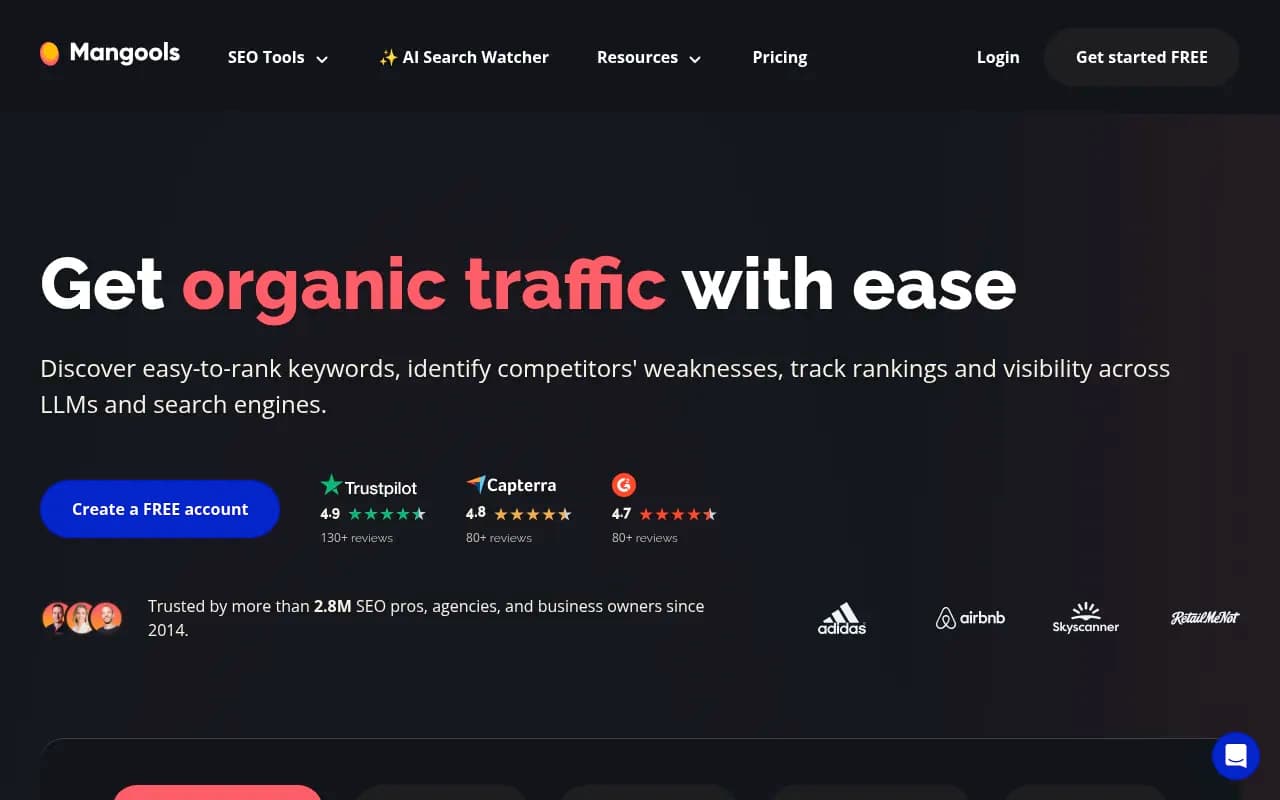
Mangools built its reputation on simplicity—five focused tools (KWFinder, SERPChecker, SERPWatcher, LinkMiner, SiteProfiler) that do one thing well instead of overwhelming you with features. If SE Ranking feels bloated or you're tired of navigating complex interfaces, Mangools offers a refreshingly clean alternative.
KWFinder is the star: keyword research with search volume, trend data, and difficulty scoring presented in the most intuitive interface in the industry. The SERP analysis shows exactly why top-ranking pages win (domain authority, page authority, backlinks, social shares) without requiring a PhD to interpret. SERPWatcher tracks rankings with clean visualizations, and LinkMiner analyzes backlinks with one-click filtering.
The trade-offs: depth. Mangools covers core SEO tasks well but lacks advanced features agencies need—no white-label reporting, no API access, no team collaboration tools, no content optimization editor, and no AI search tracking. The keyword database (2.5B keywords) is half the size of SE Ranking's, and backlink data updates less frequently.
Mangools recently added AI Search Watcher for monitoring brand mentions in ChatGPT, Perplexity, and Gemini, plus a free AI Search Grader tool. It's basic monitoring without optimization features, but it's a start.
Pricing is competitive: Basic $29/mo, Premium $52/mo, Agency $97/mo (annual billing). That's 70-90% cheaper than SE Ranking's comparable plans. The 10-day free trial and 48-hour money-back guarantee reduce risk.
The platform is beloved by freelancers and small agencies (4.9/5 on Trustpilot, 4.8/5 on Capterra) who prioritize ease of use over feature count. If you're spending more time learning tools than doing SEO, Mangools is the antidote.
Best for: Freelancers, bloggers, and small agencies who want simple, affordable SEO tools that actually get used instead of complex platforms that sit idle—especially if you're managing 1-5 clients and don't need enterprise features.
Serpstat
Serpstat is the value play—comprehensive SEO features at prices that undercut SE Ranking by 30-50%. If budget is your primary constraint but you still need depth (keyword research, rank tracking, site audits, backlink analysis, competitor intelligence), Serpstat delivers surprising capability for the cost.
The platform tracks 8.62B keywords across 230 countries, crawls sites for technical SEO issues, monitors rankings with SERP feature tracking, analyzes backlinks, and provides competitor research tools. The Keyword Clustering feature groups related keywords automatically—useful for content planning. The Missing Keywords tool shows gaps between your rankings and competitors', similar to SE Ranking's content gap analysis.
Where Serpstat lags: the interface feels dated compared to modern platforms, data freshness is inconsistent (some reports update daily, others weekly), and customer support is slower. The backlink index is smaller than Ahrefs or SE Ranking, and there's no AI search tracking at all.
The unique angle: Serpstat occasionally offers lifetime deals (AppSumo, StackSocial) at steep discounts—$69-$499 one-time payments for permanent access. If you catch these promotions, the value is unbeatable. Standard pricing runs $69/mo (Lite) to $499/mo (Enterprise), which is 30-50% cheaper than SE Ranking's equivalent plans.
Serpstat works best for agencies and freelancers managing multiple clients on tight budgets—the white-label reporting and team features are solid, and the price-to-feature ratio is hard to beat. Just expect occasional data quirks and a less polished experience.
Best for: Budget-conscious agencies and freelancers who need comprehensive SEO tools without premium pricing—especially if you can snag a lifetime deal during promotional periods.
How to Choose the Right SE Ranking Alternative
Start with your primary use case:
If you need the deepest backlink data and enterprise-scale competitor analysis: Ahrefs is the industry standard, despite the premium pricing. The backlink index and data freshness justify the cost for serious link-building campaigns.
If you're managing multiple marketing channels (SEO, PPC, content, social) and want one platform: Semrush delivers breadth no other tool matches, though you'll pay for features you might not use.
If AI search visibility matters and you want to optimize (not just monitor): Promptwatch is the only platform built around taking action—content gap analysis, AI writing agent, crawler logs, and traffic attribution that actually help you rank in ChatGPT and Claude.
If you're on a tight budget and need basic SEO tools: Ubersuggest or Mangools deliver solid keyword research and rank tracking at $29-52/mo, with Ubersuggest's lifetime deals offering the best long-term value.
If you value education and link-building intelligence: Moz Pro teaches you SEO fundamentals while providing unique link opportunity discovery tools, at prices 50% cheaper than SE Ranking.
If you need market intelligence beyond SEO: Similarweb shows you the bigger picture—total traffic, audience demographics, and competitive positioning across entire industries.
If you want comprehensive features at budget prices: Serpstat undercuts SE Ranking by 30-50% while covering most core SEO tasks, though with a less polished experience.
Consider your team size and workflow: agencies need white-label reporting and team collaboration (Ahrefs, Semrush, SE Ranking, Serpstat excel here), while solopreneurs benefit from simpler interfaces (Mangools, Ubersuggest). If you're managing 10+ clients, API access and automation matter—Ahrefs and Semrush lead, while Mangools and Ubersuggest lack these entirely.
Finally, think about where search is heading. Traditional SEO still drives the majority of traffic in 2026, but AI search is growing fast—ChatGPT has 300M+ weekly users, Perplexity is processing 1B+ queries monthly, and Google AI Overviews appear in 60%+ of searches. If your industry is being disrupted by AI recommendations (software, e-commerce, professional services, travel, finance), ignoring AI visibility is leaving money on the table. Tools like Promptwatch help you capture that traffic before competitors do.
Most teams end up using 2-3 tools: a traditional SEO platform (SE Ranking, Ahrefs, Semrush) for keyword research and rank tracking, plus a specialized tool for AI visibility (Promptwatch) if that channel matters. The key is matching tools to your actual workflow instead of paying for features that sit unused.