Key Takeaways
- Ceyo is significantly cheaper at $49/mo starting price vs Amionai's $375/mo minimum, making it accessible for individual brands and small teams
- Amionai is built specifically for agencies with white-label solutions and multi-client management, while Ceyo targets individual brands and in-house teams
- Both platforms track the same core AI engines (ChatGPT, Claude, Perplexity, Gemini) but differ in how they present insights and recommendations
- Amionai emphasizes weekly action plans and done-for-you recommendations, while Ceyo focuses on granular prompt analytics with sentiment scoring and impact metrics
- Neither platform offers a free trial, but Ceyo's entry point is 87% cheaper than Amionai's agency-focused pricing
- Ceyo provides more detailed prompt-level data (sentiment, average position, impact scores), while Amionai prioritizes actionable weekly summaries
Overview
Amionai

Amionai positions itself as an AI visibility monitoring platform with a strong agency focus. The platform tracks how brands appear in AI-powered search results from ChatGPT, Perplexity, Claude, and other LLMs, then packages findings into weekly action plans. The core value proposition: turn complex AI visibility data into concrete next steps without requiring deep technical knowledge. Amionai's pricing structure (starting at $375/mo for 5 clients) and white-label capabilities signal this is built for agencies managing multiple brands, not individual companies tracking their own presence.
The platform claims 7,000+ marketers and agencies as users, with recognizable brands like Vultr, Bookaway, and SysAid among its customers. The emphasis on "weekly action plans" suggests Amionai tries to reduce the analysis burden -- you get told what to do rather than having to interpret raw data yourself.
Ceyo
Ceyo
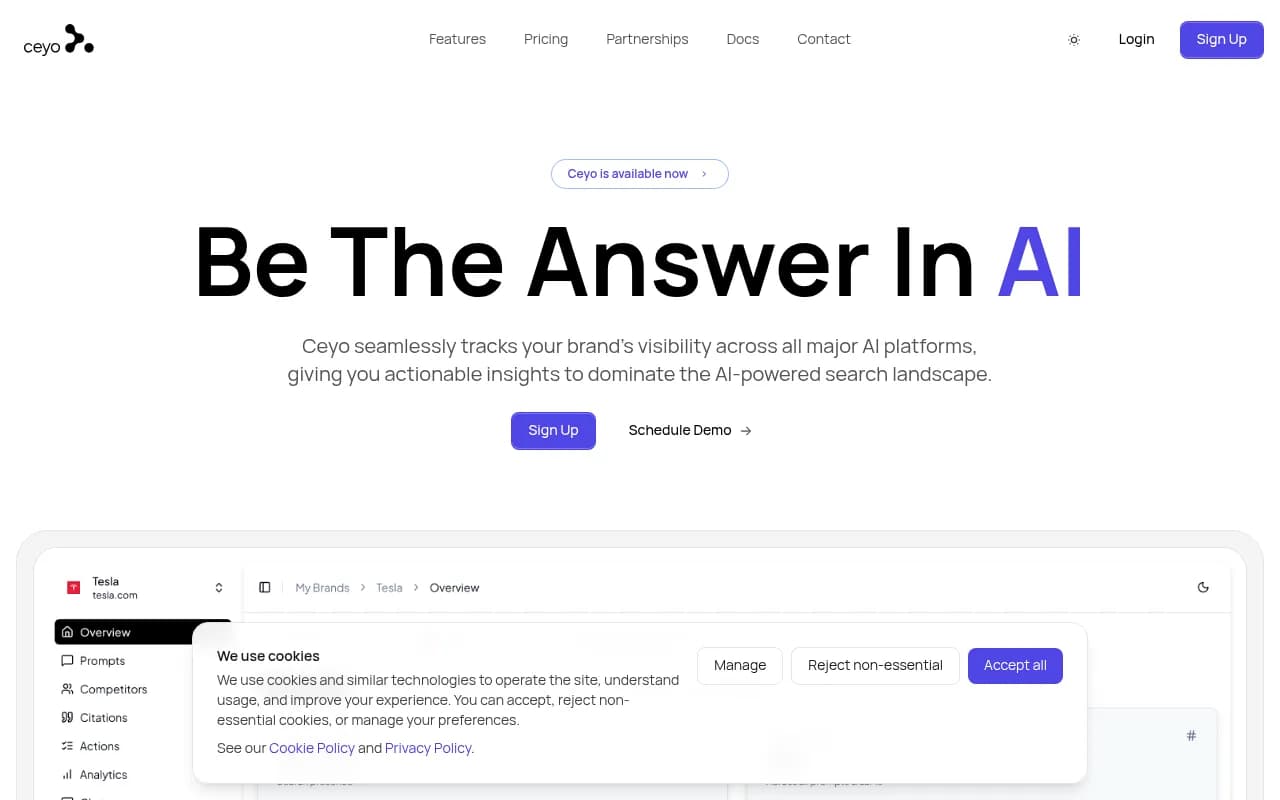
Ceyo takes a more analytics-forward approach to the same problem. The platform tracks brand visibility across ChatGPT, Gemini, Claude, and Perplexity, but presents data through detailed prompt analytics tables showing visibility percentages, sentiment scores, average positions, impact ratings, and competitor mentions for each query. The interface shown on their site looks like a data dashboard -- rows of prompts with metrics in columns, filterable by category and geography.
Pricing starts at $49/mo for the Core plan, with Standard and Enterprise tiers above that. This pricing structure suggests Ceyo is targeting individual brands, in-house marketing teams, and smaller operations that need visibility data but don't require agency-level multi-client management. The platform emphasizes "thousands of prompts" and granular tracking, positioning itself as a tool for people who want to dig into the data themselves.
Side-by-side comparison
| Feature | Amionai | Ceyo |
|---|---|---|
| Starting price | $375/mo (5 clients) | $49/mo (Core plan) |
| Free trial | No | No |
| Target audience | Agencies, multi-client management | Individual brands, in-house teams |
| AI engines tracked | ChatGPT, Perplexity, Claude, others | ChatGPT, Gemini, Claude, Perplexity |
| White-label solution | Yes | Not mentioned |
| Prompt tracking | Yes | Yes, with sentiment & impact scoring |
| Competitor analysis | Yes | Yes, shows competitor mentions per prompt |
| Action plans | Weekly action plans included | Actionable insights & recommendations |
| Multi-client management | Built-in (agency plans) | Not mentioned |
| Sentiment analysis | Not specified | Yes, per-prompt sentiment scoring |
| Geographic tracking | Yes (country/language selection) | Yes (shows GEO flags per prompt) |
| Reporting format | Weekly summaries | Detailed prompt analytics tables |
Pricing breakdown
The pricing gap between these two platforms is massive and tells you exactly who they're built for.
| Plan | Amionai | Ceyo |
|---|---|---|
| Entry tier | $375/mo (5 clients) | $49/mo (Core) |
| Mid tier | $670/mo (10 clients) | Standard (price not public) |
| Enterprise | Not specified | Enterprise (custom pricing) |
| Annual discount | Not mentioned | Available |
| Free trial | No | No |
Amionai's $375/mo starting price only makes sense if you're an agency billing 5+ clients. If you're a single brand, you're paying $375/mo for one account -- that's 7.6x more expensive than Ceyo's $49/mo entry point. The pricing structure reveals Amionai's core assumption: you're reselling this service, not using it internally.
Ceyo's $49/mo Core plan is clearly aimed at individual companies or small teams who want to track their own brand. The Standard and Enterprise tiers exist for larger operations, but the entry barrier is low enough that a startup or SMB can justify the spend.
Neither platform offers a free trial, which is frustrating. You're committing money upfront to see if the data is useful.
Target audience and use cases
The audience split here is clean.
Pick Amionai if:
- You're a digital agency managing AI visibility for multiple clients
- You need white-label reporting to present under your own brand
- You want weekly action plans delivered to clients without doing the analysis yourself
- You're billing clients for AI visibility monitoring and need multi-client dashboards
- You value done-for-you recommendations over raw data access
Pick Ceyo if:
- You're an in-house marketer tracking your own brand's AI visibility
- You want granular prompt-level data with sentiment and impact scores
- You need detailed analytics to inform your own content and SEO strategy
- You're working with a limited budget (under $100/mo)
- You prefer to analyze data yourself rather than follow pre-packaged action plans
Amionai's agency focus means the platform is optimized for people who are selling AI visibility monitoring, not necessarily doing it themselves. The weekly action plans and white-label features are designed to make client reporting easy. You're paying for packaging and presentation as much as data.
Ceyo's analytics-heavy interface suggests it's built for people who will actually use the data -- in-house SEO teams, content strategists, brand managers who need to understand why they're invisible for certain prompts and what competitors are doing differently.
Feature deep-dive
Prompt tracking and analytics
Both platforms track how your brand appears across AI search engines, but the presentation differs.
Ceyo shows detailed per-prompt metrics in a table format: visibility percentage, sentiment (positive/neutral/negative), average position, impact rating (high/medium/low), competing brands mentioned, category, and geography. This is useful if you want to prioritize prompts -- you can sort by visibility to find gaps, filter by sentiment to address negative mentions, or identify high-impact queries where you're ranking poorly.
Amionai emphasizes "weekly action plans" instead of raw tables. The implication: they're doing the analysis for you and telling you what to fix. This works well for agencies who need to deliver client reports without spending hours interpreting data, but it's less useful if you want to explore the data yourself or have specific questions the pre-packaged plan doesn't address.
Verdict: Ceyo wins for data access and flexibility. Amionai wins for hands-off reporting.
Competitor analysis
Both platforms track competitor mentions, but again, the presentation matters.
Ceyo's prompt table shows which brands appear alongside yours for each query, with logos and visibility scores. You can see at a glance that for "Best laptop for developers," Apple, Lenovo, and Dell are mentioned -- and if your brand isn't in that list, you know you're invisible for that prompt.
Amionai mentions competitor analysis as a feature but doesn't show the interface publicly. Given their focus on weekly action plans, I'd expect competitor data to be summarized in narrative form ("Your competitors are outranking you for X prompts") rather than presented as raw tables.
Verdict: Ceyo's visual competitor display is more immediately useful for understanding the competitive landscape per prompt.
Geographic and language coverage
Both platforms support multi-language and multi-region tracking.
Amionai's signup form shows country and language dropdowns, suggesting you can track how your brand appears in different markets. This is critical for global brands -- AI responses vary by region and language.
Ceyo's prompt table includes GEO flags (🇺🇸, 🇬🇧, 🇩🇪, etc.) showing which geography each prompt was tracked in. This suggests you can segment data by region and see how visibility differs across markets.
Verdict: Tie. Both platforms handle multi-region tracking, though Ceyo's visual flags make it easier to scan geographic coverage at a glance.
Sentiment analysis
Ceyo explicitly shows sentiment scoring (positive, neutral, negative) for each prompt. This is valuable -- being mentioned is good, but being mentioned negatively is a problem you need to address differently than a visibility gap.
Amionai doesn't mention sentiment analysis in their public materials. The focus on "action plans" suggests they might flag negative mentions in weekly reports, but it's not clear if sentiment is tracked systematically across all prompts.
Verdict: Ceyo wins. Explicit sentiment scoring per prompt is more useful than hoping it's included in a weekly summary.
White-label and agency features
Amionai is built for agencies. The pricing structure (per-client tiers), white-label solutions, and multi-client management are core features. If you're reselling AI visibility monitoring, Amionai gives you the infrastructure to do it under your own brand.
Ceyo doesn't mention white-label or multi-client features. The platform appears designed for single-brand use, though the Enterprise tier might include agency features -- it's not specified publicly.
Verdict: Amionai wins decisively for agencies. Ceyo isn't competing in this space.
Actionability and recommendations
Amionai's core pitch is "weekly action plans" -- you get told what to do based on the data. This is valuable for agencies who need to deliver client recommendations without doing deep analysis, or for brands who want guidance rather than raw data.
Ceyo promises "actionable insights and recommendations" but emphasizes the analytics dashboard. The implication: you get the data and tools to identify opportunities, but you're expected to interpret it yourself.
Verdict: Depends on your preference. Amionai is better for hands-off guidance. Ceyo is better if you want control over the analysis.
AI engines covered
Both platforms track the major AI search engines, but the exact list differs slightly.
Amionai: ChatGPT, Perplexity, Claude, "other LLMs" (not specified)
Ceyo: ChatGPT, Gemini, Claude, Perplexity
Ceyo explicitly lists Gemini, which is Google's LLM and increasingly important for AI search visibility. Amionai mentions "other LLMs" but doesn't specify which ones, so it's unclear if Gemini is included.
Both platforms cover the core engines (ChatGPT, Claude, Perplexity), so the difference is marginal. If Google Gemini visibility is critical for your brand, confirm with Amionai whether it's tracked.
If you're also looking to track how your brand shows up in AI search results with more advanced capabilities like crawler logs, content gap analysis, and AI-generated content optimization, Promptwatch covers that angle with deeper technical features.

User experience and interface
Ceyo's website shows a detailed prompt analytics table -- rows of queries with columns for metrics. This is a data-heavy interface that assumes you're comfortable analyzing tables and filtering data. It's efficient for power users but might feel overwhelming if you just want a summary.
Amionai's website emphasizes simplicity -- "Track when AI mentions your brand in real-time" and "Get weekly action plans." The interface isn't shown in detail, but the messaging suggests a more guided, less data-dense experience. You're getting summaries and recommendations, not raw tables.
Verdict: Ceyo is better for data-driven teams who want full control. Amionai is better for people who want simplified reporting.
Integration and API
Neither platform mentions API access or integrations in their public materials. This is a gap for both -- if you want to pull AI visibility data into your own dashboards or connect it to other tools, you'll need to confirm whether APIs are available (likely at Enterprise tiers).
Support and onboarding
Amionai mentions "7,000+ marketers & agencies" using the platform and shows recognizable brand logos, suggesting an established user base. No specific support details are mentioned, but the agency focus implies some level of onboarding or account management.
Ceyo offers a "Schedule Demo" option, which suggests personalized onboarding for new users. The platform is newer (based on the smaller customer list shown), so support quality is harder to assess.
Verdict: Unclear. Both platforms likely offer support, but neither provides detailed information publicly.
Pros and cons
Amionai pros:
- Built specifically for agencies with white-label and multi-client features
- Weekly action plans reduce analysis burden
- Established user base with recognizable brands
- Multi-language and multi-region tracking
- Competitor analysis included
Amionai cons:
- Extremely expensive for single-brand use ($375/mo minimum)
- No free trial to test before committing
- Less granular data access compared to Ceyo
- Sentiment analysis not explicitly mentioned
- Interface and exact feature set not fully transparent
Ceyo pros:
- Much cheaper entry point ($49/mo vs $375/mo)
- Detailed prompt-level analytics with sentiment and impact scores
- Visual competitor tracking per prompt
- Geographic segmentation with visual flags
- More transparent data presentation
- Annual billing discount available
Ceyo cons:
- No white-label or multi-client features (not built for agencies)
- No free trial
- Smaller user base (newer platform)
- Less emphasis on actionable recommendations vs raw data
- Standard and Enterprise pricing not public
Who should pick which tool
Choose Amionai if:
You're a digital marketing agency managing AI visibility for 5+ clients and need white-label reporting. The $375/mo price makes sense when you're billing multiple clients for the service. You value weekly action plans that you can forward to clients without doing analysis yourself. You need multi-client dashboards and branded reports. You're selling AI visibility monitoring as a service, not just tracking your own brand.
Choose Ceyo if:
You're an in-house marketer, SEO team, or brand manager tracking your own company's AI visibility. You want detailed prompt-level data with sentiment scores and impact metrics so you can prioritize optimization efforts. You're comfortable analyzing data yourself and prefer granular access over pre-packaged summaries. You're working with a limited budget (under $100/mo) and don't need multi-client features. You want to see exactly which prompts you're invisible for and which competitors are outranking you.
Consider alternatives if:
You need more than just monitoring -- if you want content gap analysis, AI crawler logs, or tools to actually fix visibility issues (not just track them), platforms like Promptwatch offer deeper optimization capabilities alongside tracking. Both Amionai and Ceyo are monitoring-focused; they show you the problem but don't help you create content or optimize for AI search.
Final verdict
These platforms serve different buyers. Amionai is an agency tool with agency pricing -- if you're managing multiple clients and need white-label reporting, the $375/mo makes sense. If you're a single brand, you're paying 7.6x more than Ceyo for similar core data.
Ceyo is the better choice for individual brands and in-house teams. The $49/mo entry point is accessible, the prompt-level analytics are more detailed, and the sentiment scoring adds useful context. You're getting more granular data for less money, but you're expected to analyze it yourself.
The real question: do you need done-for-you weekly summaries (Amionai) or detailed data tables you can explore (Ceyo)? If you're an agency reselling the service, Amionai's packaging is worth the premium. If you're tracking your own brand, Ceyo gives you better data at a fraction of the cost.