Key Takeaways
- Pricing gap: LLM Pulse starts at €49/mo (Starter) with a 14-day free trial. Amionai starts at $375/mo (Agency tier, 5 clients) with no free trial -- that's 7.6x more expensive at entry level.
- Target audience: LLM Pulse is built for individual brands and in-house teams. Amionai is explicitly designed for agencies managing multiple clients with white-label reporting.
- Prompt volume: LLM Pulse's Starter plan gives you 40 prompts for €49/mo. Amionai's Agency plan gives you 100 prompts across 5 clients for $375/mo -- 20 prompts per client on average.
- Free trial: LLM Pulse offers a 14-day free trial with no credit card required. Amionai has no free trial mentioned anywhere.
- AI model coverage: Both track ChatGPT, Perplexity, Gemini, and Google AI Mode/Overviews. LLM Pulse adds DeepSeek, Grok, Claude, Copilot, and Meta AI on Enterprise plans. Amionai's exact model list isn't publicly detailed beyond the big four.
- Content optimization: LLM Pulse includes AI-powered content recommendations in all plans. Amionai provides weekly action plans but doesn't specify if they include content generation or just strategic guidance.
Overview
Amionai
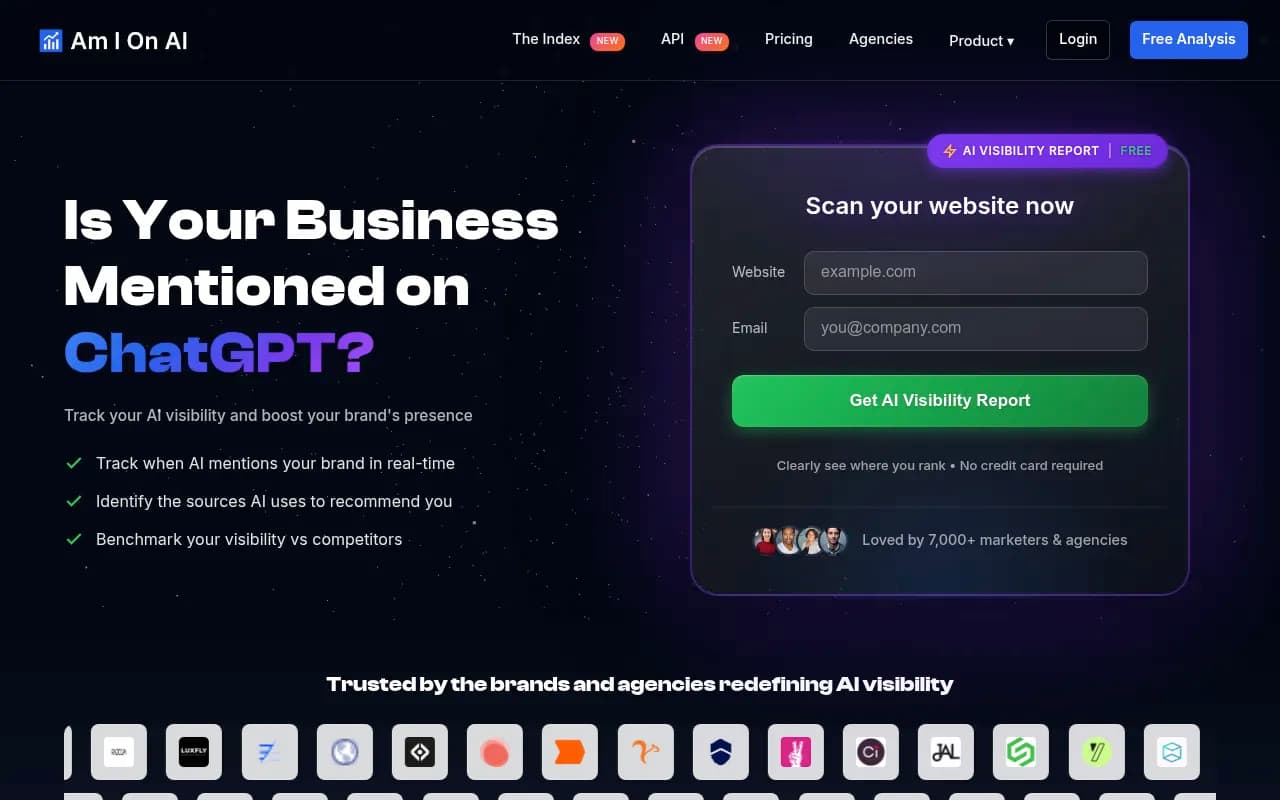
Amionai ("Am I on AI?") is an AI visibility monitoring platform aimed squarely at agencies. The entire pricing structure is built around managing multiple clients -- you can't buy a single-brand plan. The platform tracks how brands appear in AI search results from ChatGPT, Perplexity, Claude, and other LLMs, with a focus on weekly action plans, competitor analysis, and white-label reporting that agencies can rebrand for their clients. It's used by 7,000+ marketers and agencies according to their site, with clients including Ceragon, Vultr, Bookaway, and SysAid.
The core pitch: track AI visibility, benchmark against competitors, and get actionable insights delivered weekly. The white-label angle is front and center -- agencies can present the reports as their own.
LLM Pulse
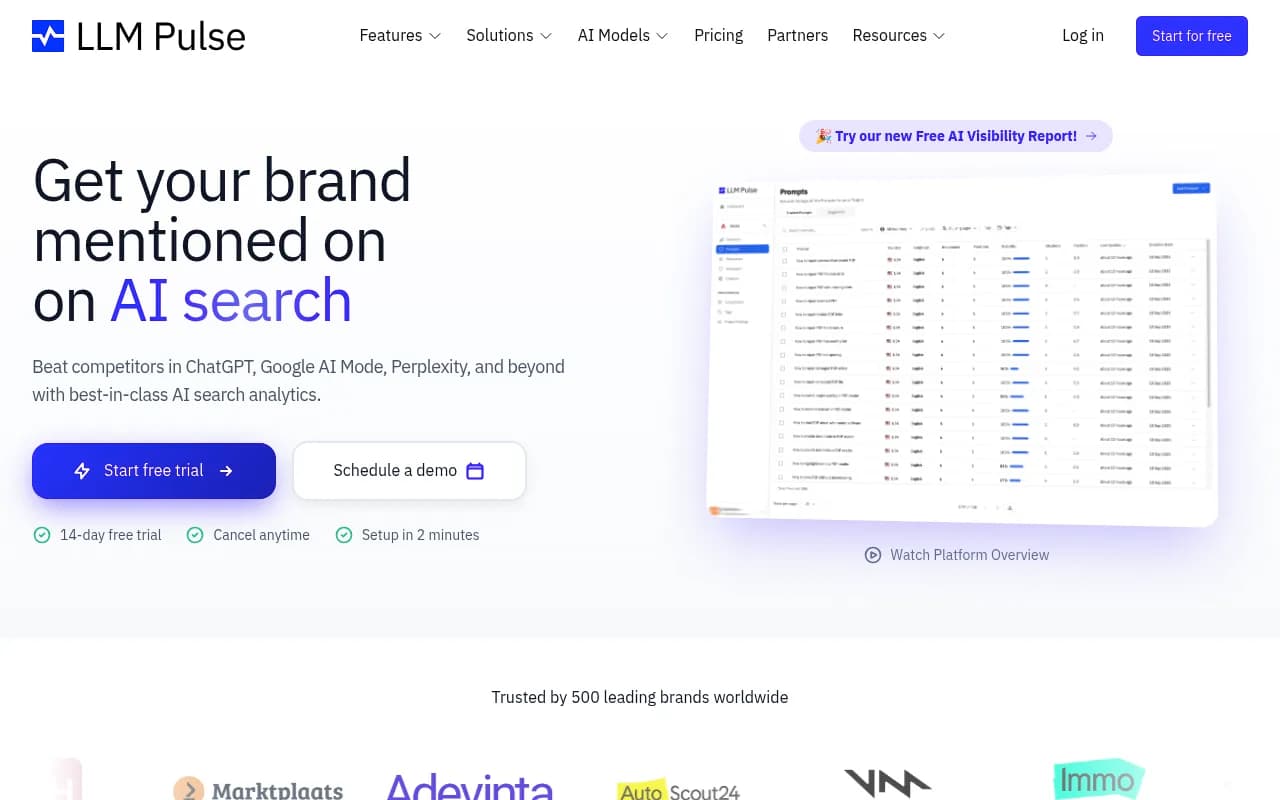
LLM Pulse is an AI search visibility tracker built for brands and in-house teams who want to monitor how ChatGPT, Perplexity, Gemini, Google AI Mode, and other LLMs mention them. The platform tracks prompts weekly, analyzes citations and sentiment, benchmarks against competitors, and provides AI-powered content recommendations to improve your presence in LLM responses. It's used by 500+ brands including Swiss Marketplace Group and Voicemod.
The platform starts at €49/mo with a 14-day free trial, making it accessible to smaller teams and individual brands. The focus is on giving you the data (visibility score, citation rate, sentiment, share of voice) and then helping you act on it with content recommendations.
Side-by-side comparison
| Feature | Amionai | LLM Pulse |
|---|---|---|
| Starting price | $375/mo (5 clients) | €49/mo (~$53) |
| Free trial | No | 14 days |
| Target audience | Agencies managing multiple clients | Individual brands, in-house teams |
| Prompts (entry tier) | 100 total (20 per client avg) | 40 |
| AI models tracked | ChatGPT, Perplexity, Claude, Gemini, Google AI (exact list unclear) | ChatGPT, Perplexity, Gemini, Google AI Mode/Overviews, DeepSeek, Grok, Claude, Copilot, Meta AI (Enterprise) |
| White-label reporting | Yes (core feature) | Not mentioned |
| Competitor analysis | Yes | Yes |
| Citation tracking | Yes | Yes |
| Sentiment analysis | Not mentioned | Yes |
| Content recommendations | Weekly action plans | AI-powered content recommendations |
| Visibility scoring | Not detailed | Visibility score, citation rate, share of voice |
| Multi-language support | Yes (language selector on site) | Not mentioned |
| Setup time | Not specified | 2 minutes (claimed) |
| Annual billing discount | Not mentioned | 17% |
Pricing breakdown
The pricing models are completely different. Amionai forces you into an agency structure. LLM Pulse has traditional SaaS tiers.
Amionai pricing
| Plan | Price | Clients | Prompts | Notes |
|---|---|---|---|---|
| Agency 5 | $375/mo | 5 | 100 total | ~20 prompts per client |
| Agency 10 | $670/mo | 10 | 200 total | ~20 prompts per client |
No single-brand option. No free trial. Annual billing discounts not mentioned. If you're an individual brand, you're paying $375/mo minimum even though you only need one "client" slot.
LLM Pulse pricing
| Plan | Price | Prompts | Notes |
|---|---|---|---|
| Starter | €49/mo (~$53) | 40 | 14-day free trial |
| Growth | €99/mo (~$107) | 100 | More AI models, advanced features |
| Scale | €299/mo (~$323) | 300+ | Enterprise features |
Annual billing saves 17%. Free trial on all plans. Single-brand focus -- you're paying for your own visibility, not managing a portfolio.
Price comparison verdict
If you're an agency managing 5+ clients, Amionai's $375/mo for 5 clients ($75 per client) is competitive with LLM Pulse's €99/mo single-brand Growth plan. But if you're a single brand, LLM Pulse is 7x cheaper at entry level and gives you a free trial to test before committing.
Feature deep-dive
AI model coverage
Both platforms track the major LLMs -- ChatGPT, Perplexity, Gemini, Google AI Mode/Overviews. LLM Pulse explicitly lists 10+ models including DeepSeek, Grok, Claude, Copilot, and Meta AI on higher tiers. Amionai mentions Claude in their description but doesn't provide a full model list on their site.
LLM Pulse wins on transparency here. You know exactly which models you're tracking at each tier. Amionai's model coverage is less clear unless you're already a customer.
Prompt tracking and monitoring
Both platforms let you define prompts (the questions people ask AI) and track how often your brand appears in responses. LLM Pulse tracks prompts weekly and shows you visibility trends over time. Amionai also does weekly tracking and provides action plans based on the results.
The difference: LLM Pulse gives you granular metrics (visibility score, citation rate, sentiment) for each prompt. Amionai focuses on action plans -- they tell you what to do, but the underlying data depth isn't as visible in their marketing.
Citation and source analysis
LLM Pulse shows you which sources AI models cite when they mention your brand -- your own content, competitor pages, third-party articles, Reddit threads. This is critical for understanding why you're being recommended (or not).
Amionai mentions "Identify the sources AI uses to recommend you" on their homepage, so they have citation tracking too. But again, the level of detail isn't spelled out.
Competitor benchmarking
Both platforms let you compare your AI visibility against competitors. LLM Pulse shows share of voice and side-by-side visibility scores. Amionai includes competitor analysis in their weekly action plans.
No clear winner here -- both have the feature, execution details would require hands-on testing.
Content optimization and recommendations
LLM Pulse includes "AI-powered content recommendations" in all plans. The platform analyzes why competitors are being cited and suggests content gaps you should fill.
Amionai provides "weekly action plans" but doesn't specify if those include content recommendations, strategic guidance, or both. The action plan framing suggests more high-level strategy than tactical content suggestions, but this isn't confirmed.
If you want explicit content recommendations, LLM Pulse is the safer bet based on what's publicly documented.
White-label reporting
Amionai's core differentiator: white-label reports that agencies can rebrand and deliver to clients. This is a non-negotiable feature if you're an agency.
LLM Pulse doesn't mention white-label reporting anywhere. It's built for brands to use directly, not for agencies to resell.
Multi-language and localization
Amionai's homepage includes language and country selectors, suggesting multi-language and geo-specific tracking.
LLM Pulse doesn't mention multi-language support in their marketing. This could be a gap if you need to track AI responses in multiple languages or regions.
Sentiment analysis
LLM Pulse explicitly tracks sentiment -- whether AI mentions your brand positively, negatively, or neutrally.
Amionai doesn't mention sentiment analysis in their public materials.
User experience and setup
LLM Pulse claims "Setup in 2 minutes" and offers a 14-day free trial with no credit card required. You can test the platform risk-free.
Amionai has no free trial. Setup time isn't specified. The agency-first structure means onboarding likely involves configuring multiple client accounts, which could take longer.
For speed and low-friction testing, LLM Pulse wins.
Who should pick which tool
Pick Amionai if:
- You're an agency managing 5+ clients and need white-label reporting
- You want a platform built specifically for the agency use case
- You need multi-language and geo-specific tracking (based on their site features)
- You're comfortable with higher pricing in exchange for multi-client management
- You prefer weekly action plans over granular data dashboards
Pick LLM Pulse if:
- You're an individual brand or in-house marketing team
- You want to test the platform with a free trial before committing
- You need detailed metrics (visibility score, citation rate, sentiment, share of voice)
- You want AI-powered content recommendations to improve your presence
- You're budget-conscious -- €49/mo is 7x cheaper than Amionai's entry point
- You want transparency on which AI models you're tracking
When to consider both:
If you're an agency, you could use Amionai for client reporting and LLM Pulse for your own brand's AI visibility. The pricing structures don't overlap -- one is for agencies, one is for brands.
Pros and cons
Amionai pros:
- White-label reporting built in -- essential for agencies
- Multi-client management from day one
- Weekly action plans for strategic guidance
- Multi-language and geo-targeting capabilities
- Used by 7,000+ marketers and agencies (larger user base claim)
Amionai cons:
- No single-brand pricing -- you pay for 5 clients minimum even if you only need one
- No free trial -- $375/mo commitment upfront
- Less transparency on AI model coverage and feature depth
- Sentiment analysis not mentioned
- Higher cost per brand compared to LLM Pulse
LLM Pulse pros:
- 7x cheaper at entry level (€49/mo vs $375/mo)
- 14-day free trial with no credit card required
- Clear AI model coverage (10+ models listed)
- Detailed metrics: visibility score, citation rate, sentiment, share of voice
- AI-powered content recommendations included
- Fast setup (2 minutes claimed)
- Annual billing discount (17%)
LLM Pulse cons:
- No white-label reporting -- not built for agencies
- Single-brand focus -- managing multiple brands requires multiple accounts
- Multi-language support not mentioned
- Smaller user base (500+ brands vs 7,000+ for Amionai)
Final verdict
These tools serve different buyers. Amionai is an agency platform with agency pricing. LLM Pulse is a brand platform with brand pricing.
If you're an agency managing multiple clients and need white-label reports, Amionai is purpose-built for you. The $375/mo entry point makes sense when you're billing 5 clients -- that's $75 per client, which is reasonable.
If you're an individual brand or in-house team, LLM Pulse is the obvious choice. It's 7x cheaper, offers a free trial, and gives you more granular data (sentiment, visibility scores, citation rates) plus content recommendations. The lack of white-label reporting doesn't matter because you're not reselling the service.
The pricing gap is too large to ignore: a single brand paying $375/mo for Amionai is overpaying by 7x compared to LLM Pulse's €49/mo Starter plan. Amionai's value proposition only makes sense at scale -- when you're managing multiple clients and need the white-label infrastructure.
One more thing: if you're tracking AI visibility and want to go beyond monitoring into optimization, Promptwatch is worth knowing about. It combines visibility tracking with content gap analysis and an AI writing agent that generates articles designed to get cited by ChatGPT, Perplexity, and other LLMs -- closing the loop from "what's missing" to "here's the content that fixes it." LLM Pulse and Amionai show you the problem; Promptwatch helps you solve it.

Bottom line: LLM Pulse for brands, Amionai for agencies. Pick based on your business model, not feature lists.