Key Takeaways
- GeoGen is 60% cheaper at entry level (€20/mo vs $49/mo) -- better for small brands testing AI visibility tracking on a budget
- Ceyo offers deeper analytics with sentiment tracking, prompt-level insights, and agency-focused reporting that GeoGen doesn't advertise
- Both are monitoring-only platforms -- they show you where you're mentioned but don't help you create content or fix visibility gaps
- Ceyo explicitly supports Claude tracking while GeoGen's model coverage is less clear beyond ChatGPT, Perplexity, Gemini, and Copilot
- GeoGen's pricing scales more gradually (€20 → €399) vs Ceyo's jump from $49 to $89-$199, making GeoGen easier to grow into
- Neither platform offers crawler logs, content generation, or traffic attribution -- features you'd get with a more comprehensive platform like Promptwatch

Overview: Two monitoring platforms with different depth
GeoGen: Budget-friendly AI visibility tracking
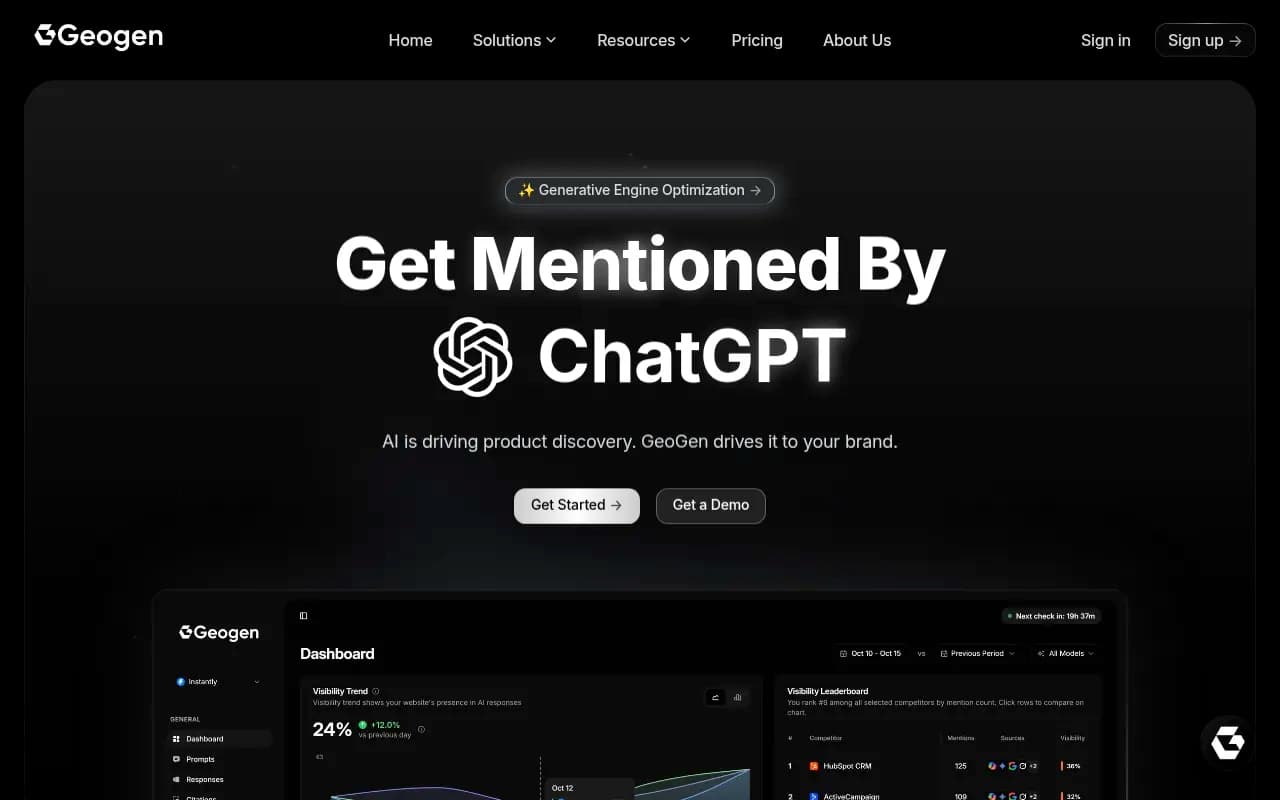
GeoGen positions itself as a straightforward Generative Engine Optimization platform for brands that want to track mentions across ChatGPT, Perplexity, Gemini, and other AI search engines. The pitch is simple: see where you're mentioned, compare yourself to competitors, get recommendations to improve. It's aimed at small to mid-sized brands that need basic visibility tracking without the complexity or cost of enterprise platforms.
The pricing starts at €20/mo for the Micro plan and scales to €399/mo for Pro, with custom enterprise pricing above that. There's a 20% discount if you pay annually. The website shows a clean dashboard interface and lists clients like CloudBlast, GdprWise, and ProxyScrape, but doesn't dive deep into specific feature sets or methodology.
Ceyo: Agency-grade prompt analytics
Ceyo

Ceyo takes a more analytics-heavy approach. It tracks brand visibility across ChatGPT, Gemini, Claude, and Perplexity with a focus on prompt-level insights -- which specific queries drive your brand mentions, what sentiment those mentions carry, how you rank against competitors for each prompt. The interface shown on their site includes detailed tables with visibility percentages, sentiment scores, average position, impact ratings, and category breakdowns.
Ceyo is explicitly built for agencies, SEO teams, and brand managers who need to report on AI visibility to clients or stakeholders. Pricing starts at $49/mo for the Core plan (1 brand) and scales to $89-$199/mo for Pro plans, with custom enterprise pricing. They list partners like BrandFirm, Zigt, and Enreach.
Side-by-Side Comparison
| Feature | GeoGen | Ceyo |
|---|---|---|
| Starting price | €20/mo (Micro) | $49/mo (Core) |
| Top-tier price | €399/mo (Pro) | $199/mo (Pro), custom enterprise |
| Free trial | Not advertised | Not advertised |
| AI models tracked | ChatGPT, Perplexity, Gemini, Copilot | ChatGPT, Gemini, Claude, Perplexity |
| Sentiment analysis | Not advertised | Yes, per-prompt sentiment scoring |
| Prompt-level analytics | Basic | Detailed (visibility %, avg position, impact) |
| Competitor tracking | Yes, competitor rankings | Yes, multi-brand comparison |
| Multi-brand support | Likely on higher plans | Yes, agency-focused |
| Content gap analysis | No | No |
| AI content generation | No | No |
| Crawler logs | No | No |
| Traffic attribution | No | No |
| Target audience | Small to mid-sized brands | Agencies, SEO teams, brand managers |
Head-to-head feature breakdown
Pricing and value
GeoGen wins on entry-level affordability. €20/mo (~$22) gets you in the door, which is less than half of Ceyo's $49/mo starting point. If you're a solo marketer or small brand just dipping your toes into AI visibility tracking, GeoGen's Micro plan is the obvious choice.
Ceyo's $49/mo Core plan includes more detailed analytics out of the gate -- sentiment tracking, prompt-level breakdowns, and agency-oriented reporting. You're paying more, but you're getting a richer dataset. The Pro plans ($89-$199/mo) add features that agencies need for client reporting, though GeoGen's €399/mo Pro tier likely competes in the same space.
Both platforms offer annual discounts (GeoGen advertises 20%, Ceyo doesn't specify). Neither advertises a free trial, which is a miss -- you're committing money before you know if the data is useful.
Verdict: GeoGen for budget-conscious brands, Ceyo if you need deeper analytics and can justify the higher cost.
AI model coverage
Both platforms cover the core LLMs: ChatGPT, Perplexity, Gemini, and Microsoft Copilot. Ceyo explicitly lists Claude, which GeoGen doesn't mention on their site. Neither platform tracks as many models as comprehensive tools (Promptwatch monitors 10+ including Grok, DeepSeek, Meta AI, and Mistral), but they hit the big four that most brands care about.
The real question is depth of tracking. Ceyo's interface shows granular data per prompt per model -- visibility percentage, sentiment, average position. GeoGen's screenshots show competitor rankings and visibility scores but less detail on the prompt-by-prompt breakdown.
Verdict: Ceyo has slightly broader coverage (Claude) and more granular per-model analytics.
Analytics and reporting
This is where the platforms diverge most sharply. GeoGen's website shows basic dashboards with competitor rankings and visibility metrics. It's clean and straightforward -- you can see at a glance how you stack up against competitors and where you're mentioned.
Ceyo's interface is built around prompt analytics. The table on their site shows:
- Prompt text ("Best laptop for developers", "Top project management tools")
- Visibility percentage (how often your brand appears in responses)
- Sentiment (positive/neutral/negative)
- Average position (where you rank in the response)
- Impact rating (high/medium/low relevance or volume)
- Competing brands mentioned
- Category and geo-targeting
This level of detail is what agencies need to justify their work to clients. You can show exactly which prompts are driving visibility, which ones you're losing to competitors, and where sentiment is slipping.
GeoGen doesn't advertise this depth of prompt-level analytics. It's more of a high-level dashboard: "Here's your visibility score, here's how you compare to competitors, here are some recommendations." That's fine for internal tracking, but harder to build client reports around.
Verdict: Ceyo for agencies and teams that need detailed reporting. GeoGen for brands that just want a quick visibility check.
Sentiment tracking
Ceyo explicitly tracks sentiment per prompt -- whether your brand is mentioned positively, neutrally, or negatively in AI responses. This is huge for brand reputation monitoring. If ChatGPT is recommending your product but with caveats ("X is good but expensive"), you want to know that.
GeoGen doesn't advertise sentiment tracking on their site. It's possible they have it buried in the product, but if it's not front and center, it's probably not a core feature.
Verdict: Ceyo wins decisively here.
Competitor analysis
Both platforms offer competitor tracking. GeoGen's site mentions "Competitor Ranking" and shows dashboards comparing your AI visibility against competitors. Ceyo's prompt tables show which other brands are mentioned alongside yours for each query.
The difference is granularity. Ceyo lets you see exactly which prompts competitors are winning and by how much. GeoGen gives you a higher-level view of overall competitive positioning.
Verdict: Ceyo for detailed competitive intelligence, GeoGen for quick competitive benchmarking.
What's missing from both platforms
Neither GeoGen nor Ceyo helps you improve your AI visibility -- they just show you where you stand. You won't get:
- Content gap analysis showing which prompts competitors rank for but you don't
- AI content generation to create articles optimized for AI search
- Crawler logs showing when AI models visit your site and what they read
- Traffic attribution connecting AI visibility to actual revenue
These are monitoring dashboards, not optimization platforms. You'll see the problem, but you're on your own to fix it. If you want the full loop -- find gaps, create content, track results -- you'd need something like Promptwatch, which combines monitoring with content gap analysis, an AI writing agent, and crawler log tracking.
Verdict: Both platforms are incomplete if you want to actively improve AI visibility, not just measure it.
User interface and ease of use
GeoGen's screenshots show a clean, minimalist interface. It looks easy to navigate -- a few key metrics on the dashboard, competitor rankings, recommendations. Not overwhelming.
Ceyo's interface is denser. The prompt analytics table has a lot of columns and data points. This is good for power users who want to slice and dice the data, but it might feel like overkill if you just want a quick visibility check.
Verdict: GeoGen for simplicity, Ceyo for depth. Pick based on your tolerance for data density.
Target audience fit
GeoGen is positioned for "small to mid-sized brands focused on basic AI visibility tracking." The pricing (€20-€399) and feature set back this up. It's a tool for marketers who want to keep an eye on AI mentions without drowning in analytics.
Ceyo is explicitly built for "agencies, SEO teams, and brand managers." The prompt-level analytics, sentiment tracking, and multi-brand support are all agency features. If you're managing multiple clients and need to produce detailed reports, Ceyo is the better fit.
Verdict: GeoGen for individual brands, Ceyo for agencies and teams.
Pricing comparison
| Plan | GeoGen | Ceyo |
|---|---|---|
| Entry level | €20/mo (Micro) | $49/mo (Core, 1 brand) |
| Mid-tier | Not specified | $89-$199/mo (Pro) |
| Top tier | €399/mo (Pro) | Custom (Enterprise) |
| Annual discount | 20% | Not specified |
| Free trial | Not advertised | Not advertised |
GeoGen's pricing is more transparent and granular. You can start at €20 and scale up as your needs grow. Ceyo's jump from $49 to $89-$199 is steeper, which might price out smaller brands.
Both platforms hide their full feature breakdowns behind the pricing tiers, so you'll need to contact sales or sign up to see exactly what you get at each level.
Pros and cons
GeoGen pros
- Significantly cheaper entry point (€20/mo vs $49/mo)
- Clean, simple interface that's easy to navigate
- Gradual pricing scale makes it easier to grow into higher tiers
- 20% annual discount clearly advertised
GeoGen cons
- No sentiment tracking advertised
- Less detailed prompt-level analytics compared to Ceyo
- Unclear AI model coverage beyond the big four
- No content optimization or generation features
- No free trial to test before committing
Ceyo pros
- Detailed prompt-level analytics with visibility %, sentiment, and impact ratings
- Explicitly tracks Claude in addition to ChatGPT, Gemini, Perplexity
- Built for agencies with multi-brand support and client reporting features
- Sentiment tracking for brand reputation monitoring
Ceyo cons
- Higher starting price ($49/mo vs €20/mo)
- Steeper pricing jumps between tiers
- Denser interface might overwhelm users who just want a quick check
- No content optimization or generation features
- No free trial advertised
Who should pick which tool
Pick GeoGen if:
- You're a small brand or solo marketer testing AI visibility tracking for the first time
- You want a simple dashboard without overwhelming analytics
- Budget is tight and €20/mo is more palatable than $49/mo
- You just need to know "Am I mentioned? How do I compare to competitors?"
- You're willing to sacrifice depth for simplicity and cost
Pick Ceyo if:
- You're an agency managing multiple clients and need detailed reporting
- You want prompt-level analytics showing exactly which queries drive visibility
- Sentiment tracking matters for brand reputation monitoring
- You need to justify your work with granular data (visibility %, avg position, impact ratings)
- You can afford $49-$199/mo for richer insights
Pick neither if:
- You want to actively improve AI visibility, not just monitor it -- look at platforms with content gap analysis and AI content generation like Promptwatch
- You need crawler logs showing when AI models visit your site
- You want traffic attribution connecting AI visibility to revenue
- You need to track 10+ AI models including Grok, DeepSeek, Meta AI, etc.
Final verdict
GeoGen and Ceyo are both solid monitoring platforms, but they serve different audiences. GeoGen is the budget-friendly option for small brands that want basic AI visibility tracking without complexity. Ceyo is the agency-grade tool for teams that need detailed prompt analytics and client reporting.
Neither platform helps you fix visibility issues -- they just show you the problem. If you want the full optimization loop (find gaps → create content → track results), you'll need a more comprehensive platform.
For most small brands just getting started with AI visibility tracking, GeoGen's €20/mo entry point is hard to beat. For agencies and SEO teams that need to justify their work with data, Ceyo's prompt-level analytics are worth the higher cost. Pick based on your budget and how deep you need to go into the data.