Key takeaways
- Both Goodie AI and Ansehn are AI search visibility monitoring platforms -- neither publishes pricing, and both require a sales demo to get started.
- Goodie AI tracks 11 AI models including Amazon Rufus, Grok, and DeepSeek; Ansehn publicly lists 4 primary models with vague "and more" coverage.
- Ansehn has a self-serve sign-up flow, which gives it a lower barrier to entry than Goodie AI's demo-only approach.
- Neither platform has a clearly documented, built-in AI content generation engine -- both describe optimization features but are light on specifics.
- Goodie AI has a more established enterprise brand roster (Dermalogica, Rathbones); Ansehn lists Bosch and Quirion as notable customers.
- If you need a platform that goes beyond monitoring to actually generate content and close the visibility gap, both tools leave you wanting more -- that's where platforms like Promptwatch pull ahead.
Overview
Goodie AI
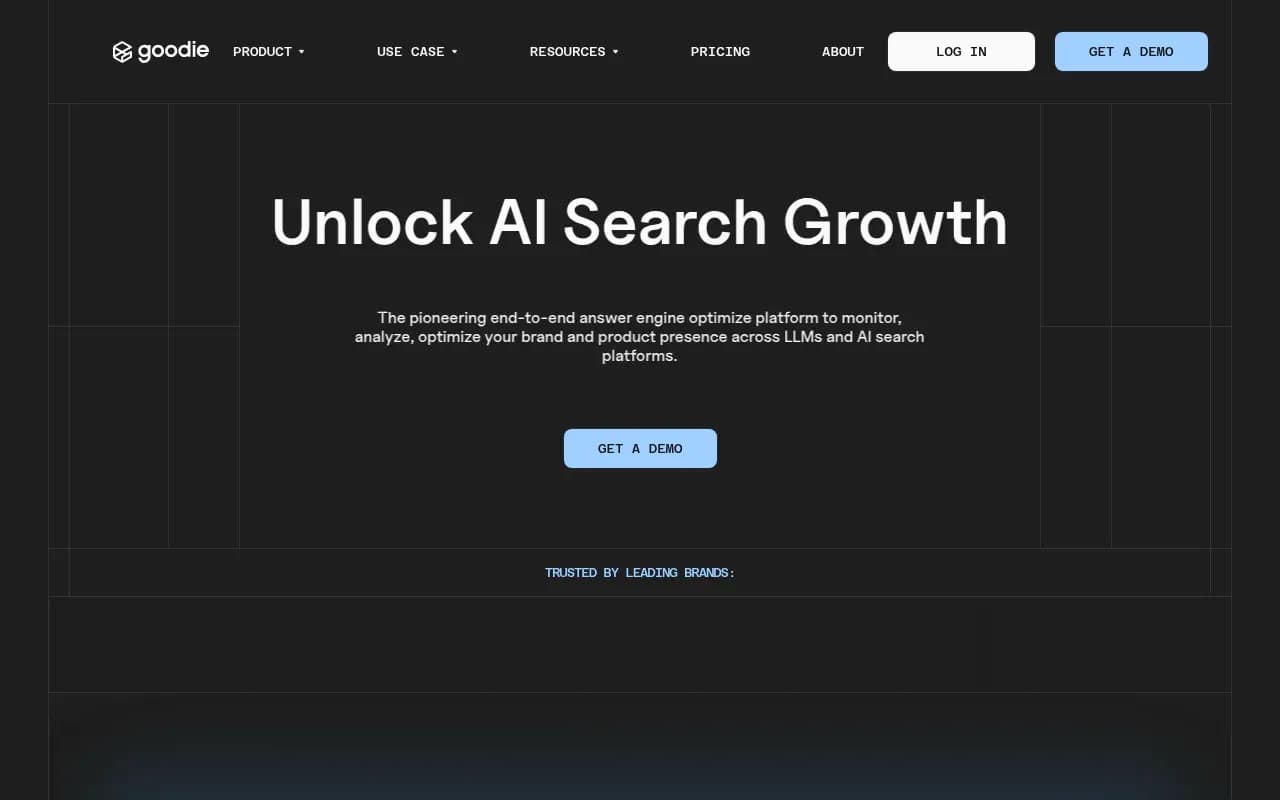
Goodie AI (higoodie.com) positions itself as an "end-to-end AEO platform" built around a four-step closed loop: Research, Monitor, Action, Measure. The pitch is that it doesn't just track your brand in AI results -- it helps you act on what you find. In practice, the monitoring side is well-developed, covering 11 AI models including some that competitors miss (Amazon Rufus is a notable one for e-commerce brands). The enterprise focus is clear from the customer list: Dermalogica, Rathbones, Skylum, Vectara. Getting access requires booking a demo -- there's no self-serve option.
Ansehn
Ansehn
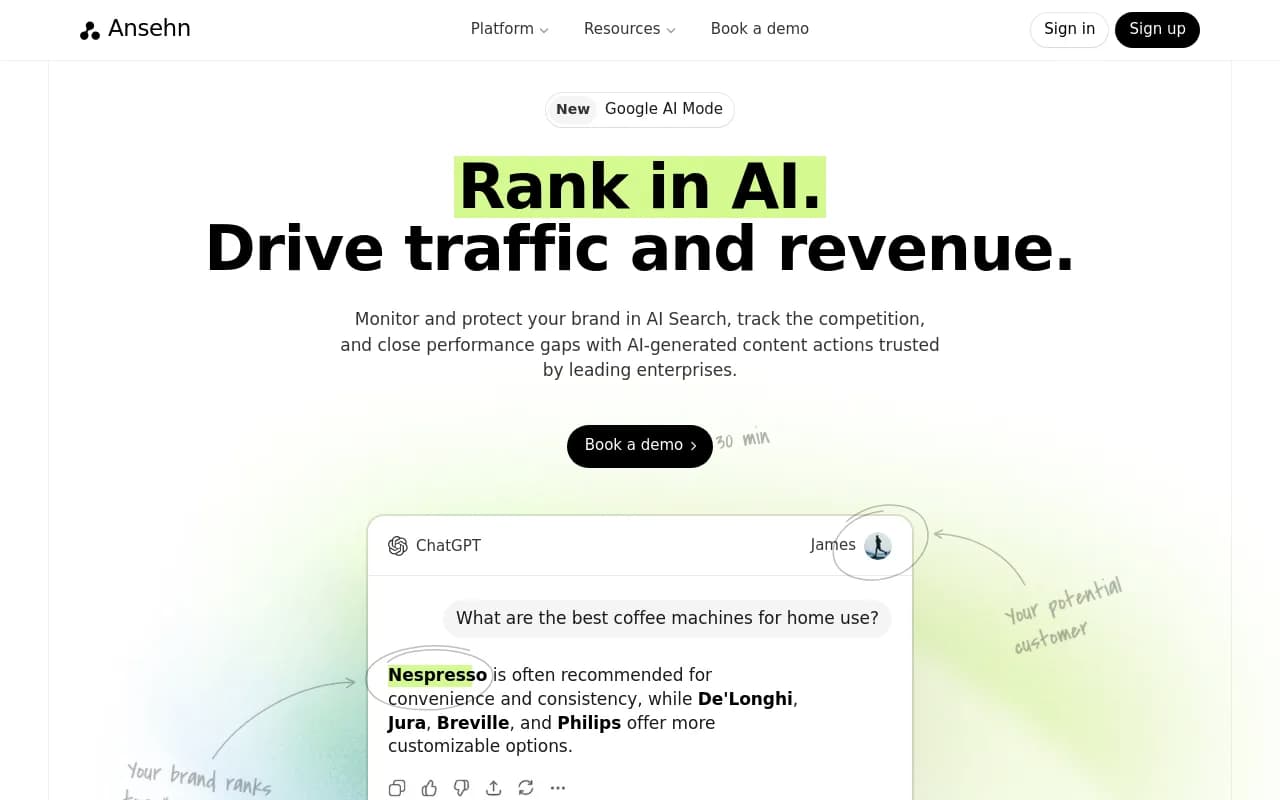
Ansehn (ansehn.com) takes a cleaner, more direct approach to the same problem. The homepage frames it around simulating how buyers use AI to make purchase decisions -- a smart angle that resonates with marketing and demand-gen teams. It covers ChatGPT, Perplexity, Google AI Overview, and Claude as its named models, with "and more" left deliberately vague. Customers include Bosch, Pixum, and Quirion. Unlike Goodie AI, Ansehn has a "Sign up" button alongside its demo booking, suggesting at least some self-serve access path exists.
Side-by-side comparison
| Feature | Goodie AI | Ansehn |
|---|---|---|
| AI models tracked | 11 (ChatGPT, Gemini, Perplexity, Claude, Grok, DeepSeek, Meta AI, Copilot, AI Overview, AI Mode, Amazon Rufus) | 4+ named (ChatGPT, Perplexity, Google AI Overview, Claude) |
| Amazon Rufus tracking | Yes | Not mentioned |
| Self-serve sign-up | No (demo only) | Yes (sign-up available) |
| Free trial | Not advertised | Not clearly advertised |
| Public pricing | No | No |
| Content optimization tools | Referenced ("Action" step) | Referenced ("AI-generated content actions") |
| Competitor benchmarking | Yes | Yes |
| API access | Not publicly documented | Yes (docs.ansehn.com) |
| Target audience | Enterprise brands, agencies | Marketing teams, agencies, B2B/B2C brands |
| Prompt/query research | Yes | Yes |
| Citation tracking | Yes | Yes |
| Sentiment tracking | Yes | Not clearly stated |
| Documentation | Limited public docs | Full documentation site |
| Notable customers | Dermalogica, Rathbones, Skylum | Bosch, Quirion, Pixum |
Head-to-head feature deep-dive
AI model coverage
This is where the gap between the two tools is most concrete. Goodie AI tracks 11 models and names every one of them: ChatGPT, Gemini, Perplexity, Claude, Grok, DeepSeek, Meta AI, Microsoft Copilot, Google AI Overview, Google AI Mode, and Amazon Rufus. That last one matters a lot for consumer brands -- Rufus is Amazon's AI shopping assistant, and it's increasingly influencing purchase decisions on the world's largest e-commerce platform. No other monitoring tool in this tier publicly claims Rufus coverage.
Ansehn names four models and adds "and more" without specifying what that means. For a buyer trying to decide whether a tool covers Grok or DeepSeek, that vagueness is frustrating. It might cover more than it advertises, but you'd have to book a demo to find out.
Verdict: Goodie AI wins on model breadth, especially for e-commerce brands that care about Amazon Rufus.
Onboarding and accessibility
Goodie AI is demo-only. You fill out a contact form, wait for a sales rep, and go through a discovery call before you see the product. That's fine for enterprise procurement cycles, but it's a real friction point for smaller teams or anyone who just wants to evaluate the tool quickly.
Ansehn has a "Sign up" button right on the homepage. Whether that leads to a full free trial or a limited sandbox isn't entirely clear from the public site, but the option exists. There's also a proper documentation site (docs.ansehn.com) with API references -- a sign that the product is built for teams who want to integrate and explore on their own terms.
Verdict: Ansehn is more accessible for teams that don't want to sit through a sales process first.
Content optimization and gap analysis
Both platforms talk about optimization, but neither is particularly transparent about what that means in practice. Goodie AI's "Action" step in its closed loop promises to "identify optimization gaps and execute improvements across owned and earned assets." Ansehn mentions "AI-generated content actions" on its homepage. These are promising descriptions, but without hands-on access or detailed feature documentation, it's hard to know how deep the tooling goes.
What's clear is that neither platform has publicly documented a built-in AI writing agent or content generation workflow comparable to what more comprehensive platforms offer. If content creation is a core need -- not just knowing what's missing, but actually producing the articles and pages to fill those gaps -- both tools will likely leave you doing that work elsewhere.
Verdict: Draw, with a caveat that both are light on specifics here.
Competitor benchmarking
Both tools offer competitive benchmarking -- tracking how your brand's AI visibility compares to competitors across models and prompts. Goodie AI mentions "competitive share" as part of its monitoring feature set. Ansehn frames this as tracking "the competition" and closing "performance gaps." Neither has published screenshots or detailed documentation of what these dashboards look like, so the comparison is largely based on marketing copy.
Verdict: Draw -- both cover the basics, but depth is unclear without a demo.
Measurement and attribution
Goodie AI's fourth closed-loop step is "Measure" -- connecting visibility to business outcomes and proving ROI. That's the right ambition. Ansehn's homepage mentions tracking rankings and benchmarking but doesn't go into attribution detail publicly.
Neither platform has published specifics about traffic attribution methods (pixel, GSC integration, server logs, etc.), which is a gap worth probing in any demo.
Verdict: Goodie AI appears to have thought more about attribution, but neither tool is transparent enough to call a clear winner.
API and integrations
Ansehn has a public documentation site with API references, which is a meaningful signal. It suggests the product is mature enough to support custom integrations and that the team is comfortable with developers poking around. Goodie AI doesn't have a comparable public docs site, though enterprise contracts often include API access that isn't advertised publicly.
Verdict: Ansehn edges ahead on documented API access.
Pricing comparison
Neither Goodie AI nor Ansehn publishes pricing. Both are custom/quote-based, which is common in the enterprise GEO/AEO space but genuinely inconvenient for buyers doing initial research.
| Plan | Goodie AI | Ansehn |
|---|---|---|
| Free tier | None | None confirmed |
| Self-serve starter | Not available | Possibly (sign-up exists) |
| Pricing model | Custom quote | Custom quote |
| Trial | Not advertised | Not clearly advertised |
| How to get pricing | Book a demo | Book a demo |
The lack of public pricing from both tools means you're going in blind on cost. If budget transparency matters to your evaluation process, this is worth flagging early in any demo call.
For context, platforms in this space with public pricing -- like Promptwatch, which starts at $99/month -- give you a much clearer sense of what you're committing to before you talk to anyone.

Pros and cons
Goodie AI
Pros:
- Broadest model coverage in this comparison, including Amazon Rufus
- Established enterprise customer base suggests product maturity
- Four-step closed loop framework is well-articulated
- Sentiment tracking included
Cons:
- No self-serve access -- demo required to see anything
- No public pricing or trial
- Limited public documentation
- Content generation tooling is vague
- No API documentation publicly available
Ansehn
Pros:
- Self-serve sign-up lowers the barrier to entry
- Public API documentation (docs.ansehn.com)
- Clean, buyer-focused positioning
- Notable enterprise customers (Bosch)
Cons:
- Model coverage is vague beyond the four named models
- No Amazon Rufus tracking mentioned
- No public pricing
- Content optimization features are described loosely
- Smaller brand recognition than Goodie AI in the GEO space
Who should pick which tool
Pick Goodie AI if:
- You're an enterprise brand or agency that needs Amazon Rufus tracking for e-commerce visibility
- You want the broadest possible AI model coverage (11 models, all named)
- You're comfortable with a sales-led procurement process
- Sentiment tracking across AI responses is important to your use case
Pick Ansehn if:
- You want to get hands-on with a tool without going through a full sales cycle first
- API access and developer-friendly documentation matter to your workflow
- Your focus is on the four major models (ChatGPT, Perplexity, Google AI, Claude) and you don't need Rufus or Grok coverage
- You're a smaller team or agency that prefers a more accessible entry point
Consider neither if:
- You need built-in AI content generation to actually fix visibility gaps, not just identify them
- You want transparent pricing before committing to a demo
- You need proven traffic attribution from AI search to revenue
Final verdict
Goodie AI and Ansehn are solving the same problem -- tracking brand visibility in AI search results -- and both do it reasonably well within their respective positioning. Goodie AI has the edge on model coverage and enterprise credibility; Ansehn has the edge on accessibility and API documentation. Neither is a clear runaway winner, and the lack of public pricing from both makes it genuinely hard to compare value.
The honest answer: if Amazon Rufus matters to your business, Goodie AI is the only one of these two worth evaluating. If you want to get into a product quickly without a sales call, Ansehn is the more practical starting point. But if you're looking for a platform that doesn't just show you the gap but helps you close it with content, neither tool fully delivers on that promise.