Key takeaways
- Goodie AI covers 11 AI models including Amazon Rufus; Bear AI's entry plan covers just 2 models, with 6+ only on Enterprise
- Bear AI has public, self-serve pricing from $199/month; Goodie AI is demo-only with custom quotes, which almost always means higher enterprise-level costs
- Bear AI explicitly targets revenue conversion from AI traffic -- it has lead generation tools built in; Goodie AI focuses on visibility monitoring and optimization without a strong conversion layer
- Goodie AI is the more mature enterprise platform with a research-monitor-action-measure loop; Bear AI is a leaner, faster-moving startup (Y Combinator-backed) with a narrower but sharper focus
- Neither tool offers the depth of content generation or crawler log analysis that more comprehensive platforms provide
- If you're an e-commerce or retail brand, Goodie's Amazon Rufus tracking is a meaningful differentiator; for SaaS and growth-stage companies, Bear AI's revenue focus is more directly useful
Overview
Goodie AI
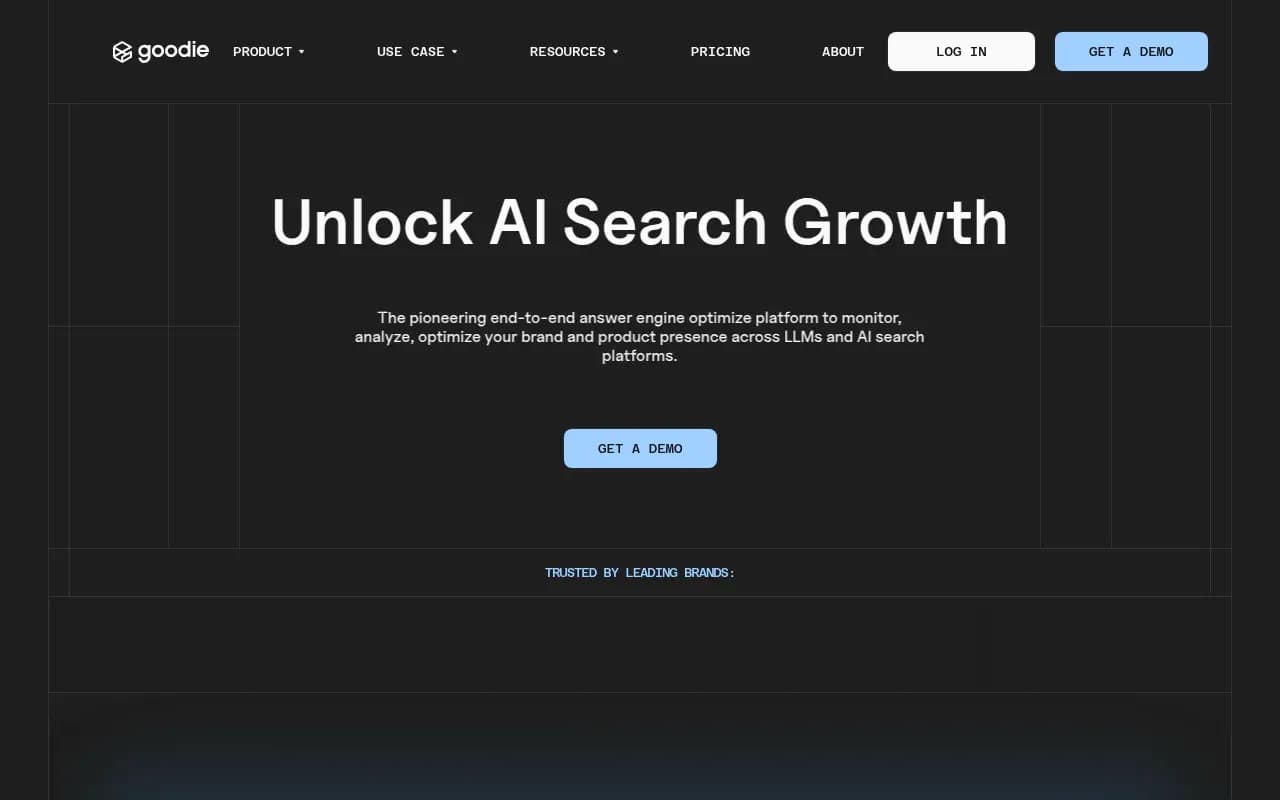
Goodie AI (higoodie.com) positions itself as an "end-to-end AEO platform" for enterprise brands and agencies. The pitch is a closed loop: research customer prompts, monitor brand visibility across AI models, take action on optimization gaps, then measure ROI. It tracks 11 AI models -- ChatGPT, Gemini, Perplexity, Claude, Google AI Overviews, Grok, Meta AI, Copilot, DeepSeek, Google AI Mode, and Amazon Rufus. Clients include Dermalogica, Skylum, and Rathbones.
The enterprise positioning is real. There's no self-serve plan, no public pricing, and no free trial listed on the site. You book a demo, talk to sales, and get a custom quote. That's fine if you're a large brand with a proper procurement process, but it's a meaningful barrier for everyone else.
Bear AI
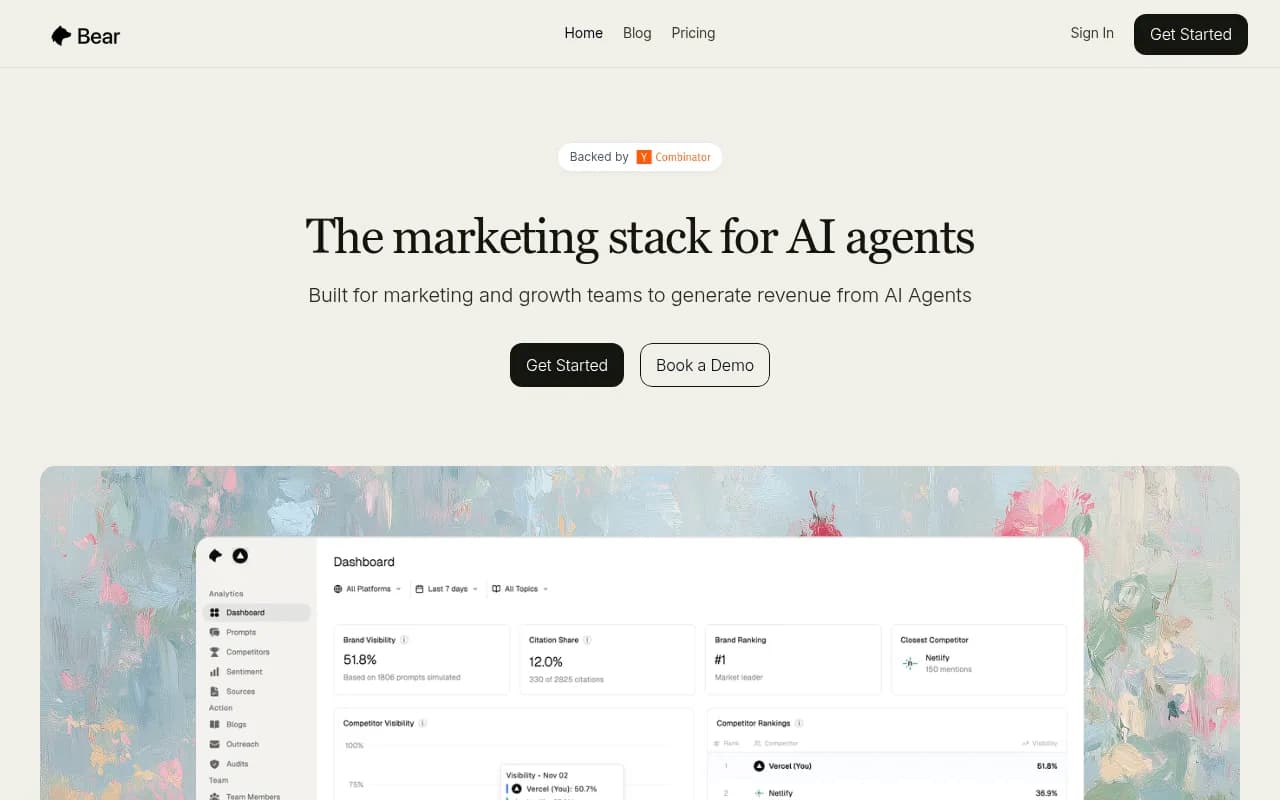
Bear AI (usebear.ai) takes a different angle. It's backed by Y Combinator and describes itself as "the marketing stack for AI agents" -- built specifically to help growth teams generate revenue from AI-driven traffic. The emphasis isn't just on monitoring where your brand shows up; it's on identifying high-intent visitors arriving from AI sources and converting them into leads.
The platform covers ChatGPT, Claude, Google AI Overviews, Perplexity, and Gemini. Pricing is public and starts at $199/month, which makes it accessible without a sales call. Customers include Peerspace, Groww, and Wispr Flow -- a mix of SaaS and marketplace companies.
Side-by-side comparison
| Feature | Goodie AI | Bear AI |
|---|---|---|
| Pricing model | Custom/quote only | From $199/mo (self-serve) |
| Free tier | No | No |
| AI models tracked | 11 (incl. Amazon Rufus) | 2 on Basic, 6+ on Enterprise |
| Prompt tracking | Yes | Yes (75/mo on Basic) |
| Brand mention monitoring | Yes | Yes |
| Citation tracking | Yes | Yes |
| Competitor analysis | Yes | Yes |
| Content/blog generation | Not publicly detailed | Yes (2 blogs/mo on Basic) |
| Lead generation tools | No | Yes (Enterprise) |
| AI traffic attribution | Yes (ROI measurement) | Yes (traffic analysis) |
| Amazon Rufus tracking | Yes | No |
| Crawler log analysis | Not publicly detailed | Not publicly detailed |
| Target audience | Enterprise brands, agencies | Growth/marketing teams, SMBs |
| Sales process | Demo required | Self-serve or demo |
| Y Combinator backed | No | Yes |
Head-to-head feature deep-dive
AI model coverage
Goodie AI's 11-model coverage is one of its strongest cards. Most competitors track 5-7 models. The inclusion of Amazon Rufus is genuinely rare -- it matters a lot if you sell physical products and want to know how Amazon's AI shopping assistant talks about your brand. Google AI Mode is also on the list, which is relatively new and not universally tracked.
Bear AI covers the core five: ChatGPT, Claude, Google AI Overviews, Perplexity, and Gemini. That's enough for most SaaS and service businesses, but if you're in retail, e-commerce, or any sector where Amazon's AI matters, Bear AI has a real gap here.
Verdict: Goodie AI wins on breadth. Bear AI is fine for most use cases but falls short for e-commerce.
Pricing and accessibility
This is where the two tools diverge most sharply. Bear AI publishes its pricing. You can sign up, pick a plan, and start without talking to anyone. That's a meaningful advantage for teams that want to move fast or don't have budget for enterprise contracts.
Goodie AI's demo-only model isn't unusual for enterprise software, but it does mean you're committing time before you know if the price is even in your range. Based on the enterprise positioning and client list, expect pricing well above Bear AI's entry point.
Verdict: Bear AI wins on accessibility. Goodie AI is likely the better fit if you have an enterprise procurement process and budget to match.
Monitoring and analytics
Both platforms track brand mentions, citations, and competitive positioning across AI models. Goodie AI's research phase -- understanding real customer prompts and search volume patterns -- sounds more structured, with explicit mention of prompt research as a distinct step before monitoring begins.
Bear AI's analytics focus on traffic: which AI agents are sending visitors to your site, how often, and what those visitors do. It's more traffic-analytics-flavored than pure visibility monitoring.
| Capability | Goodie AI | Bear AI |
|---|---|---|
| Brand mention tracking | Yes | Yes |
| Citation analysis | Yes | Yes |
| Competitor share of voice | Yes | Yes |
| Prompt research/volume | Yes | Yes (75 prompts on Basic) |
| Traffic source attribution | Yes | Yes (core feature) |
| Sentiment tracking | Yes | Not prominently featured |
Verdict: Goodie AI goes deeper on the monitoring and research side. Bear AI's traffic attribution is more actionable for teams focused on revenue.
Content and optimization tools
This is where both tools show their limits compared to more comprehensive platforms. Bear AI includes blog content generation -- 2 articles per month on Basic, more on higher tiers. That's a real feature, even if the volume is low at entry level.
Goodie AI mentions an "Action" phase in its closed loop -- "identify optimization gaps and execute improvements across owned and earned assets" -- but the specifics aren't publicly detailed. It's unclear whether this means built-in content generation or guidance on what to fix manually.
Verdict: Bear AI edges ahead here purely because it has a documented content feature. Goodie AI's optimization capabilities may be stronger in practice, but you'd need a demo to find out.
Worth noting: if content generation for AI search is a priority, Promptwatch has a built-in AI writing agent specifically trained on citation data from 880M+ AI responses -- it's worth looking at alongside either of these tools.

Revenue and conversion focus
Bear AI's clearest differentiator is its lead generation layer. On Enterprise plans, it identifies high-intent visitors arriving from AI sources and provides tools to convert them. This is a genuinely different angle from most AI visibility platforms, which stop at "here's your visibility score."
Goodie AI's "Measure" phase promises ROI attribution connecting visibility to business outcomes, but the mechanism isn't spelled out publicly. It likely means reporting on traffic and conversions driven by improved AI visibility, rather than active lead capture.
Verdict: Bear AI wins here. The lead generation feature is unique and directly tied to revenue.
Target audience fit
Goodie AI is built for enterprise marketing teams and agencies managing large brands. The client list (Dermalogica, Rathbones) and the demo-only sales process confirm this. If you're running a 50-person marketing team at a mid-to-large brand, Goodie is designed for you.
Bear AI targets growth and marketing teams at companies that are moving fast and want to monetize AI traffic without a lengthy procurement cycle. The Y Combinator backing and self-serve pricing signal a startup-friendly product philosophy.
Pricing comparison
| Plan | Goodie AI | Bear AI |
|---|---|---|
| Entry-level | Custom (demo required) | $199/mo (Basic) |
| Mid-tier | Custom | Not publicly listed |
| Enterprise | Custom | Custom (unlimited prompts, 6+ models) |
| Free trial | Not listed | Not listed |
| Self-serve signup | No | Yes |
Bear AI's Basic plan at $199/month includes 75 prompts, 2 blog posts, and 2 AI models. Enterprise adds lead generation, 6+ models, and unlimited prompts. Goodie AI's pricing is entirely opaque without a sales conversation.
Pros and cons
Goodie AI
Pros:
- Broadest AI model coverage in this comparison (11 models, including Amazon Rufus)
- Structured research-monitor-action-measure framework
- Sentiment tracking included
- Suited for enterprise brands with complex needs
- Established client base across multiple industries
Cons:
- No public pricing -- you have to talk to sales
- No self-serve option
- Content generation capabilities not clearly documented
- Higher barrier to entry for smaller teams
- Lead generation / conversion tools not part of the offering
Bear AI
Pros:
- Transparent, self-serve pricing from $199/month
- Lead generation tools for converting AI traffic (Enterprise)
- Blog content generation included
- Y Combinator-backed with active development
- Traffic attribution is a core, well-documented feature
- Accessible for growth-stage companies
Cons:
- Only 2 AI models on the Basic plan -- limited for the price
- No Amazon Rufus or Grok tracking
- Smaller company with less established track record
- Content generation volume is low on entry plans (2 blogs/month)
- Monitoring depth may not match enterprise-grade competitors
Who should pick which tool
Pick Goodie AI if:
- You're an enterprise brand or agency with a formal procurement process
- Amazon Rufus tracking matters to your business (retail, e-commerce, CPG)
- You need sentiment analysis and competitive share of voice across 10+ AI models
- You want a structured AEO framework with dedicated research and measurement phases
- Budget isn't the primary constraint
Pick Bear AI if:
- You're a growth or marketing team that wants to start quickly without a sales process
- Converting AI traffic into leads is your primary goal, not just monitoring visibility
- You're a SaaS, marketplace, or service business where the five core AI models are sufficient
- You want content generation included in the platform
- You're working with a tighter budget and need predictable monthly pricing
Final verdict
These two tools are solving adjacent but distinct problems. Goodie AI is a serious enterprise monitoring platform with the widest model coverage in this comparison -- if Amazon Rufus or a 10+ model requirement is on your checklist, it's the obvious choice. Bear AI is the better pick for growth teams that want to move fast, see public pricing upfront, and actually convert AI-driven traffic into revenue rather than just track it. The lead generation angle is genuinely differentiated. Neither tool is a clear all-around winner -- the right choice depends almost entirely on your company size, budget, and whether you prioritize monitoring depth or revenue conversion.