Key takeaways
- Meridian is a managed, agency-style platform -- you get expert execution alongside the software. Promptmonitor is a self-serve SaaS tool you run yourself.
- Promptmonitor starts at $29/month with a free trial. Meridian has no public pricing and requires a demo call, which usually signals a four-figure monthly commitment.
- Meridian covers 9+ AI models including Meta AI, Grok, and DeepSeek. Promptmonitor focuses on ChatGPT, Claude, Gemini, and Perplexity -- the four most widely used, but a narrower set.
- Neither tool has built-in AI content generation. Meridian compensates with human expert execution; Promptmonitor gives you action recommendations but leaves the writing to you.
- Promptmonitor has a live public demo you can explore right now. Meridian requires a scheduled call to see anything.
- If you're a lean team that wants to track AI visibility without a big budget, Promptmonitor is the practical pick. If you want a team to actively manage and improve your AI search presence, Meridian is the more serious option -- assuming the price fits.
Overview
Meridian

Meridian positions itself as more than a monitoring dashboard. The pitch is "agentic AI platform" combined with hands-on expert execution -- the idea being that tracking your AI visibility is only half the job, and someone (or something) should actually be doing the optimization work too. It covers a wide range of AI models: ChatGPT, Perplexity, Gemini, Google AI, Claude, Meta AI, Copilot, Grok, and DeepSeek. The platform tracks category-level visibility, sentiment scores, citation sources, and competitive benchmarking. It's clearly built for mid-market and enterprise brands that want a managed growth system, not just a data dashboard.
The "agentic" framing is interesting -- Meridian seems to be leaning into multi-agent AI workflows to automate parts of the optimization process, though the specifics of what the agents actually do aren't fully transparent from the public website. The demo-only pricing model tells you something about the target customer: this isn't a tool you spin up on a credit card.
Promptmonitor
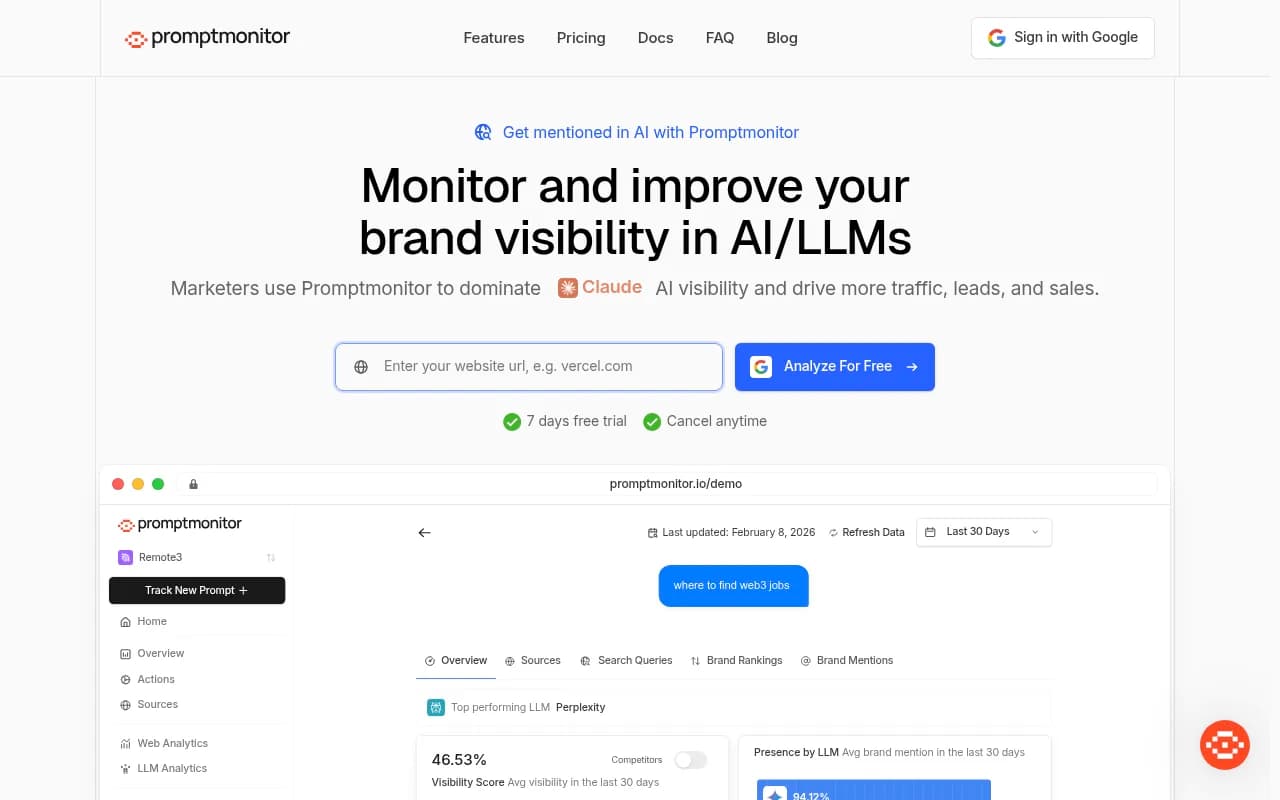
Promptmonitor takes the opposite approach: accessible, self-serve, and priced for teams that are just getting started with AI visibility tracking. The core product monitors brand mentions across ChatGPT, Claude, Gemini, and Perplexity, shows which sources those models cite, and gives you an "Actions" section with recommendations on what to do next. There's a public live demo you can explore without signing up, which is a nice touch for a tool in this space.
The interface is clean and the data is presented clearly -- visibility scores, presence by LLM, source tracking, and some basic web analytics. It won't overwhelm you. The trade-off is that it's genuinely a monitoring tool. The "Actions" tab hints at optimization guidance, but there's no content generation, no crawler log analysis, and no deep prompt intelligence. You get the "what" but have to figure out the "how" yourself.
Side-by-side comparison
| Feature | Meridian | Promptmonitor |
|---|---|---|
| Pricing model | Custom (demo required) | Freemium, from $29/mo |
| Free trial | No (demo only) | 7-day free trial |
| AI models covered | 9+ (ChatGPT, Perplexity, Gemini, Google AI, Claude, Meta AI, Copilot, Grok, DeepSeek) | 4 (ChatGPT, Claude, Gemini, Perplexity) |
| Brand visibility tracking | Yes | Yes |
| Sentiment tracking | Yes | Limited |
| Citation/source tracking | Yes | Yes |
| Competitive benchmarking | Yes | Yes (basic) |
| Content gap analysis | Not self-serve (expert-led) | No |
| Content generation | No (human expert execution) | No |
| AI crawler logs | Not mentioned | No |
| Prompt intelligence / volume data | Not publicly detailed | No |
| Action recommendations | Expert-led | Basic (Actions tab) |
| Multi-language / multi-region | Yes (shown in demo) | Not prominently featured |
| API / integrations | Not publicly detailed | Not prominently featured |
| Target audience | Mid-market / enterprise | SMBs, startups, solo marketers |
| Setup | Demo + onboarding | Self-serve |
Head-to-head feature deep-dive
Monitoring coverage
Meridian covers more AI models out of the box. Nine platforms including Meta AI, Grok, and DeepSeek puts it ahead of Promptmonitor's four-model lineup. For most brands, ChatGPT, Perplexity, Gemini, and Claude represent the bulk of AI search traffic right now -- so Promptmonitor's coverage isn't a disaster. But if you're in a market where Grok or Meta AI are relevant (social-native audiences, for instance), Meridian's broader coverage matters.
Meridian also shows multi-language, multi-region tracking in its demo -- the Japanese hotel booking example on the homepage is a deliberate signal that it can handle international brands. Promptmonitor doesn't prominently feature this capability.
Verdict: Meridian wins on coverage breadth. Promptmonitor is adequate for most English-language use cases.
Sentiment and visibility scoring
Both tools track visibility scores and sentiment, but Meridian goes deeper here. Its dashboard shows visibility scores, sentiment scores (with percentage changes), and position rankings -- essentially treating AI search like a SERP where you can track your rank. The sentiment score (93 in the demo, up 6%) is a useful signal for brand health in AI responses.
Promptmonitor's visibility score is a composite of presence and cross-model consistency. It's a simpler metric -- useful for a quick read but less granular than Meridian's approach. You can see presence by LLM (e.g., Gemini at 80.77%, Perplexity at 69.23%, ChatGPT at 26.92%) which is genuinely useful for understanding where you're winning and losing.
Verdict: Meridian's scoring system is more sophisticated. Promptmonitor's is easier to understand at a glance.
Citation and source tracking
This is where both tools do solid work. Promptmonitor's source tracking is one of its stronger features -- you can see exactly which URLs AI models are citing, which models use each source, how many times it's been cited, and when it was first identified. The ability to filter by "Opportunity" (sources that mention competitors but not you) is a genuinely useful feature for finding gaps.
Meridian tracks citations too, but the specifics of how it surfaces source data aren't as transparent from the public website. Given it's a managed service, some of this analysis likely happens in reports rather than a self-serve dashboard.
Verdict: Promptmonitor's self-serve source tracking is more transparent and immediately actionable for a solo marketer. Meridian's is likely more comprehensive but less accessible.
Optimization and action-taking
This is the biggest gap between the two tools -- and honestly, between both of them and more comprehensive platforms.
Meridian's answer to "what do I do with this data?" is human experts. The "hands-on execution" part of their pitch means you're paying for a team that will actually implement changes, not just tell you what to do. That's valuable if you have the budget and want to outsource the work. But it's also opaque -- you're trusting their process rather than running your own.
Promptmonitor has an "Actions" tab that presumably surfaces recommendations based on your monitoring data. From the live demo, it shows related prompts and optimization suggestions. But there's no content generation, no automated gap analysis tied to competitor prompts, and no way to go from "I'm not being cited for this query" to "here's a draft article that could fix that" within the platform.
Neither tool closes the full loop from data to content to results. If that's what you need, it's worth looking at platforms like Promptwatch that combine monitoring with built-in content generation and answer gap analysis -- the kind of workflow where you find the gap, generate the content, and track the improvement all in one place.

Verdict: Meridian wins if you want someone else to do the work. Promptmonitor gives you pointers but leaves execution entirely to you.
Ease of use and setup
Promptmonitor is genuinely easy to get started with. There's a public demo, a 7-day free trial, and a self-serve signup flow. You can be tracking prompts within minutes. The interface is clean -- visibility scores, LLM presence breakdowns, source tables -- and it doesn't require any technical setup.
Meridian requires a demo call before you can access anything. That's a deliberate choice -- it signals a more consultative sales process and a higher-touch onboarding. For some buyers that's reassuring; for others it's a friction point. If you want to evaluate a tool before talking to a salesperson, Meridian makes that impossible.
Verdict: Promptmonitor wins on accessibility and speed to value. Meridian's onboarding is more involved by design.
Multi-language and international tracking
Meridian explicitly shows multi-language tracking in its homepage demo (Japanese hotel booking query, Canadian dating app query). This suggests genuine multi-region capability built into the core product.
Promptmonitor doesn't prominently feature multi-language support. It may handle non-English prompts, but it's not a selling point they lead with.
Verdict: Meridian is the better choice for international brands.
Pricing comparison
| Plan | Meridian | Promptmonitor |
|---|---|---|
| Free / trial | Demo only | 7-day free trial |
| Starter | Custom (demo required) | $29/mo |
| Growth | Custom (demo required) | $39/mo |
| Pro | Custom (demo required) | $129/mo |
| Agency / Enterprise | Custom (demo required) | Custom pricing |
Meridian's pricing is entirely opaque. No tiers, no ballpark figures, nothing. Given the managed service model and the enterprise positioning, you're almost certainly looking at a minimum of several hundred dollars per month, more likely $1,000+ depending on scope. That's not a criticism -- managed services cost more because you're paying for expertise, not just software -- but it does mean Meridian is out of reach for most small teams.
Promptmonitor's pricing is refreshingly transparent. $29/month for Starter is genuinely affordable, and even the $129/month Pro plan is accessible for a small marketing team. The 7-day free trial means you can validate whether it works for your use case before spending anything.
Pros and cons
Meridian
Pros:
- Broad AI model coverage (9+ platforms including Meta AI, Grok, DeepSeek)
- Managed execution means you're not just getting data -- someone acts on it
- Multi-language and multi-region tracking built in
- Sophisticated sentiment and position tracking
- Agentic AI workflows for optimization (though specifics are vague publicly)
Cons:
- No public pricing -- requires a demo call to learn anything
- No self-serve trial or demo access
- Optimization process is opaque -- hard to know exactly what the agents do
- Likely expensive, putting it out of reach for SMBs
- Less transparency on how source/citation data is surfaced in the dashboard
Promptmonitor
Pros:
- Very affordable, starting at $29/month
- 7-day free trial with no credit card friction
- Public live demo you can explore before signing up
- Clean, easy-to-use interface
- Good source tracking with "Opportunity" filter for competitive gaps
- Transparent visibility scoring by LLM
Cons:
- Only covers 4 AI models (ChatGPT, Claude, Gemini, Perplexity)
- No content generation or AI writing capabilities
- Action recommendations are basic -- no automated gap analysis
- No AI crawler logs or prompt volume/difficulty data
- Multi-language support not prominently featured
- "Actions" tab feels underdeveloped compared to the monitoring features
Who should pick which tool
Choose Meridian if:
- You're a mid-market or enterprise brand with budget for a managed service
- You want experts handling the optimization work, not just a dashboard
- You operate in multiple languages or regions
- You need coverage across all major AI platforms including Meta AI, Grok, and DeepSeek
- You're comfortable with a sales-led buying process
Choose Promptmonitor if:
- You're a startup, SMB, or solo marketer with a limited budget
- You want to get started quickly without a sales call
- Your primary AI search concerns are ChatGPT, Perplexity, Gemini, and Claude
- You need basic monitoring and source tracking, not full optimization
- You want to trial a tool before committing any money
Final verdict
These two tools are aimed at genuinely different buyers, which makes a direct "winner" call a bit misleading. Meridian is a premium managed service for brands that want someone else to handle AI search optimization -- the software is the delivery mechanism, not the product itself. Promptmonitor is a lightweight self-serve tracker for teams that want visibility data without the overhead of a managed engagement.
If budget is tight and you just need to know where you stand in AI search results, Promptmonitor gets the job done for $29/month. If you're a larger brand that wants to actively move the needle and has the budget for a managed approach, Meridian is worth the demo call. Neither tool fully solves the content optimization problem on its own -- that's the gap both leave open.