Key Takeaways
- Completely different purposes: Meteoria monitors how AI models mention your brand (GEO/AI visibility), while Amplitude tracks product usage and user behavior (product analytics). They solve different problems.
- Pricing gap: Meteoria starts at €75/month for 25 prompts with unlimited seats. Amplitude offers a free tier up to 10K monthly tracked users, then jumps to $49/month for 300K MTUs -- but enterprise pricing can hit $2K-50K+ annually.
- Target audience split: Meteoria is for marketing/SEO teams worried about AI search visibility. Amplitude is for product managers, growth teams, and engineers optimizing conversion funnels and feature adoption.
- Data sources: Meteoria queries ChatGPT, Perplexity, Google AI Overview, Gemini, and Grok to see if your brand gets mentioned. Amplitude instruments your app/website to track clicks, sessions, and user journeys.
- Actionability: Meteoria shows you where you're invisible in AI responses and which sources AI models cite. Amplitude shows you where users drop off in your product and which features drive retention.
- Geographic focus: Meteoria is French-built with strong European presence. Amplitude is US-based and used by global enterprises like Walmart, NBC, and Atlassian.
Overview
Meteoria: AI visibility tracking

Meteoria is a French GEO (Generative Engine Optimization) platform launched to help brands understand how AI models talk about them. It runs custom prompts through ChatGPT, Perplexity, Google AI Overview, Gemini, and Grok, then analyzes whether your brand appears in responses, your position relative to competitors, and the sentiment AI models express. The platform targets marketing and SEO teams who realize that traditional search is shifting to conversational AI -- and want to track their visibility in this new landscape.
Meteoria's core workflow: define strategic prompts (product queries, comparison questions, recommendation requests), run them across multiple AI models, quantify your visibility score, identify which sources the AI cites, and compare your performance against competitors. It's monitoring-focused -- you get dashboards showing trends, competitor heatmaps, and source analysis, but you're responsible for creating the content that improves your visibility.
Amplitude: Product analytics and experimentation
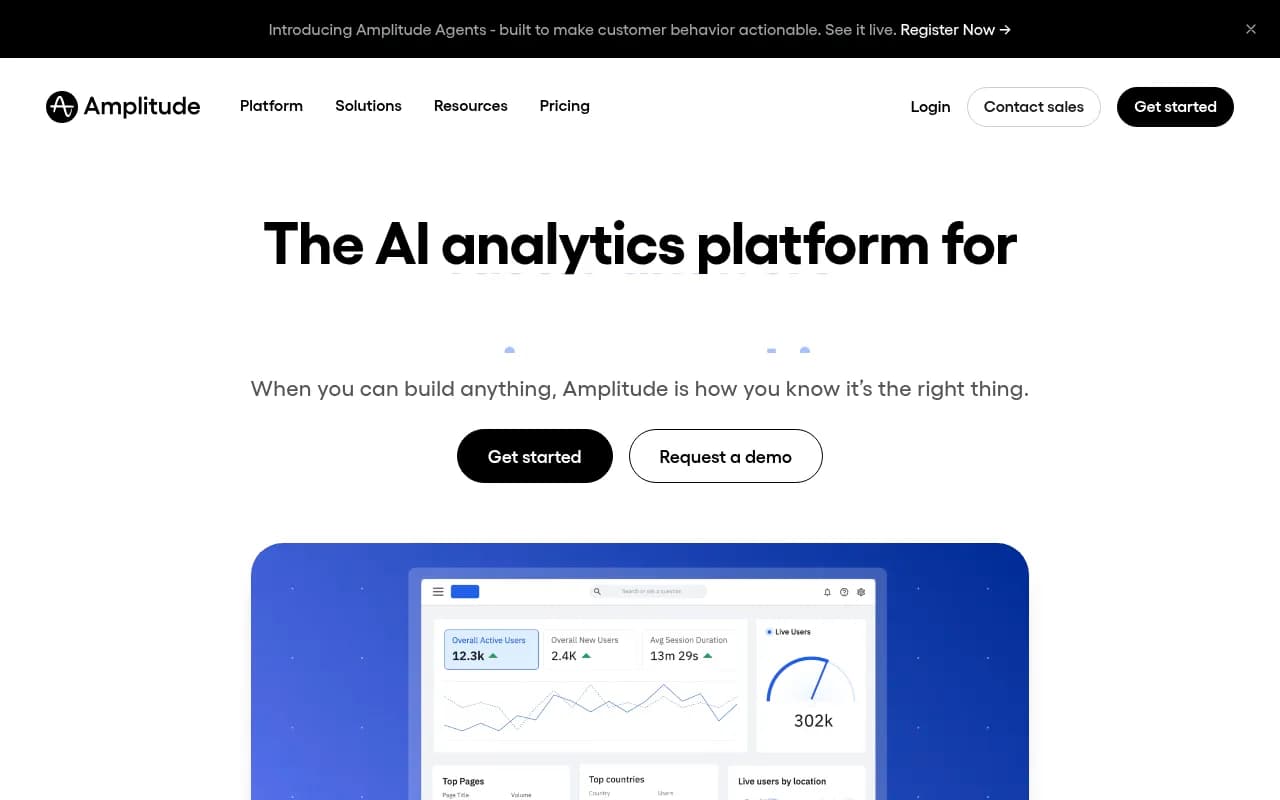
Amplitude is a digital analytics platform that tracks how users interact with your product. You instrument your app or website with Amplitude's SDK, send event data (clicks, page views, feature usage), and analyze user behavior to optimize conversion rates, retention, and engagement. It's used by product managers, growth teams, and data analysts at companies like Walmart, Atlassian, and NBC to answer questions like "Which onboarding flow converts better?" or "What features do power users engage with most?"
Amplitude's strength is behavioral cohort analysis and funnel visualization. You can segment users by any attribute (signup date, plan type, device), track their journey through your product, run A/B tests, and measure the impact of feature changes on key metrics. The platform includes AI-powered insights that surface anomalies and suggest optimization opportunities. It's built for product-led growth -- understanding what users do inside your product so you can build better features and improve retention.
Side-by-Side Comparison
| Feature | Meteoria | Amplitude |
|---|---|---|
| Primary use case | AI search visibility tracking (GEO) | Product usage analytics |
| Data source | Queries to ChatGPT, Perplexity, Google AI Overview, Gemini, Grok | Event data from your app/website via SDK |
| Starting price | €75/mo (25 prompts, unlimited seats) | Free up to 10K MTUs, then $49/mo (300K MTUs) |
| Free tier | 7-day trial | Yes, up to 10K monthly tracked users |
| Target users | Marketing, SEO, brand teams | Product managers, growth teams, engineers |
| Key metrics | Visibility score, competitor position, sentiment, source citations | Conversion rates, retention, feature adoption, user journeys |
| AI models tracked | ChatGPT, Perplexity, Google AI Overview, Gemini, Grok | N/A (analyzes your product, not AI models) |
| Integrations | Standalone (queries AI models directly) | 100+ integrations (Segment, mParticle, Snowflake, etc.) |
| Experimentation | No | Yes, built-in A/B testing and feature flags |
| Reporting | Dashboards, competitor heatmaps, source analysis | Funnels, cohorts, retention curves, user paths |
| Seats/users | Unlimited on all plans | Varies by plan |
| Geographic strength | Europe (French company) | Global (US-based, enterprise focus) |
| Typical customer | Brands tracking AI search mentions | SaaS products, eCommerce, media apps |
Use case: When to pick which platform
Pick Meteoria if:
- Your main concern is how AI models like ChatGPT and Perplexity talk about your brand when users ask for recommendations or comparisons
- You're doing SEO or content marketing and want to understand AI search visibility alongside traditional Google rankings
- You need to track competitor mentions in AI responses and identify which sources (websites, Reddit threads, YouTube videos) AI models cite
- You want sentiment analysis on how AI models describe your brand
- You're a European company or agency managing multiple client brands (unlimited seats make this cost-effective)
- You're building a GEO strategy and need baseline visibility data before creating optimized content
Pick Amplitude if:
- You need to understand how users navigate your product, where they drop off, and which features drive retention
- You're running A/B tests on onboarding flows, pricing pages, or feature releases and need statistically valid results
- You want to segment users by behavior (power users vs casual users) and personalize their experience
- You're optimizing conversion funnels -- signup to activation, trial to paid, free to premium
- You need to justify product decisions with data on feature adoption and user engagement
- You're a product-led growth company where user behavior inside the product is your primary growth lever
These tools don't overlap. Meteoria tells you if ChatGPT recommends your brand. Amplitude tells you if users who click your CTA actually convert. Different questions, different data.
If you're also looking to track how your brand shows up in AI search results and optimize your content for AI visibility, Promptwatch covers that angle with additional capabilities like content gap analysis and AI-powered content generation.

Pricing breakdown
| Plan | Meteoria | Amplitude |
|---|---|---|
| Free tier | 7-day trial | Up to 10K MTUs (monthly tracked users) |
| Entry plan | Basic: €75/mo (25 prompts, unlimited seats) | Plus: $49/mo (300K MTUs, 12-month data retention) |
| Mid-tier | Pro: €175/mo (100 prompts, unlimited seats) | Growth: Custom pricing (typically $2K-10K+/mo for larger volumes) |
| Enterprise | €300+/mo (200+ prompts, unlimited seats) | Custom (typically $10K-50K+/year for enterprise features) |
| Billing | Monthly or annual | Monthly or annual (annual gets discount) |
| Seats | Unlimited on all plans | Varies by plan (Plus: 5 seats, Growth: custom) |
| Overage charges | Not specified (likely need to upgrade plan) | Yes, per additional MTU or event volume |
Meteoria's pricing is straightforward: you pay for the number of prompts you want to track, and everyone on your team can access the data. Amplitude's pricing is volume-based -- you pay for the number of unique users you track each month. For small products, Amplitude's free tier is generous. For high-traffic apps, costs scale quickly.
Feature deep-dive
Data collection and sources
Meteoria doesn't instrument your website. It queries AI models directly with prompts you define. You specify the questions ("Best project management tools for remote teams", "Top CRM software for small businesses"), and Meteoria runs them through ChatGPT, Perplexity, Google AI Overview, Gemini, and Grok. It parses the responses to see if your brand appears, your position in lists, and which sources the AI cites. This is passive monitoring -- you're not tracking user behavior, you're tracking AI behavior.
Amplitude requires you to instrument your product. You add their JavaScript SDK to your website or mobile SDK to your app, then send events ("User clicked signup", "User completed onboarding step 2", "User upgraded to pro plan"). Amplitude stores this event data and lets you query it to build funnels, cohorts, and retention curves. The data is behavioral -- what users actually did in your product.
Completely different data models. Meteoria analyzes text responses from AI models. Amplitude analyzes user actions in your product.
Competitor analysis
Meteoria's competitor tracking is central to the platform. You define your competitors, and Meteoria shows you side-by-side visibility scores for each prompt. If ChatGPT recommends your competitor 80% of the time and your brand 20% of the time for "best email marketing software", you see that gap immediately. The competitor heatmaps show which AI models favor which brands, and the source analysis reveals where competitors are getting cited (specific blog posts, Reddit threads, review sites).
Amplitude doesn't track competitors. It tracks your users. You can benchmark your metrics against industry averages (Amplitude publishes benchmark reports), but you're not seeing competitor product data unless you have access to their Amplitude workspace (you don't).
If competitive intelligence in AI search is your goal, Meteoria delivers. If you want to know how your product stacks up on conversion rates or retention, you need external benchmarks or your own historical data in Amplitude.
Sentiment and brand analysis
Meteoria includes sentiment analysis -- it evaluates whether AI models describe your brand positively, negatively, or neutrally. This matters for brand reputation. If Perplexity consistently mentions your product with caveats ("X is popular but has reliability issues"), you see that pattern in the sentiment scores. Meteoria tracks both explicit sentiment ("X is great") and implicit sentiment (tone and context).
Amplitude doesn't do sentiment analysis. It tracks quantitative behavior -- clicks, conversions, time spent. You can infer satisfaction from retention rates or NPS surveys (if you send that data to Amplitude as an event), but Amplitude isn't analyzing text or sentiment.
Reporting and dashboards
Meteoria's dashboards focus on visibility trends over time, competitor positioning, and source breakdowns. You see charts showing your visibility score across different AI models, heatmaps comparing you to competitors, and lists of the most-cited sources. The interface is designed for marketers -- visual, trend-focused, easy to share with stakeholders who want to know "Are we visible in ChatGPT?"
Amplitude's dashboards are built for product analysis. You create funnels (signup -> activation -> paid conversion), cohort retention curves (how many users from January are still active in March), and user path visualizations (what do users do after they land on the homepage). The interface is powerful but has a learning curve -- you need to understand event taxonomy and cohort logic to get value. Amplitude also includes AI-powered insights that surface anomalies ("Conversion dropped 15% this week") and suggest areas to investigate.
Meteoria is simpler to use if you're not a data analyst. Amplitude is more powerful if you are.
Experimentation and optimization
Meteoria is monitoring-only. It tells you where you're invisible and which sources AI models prefer, but it doesn't help you run experiments or optimize content directly. You take the insights ("We're not cited for X prompt, but competitor Y is because they have a guide on Z") and create content yourself.
Amplitude includes built-in A/B testing and feature flags. You can run experiments on different onboarding flows, pricing pages, or feature variations, then measure the impact on conversion, retention, or revenue. Amplitude's experimentation suite integrates with the analytics data, so you see results in the same platform where you analyze user behavior. This closes the loop -- identify a problem in the funnel, test a solution, measure the outcome.
If you want to test and iterate on your product, Amplitude gives you the tools. Meteoria gives you visibility data but leaves optimization to you.
Integrations and data ecosystem
Meteoria is standalone. It queries AI models and stores the results in its own database. You export reports or view dashboards, but there's no mention of integrations with other marketing tools, CRMs, or data warehouses. It's a single-purpose tool.
Amplitude integrates with 100+ tools -- CDPs like Segment and mParticle, data warehouses like Snowflake and BigQuery, CRMs like Salesforce, and marketing platforms like Braze and Iterable. You can send Amplitude data to other systems (e.g. sync high-value user cohorts to your email tool) or pull data from other sources into Amplitude for unified analysis. Amplitude also has a robust API for custom integrations.
If you need analytics that plugs into a broader data stack, Amplitude fits. Meteoria is more of a standalone monitoring dashboard.
AI and automation
Meteoria's "AI" is the AI models it monitors -- ChatGPT, Perplexity, etc. The platform itself doesn't use AI to generate insights or automate actions. You get raw visibility data and source lists.
Amplitude recently launched AI Agents that monitor your data 24/7 and surface issues automatically ("Conversion in the checkout funnel dropped 20% for mobile users in the last 3 days"). These agents analyze patterns, detect anomalies, and suggest areas to investigate. Amplitude also uses AI to predict user behavior (churn risk, likelihood to convert) and recommend next-best actions.
Amplitude is leaning into AI-powered analytics. Meteoria is focused on tracking AI-generated content.
Pros and cons
Meteoria pros:
- Unlimited seats on all plans -- great for agencies or large teams
- Tracks multiple AI models (ChatGPT, Perplexity, Google AI Overview, Gemini, Grok) in one dashboard
- Competitor visibility comparison built-in
- Sentiment analysis for brand reputation monitoring
- Source citation tracking helps you understand where to get mentioned
- Lower entry price (€75/mo) compared to enterprise analytics tools
- French company with European data privacy focus
Meteoria cons:
- Monitoring-only -- no content creation, optimization, or experimentation tools
- Limited to AI search visibility (doesn't track traditional SEO, social media, or other channels)
- Prompt limits can be restrictive (25 prompts on Basic plan)
- No integrations with other marketing or analytics tools mentioned
- Newer platform with smaller customer base compared to established analytics tools
- No free tier beyond 7-day trial
Amplitude pros:
- Generous free tier (10K MTUs) for small products
- Deep behavioral analytics -- funnels, cohorts, retention, user paths
- Built-in A/B testing and experimentation
- 100+ integrations with CDPs, data warehouses, and marketing tools
- AI-powered insights and anomaly detection
- Proven at scale (used by Walmart, Atlassian, NBC)
- Strong documentation and community support
Amplitude cons:
- Pricing scales quickly with user volume (can hit $10K-50K+/year for enterprise)
- Steep learning curve -- requires understanding of event taxonomy and analytics concepts
- Overkill if you just need basic traffic analytics (Google Analytics is simpler)
- Implementation requires engineering resources to instrument your product
- Not designed for AI search visibility or brand monitoring
- Free tier limits (10K MTUs) may be too small for growing products
Who should pick which tool
Choose Meteoria if you are:
- A marketing or SEO team tracking brand mentions in AI search engines
- An agency managing AI visibility for multiple clients (unlimited seats are a big advantage)
- A brand worried about how ChatGPT and Perplexity describe your products vs competitors
- Building a GEO strategy and need baseline data on AI visibility
- Focused on European markets where Meteoria has stronger presence
- Looking for a simple, focused tool that does one thing well (AI visibility tracking)
Choose Amplitude if you are:
- A product manager optimizing conversion funnels and feature adoption
- A growth team running A/B tests on onboarding, pricing, or engagement flows
- A SaaS company, eCommerce site, or media app that needs to understand user behavior inside your product
- An enterprise with complex analytics needs and a data team to manage implementation
- Focused on product-led growth where user behavior is your primary metric
- Already using tools like Segment or Snowflake and need analytics that integrates with your data stack
You might need both if:
- You're a product company that also cares about brand visibility in AI search. Use Amplitude to optimize your product experience and Meteoria to track how AI models talk about your brand in recommendation queries.
- You're an agency offering both product analytics (for SaaS clients) and AI visibility tracking (for brand clients). Different tools for different client needs.
But realistically, most companies pick one or the other based on their primary goal. Product teams pick Amplitude. Marketing teams pick Meteoria.
Final verdict
Meteoria and Amplitude solve completely different problems. Meteoria is for marketers who want to know if ChatGPT recommends their brand when users ask for product suggestions. Amplitude is for product teams who want to know why users drop off in the signup flow.
If you're choosing between them, you're probably asking the wrong question. The real question is: what problem are you trying to solve? If it's AI search visibility and competitor positioning in AI responses, Meteoria is purpose-built for that. If it's understanding user behavior inside your product to optimize conversion and retention, Amplitude is the industry standard.
Meteoria is simpler, cheaper to start, and focused on a single use case. Amplitude is more powerful, more expensive at scale, and requires more setup -- but it's the tool you need if product analytics is your goal.
One tracks what AI says about you. The other tracks what users do in your product. Pick based on which question matters more to your business right now.