Key Takeaways
- Pricing: Meteoria starts at €75/month (25 prompts) vs Gauge at $95/month (~€90), making Meteoria slightly cheaper at entry level but Gauge more competitive on features per dollar
- LLM coverage: Meteoria tracks 5 AI models (ChatGPT, Perplexity, Google AI Overview, Gemini, Grok) while Gauge covers 7+ including Claude and Copilot -- broader coverage if you need those specific models
- Geographic focus: Meteoria is French-built with strong European market positioning and multi-language support, while Gauge targets primarily English-speaking markets
- Action vs monitoring: Both platforms claim optimization features, but neither offers built-in content generation -- you get recommendations and gap analysis, then need to create content yourself
- Sentiment analysis: Meteoria explicitly tracks brand sentiment (positive/negative/neutral) across responses, a feature Gauge doesn't highlight as prominently
- Traffic attribution: Gauge emphasizes connecting AI visibility to actual website traffic, while Meteoria focuses more on visibility metrics and competitor positioning
Overview
Meteoria

Meteoria is a French GEO (Generative Engine Optimization) platform launched to help brands track how AI models mention them. The platform monitors ChatGPT, Perplexity, Google AI Overview, Gemini, and Grok across custom prompts you define. You get visibility scores, competitor comparisons, sentiment analysis, and source attribution -- which websites and content the AI models are citing when they mention (or don't mention) your brand.
The interface is entirely in French, though the platform can track prompts in any language. Pricing starts at €75/month for 25 prompts with unlimited seats and projects, making it accessible for smaller teams. Over 1,000 companies reportedly use it, including French brands like Cdiscount, Pierre Fabre, and La Poste.
Gauge
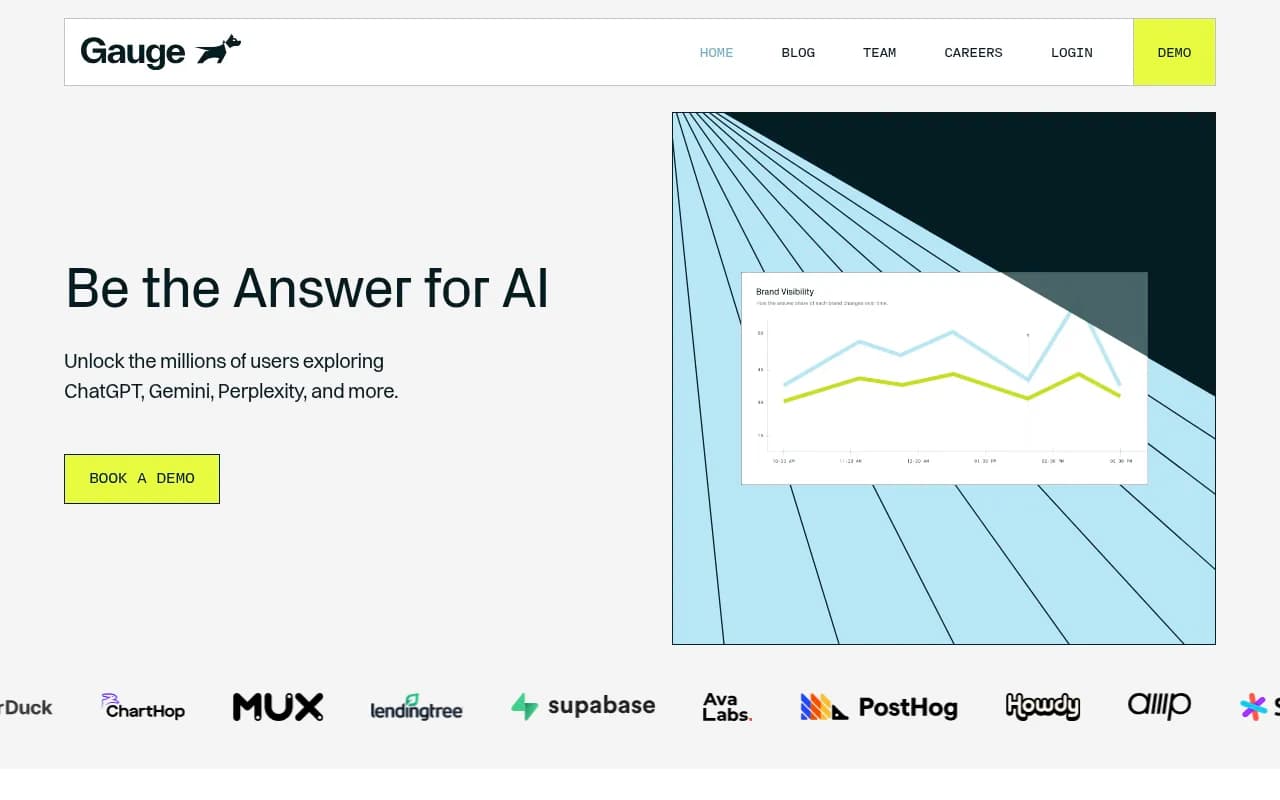
Gauge positions itself as a complete AI visibility platform for tracking brand presence across ChatGPT, Claude, Gemini, Perplexity, Copilot, Google AI Mode, and AI Overviews. The platform follows a track-understand-act workflow: monitor AI responses for brand mentions, analyze citation patterns and content gaps, then get recommendations for improving visibility.
Gauge targets marketing teams and agencies in English-speaking markets. Pricing starts at $95/month with annual billing, jumping to $399/month for the Growth plan. The platform emphasizes connecting AI visibility to actual traffic and conversions, not just monitoring mentions.
Side-by-Side Comparison
| Feature | Meteoria | Gauge |
|---|---|---|
| Starting price | €75/mo (25 prompts) | $95/mo (~€90) |
| Mid-tier price | €175/mo (100 prompts) | $399/mo (Growth plan) |
| Free trial | 7 days | Yes (duration not specified) |
| LLMs tracked | 5 (ChatGPT, Perplexity, Google AI Overview, Gemini, Grok) | 7+ (adds Claude, Copilot, AI Mode) |
| Sentiment analysis | Yes (explicit/implicit) | Not prominently featured |
| Traffic attribution | Basic content analysis | Emphasized as core feature |
| Content generation | No | No |
| Competitor tracking | Yes | Yes |
| Source analysis | Yes | Yes |
| Multi-language | Yes | Primarily English |
| Seats included | Unlimited | Varies by plan |
| Interface language | French | English |
Head-to-head feature breakdown
LLM coverage and tracking depth
Meteoria covers five AI models: ChatGPT, Perplexity, Google AI Overview, Gemini, and Grok. That's the core set most brands care about in 2026, especially in European markets where Google AI Overview and Perplexity have strong adoption.
Gauge adds Claude and Copilot to the mix, bringing the total to seven models. If your audience uses Claude heavily (common in technical and research communities) or if you're targeting Microsoft ecosystem users with Copilot, Gauge gives you visibility there. For most brands, the five models Meteoria covers represent 80%+ of AI search volume, but the gap matters if you're in specific verticals.
Both platforms let you define custom prompts that match how your actual customers search. Neither locks you into fixed prompt sets like some competitors do. You can segment by persona, geography, product category, and buying stage.
Verdict: Gauge wins on breadth if you need Claude/Copilot coverage. Meteoria's five-model focus is sufficient for most European brands.
Pricing and value
| Plan | Meteoria | Gauge |
|---|---|---|
| Entry | €75/mo (25 prompts, unlimited seats) | $95/mo annual (~€90, seat limits vary) |
| Mid-tier | €175/mo (100 prompts) | $399/mo (Growth plan) |
| High-volume | €300/mo (200+ prompts) | Custom (Enterprise) |
Meteoria's pricing is straightforward: you pay for prompt volume, and you get unlimited seats and projects at every tier. That's a big deal for agencies or larger teams where per-seat pricing adds up fast. The €75 entry point is accessible for small businesses testing GEO for the first time.
Gauge starts at $95/month with annual billing (roughly €90), so the entry prices are close. But Gauge's Growth plan jumps to $399/month -- more than double Meteoria's €175 mid-tier. Gauge doesn't publish what you get at each tier beyond the entry level, which makes it hard to compare value directly. The lack of transparent pricing past the starter plan is frustrating.
Both offer free trials. Meteoria's is explicitly 7 days; Gauge mentions a trial but doesn't specify duration on the public site.
Verdict: Meteoria offers better value transparency and unlimited seats. Gauge's pricing structure is opaque beyond the entry tier.
Sentiment and brand perception tracking
Meteoria explicitly tracks sentiment -- both explicit ("This brand is great") and implicit (tone, context, positioning) -- across AI responses. You can see how often your brand is mentioned positively, negatively, or neutrally, and track sentiment trends over time. This matters for brand teams who care about perception, not just visibility.
Gauge doesn't highlight sentiment analysis as a core feature. The focus is more on presence/absence, citation sources, and content gaps. You can see what's being said, but you're doing the sentiment analysis manually.
For most B2B brands, sentiment in AI responses is less critical than just getting mentioned at all. But if you're in consumer goods, hospitality, or any category where brand perception drives purchase decisions, Meteoria's sentiment tracking is valuable.
Verdict: Meteoria wins if sentiment matters to your brand strategy.
Content gap analysis and recommendations
Both platforms identify content gaps -- prompts where competitors are visible but you're not, topics where AI models cite other sources instead of yours.
Meteoria surfaces the sources AI models use when answering prompts in your category. You can see which websites, articles, and content types get cited most often, then reverse-engineer what's working. The platform gives you visibility into the problem but doesn't generate content for you.
Gauge emphasizes "actionable recommendations" for onsite and offsite optimization. The marketing copy suggests you get specific guidance on what to fix, but it's not clear how prescriptive those recommendations are. Like Meteoria, Gauge doesn't include built-in content generation.
Neither platform solves the "now what?" problem the way Promptwatch does with its AI writing agent that generates citation-optimized content based on gap analysis. With Meteoria or Gauge, you identify the gaps, then you're on your own to create content.

Verdict: Tie. Both identify gaps; neither helps you fill them with content.
Traffic attribution and ROI measurement
Gauge makes a big deal about connecting AI visibility to actual website traffic and conversions. The platform claims to show you which AI mentions drive real visits, helping you prove ROI to stakeholders. This is critical for justifying GEO spend -- visibility metrics are interesting, but traffic and revenue are what matter.
Meteoria includes "content and traffic analysis" to understand your compatibility with LLMs and concrete results, but it's less emphasized than Gauge's traffic attribution features. The focus is more on visibility scores and competitor positioning.
If you're trying to build a business case for GEO investment, Gauge's traffic attribution is more directly useful. If you're early-stage and just trying to understand where you stand, Meteoria's visibility metrics are sufficient.
Verdict: Gauge wins for teams that need to prove ROI with traffic data.
User experience and interface
Meteoria's interface is entirely in French. If your team is French-speaking or comfortable with French, this is fine. If not, it's a barrier. The platform can track prompts in any language, but you're navigating the dashboard in French.
Gauge is English-only, which limits its appeal outside English-speaking markets but makes it accessible to the global majority of marketing teams.
Both platforms emphasize clean dashboards with visibility scores, competitor heatmaps, and source breakdowns. Neither has a public demo environment, so you're relying on screenshots and trial periods to evaluate UX.
Verdict: Depends on your team's language. French teams prefer Meteoria; everyone else likely prefers Gauge.
Multi-language and geographic targeting
Meteoria supports multi-language prompts and geographic segmentation. You can track how AI models respond to prompts in French, English, German, Spanish, etc., and segment by country or region. This is valuable for European brands operating across multiple markets.
Gauge's multi-language capabilities aren't prominently featured. The platform seems built primarily for English-language tracking, though it likely supports other languages at the prompt level.
If you're a European brand tracking visibility across France, Germany, UK, and Spain, Meteoria's multi-language support is a clear advantage.
Verdict: Meteoria wins for multi-market European brands.
Competitor benchmarking
Both platforms let you track competitors and compare your visibility scores side-by-side. You can see who's winning for specific prompts, which sources competitors get cited from, and how your position changes over time.
Meteoria shows competitor positioning as a core dashboard metric -- you see your rank relative to competitors for each prompt category. The sentiment analysis extends to competitors too, so you can see if they're being mentioned more positively.
Gauge emphasizes "how your brand stacks up against competitors" with heatmaps and gap analysis. The focus is on identifying where competitors are visible and you're not.
Functionality is similar. Both give you the data you need to understand competitive dynamics in AI search.
Verdict: Tie. Both handle competitor tracking well.
Pros and cons
Meteoria pros
- Unlimited seats and projects at all pricing tiers -- no per-seat upcharges
- Explicit sentiment tracking (positive/negative/neutral) across AI responses
- Strong multi-language and multi-region support for European markets
- Transparent pricing with clear prompt limits at each tier
- Lower entry price (€75/mo vs ~€90/mo for Gauge)
Meteoria cons
- Interface only in French -- barrier for non-French teams
- Smaller LLM coverage (5 models vs Gauge's 7+)
- Less emphasis on traffic attribution and ROI measurement
- No built-in content generation or optimization tools
- Smaller user base and ecosystem compared to English-market platforms
Gauge pros
- Broader LLM coverage including Claude and Copilot
- Strong emphasis on traffic attribution and ROI measurement
- English interface accessible to global teams
- Clear track-understand-act workflow
- Targets agencies with scalable plans
Gauge cons
- Opaque pricing beyond the entry tier -- Growth plan jumps to $399/mo
- Per-seat pricing at higher tiers (vs Meteoria's unlimited seats)
- Sentiment analysis not prominently featured
- Less clear multi-language and multi-region capabilities
- No built-in content generation despite "act" positioning
Who should pick which tool
Pick Meteoria if:
- Your team is French-speaking or comfortable navigating a French interface
- You're a European brand tracking visibility across multiple languages and countries
- Sentiment analysis matters to your brand strategy (consumer goods, hospitality, etc.)
- You have a larger team and want unlimited seats without per-seat charges
- You're budget-conscious and want transparent, predictable pricing
- The five core LLMs (ChatGPT, Perplexity, Google AI Overview, Gemini, Grok) cover your needs
Pick Gauge if:
- You need English-language interface and support
- Claude and Copilot coverage is important for your audience
- Proving ROI with traffic attribution is a priority for your stakeholders
- You're primarily focused on English-speaking markets (US, UK, Australia, etc.)
- You're willing to pay more for broader LLM coverage and traffic analytics
- You're an agency managing multiple client accounts
Consider Promptwatch if:
- You want to go beyond monitoring to actually fixing the gaps -- Promptwatch includes an AI writing agent that generates citation-optimized content based on your gap analysis, plus crawler logs, Reddit/YouTube tracking, and page-level visibility tracking. It's the only platform that closes the loop from "here's what's missing" to "here's the content to fix it."
Final verdict
Meteoria and Gauge are both solid monitoring platforms that do roughly the same job: track your brand across AI models, compare against competitors, identify content gaps. Neither is a complete optimization platform -- you get the data, but you're on your own to create content and fix the gaps.
Meteoria wins on value (unlimited seats, transparent pricing, sentiment tracking) and is the better choice for European brands operating in multiple languages. The French interface is a barrier for non-French teams, but if that's not an issue, you're getting more features per euro.
Gauge wins on LLM breadth (Claude, Copilot) and traffic attribution, making it better for English-market teams that need to prove ROI with hard traffic numbers. But the opaque pricing and per-seat model make it harder to predict costs as you scale.
For most teams, the decision comes down to language and geography. French/European brands lean Meteoria; English/US brands lean Gauge. If you need a platform that actually helps you create content to fill the gaps, look at Promptwatch instead.