Key Takeaways
- Meteoria is monitoring-focused -- it tracks AI visibility across ChatGPT, Perplexity, Google AI Overview, Gemini, and Grok, but stops there. No content creation, no SEO tools, just pure tracking and competitor analysis.
- Orchly bundles AI visibility with SEO automation -- you get tracking across the same AI models plus Google organic search, but the real value is the built-in content agents that write, optimize, and publish articles based on what's missing.
- Pricing gap is significant -- Meteoria starts at €75/mo (~$82) for 25 prompts with unlimited seats. Orchly starts at $49/mo for the Essential plan but limits you to 14 days of trial before charging. Orchly's Pro plan ($125/mo) includes content generation; Meteoria's highest tier (€300+/mo) still doesn't.
- Meteoria has stronger French-market positioning -- interface in French, European data privacy, and pricing in euros. Orchly is US-focused with global reach.
- If you just need visibility dashboards, Meteoria is cleaner. If you want to close the loop from tracking to content creation to optimization, Orchly does that (though you're paying for features you might not use).
- Neither platform offers crawler log analysis or Reddit/YouTube tracking -- if you need those, Promptwatch covers AI crawler logs, citation sources, and Reddit discussions that influence AI recommendations.

Overview
Meteoria

Meteoria is a French GEO platform built around one job: tracking how AI models mention your brand. You set up custom prompts that match your business (product queries, competitor comparisons, location-based searches), and Meteoria runs them daily across ChatGPT, Perplexity, Google AI Overview, Gemini, and Grok. You get visibility scores, competitor positioning, sentiment analysis, and source attribution. The platform is designed for marketing teams that want to monitor AI search presence without getting into content creation or technical SEO.
Unlimited seats and projects across all plans. French interface with European data hosting. Pricing starts at €75/mo for 25 prompts.
Orchly
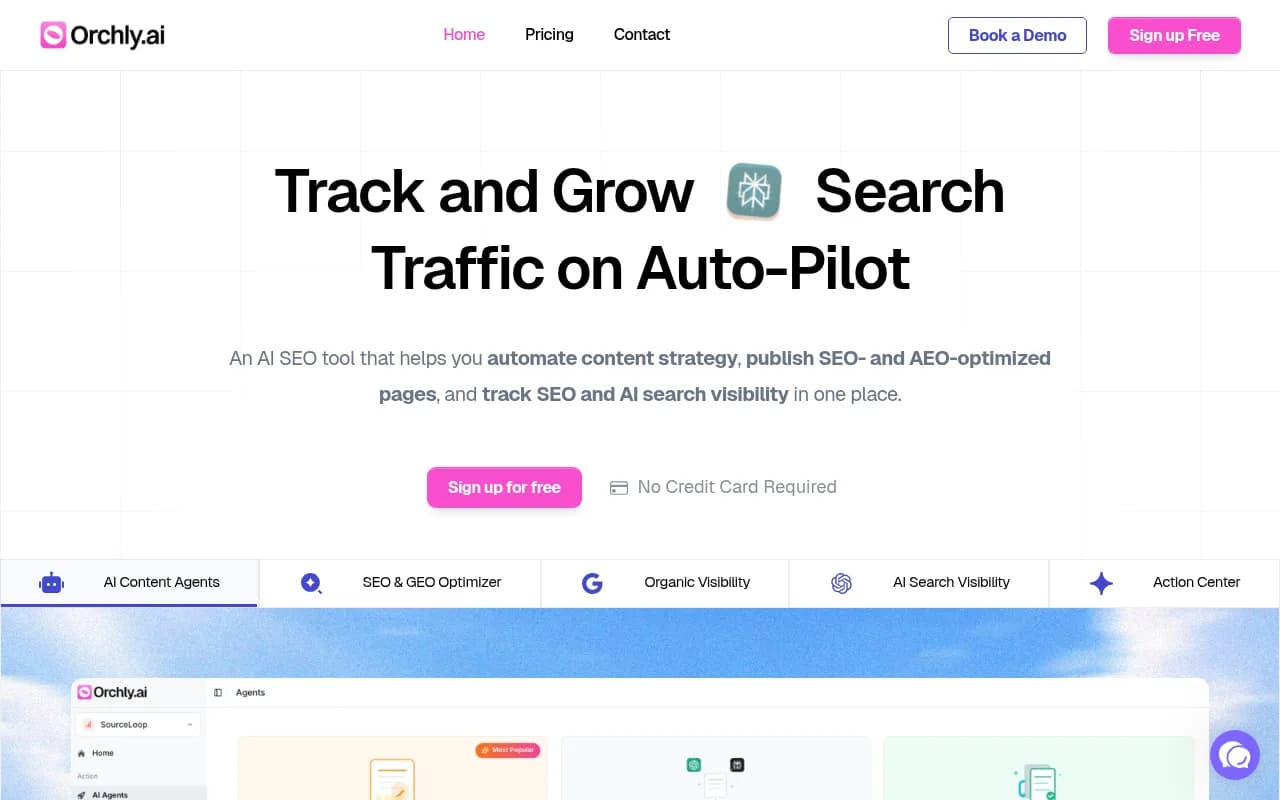
Orchly positions itself as an "AI SEO automation platform" -- it tracks AI visibility like Meteoria does, but then adds SEO research, content generation agents, and optimization tools on top. The pitch is end-to-end: find gaps in your AI and Google visibility, generate content to fill those gaps, optimize it for both traditional search and LLMs, then publish and track results. The AI content agents are trained on your data and can write, refresh, and schedule posts. You also get technical SEO audits, backlink analysis, and white-label reporting.
Pricing starts at $49/mo (Essential) with a 14-day free trial. Pro plan at $125/mo unlocks content generation.
Side-by-Side Comparison
| Feature | Meteoria | Orchly |
|---|---|---|
| AI models tracked | ChatGPT, Perplexity, Google AI Overview, Gemini, Grok | ChatGPT, Claude, Perplexity, Gemini, Google AI products |
| Google organic SEO tracking | No | Yes (rankings, traffic, technical audits) |
| Custom prompts | Yes (25-200+ depending on plan) | Yes (volume varies by plan) |
| Competitor benchmarking | Yes (visibility scores, positioning) | Yes (AI visibility comparison) |
| Sentiment analysis | Yes (implicit and explicit brand sentiment) | Limited |
| Source attribution | Yes (shows which sources AI models cite) | Yes (citation tracking) |
| Content generation | No | Yes (AI agents write and refresh content) |
| SEO optimization tools | No | Yes (150+ factors, structured data, internal linking) |
| Content publishing | No | Yes (auto-schedule and publish to CMS) |
| Unlimited seats | Yes (all plans) | No (seat limits vary by plan) |
| Free trial | 7 days | 14 days |
| Starting price | €75/mo (~$82) | $49/mo |
| Language/region focus | French/European | US/Global |
Monitoring capabilities
Both platforms track the same core AI models -- ChatGPT, Perplexity, Google AI products -- but the depth and presentation differ.
Meteoria runs your custom prompts daily and calculates a visibility score (percentage of responses where your brand appears), position relative to competitors, and sentiment (positive, neutral, negative). The source attribution feature shows which URLs, domains, or content types the AI models cited when mentioning you. This is useful for understanding where to get coverage (Reddit threads, industry blogs, your own site). The interface is built around dashboards that slice data by LLM, prompt category, geography, and persona. You can see trends over time and compare your visibility to up to 10 competitors per project.
Orchly tracks similar metrics -- visibility across AI models, competitor comparison, citation sources -- but wraps it into a broader "action center" that surfaces optimization opportunities. The AI visibility module is one piece of a larger workflow. You see where you're invisible, but the platform immediately suggests content to create or pages to optimize based on that gap. The monitoring feels less like a standalone dashboard and more like input for the content engine.
Verdict: If you want deep, focused AI visibility tracking with clean dashboards, Meteoria is more purpose-built. If you want monitoring that feeds directly into content creation, Orchly's integrated approach makes sense.
Content creation and optimization
This is where the platforms diverge completely.
Meteoria does not generate content. It shows you the data -- which prompts you're invisible for, which competitors are winning, which sources are being cited -- but you have to act on it yourself. The platform is monitoring-only.
Orchly includes AI content agents that write articles, listicles, comparisons, and refreshes based on your visibility gaps and SEO research. The agents are trained on your existing content (voice, style, facts) so the output isn't generic. You can set up workflows where the agent drafts an article, you review it, make edits, and then it auto-publishes to your CMS on a schedule. The optimization layer adds structured data, internal/external links, NLP keywords, and formatting (tables, images, videos) to make content rank in both Google and AI search.
Orchly also includes a 150+ factor SEO/GEO optimizer that analyzes pages and suggests fixes -- missing schema, weak internal linking, crawl errors, indexing issues, AI-readiness gaps. This is a full content ops platform, not just a tracker.
Verdict: Meteoria gives you the "what" (where you're invisible). Orchly gives you the "what" and the "how" (tools to fix it). If you have a content team that can act on insights, Meteoria is enough. If you want the platform to help you create and optimize, Orchly is the move.
Pricing comparison
| Plan | Meteoria | Orchly |
|---|---|---|
| Free trial | 7 days | 14 days |
| Starter/Essential | €75/mo (~$82) -- 25 prompts, unlimited seats/projects | $49/mo -- Essential plan (details not fully public, limited prompts) |
| Mid-tier/Pro | €175/mo (~$191) -- 100 prompts, unlimited seats/projects | $125/mo -- Pro plan (includes content generation, more prompts) |
| High-tier/Enterprise | €300+/mo (~$328+) -- 200+ prompts, custom setup | Custom pricing (Enterprise) |
| Annual discount | Not specified | 25% off annual plans |
Meteoria's pricing is transparent and includes unlimited seats/projects at every tier, which is a big deal for agencies or teams. You're paying purely for prompt volume. Orchly's pricing is less clear on the website -- the Essential plan exists but feature details are vague. The Pro plan at $125/mo is where content generation unlocks, so if you want the full platform, you're paying more than Meteoria's mid-tier.
Orchly's 25% annual discount brings the Pro plan down to ~$94/mo if you pay upfront. Meteoria doesn't advertise annual discounts but might offer them on request.
Verdict: Meteoria is cheaper if you just need monitoring. Orchly costs more but includes content tools that might replace other subscriptions (SEO research tools, content writers, optimization plugins).
User interface and workflow
Meteoria has a clean, dashboard-heavy interface. You create projects (one per brand or product line), define prompts, select competitors, and let it run. The main views are:
- Visibility score trends over time
- Competitor heatmaps (who's winning for which prompts)
- Source analysis (which URLs/domains are cited)
- Sentiment breakdown (positive/neutral/negative mentions)
Everything is filterable by LLM, geography, persona, and prompt category. The French interface might be a plus or a barrier depending on your team. The platform feels purpose-built for monitoring -- no clutter, no upsells to other features.
Orchly has a more complex interface because it's doing more. The main sections are:
- AI visibility tracking (similar to Meteoria's dashboards)
- SEO analytics (Google rankings, traffic, technical issues)
- Action center (prioritized list of content to create or optimize)
- Content agents (draft, review, schedule, publish)
- Optimizer (page-level SEO/GEO analysis)
The learning curve is steeper. You're managing multiple workflows (tracking, content creation, optimization, publishing) in one platform. The upside is everything connects -- a visibility gap becomes a content brief becomes a published article. The downside is it's a lot to set up and maintain.
Verdict: Meteoria is simpler and faster to onboard. Orchly requires more setup but rewards you with automation once configured.
Competitor and sentiment analysis
Both platforms let you benchmark against competitors, but the depth differs.
Meteoria lets you add up to 10 competitors per project. You see their visibility scores, position relative to yours, and which prompts they dominate. The sentiment analysis is more robust here -- Meteoria extracts both explicit sentiment ("Brand X is the best") and implicit sentiment (tone, context) from AI responses. You can track how sentiment shifts over time and correlate it with campaigns or content changes.
Orchly includes competitor visibility comparison but doesn't emphasize sentiment as much. The focus is on identifying content gaps -- prompts where competitors are visible and you're not -- and then generating content to close those gaps. Sentiment tracking exists but isn't a headline feature.
Verdict: Meteoria is better for brand monitoring and sentiment tracking. Orchly is better for competitive content strategy.
Integration and reporting
Meteoria doesn't advertise deep integrations. You can export data (likely CSV or PDF reports) but there's no mention of API access, CMS connectors, or analytics platform integrations. The platform is standalone.
Orchly integrates with CMS platforms (WordPress, likely others) for auto-publishing. It also offers white-label reporting, which is useful for agencies presenting data to clients. API access isn't mentioned on the public site but might be available at Enterprise tier.
Neither platform integrates with Google Search Console or Google Analytics for traffic attribution, which is a gap. If you want to connect AI visibility to actual website traffic, you'd need to do that manually or use a platform like Promptwatch that includes traffic attribution via code snippet or server log analysis.
Verdict: Orchly has more integrations (CMS, white-label reports). Meteoria is more isolated but simpler.
Pros and cons
Meteoria pros
- Clean, focused interface built for monitoring
- Unlimited seats and projects at all pricing tiers
- Strong sentiment analysis (explicit and implicit)
- French interface and European data hosting
- Transparent pricing with no hidden tiers
Meteoria cons
- No content creation or optimization tools
- No SEO tracking (only AI visibility)
- Limited integrations or API access
- Smaller prompt allowances at lower tiers (25 prompts on Basic)
Orchly pros
- End-to-end platform (tracking + content + optimization + publishing)
- AI content agents trained on your data
- SEO and AI visibility in one place
- 150+ factor optimizer for technical SEO and GEO
- White-label reporting for agencies
Orchly cons
- More expensive if you want content generation (Pro plan required)
- Steeper learning curve and more complex setup
- Pricing details not fully transparent on website
- Seat limits (not unlimited like Meteoria)
Who should pick which tool
Pick Meteoria if:
- You just need AI visibility tracking and competitor benchmarking
- You have a content team that can act on insights without platform help
- You want unlimited seats for your team or agency clients
- You prefer a simple, focused tool over an all-in-one platform
- You operate in French-speaking markets or want European data hosting
Pick Orchly if:
- You want to automate content creation based on visibility gaps
- You need both AI visibility and Google SEO tracking in one platform
- You're willing to pay more for integrated content ops (research, writing, optimization, publishing)
- You want technical SEO audits and optimization tools alongside monitoring
- You're an agency that needs white-label reporting
Consider Promptwatch if:
- You need AI crawler logs to see how ChatGPT, Claude, and Perplexity are actually reading your site
- You want Reddit and YouTube tracking to understand which discussions influence AI recommendations
- You need content gap analysis that shows exactly which prompts competitors rank for but you don't, then helps you generate content to fill those gaps
- You want traffic attribution to connect AI visibility to actual revenue
Final verdict
Meteoria is the better choice if you want a clean, affordable AI visibility tracker with strong sentiment analysis and unlimited seats. It does one thing well and doesn't try to be more than that. The French focus and European hosting are bonuses for EU-based teams.
Orchly makes sense if you want a platform that goes beyond monitoring -- it tracks visibility, identifies gaps, generates content, optimizes it, and publishes it. You're paying for automation and integration, which can replace multiple tools. But if you don't need the content engine, you're overpaying for features you won't use.
Neither platform is a full optimization solution. Meteoria shows you the problem but doesn't help you fix it. Orchly helps you fix it but lacks some advanced features (crawler logs, Reddit tracking, traffic attribution) that platforms like Promptwatch include. Your choice depends on whether you want monitoring-only, monitoring + content automation, or monitoring + optimization + traffic insights.