Key takeaways
- Peec AI starts at $95/mo with a free trial; Brandlight.ai starts at $199/mo with custom enterprise pricing on top -- you're paying roughly 2x more from day one with Brandlight.
- Both tools are monitoring-only. Neither generates content, provides AI crawler logs, or attributes AI traffic to revenue. They show you data; what you do with it is up to you.
- Peec AI tracks 3 AI models (ChatGPT, Perplexity, Gemini). Brandlight.ai adds Claude to that list, giving it a small but real edge in model coverage.
- Brandlight.ai is explicitly built for Fortune 500 and enterprise teams -- its feature set, pricing, and sales process reflect that. Peec AI is self-serve and accessible to any marketing team.
- Peec AI has 2,000+ marketing teams using it and a clean, fast onboarding experience. Brandlight.ai requires a demo call to get started.
- If you're a mid-market team that wants quick setup and affordable monitoring, Peec AI wins. If you're a large enterprise brand that needs multi-brand tracking and white-glove support, Brandlight.ai is the more appropriate fit.
Overview
Peec AI

Peec AI describes itself as "AI search analytics for marketing teams," and that's an accurate summary. It tracks visibility, position, and sentiment across ChatGPT, Perplexity, and Gemini. The interface is clean and self-serve -- you add your brand, set up prompts, and start seeing data within minutes. Trusted by 2,000+ marketing teams, it's clearly found product-market fit with the SMB and mid-market segment that wants AI search monitoring without a lengthy procurement process.
The core metrics are Visibility (share of chats where your brand is mentioned), Position (where you rank within AI responses), and Sentiment (how AI models describe your brand). You can organize prompts with tags, track across countries, and benchmark competitors side by side.
Brandlight.ai
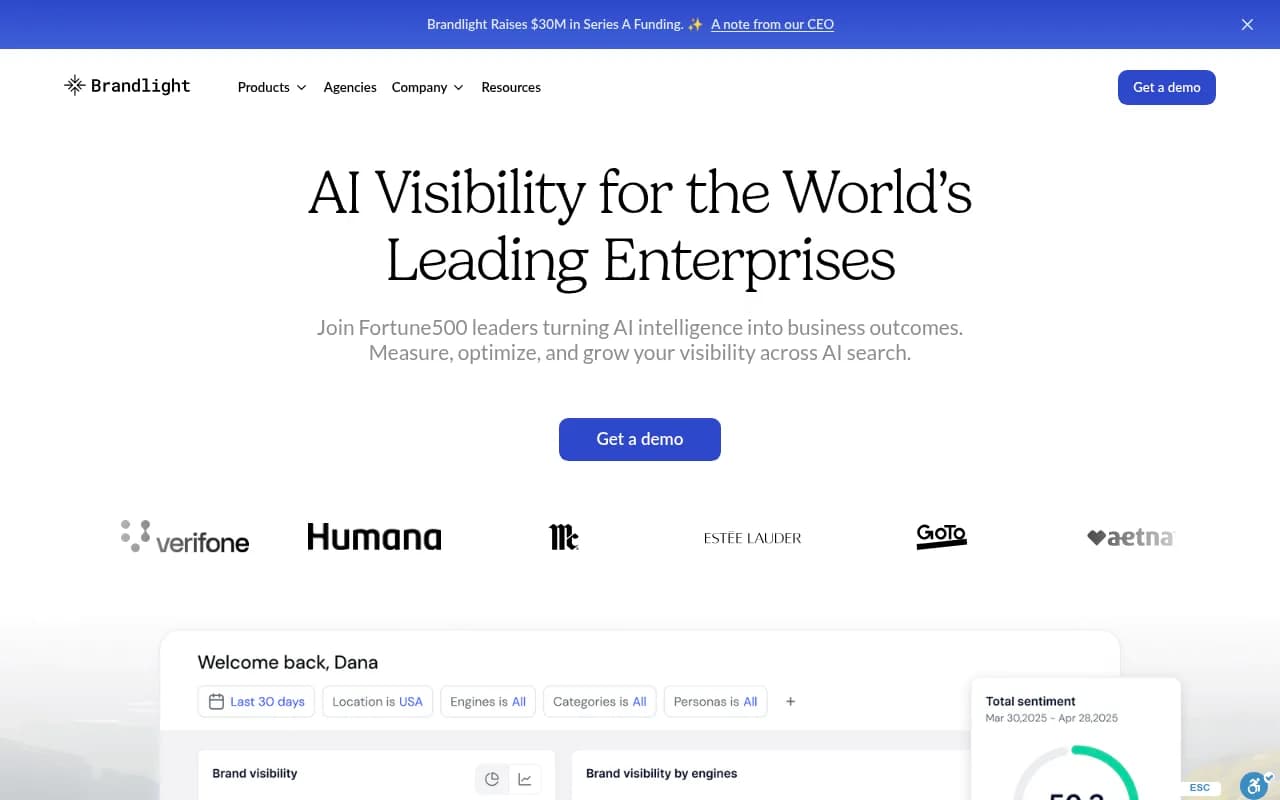
Brandlight.ai pitches itself as the enterprise choice for the "AI platform shift." Its homepage features logos from Humana, Aetna, Kimberly-Clark, MasterCard, and Estee Lauder -- companies with complex brand portfolios and dedicated marketing operations teams. The platform monitors brand mentions, sentiment, citations, and competitive positioning across ChatGPT, Perplexity, Claude, and Gemini.
Unlike Peec AI's self-serve model, Brandlight.ai requires a demo call to get started. That's a meaningful signal about who it's built for: teams with budget approval processes, legal review, and a need for account management. The entry price of $199/mo for basic monitoring reflects this positioning.
Side-by-side comparison
| Feature | Peec AI | Brandlight.ai |
|---|---|---|
| Starting price | $95/mo | $199/mo |
| Free tier | Free trial | Free version (limited) |
| Target audience | SMB / mid-market marketing teams | Fortune 500 / enterprise brands |
| AI models tracked | ChatGPT, Perplexity, Gemini | ChatGPT, Perplexity, Claude, Gemini |
| Visibility tracking | Yes | Yes |
| Sentiment tracking | Yes | Yes |
| Position tracking | Yes | Yes |
| Competitor benchmarking | Yes | Yes |
| Citation tracking | Basic | Yes |
| Content generation | No | No |
| AI crawler logs | No | No |
| Traffic attribution | No | No |
| Onboarding | Self-serve | Demo required |
| Multi-brand support | Limited | Yes (enterprise) |
| Country/region tracking | Yes | Yes |
| API access | Not confirmed | Not confirmed |
| G2 reviews | ~9 | Limited public reviews |
Head-to-head feature deep-dive
Pricing and accessibility
Peec AI's pricing starts at $95/mo with a free trial you can activate without talking to anyone. That's a real advantage for teams that want to evaluate a tool before committing budget. The freemium model means you can get a feel for the data quality and interface before spending anything.
Brandlight.ai's $199/mo entry point is for "basic monitoring," with an "activation plan" at $750/mo and custom enterprise pricing above that. The demo-first sales process means you can't just sign up and start exploring -- you're committing to a sales conversation before you see the product. For large enterprises with procurement teams, that's normal. For a 5-person marketing team, it's friction.
Verdict: Peec AI wins on accessibility and price for most teams. Brandlight.ai's pricing only makes sense if you're at enterprise scale with a corresponding budget.
AI model coverage
| Model | Peec AI | Brandlight.ai |
|---|---|---|
| ChatGPT | Yes | Yes |
| Perplexity | Yes | Yes |
| Gemini | Yes | Yes |
| Claude | No | Yes |
| Grok | No | No |
| Meta AI | No | No |
| DeepSeek | No | No |
| Copilot | No | No |
Brandlight.ai covers Claude, which Peec AI doesn't. That matters if your audience uses Claude heavily -- it's the second most-used AI assistant after ChatGPT in many professional contexts. That said, both tools miss a significant chunk of the AI search landscape: Grok, Meta AI, DeepSeek, Copilot, and Google AI Overviews are all absent from both platforms.
Verdict: Brandlight.ai has a slight edge with Claude coverage, but neither tool gives you comprehensive model tracking.
Core monitoring metrics
Both tools track the same three fundamental metrics: visibility (how often your brand appears), position (where you rank in AI responses), and sentiment (how AI describes your brand). The execution is similar -- you set up prompts relevant to your category, and the platform runs them periodically across the tracked models.
Peec AI's interface shows these metrics clearly with trend lines and competitor comparisons. The dashboard screenshot shows a clean layout with visibility, sentiment, and position scores displayed alongside competitor benchmarks -- you can see at a glance that Attio has 47% visibility versus Salesforce at 62%, for example.
Brandlight.ai's dashboard shows a "Brandlight Score" (72% in their demo) alongside sentiment breakdowns. The enterprise positioning suggests more granular reporting and the ability to track multiple brands or product lines simultaneously.
Verdict: Functionally similar for core monitoring. Brandlight.ai likely has more depth for complex brand portfolios; Peec AI is cleaner for single-brand tracking.
Competitor benchmarking
Both platforms let you benchmark your brand against competitors. Peec AI shows competitor visibility scores side by side in its main dashboard -- it's one of the more useful parts of the product. You can see which competitors are winning in AI search for the prompts you care about.
Brandlight.ai's competitive positioning features are less transparent from public information, but given its enterprise focus, it likely supports more sophisticated multi-competitor analysis and custom reporting.
Verdict: Peec AI's competitor benchmarking is visible and accessible. Brandlight.ai's depth is harder to evaluate without a demo.
Content optimization and gap analysis
This is where both tools hit the same wall. Neither Peec AI nor Brandlight.ai helps you do anything about what you discover. You can see that a competitor has 62% visibility and you have 47%, but neither platform tells you which content gaps are causing that difference or helps you create content to close it.
This is the core limitation of monitoring-only platforms. If you want to move from "I know I'm invisible" to "here's what I'm doing about it," you need a platform that goes further. Promptwatch is worth looking at here -- it combines monitoring with answer gap analysis and AI content generation specifically designed to improve AI search visibility.

Verdict: Both tools fall short here. This is a genuine gap in both products.
Onboarding and ease of use
Peec AI is self-serve. You sign up, add your brand, configure prompts, and you're tracking within minutes. The interface is clean enough that you don't need a training session. This is a real advantage for teams that want to move fast.
Brandlight.ai requires a demo call. That's not inherently bad -- enterprise software often needs configuration and scoping -- but it means you can't evaluate the product on your own timeline. If you're comparing tools on a Friday afternoon, Peec AI lets you start immediately; Brandlight.ai makes you wait for a sales calendar slot.
Verdict: Peec AI wins on ease of entry. Brandlight.ai's process is appropriate for enterprise but frustrating for everyone else.
Customer base and social proof
Peec AI claims 2,000+ marketing teams and shows a mix of brand and agency logos. It has around 9 reviews on G2, which is honest but thin -- it's a younger product and the review count reflects that.
Brandlight.ai shows Fortune 500 logos (Humana, Aetna, Kimberly-Clark, MasterCard, Estee Lauder) and positions itself as the enterprise standard. Public reviews are similarly limited, which makes independent validation difficult for both tools.
Verdict: Peec AI has more users by volume; Brandlight.ai has more recognizable enterprise names. Neither has the review depth of more established platforms.
Pricing comparison
| Plan | Peec AI | Brandlight.ai |
|---|---|---|
| Free | Free trial | Free version (limited) |
| Entry / Basic | $95/mo | $199/mo |
| Mid-tier | Not publicly listed | $750/mo (Activation) |
| Enterprise | Not publicly listed | Custom pricing |
Peec AI's pricing is more transparent. Brandlight.ai's $750/mo "activation plan" suggests a meaningful jump from basic monitoring to anything resembling a full feature set. Enterprise pricing is custom for both, but Brandlight.ai's baseline is already 2x Peec AI's.
Pros and cons
Peec AI
Pros:
- Affordable entry point at $95/mo with a free trial
- Self-serve onboarding -- no sales call required
- Clean, intuitive interface with clear visibility/position/sentiment metrics
- 2,000+ teams using it, suggesting a stable product
- Good competitor benchmarking in the main dashboard
- Country-level tracking available
Cons:
- Only tracks 3 AI models (no Claude, Grok, Meta AI, etc.)
- Monitoring-only -- no content generation, no crawler logs, no traffic attribution
- Limited public reviews make it hard to validate data quality independently
- Unclear API access or advanced export options
- Not built for complex multi-brand enterprise deployments
Brandlight.ai
Pros:
- Covers Claude in addition to ChatGPT, Perplexity, and Gemini
- Built for enterprise with multi-brand support
- Fortune 500 customer logos suggest credibility at scale
- Likely more sophisticated reporting for large organizations
- "Activation plan" suggests some optimization guidance beyond pure monitoring
Cons:
- Starts at $199/mo -- 2x Peec AI's entry price
- Demo-required onboarding adds friction
- Still monitoring-only -- no content generation or crawler logs
- Limited public reviews or independent validation
- Pricing jumps significantly from basic ($199) to activation ($750)
- Not accessible for small or mid-market teams on tight budgets
Who should pick which tool
Choose Peec AI if:
- You're a marketing team at an SMB or mid-market company
- You want to start tracking AI search visibility quickly without a sales process
- Budget is a real constraint and $95/mo is the right range
- You need clean, simple monitoring for one brand across the main AI platforms
- You're an agency managing multiple clients at accessible price points
Choose Brandlight.ai if:
- You're at a Fortune 500 or large enterprise with a dedicated marketing operations team
- You need multi-brand tracking across a complex portfolio
- Claude coverage is important for your audience
- You have budget for $199-750+/mo and need enterprise-grade support and SLAs
- Your procurement process requires a formal demo and vendor evaluation
Consider neither if:
- You need to actually improve your AI search visibility, not just measure it -- both tools stop at monitoring
- You want crawler logs to understand how AI engines discover your content
- You need traffic attribution connecting AI visibility to revenue
- You track more than 4 AI models
Final verdict
Peec AI and Brandlight.ai are solving the same problem for very different buyers. Peec AI is the practical choice for the vast majority of marketing teams: affordable, self-serve, and functional for tracking the three AI platforms that matter most. Brandlight.ai is a credible enterprise option if you're at a scale where $750/mo is a rounding error and you need Claude coverage and multi-brand support.
The honest caveat for both: they're dashboards, not optimization tools. You'll know where you stand in AI search, but you won't get much help changing it. For teams that want to close the loop between monitoring and actually improving AI visibility, that's a real limitation worth weighing before committing to either platform.