Key takeaways
- Promptwatch is built specifically for AI search visibility -- it tracks 10+ LLMs, shows crawler logs, analyzes citations, and generates content engineered to get cited. Rankpilot is primarily a Google SEO tool that adds ChatGPT ranking as a secondary goal.
- Rankpilot starts cheaper ($59/mo early access vs $99/mo for Promptwatch Essential), but the feature depth gap is substantial -- especially for teams that care about AI monitoring beyond basic content publishing.
- Rankpilot automates content writing and posting on autopilot, which is useful for volume-driven SEO strategies. Promptwatch's content agent is more targeted -- it generates content based on real citation gaps and prompt data, not just keyword volume.
- Promptwatch covers 10 AI models (ChatGPT, Claude, Gemini, Perplexity, Grok, DeepSeek, Copilot, Meta AI, Mistral, Google AI Overviews). Rankpilot's AI tracking appears limited to ChatGPT and Google AI Overviews.
- If your goal is to rank on Google through automated blogging and backlinks, Rankpilot is a reasonable option. If your goal is to understand and improve how AI models talk about your brand, Promptwatch is the right tool.
- Promptwatch has 8,150+ brands using it (including Booking.com, Typeform, Yelp) and a 4.7/5 rating on G2. Rankpilot is a newer, smaller platform with around 1,244 businesses.
Overview
Promptwatch

Promptwatch is an end-to-end AI search visibility platform. The core idea is a three-step loop: find the prompts where competitors are visible but you're not, generate content that fills those gaps, then track whether AI models start citing your new pages. It monitors 10 AI engines in real time, logs AI crawler activity on your site, and analyzes over 880 million citations to tell you what content actually gets recommended. Trusted by 8,150+ brands and agencies, it's one of the most complete platforms in the GEO (Generative Engine Optimization) space.
Rankpilot
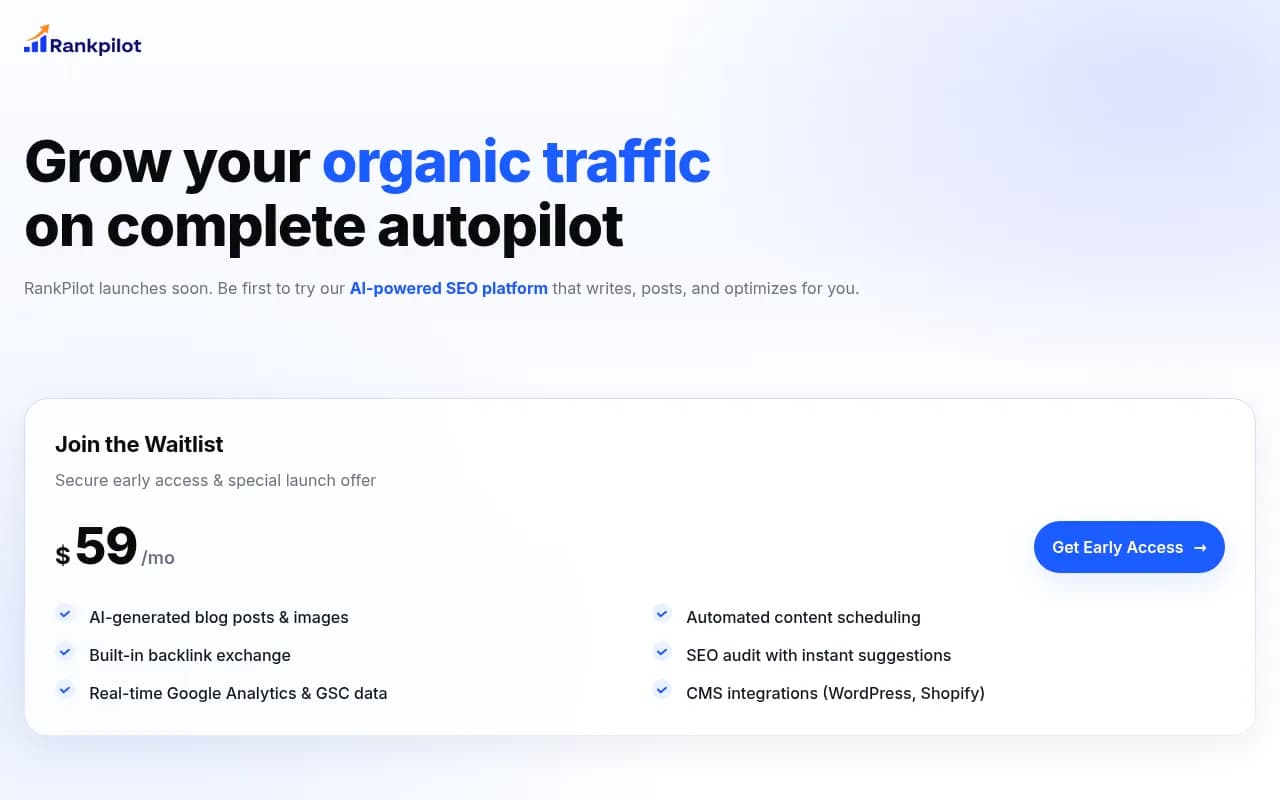
Rankpilot positions itself as an AI-powered SEO platform for ranking on both Google and ChatGPT. Its main pitch is automation: it writes content, publishes it, and builds backlinks without you having to manage each step manually. It's aimed at small business owners and site operators who want a hands-off content machine. The ChatGPT ranking angle is real but limited -- Rankpilot doesn't offer the depth of AI monitoring, citation analysis, or LLM-specific tracking that a dedicated AI visibility tool provides.
Side-by-side comparison
| Feature | Promptwatch | Rankpilot |
|---|---|---|
| Primary focus | AI search visibility & GEO | Google SEO + ChatGPT ranking |
| AI models monitored | 10 (ChatGPT, Claude, Gemini, Perplexity, Grok, DeepSeek, Copilot, Meta AI, Mistral, Google AI Overviews) | ChatGPT + Google (limited) |
| AI crawler logs | Yes -- real-time logs per page | No |
| Citation analysis | Yes -- 880M+ citations analyzed | No |
| Content generation | Yes -- citation-grounded AI agent | Yes -- automated blog writing |
| Backlink building | No | Yes |
| Prompt volume & difficulty | Yes | No |
| Answer gap analysis | Yes | No |
| Competitor visibility heatmaps | Yes | No |
| Reddit & YouTube tracking | Yes | No |
| ChatGPT Shopping tracking | Yes | No |
| Google SEO focus | No | Yes |
| Multi-language / multi-region | Yes | Limited |
| Agency features | Yes (multi-site, white-label, API) | Not specified |
| G2 rating | 4.7/5 | Not listed |
| Customer base | 8,150+ brands | 1,244+ businesses |
| Free trial | 7-day free trial | 3-day trial |
| Starting price | $99/mo | $59/mo (early access) |
Head-to-head feature deep-dive
AI search monitoring
This is where the two tools diverge most sharply.
Promptwatch monitors 10 AI engines continuously. You can see your brand's visibility score, share of voice, and sentiment across ChatGPT, Claude, Gemini, Perplexity, Grok, DeepSeek, Copilot, Meta AI, Mistral, and Google AI Overviews. It tracks real user prompts, not just a fixed set of test queries you define yourself. The crawler logs feature is particularly useful -- you can see exactly which pages ChatGPT or Perplexity crawled, when they crawled them, and whether they hit any errors.
Rankpilot tracks rankings on Google and ChatGPT. The ChatGPT tracking appears to be focused on whether your content surfaces in responses, but there's no mention of crawler logs, citation-level data, prompt volume metrics, or multi-model monitoring. It's more of a "did we rank?" check than a full visibility intelligence layer.
Verdict: Promptwatch wins decisively. If AI search monitoring is your goal, Rankpilot isn't really in the same category.
Content generation
Both tools generate content, but the approach is different.
Rankpilot's content engine is built for volume and automation. It writes blog posts, handles publishing, and builds backlinks -- the goal is to feed Google's algorithm with a steady stream of content. For site owners who want a set-it-and-forget-it content pipeline, this is genuinely useful.
Promptwatch's content agent is more surgical. It generates articles, listicles, and comparison pages based on real citation gap data -- meaning it identifies which prompts competitors are getting cited for that you're not, then creates content specifically designed to fill those gaps. The output is grounded in 880M+ citations, prompt volumes, and competitor analysis. It's not trying to produce volume; it's trying to produce content that AI models will actually cite.
Verdict: Depends on your goal. For Google SEO volume, Rankpilot's automation is convenient. For AI search optimization, Promptwatch's citation-grounded approach is more targeted and more likely to move your AI visibility metrics.
Pricing
| Plan | Promptwatch | Rankpilot |
|---|---|---|
| Entry / Early access | $99/mo (Essential) | $59/mo (Early access) |
| Mid-tier | $249/mo (Professional) | $99/mo (Essentials) |
| Growth | $579/mo (Business) | $197/mo (Growth) |
| Top tier | Custom (Agency/Enterprise) | $297/mo (PRO) |
| Free trial | 7 days | 3 days |
Rankpilot is cheaper at every tier. That's worth acknowledging. But the comparison only makes sense if both tools solve the same problem -- and they don't. Rankpilot's $59/mo plan is for automated content publishing. Promptwatch's $99/mo plan is for AI search visibility monitoring with crawler logs, citation analysis, and content gap identification. They're different products at different price points.
If you're purely trying to automate Google SEO content on a tight budget, Rankpilot is more affordable. If you need to understand and improve your brand's presence in LLMs, Rankpilot's lower price doesn't help because it doesn't do that job.
Verdict: Rankpilot is cheaper. Promptwatch delivers more for AI visibility use cases.
Backlinks and Google SEO
Rankpilot includes backlink building as part of its offering -- this is something Promptwatch doesn't do at all. For teams running traditional SEO alongside AI visibility work, this is a real differentiator for Rankpilot. Automated backlink acquisition is a meaningful feature for Google rankings, though the quality and approach matter a lot in practice.
Promptwatch doesn't touch Google SEO in the traditional sense. Its focus is entirely on AI search engines. If you need both, you'd likely need Rankpilot (or another SEO tool) alongside Promptwatch.
Verdict: Rankpilot wins for Google SEO and backlinks. Promptwatch doesn't compete here.
Competitor analysis
Promptwatch has dedicated competitor heatmaps that show how your AI visibility compares to specific competitors across different LLMs and prompts. You can see who's winning for each query and why, which makes it actionable rather than just informational.
Rankpilot's competitor analysis appears to be keyword-focused -- tracking which keywords competitors rank for on Google. There's no indication of LLM-level competitor visibility comparison.
Verdict: Promptwatch wins for AI-focused competitor analysis. Rankpilot's competitor features are more relevant to Google SEO.
Integrations and reporting
Promptwatch integrates with Cloudflare, Fastly, Vercel, Google Search Console, and Looker Studio. It also has an API for custom workflows and supports server log analysis for traffic attribution. The agency tier includes white-label reporting.
Rankpilot's integrations aren't prominently documented. The platform appears to handle publishing and backlinks internally, which suggests a more self-contained workflow rather than a data layer that plugs into other tools.
Verdict: Promptwatch has more integration depth, especially for agencies and teams that need custom reporting.
Pros and cons
Promptwatch
Pros:
- Monitors 10 AI models, not just ChatGPT
- Real-time AI crawler logs -- a feature most competitors lack entirely
- Citation analysis grounded in 880M+ data points
- Content generation tied to actual visibility gaps, not generic keyword volume
- Answer gap analysis shows exactly which prompts you're missing
- Reddit and YouTube tracking for off-site citation intelligence
- ChatGPT Shopping tracking
- Strong agency features: multi-site, white-label, Looker Studio, API
- 4.7/5 on G2 with 8,150+ customers
Cons:
- No backlink building or traditional Google SEO features
- More expensive than Rankpilot at every tier
- Overkill for teams that only care about Google rankings
Rankpilot
Pros:
- Cheaper entry point ($59/mo early access)
- Automated content writing and publishing -- genuinely hands-off
- Backlink building included
- Covers both Google and ChatGPT ranking in one tool
- Simple, accessible for non-technical users
Cons:
- Limited AI model coverage (primarily ChatGPT and Google)
- No AI crawler logs or citation-level analysis
- No prompt volume data or answer gap analysis
- No competitor AI visibility heatmaps
- Smaller platform with less proven track record
- Content generation isn't grounded in citation data -- more generic SEO content
Who should pick which tool
Choose Promptwatch if:
- Your primary goal is understanding and improving how AI models like ChatGPT, Claude, or Perplexity mention your brand
- You want to track AI crawler activity on your site and fix indexing issues
- You need competitor visibility data across multiple LLMs
- You're an agency managing AI visibility for multiple clients
- You want content generation that's tied to real citation gaps, not just keyword volume
- You need multi-model, multi-language, multi-region monitoring
Choose Rankpilot if:
- Your main goal is ranking on Google through automated content and backlinks
- You want a hands-off content publishing pipeline
- Budget is a primary constraint and you need something functional at a lower price point
- You're a small business owner who wants one tool to handle content creation and basic ChatGPT visibility
- You don't need deep LLM monitoring -- just a basic signal that your content is showing up
Final verdict
These two tools are solving different problems. Rankpilot is an automated SEO content machine with a ChatGPT ranking angle bolted on. Promptwatch is a dedicated AI search visibility platform that happens to include content generation as part of a broader optimization loop.
If you're serious about AI search visibility -- tracking how 10 different LLMs talk about your brand, understanding which pages AI crawlers are reading, identifying citation gaps, and generating content that actually gets cited -- Promptwatch is the clear choice. Rankpilot doesn't compete on those dimensions.
If you want to automate Google SEO content at a lower price point and treat ChatGPT visibility as a nice-to-have, Rankpilot is worth considering. Just go in knowing that the AI monitoring side is thin compared to what a purpose-built platform like Promptwatch provides.