Key takeaways
- XFunnel is enterprise-only with custom pricing and no public rates; GeoGen offers transparent plans from €20/mo to €399/mo, making it 10-20x more accessible for smaller brands
- XFunnel was acquired by HubSpot in 2024 and positions itself as a conversion optimization platform; GeoGen remains independent and focuses on straightforward visibility tracking
- Both platforms track the major AI models (ChatGPT, Perplexity, Gemini, Copilot), but XFunnel emphasizes experimentation and testing while GeoGen emphasizes monitoring and reporting
- XFunnel's customer roster includes Monday.com, Wix, LastPass, and Getty Images -- enterprise brands with dedicated marketing teams; GeoGen serves smaller companies like CloudBlast, GdprWise, and ProxyScrape
- Neither platform offers content gap analysis or AI content generation -- they're monitoring-first tools that show you where you stand but don't help you create the content AI models want to cite
- If you need basic AI visibility tracking on a budget, GeoGen wins. If you're an enterprise with complex requirements and budget to match, XFunnel (now part of HubSpot) is the play.
Overview
XFunnel: enterprise GEO with HubSpot backing
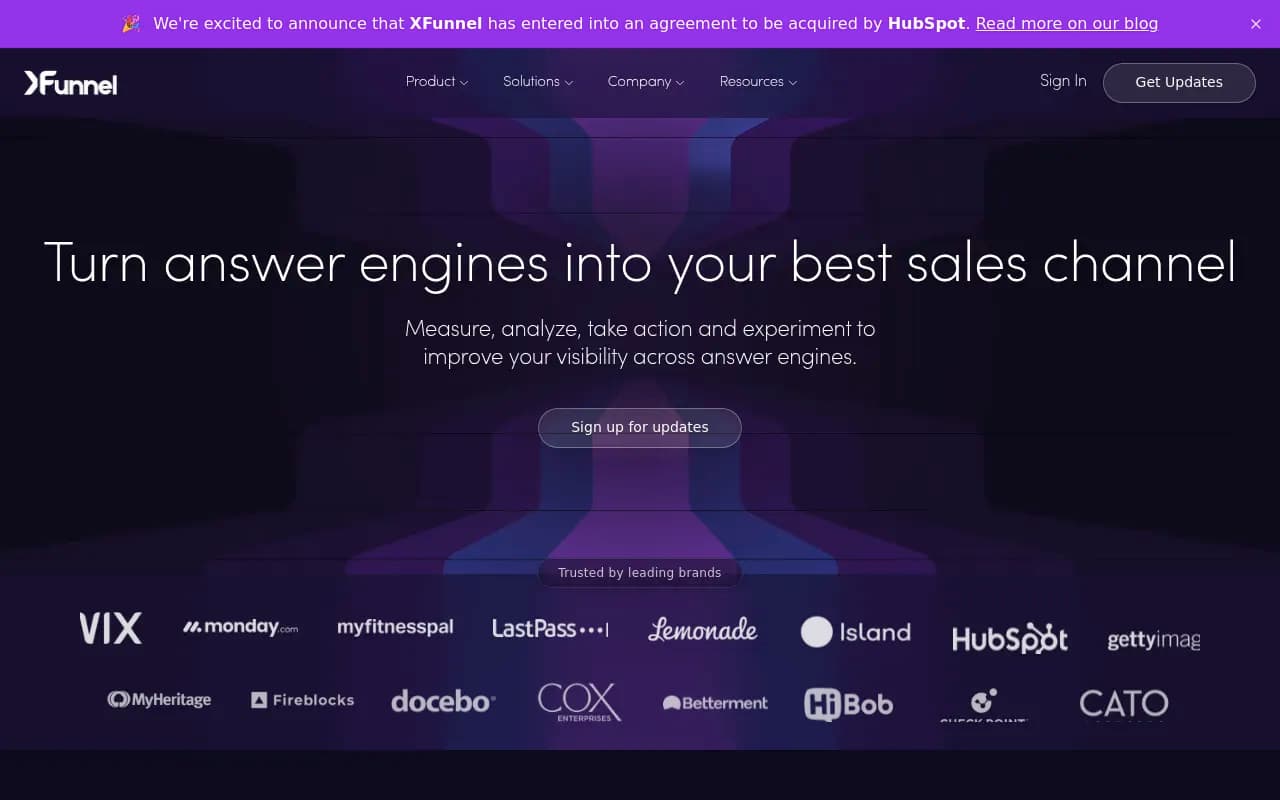
XFunnel markets itself as a platform to "turn answer engines into your best sales channel." It's built for marketing teams at enterprise companies who want to measure, analyze, and experiment with their visibility across AI-powered search engines. The platform tracks citations, discovers relevant search questions, and provides optimization recommendations.
The big news: XFunnel entered into an agreement to be acquired by HubSpot in 2024. This means the platform now has the backing of a major marketing automation player, which could accelerate feature development and integration capabilities. It also signals that XFunnel is firmly positioned as an enterprise tool -- HubSpot doesn't acquire products for the small business market.
XFunnel's customer list reads like a who's who of B2B SaaS and enterprise brands: Wix, Monday.com, MyFitnessPal, LastPass, Lemonade, Getty Images, Fireblocks, Docebo, Cox, Betterment, Check Point, and Cato Networks. These are companies with substantial marketing budgets and dedicated teams.
Pricing is custom enterprise only. No public rates, no self-service signup. You contact sales, discuss your needs, and get a quote.
GeoGen: affordable AI visibility tracking
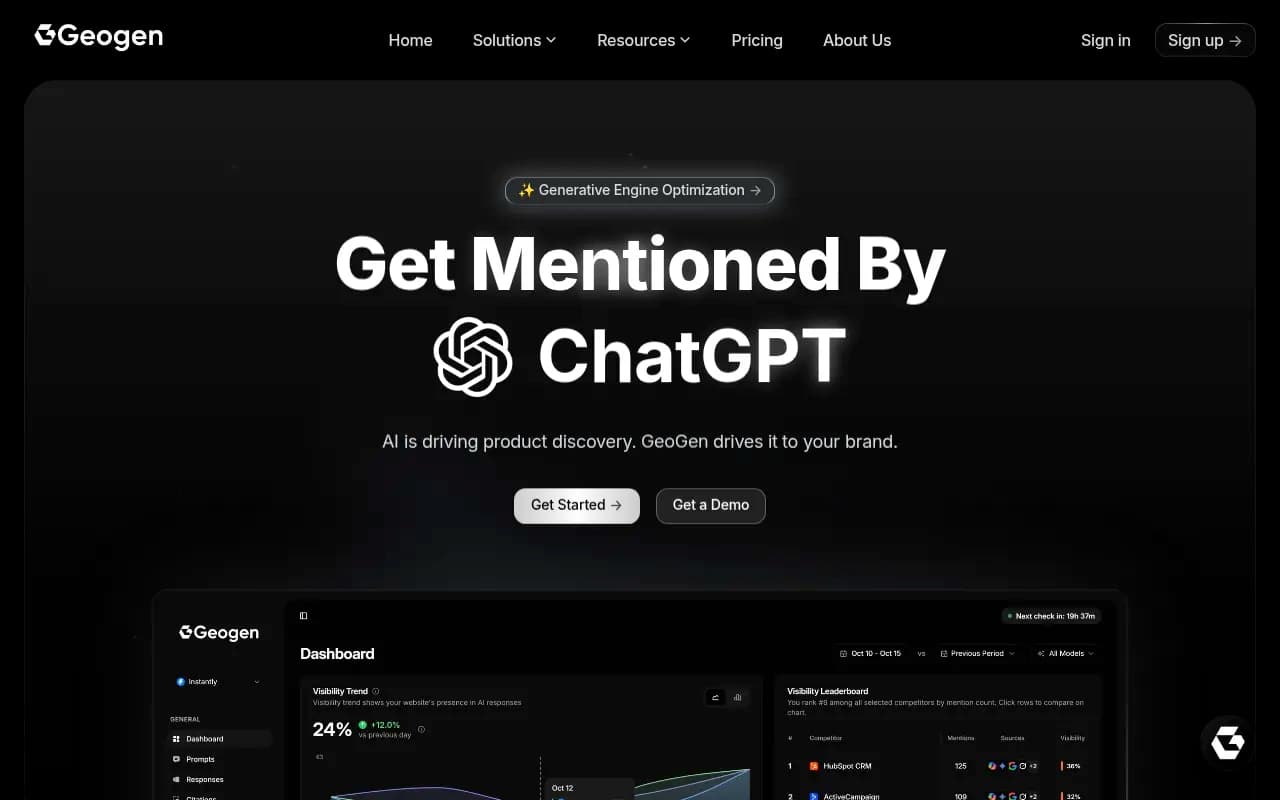
GeoGen takes a different approach. It's a GEO platform designed for small to mid-sized brands who want to monitor their visibility across ChatGPT, Perplexity, Gemini, Grok, and Microsoft Copilot without enterprise-level complexity or pricing.
The platform focuses on the basics: track brand mentions, analyze competitor rankings, get recommendations to improve your AI search presence. The interface is straightforward, the pricing is transparent, and you can sign up and start tracking within minutes.
GeoGen's customer roster includes smaller companies like CloudBlast, GdprWise, ProxyScrape, and TextBroker -- brands that need AI visibility insights but don't have enterprise budgets or dedicated GEO teams.
Pricing starts at €20/mo for the Micro plan and goes up to €399/mo for Pro, with custom enterprise pricing available for larger organizations. Annual billing gets you a 20% discount. This is a completely different pricing model from XFunnel -- accessible, transparent, and designed for self-service.
Side-by-side comparison
| Feature | XFunnel | GeoGen |
|---|---|---|
| Pricing model | Custom enterprise (contact sales) | €20/mo to €399/mo, transparent tiers |
| Free trial | Not specified | Not specified |
| Target market | Enterprise brands, large marketing teams | Small to mid-sized brands |
| AI models tracked | ChatGPT, Perplexity, Gemini, Copilot, Grok | ChatGPT, Perplexity, Gemini, Copilot, Grok |
| Citation tracking | Yes | Yes |
| Competitor analysis | Yes | Yes |
| Optimization recommendations | Yes, with experimentation focus | Yes, basic recommendations |
| Content gap analysis | No | No |
| AI content generation | No | No |
| HubSpot integration | Native (acquired by HubSpot) | Not specified |
| Self-service signup | No | Yes |
| Customer profile | Monday.com, Wix, LastPass, Getty Images | CloudBlast, GdprWise, ProxyScrape |
Head-to-head feature breakdown
Pricing and accessibility
This is where the two platforms diverge most sharply.
XFunnel uses custom enterprise pricing with no public rates. You fill out a contact form, talk to sales, and get a quote based on your company size, needs, and budget. This is standard for enterprise software, but it means smaller brands and solo marketers are effectively locked out. If you're a startup or small business, you're not getting access to XFunnel unless you have a substantial budget.
GeoGen publishes transparent pricing tiers:
- Micro: €20/mo
- Standard: €99/mo
- Pro: €399/mo
- Enterprise: custom pricing
Annual billing gets you 20% off. You can sign up, enter your credit card, and start tracking immediately. No sales calls, no negotiations, no waiting.
For a small brand or agency managing multiple clients, GeoGen's pricing is 10-20x more accessible. For an enterprise with a six-figure marketing budget, XFunnel's custom pricing might actually be competitive -- but you won't know until you talk to sales.
Verdict: GeoGen wins on accessibility and transparency. XFunnel wins if you're an enterprise that values white-glove sales and custom contracts.
AI model coverage
Both platforms track the major AI search engines:
- ChatGPT (OpenAI)
- Perplexity
- Google Gemini
- Microsoft Copilot
- Grok (X.AI)
Neither platform tracks Google AI Overviews, Claude, Meta AI, DeepSeek, or Mistral -- models that platforms like Promptwatch monitor as part of a more comprehensive AI visibility strategy.

The model coverage is essentially identical between XFunnel and GeoGen. Both focus on the same five AI search engines. The difference is in what they do with the data.
Verdict: Tie. Both platforms cover the same core AI models.
Citation and mention tracking
Both platforms track when and where your brand gets mentioned in AI search results. You can see:
- Which prompts trigger mentions of your brand
- How often you're cited vs competitors
- Which sources AI models pull from when mentioning you
- Trends over time
XFunnel emphasizes "conversion across AI platforms" and positions citation tracking as part of a broader funnel optimization strategy. The interface is built around understanding how AI mentions drive downstream actions.
GeoGen focuses on straightforward monitoring and reporting. You see your mentions, you see competitor mentions, you get a dashboard. It's less about conversion optimization and more about visibility awareness.
Verdict: XFunnel if you're optimizing for conversions and have the team to act on the data. GeoGen if you just want to know where you stand.
Competitor analysis
Both platforms let you track competitors and see how your visibility compares.
XFunnel's competitor analysis is built into the experimentation workflow -- you can see how changes to your content or strategy affect your position relative to competitors. The platform is designed for teams running active optimization campaigns.
GeoGen's competitor analysis is more static -- you add competitors, you see their rankings, you compare. It's reporting-focused rather than action-focused.
Verdict: XFunnel for active optimization. GeoGen for passive monitoring.
Optimization and recommendations
This is where the platforms start to differ in philosophy.
XFunnel positions itself as an experimentation platform. The idea is that you measure your baseline visibility, run experiments (change your content, adjust your strategy, publish new pages), and measure the impact. The platform provides recommendations, but the emphasis is on testing and iteration.
GeoGen provides basic recommendations to improve your AI search presence, but it's not built around experimentation or A/B testing. You get suggestions, you implement them (or don't), and you track the results over time.
Neither platform offers content gap analysis -- the ability to see exactly which prompts your competitors rank for but you don't, and what content you're missing. Neither platform generates AI-optimized content for you. They show you where you stand, but they don't help you create the content AI models want to cite.
For that, you'd need a platform like Promptwatch, which combines visibility tracking with answer gap analysis and AI content generation. Promptwatch shows you the specific topics and questions your site is missing, then helps you create articles grounded in real citation data.
Verdict: XFunnel if you have a team dedicated to running GEO experiments. GeoGen if you want basic recommendations without the complexity. Neither platform if you need help creating the content.
Integrations and ecosystem
XFunnel's acquisition by HubSpot is a game-changer here. The platform now has native integration with HubSpot's CRM, marketing automation, and analytics tools. If you're already a HubSpot customer, XFunnel slots into your existing workflow.
GeoGen doesn't advertise specific integrations. It's a standalone monitoring platform. You log in, check your dashboard, export reports. No mention of API access or third-party integrations on the website.
Verdict: XFunnel wins decisively if you're in the HubSpot ecosystem. GeoGen if you want a simple standalone tool.
User interface and ease of use
GeoGen's website and dashboard screenshots suggest a clean, straightforward interface. The platform is designed for self-service -- you sign up, add your brand and competitors, and start tracking. No onboarding calls, no training required.
XFunnel's interface (based on website screenshots) looks more complex and feature-rich. It's built for marketing teams who will spend hours per week in the platform, running experiments and analyzing data. The learning curve is steeper, but the depth is greater.
Verdict: GeoGen for simplicity and speed. XFunnel for power users who want depth.
Support and onboarding
XFunnel is enterprise software, which typically means dedicated account managers, onboarding calls, and priority support. You're paying for white-glove service.
GeoGen's support model isn't detailed on the website, but the self-service pricing suggests a more hands-off approach. You might get email support or a knowledge base, but probably not a dedicated account manager unless you're on the enterprise plan.
Verdict: XFunnel for hands-on support. GeoGen for self-sufficient teams.
Pricing comparison
| Plan | XFunnel | GeoGen |
|---|---|---|
| Entry-level | Custom (contact sales) | €20/mo (Micro) |
| Mid-tier | Custom (contact sales) | €99/mo (Standard) |
| High-tier | Custom (contact sales) | €399/mo (Pro) |
| Enterprise | Custom (contact sales) | Custom (contact sales) |
| Annual discount | Unknown | 20% off |
| Free trial | Not specified | Not specified |
The pricing difference is stark. GeoGen's most expensive public plan (€399/mo) is likely cheaper than XFunnel's entry-level enterprise contract. For small brands, GeoGen is the only realistic option. For enterprises, XFunnel's custom pricing might be competitive with GeoGen's enterprise tier, but you won't know without a sales conversation.
Pros and cons
XFunnel pros
- Backed by HubSpot with native CRM and marketing automation integration
- Built for enterprise customers with complex needs and dedicated teams
- Emphasizes experimentation and conversion optimization, not just monitoring
- Customer roster includes major brands (Wix, Monday.com, LastPass, Getty Images)
- Likely includes dedicated account management and priority support
XFunnel cons
- Custom enterprise pricing with no public rates -- inaccessible for small brands
- No self-service signup -- you must go through sales
- Steeper learning curve and more complexity than simpler alternatives
- Doesn't offer content gap analysis or AI content generation
- Limited AI model coverage (5 models vs 10+ in platforms like Promptwatch)
GeoGen pros
- Transparent pricing from €20/mo to €399/mo -- accessible for small brands
- Self-service signup and onboarding -- no sales calls required
- Clean, straightforward interface designed for ease of use
- Covers the major AI search engines (ChatGPT, Perplexity, Gemini, Copilot, Grok)
- 20% discount on annual billing
GeoGen cons
- Basic feature set focused on monitoring, not optimization
- No content gap analysis or AI content generation capabilities
- No advertised integrations or API access
- Smaller customer base and less brand recognition than XFunnel
- Limited AI model coverage compared to comprehensive platforms
Who should choose which platform
Choose XFunnel if:
- You're an enterprise brand with a substantial marketing budget (six figures+)
- You're already using HubSpot and want native integration
- You have a dedicated team to run GEO experiments and act on insights
- You value white-glove support and dedicated account management
- You're optimizing for conversions and revenue, not just visibility
- You're comfortable with custom enterprise pricing and sales processes
Choose GeoGen if:
- You're a small to mid-sized brand with a limited budget
- You want transparent pricing and self-service signup
- You need basic AI visibility tracking without enterprise complexity
- You're a solo marketer or small team managing multiple brands
- You want to get started quickly without sales calls or onboarding
- You're okay with monitoring-focused features and basic recommendations
Consider Promptwatch if:
- You need more than just monitoring -- you want to actually improve your AI visibility
- You want content gap analysis that shows exactly what you're missing
- You need AI content generation grounded in real citation data
- You want comprehensive coverage (10 AI models including Claude, Meta AI, DeepSeek)
- You want crawler logs, Reddit/YouTube tracking, and ChatGPT Shopping monitoring
- You want a platform that closes the loop from visibility tracking to content creation to results
Final verdict
XFunnel and GeoGen are targeting completely different markets, and the right choice depends entirely on your budget and needs.
If you're an enterprise brand with a six-figure marketing budget, a dedicated team, and a need for deep HubSpot integration, XFunnel is the obvious choice. The HubSpot acquisition gives it credibility and ecosystem advantages that GeoGen can't match. You'll pay enterprise prices, but you'll get enterprise features and support.
If you're a small brand, startup, or agency managing multiple clients on a budget, GeoGen is the only realistic option. XFunnel won't even talk to you without a substantial budget. GeoGen's transparent pricing (€20/mo to €399/mo) makes AI visibility tracking accessible to brands that can't afford enterprise contracts.
But here's the catch: both platforms are monitoring-first tools. They show you where you stand in AI search results, but they don't help you create the content AI models want to cite. You're left with data and recommendations but no clear path to action.
If you want a platform that closes the loop -- tracking visibility, identifying content gaps, generating AI-optimized content, and measuring results -- you need something like Promptwatch. It's the only platform that combines monitoring with content gap analysis and AI content generation, all grounded in 880M+ citations analyzed.
Bottom line: GeoGen for budget-conscious monitoring, XFunnel for enterprise optimization, Promptwatch for end-to-end AI visibility improvement.