Key Takeaways
- Goodie AI is no longer operational -- the domain is listed for sale for $80,000, making this comparison largely academic
- XFunnel was acquired by HubSpot in 2025 and continues to operate, but uses enterprise-only pricing (no public rates)
- XFunnel serves major brands like Wix, Monday.com, MyFitnessPal, and LastPass with citation tracking across AI search engines
- Neither platform offers transparent pricing -- XFunnel requires sales contact, Goodie AI is defunct
- If you're evaluating GEO platforms in 2026, you'll need to look at active alternatives with clearer pricing and feature sets
- For a platform that combines monitoring with actual optimization tools, Promptwatch offers citation tracking, content gap analysis, and AI content generation starting at $99/mo
Overview
XFunnel
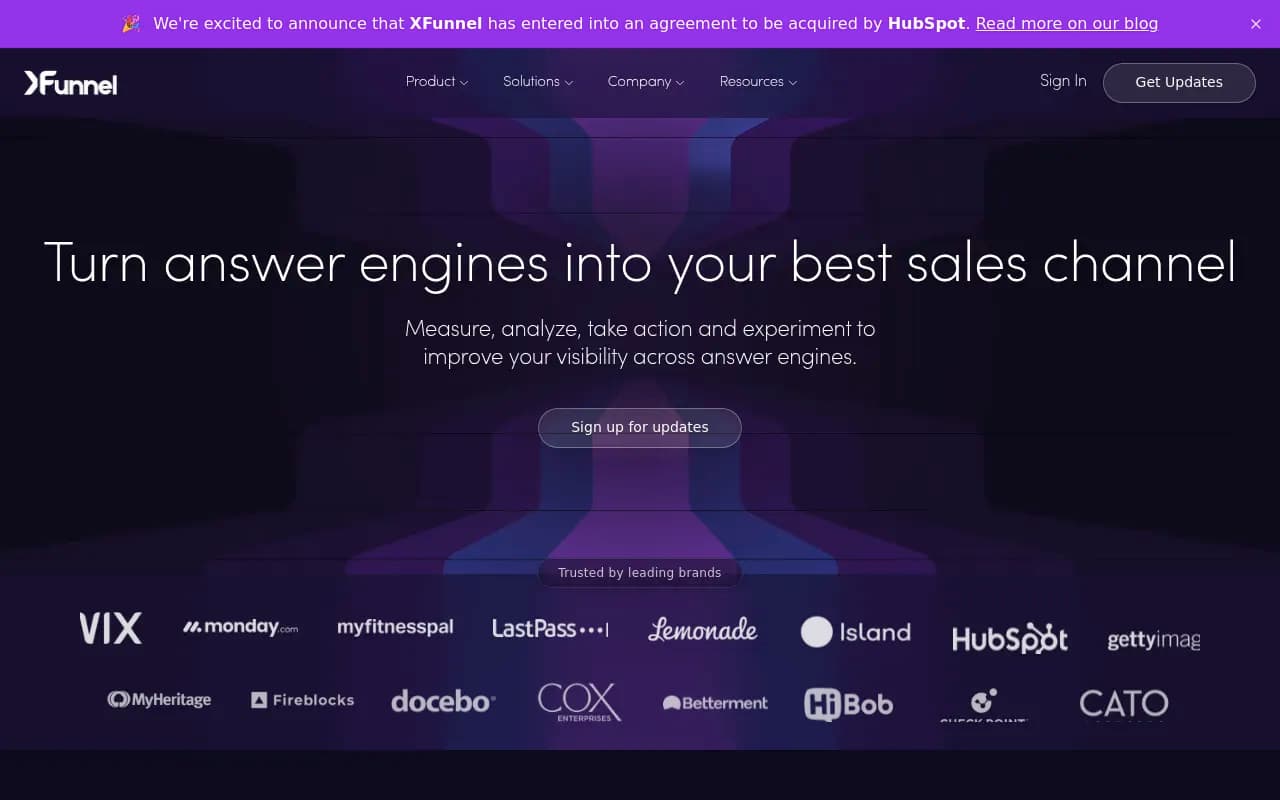
XFunnel is an enterprise GEO platform that helps marketing teams track brand visibility across AI-powered search engines like ChatGPT, Perplexity, and other answer engines. The platform was acquired by HubSpot in 2025, which signals both validation of the GEO category and uncertainty about XFunnel's future as a standalone product.
The tool focuses on three core areas: measuring citations across AI platforms, analyzing which search questions trigger brand mentions, and tracking visibility trends over time. XFunnel's client roster includes recognizable brands like Wix, Monday.com, MyFitnessPal, LastPass, and Lemonade -- all enterprise customers dealing with the challenge of being visible in AI-generated answers.
Goodie AI
Goodie AI was positioned as an AI visibility tracker for monitoring brand mentions across ChatGPT, Perplexity, and other LLMs. The platform was described as a basic monitoring tool starting at $399/mo, lacking features like AI crawler logs, content gap analysis, and optimization capabilities.
However, as of 2026, Goodie AI is no longer operational. The goodie.ai domain is listed for sale on Spaceship.com for $80,000, indicating the company has shut down. This makes any feature comparison somewhat pointless, but the story is worth telling because it illustrates how quickly the GEO landscape is consolidating.
Side-by-side comparison
| Feature | XFunnel | Goodie AI |
|---|---|---|
| Operational status | Active (acquired by HubSpot) | Defunct (domain for sale) |
| Pricing | Custom enterprise (contact sales) | Was $399/mo (no longer available) |
| Free tier | No | No |
| AI platforms monitored | ChatGPT, Perplexity, answer engines | ChatGPT, Perplexity, LLMs |
| Citation tracking | Yes | Yes (when operational) |
| Content gap analysis | Not mentioned | No |
| AI crawler logs | Not mentioned | No |
| Content generation | Not mentioned | No |
| Prompt intelligence | Yes (discover relevant questions) | Not mentioned |
| Enterprise clients | Wix, Monday.com, MyFitnessPal, LastPass | Unknown |
| HubSpot integration | Native (owned by HubSpot) | No |
| Target audience | Enterprise marketing teams | Was mid-market teams |
The elephant in the room: Goodie AI is gone
Let's address this directly. Goodie AI shut down. The domain is for sale. Any comparison of features, pricing, or capabilities is academic because you literally cannot sign up for Goodie AI anymore.
This isn't uncommon in emerging software categories. The GEO space exploded in 2024-2025 with dozens of startups racing to build AI visibility tracking tools. Some got acquired (XFunnel by HubSpot), some raised funding and scaled, and some -- like Goodie AI -- didn't make it.
What's interesting is the timing. Goodie AI was charging $399/mo for basic monitoring, which positioned it as a mid-market tool. But the market seems to be splitting into two camps: enterprise platforms with custom pricing (XFunnel, Profound, Scrunch) and more accessible tools with transparent pricing (Promptwatch at $99-579/mo, Otterly.AI, Peec.ai). The middle ground where Goodie AI sat turned out to be a tough place to survive.
XFunnel's enterprise positioning
What XFunnel actually does
XFunnel tracks how often your brand gets cited in AI-generated answers across platforms like ChatGPT and Perplexity. You can see which prompts trigger mentions, how your visibility trends over time, and which competitors are showing up in the same contexts.
The platform also surfaces "relevant search questions" -- prompts where your brand could be mentioned but isn't. This is useful for identifying content gaps, though XFunnel doesn't appear to offer built-in tools to actually create that content.
The HubSpot acquisition changes everything
XFunnel announced its HubSpot acquisition in late 2025. For existing customers, this probably means tighter integration with HubSpot's CRM and marketing tools. For potential new customers, it raises questions:
- Will XFunnel remain a standalone product or get absorbed into HubSpot's suite?
- Will pricing change (likely upward if it becomes a HubSpot add-on)?
- Will the roadmap shift to prioritize HubSpot customers over standalone users?
Acquisitions like this can go either way. Sometimes the acquired product gets better resources and grows faster. Sometimes it gets quietly sunset as the acquirer absorbs the team and tech.
Who XFunnel is built for
The client list tells the story: Wix, Monday.com, MyFitnessPal, Getty Images, Fireblocks. These are enterprise brands with dedicated marketing teams and budgets to match. XFunnel isn't trying to serve solo marketers or small agencies -- it's going after companies where a 5-10% improvement in AI visibility could mean millions in revenue.
The custom pricing model reinforces this. If you have to ask how much it costs, you're probably not the target customer.
What Goodie AI was trying to do
Based on the limited information available before Goodie AI shut down, it was positioned as a more accessible alternative to enterprise GEO platforms. The $399/mo starting price suggested a focus on mid-market teams who wanted basic AI visibility tracking without enterprise complexity.
The problem: "basic monitoring" turned out not to be enough. Marketing teams don't just want to see where they're invisible in AI search -- they want tools to fix it. Platforms that only show you the problem without helping you solve it struggle to retain customers.
This is the same challenge facing other monitoring-only tools like Otterly.AI and Peec.ai. Tracking is table stakes. The real value is in optimization -- content gap analysis, prompt intelligence, AI content generation, crawler log analysis. Goodie AI apparently didn't build those capabilities fast enough.
Pricing comparison
| Plan | XFunnel | Goodie AI |
|---|---|---|
| Entry tier | Contact sales | $399/mo (defunct) |
| Mid tier | Contact sales | Unknown (defunct) |
| Enterprise | Contact sales | Unknown (defunct) |
| Free trial | Unknown | Unknown |
| Annual discount | Unknown | Unknown |
The pricing comparison here is useless because one platform is dead and the other doesn't publish rates. But it's worth noting what this tells you about the market.
XFunnel's enterprise-only pricing works when you have a strong brand, proven ROI, and clients who can afford to pay $10k-50k+ annually. Goodie AI's $399/mo price point was trying to capture the mid-market, but apparently couldn't deliver enough value to justify the cost.
Meanwhile, platforms like Promptwatch are proving that transparent pricing ($99-579/mo) combined with optimization tools (not just monitoring) can work for a broader range of customers.

Feature deep-dive
Citation tracking
Both platforms tracked how often brands get mentioned in AI-generated answers. XFunnel does this across multiple AI engines and lets you see trends over time. Goodie AI had similar capabilities when it was operational.
The limitation with both: citation tracking alone doesn't tell you what to do about it. You can see that your competitor gets cited 3x more often than you, but then what? You need tools to understand why (content gap analysis), what to create (prompt intelligence), and how to optimize (AI content generation).
XFunnel surfaces "relevant search questions" which is a step in the right direction, but it's not clear if they provide the next layer -- actual guidance on creating content that will get cited.
Content optimization
Neither platform appears to offer built-in content creation or optimization tools. XFunnel shows you the questions, but you're on your own to create content that answers them. Goodie AI didn't have these capabilities either.
This is where the monitoring-only approach falls short. Compare this to platforms that include AI content generation grounded in citation data -- they close the loop from "here's the gap" to "here's the content that fills it."
AI crawler visibility
No information available about whether XFunnel tracks AI crawler activity (which pages ChatGPT, Claude, Perplexity crawlers are reading, how often they return, errors they encounter). Goodie AI definitely didn't have this.
Crawler logs are important because they show you how AI engines discover and index your content. If ChatGPT's crawler is hitting 404s or getting blocked by robots.txt, you'll never get cited no matter how good your content is.
Prompt intelligence
XFunnel mentions discovering "relevant search questions" which suggests some level of prompt intelligence. But it's unclear if they provide volume estimates, difficulty scores, or query fan-outs (how one prompt branches into related sub-queries).
Goodie AI didn't appear to have prompt intelligence features based on available information.
Integration capabilities
XFunnel now has native HubSpot integration (since they're owned by HubSpot). This is huge for teams already using HubSpot for CRM, marketing automation, and content management. You can presumably pipe AI visibility data directly into your existing workflows.
Goodie AI's integration capabilities are unknown and irrelevant since the platform is defunct.
Pros and cons
XFunnel pros
- Proven with major enterprise clients (Wix, Monday.com, MyFitnessPal)
- HubSpot acquisition brings resources and integration potential
- Tracks citations across multiple AI platforms
- Surfaces relevant search questions for content planning
- Built for teams that need enterprise-grade reliability
XFunnel cons
- No public pricing (enterprise sales process required)
- Future roadmap uncertain post-acquisition
- Doesn't appear to include content optimization or generation tools
- Likely expensive for small teams or agencies
- May get absorbed into HubSpot suite and lose standalone identity
Goodie AI pros
- None (platform is defunct)
Goodie AI cons
- Platform shut down, domain for sale
- Was a monitoring-only tool without optimization features
- Lacked AI crawler logs, content gap analysis, prompt intelligence
- Mid-market pricing ($399/mo) without mid-market value delivery
- No path forward for existing or potential customers
Who should pick which platform
Choose XFunnel if:
- You're an enterprise marketing team with budget for custom pricing
- You're already using HubSpot and want native integration
- You need proven reliability with major brand references
- You have in-house content teams to act on the insights (since XFunnel doesn't generate content)
- You're comfortable with the uncertainty of a recently acquired product
Don't choose Goodie AI because:
- It doesn't exist anymore. The platform is shut down.
Consider alternatives if:
- You want transparent pricing instead of enterprise sales cycles
- You need optimization tools (content generation, gap analysis) not just monitoring
- You're a small-to-mid-size team or agency without enterprise budgets
- You want AI crawler logs, prompt intelligence, and Reddit/YouTube tracking
- You prefer a platform with a clear independent roadmap
For teams that want the full optimization loop -- find gaps, generate content, track results -- platforms like Promptwatch offer citation tracking, content gap analysis, AI content generation, and crawler logs starting at $99/mo with transparent pricing.
The bigger picture: GEO platform consolidation
The XFunnel acquisition and Goodie AI shutdown tell a story about where the GEO category is heading. We're seeing consolidation. Some platforms get acquired by larger players (XFunnel by HubSpot). Some shut down (Goodie AI). Some are raising funding and scaling aggressively.
What's emerging is a split between enterprise platforms with custom pricing and feature-rich tools with transparent pricing. The middle ground -- basic monitoring at mid-market prices -- isn't sustainable. Teams either want the full enterprise treatment or they want accessible tools they can start using today without a sales call.
The platforms surviving and thriving are the ones that go beyond monitoring to actually help you improve your AI visibility. Tracking citations is table stakes. The value is in optimization.
Final verdict
This comparison is lopsided because one platform is dead. XFunnel is the only option between these two, but that doesn't make it the right choice for everyone.
XFunnel works if you're an enterprise team with budget, you're already in the HubSpot ecosystem, and you have content teams ready to act on insights. The HubSpot acquisition is both a strength (resources, integration) and a risk (uncertain roadmap).
For everyone else -- small teams, agencies, mid-market companies -- you'll want to look at GEO platforms with transparent pricing and optimization tools built in. The future of AI search visibility isn't just tracking where you're invisible. It's having the tools to fix it.