Contentsquare Review 2026
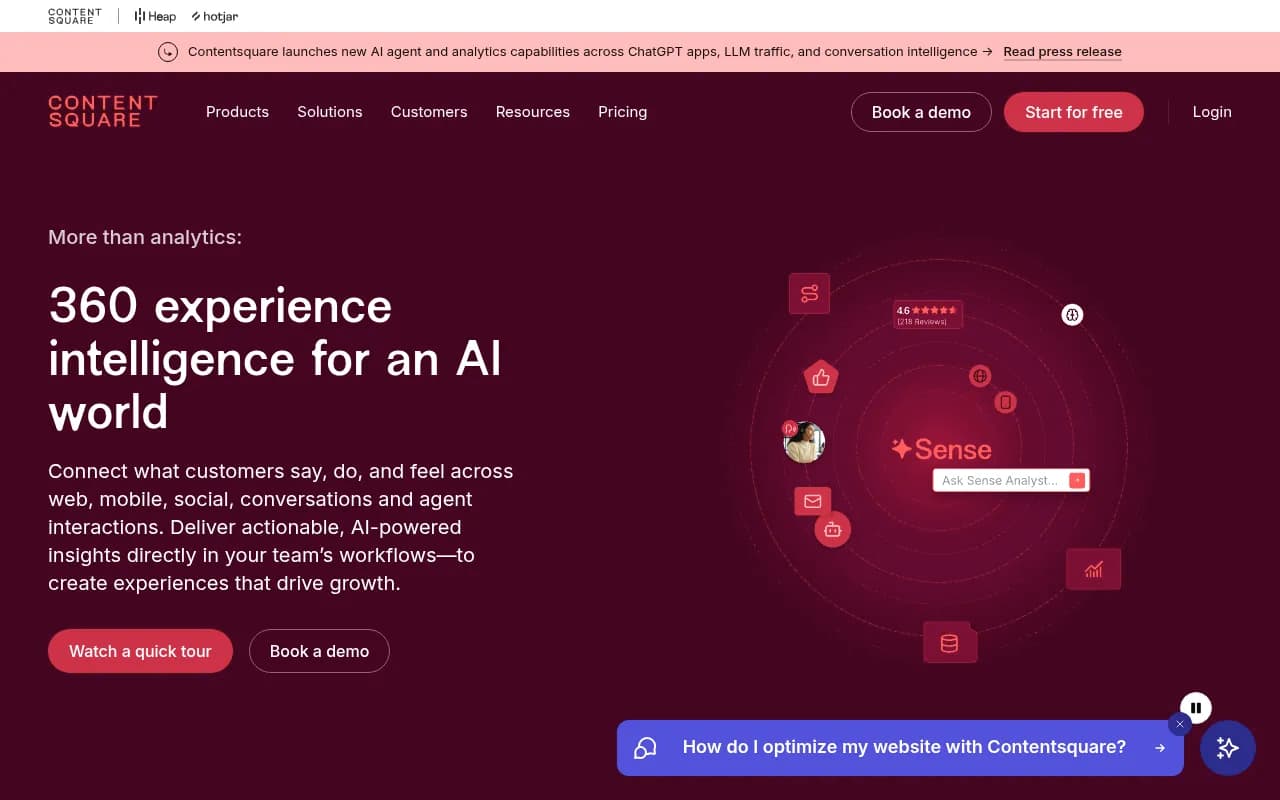
Contentsquare is an AI-powered experience intelligence platform used by 3,000+ enterprise brands. It combines experience analytics, product analytics, session replay, heatmaps, and voice of customer tools to help teams understand and optimize digital journeys.
Key takeaways
- Contentsquare is one of the most complete experience intelligence platforms available, combining heatmaps, session replay, journey analytics, product analytics, and voice of customer tools in a single suite.
- Built for enterprise and mid-market teams -- pricing starts around $10,000/month for full enterprise plans, though a free tier and a Growth plan exist for smaller teams.
- The AI assistant ("Sense") is genuinely useful for surfacing insights without requiring analysts to dig through raw data manually.
- The platform covers web, mobile apps, and now AI/LLM interactions -- a recent expansion that puts it ahead of most pure-play analytics tools.
- Steep learning curve and pricing make it a poor fit for small businesses or solo operators; tools like Hotjar or Microsoft Clarity are more appropriate at that scale.
Contentsquare is a Paris-founded, now globally scaled experience intelligence platform that helps digital teams understand what users actually do on their websites and apps -- not just what they click, but why they leave, where they hesitate, and what content drives real conversions. The company was founded in 2012 by Jonathan Cherki and has grown through a combination of organic product development and acquisitions, most notably picking up Heap (product analytics) and Hotjar (consumer-grade behavior analytics) to build out a broader portfolio under the Contentsquare umbrella. By 2026, the platform serves over 3,000 enterprise and mid-market brands including Toyota, Nespresso, Audi, Bose, and Royal Caribbean.
The core problem Contentsquare solves is the gap between quantitative analytics (what Google Analytics or Mixpanel tells you) and the actual human experience behind those numbers. A 40% drop-off rate on a checkout page is a data point; a heatmap showing users repeatedly clicking a non-clickable element, combined with a session replay of someone rage-clicking in frustration, is an actionable insight. Contentsquare captures both layers and then uses AI to connect them into recommendations your team can act on without needing a dedicated data science team.
The target audience is primarily enterprise digital teams -- ecommerce managers at large retailers, product managers at SaaS companies, UX researchers at financial services firms, and digital marketing teams at travel brands. It's built for organizations with enough traffic volume and enough complexity in their digital experience that manual analysis would be impractical. That said, the recent addition of free and Growth-tier plans signals an effort to reach mid-market teams earlier in their journey.
Key features
Experience Analytics (heatmaps, zone-based analysis, and session replay)
This is the original core of the platform and still its most differentiated capability. Unlike traditional click heatmaps, Contentsquare's zone-based analysis automatically segments every element on a page and shows you metrics like exposure rate (how many users even scrolled far enough to see it), click rate, and revenue attribution per zone. You don't need to manually tag elements -- the platform captures everything automatically. Session replays are available with privacy masking built in, and you can filter replays by segment, device type, or specific behaviors like rage clicks or U-turns (when a user navigates back immediately after landing on a page).
Journey analysis and funnel visualization
Contentsquare maps full user journeys across sessions, showing you the paths people actually take rather than the paths you assumed they'd take. The journey analysis tool surfaces unexpected navigation patterns -- users who visit the FAQ page before checkout, for example, or who loop between product pages multiple times before converting. Funnel analysis lets you define conversion goals and see where users drop off, with the ability to drill into the specific pages and interactions causing friction.
Product Analytics (via Heap integration)
Following the Heap acquisition, Contentsquare now offers a full product analytics layer that captures every user interaction automatically -- no manual event tracking required. This is a meaningful differentiator against tools like Amplitude or Mixpanel, which require engineering work to instrument events before you can analyze them. Heap's retroactive analysis capability means you can ask questions about user behavior that you didn't think to track when you first deployed the SDK.
Voice of Customer tools
The VoC suite includes on-site surveys, feedback widgets, and NPS collection. What makes this more useful than standalone survey tools is the context layer: when a user submits negative feedback, you can immediately pull up their session replay to see exactly what they experienced before they complained. That connection between sentiment and behavior is something you'd otherwise have to stitch together manually across multiple tools.
Conversation Intelligence
A newer addition to the platform, Conversation Intelligence analyzes customer service and chatbot interactions to surface patterns in what customers are asking, complaining about, and struggling with. This feeds back into the experience optimization loop -- if a large segment of users is asking the same question in chat, that's a signal that something on the website isn't clear enough.
Sense AI agent
Sense is Contentsquare's contextual AI assistant, and it's more useful than most "AI-powered" features in analytics tools. Rather than just generating charts, Sense can answer natural language questions like "why did our checkout conversion drop last week?" and surface relevant session replays, heatmaps, and journey data to support the answer. It's designed to make the platform accessible to non-analysts -- marketers and product managers who wouldn't normally dig into raw behavioral data. The quality of the answers depends on having enough traffic volume to generate statistically meaningful insights, so it works best for high-traffic sites.
Experience Monitoring
This module tracks performance issues -- JavaScript errors, slow page loads, API failures -- and connects them to behavioral impact. If a JS error is causing 12% of users to abandon a form, Experience Monitoring surfaces that connection rather than leaving you to correlate error logs with analytics data manually. It's essentially a lightweight RUM (Real User Monitoring) layer built into the same platform.
Mobile app analytics
Contentsquare covers native iOS and Android apps with the same behavioral analytics capabilities as web -- heatmaps, session replay, journey analysis. Mobile-specific features include gesture tracking (swipes, pinches) and the ability to analyze app performance alongside web performance in a unified view. This matters for brands where the mobile app and website serve overlapping customer journeys.
AI and LLM traffic analytics
In early 2026, Contentsquare announced new capabilities for tracking traffic and interactions from AI agents and LLMs -- including ChatGPT apps and other AI-driven interfaces. This is a forward-looking addition that acknowledges the growing share of digital traffic coming from AI-mediated interactions rather than direct browser visits.
Who is it for
The clearest fit is enterprise ecommerce and retail teams managing high-traffic websites where even small conversion rate improvements translate to significant revenue. A team at a major retailer running 50+ A/B tests per year, trying to understand why certain variants win or lose, will get enormous value from the combination of heatmaps, session replay, and journey analysis. The same applies to travel and hospitality brands -- Easyjet and Royal Caribbean are listed customers -- where complex multi-step booking flows create many opportunities for friction.
Financial services and insurance companies are another strong vertical. Admiral (the UK insurer) is a named customer, and the platform's privacy controls and compliance features make it viable in regulated industries where raw session data needs careful handling. The Conversation Intelligence module is particularly relevant here, where customer service interactions are high-volume and high-stakes.
Product teams at SaaS companies with complex onboarding flows or feature adoption challenges will find the Heap-powered product analytics layer valuable. The no-instrumentation approach means product managers can start getting answers without waiting for engineering to tag events -- a common bottleneck at growing SaaS companies.
Who should not use Contentsquare: small businesses, early-stage startups, and solo operators. The enterprise pricing (starting around $10,000/month for full plans) is simply not justifiable at low traffic volumes, and the platform's complexity requires dedicated time to learn and use effectively. For teams with under 100,000 monthly sessions, Hotjar's free or low-cost plans, or Microsoft Clarity (free), will cover the core use cases without the overhead.
Integrations and ecosystem
Contentsquare connects with 100+ tools across the marketing and analytics stack. Key integrations include:
- A/B testing platforms: Optimizely, Adobe Target, VWO, AB Tasty -- allowing you to layer behavioral data on top of experiment results
- Analytics platforms: Google Analytics 4, Adobe Analytics -- for combining quantitative and qualitative data
- Tag managers: Google Tag Manager, Tealium, Adobe Launch
- Customer data platforms: Segment, mParticle
- CRM and support: Salesforce, Zendesk
- Data warehouses: BigQuery, Snowflake (for exporting raw data)
- Collaboration tools: Slack (for sharing insights and alerts)
The platform has a REST API for custom data exports and integrations. There are native SDKs for iOS and Android mobile apps, and a JavaScript tag for web deployment. Contentsquare also has a Looker Studio connector for teams that want to build custom dashboards on top of the behavioral data.
Browser extensions exist for certain features, and the platform is accessible via web browser -- there's no dedicated desktop app. Mobile access is limited to the SDK for data collection rather than a management app.
Pricing and value
Contentsquare's pricing is tiered and somewhat opaque at the enterprise level, which is common for platforms of this complexity.
- Free plan: Available for smaller sites, covering basic heatmaps and session replay with limited data retention and session volume. Good for evaluation but not production use.
- Growth plan: Aimed at mid-market teams, with pricing that scales based on traffic volume. Specific numbers aren't published but are positioned well below enterprise rates.
- Enterprise plans: Usage-based pricing starting around $10,000/month, with annual contracts. Costs scale with session volume, number of sites, and which modules you need. Full access to Experience Analytics, Product Analytics, VoC, Conversation Intelligence, and Experience Monitoring.
For context, competitors like FullStory and Quantum Metric operate in a similar price range at the enterprise tier. Heap (now part of Contentsquare) historically had its own pricing structure that has been folded into the broader platform. Hotjar, which Contentsquare also owns, remains a separate product with its own lower-cost plans targeting smaller teams.
The value proposition at enterprise scale is strong if you're currently paying for separate tools for session replay, product analytics, surveys, and performance monitoring. Consolidating those into one platform with a unified data model can reduce both cost and the friction of stitching data together manually.
Strengths and limitations
What it does well:
- Automatic data capture is a genuine differentiator. No manual tagging means faster time to insight and the ability to answer retroactive questions about user behavior.
- Cross-channel journey analysis connecting web, mobile, and now AI/LLM interactions in a single view is ahead of most point solutions.
- The zone-based heatmap analysis with revenue attribution per page element is more sophisticated than what you get from Hotjar or Crazy Egg -- it's not just showing you where people click, it's showing you the revenue impact of each zone.
- Privacy and compliance controls are enterprise-grade, with data masking, GDPR compliance, and regional data residency options that matter for regulated industries.
- Sense AI genuinely reduces the analyst bottleneck -- non-technical team members can get meaningful answers without writing SQL or building custom reports.
Honest limitations:
- Pricing and complexity put it out of reach for most small and mid-sized businesses. The platform is powerful but requires investment in onboarding and ongoing management to get full value.
- The breadth of the platform can work against you. With Experience Analytics, Product Analytics, VoC, Conversation Intelligence, and Experience Monitoring all available, teams without a clear use case can spend months exploring without driving concrete outcomes.
- Data volume requirements mean some AI-powered features (like Sense's automated insights) work best on high-traffic sites. Lower-traffic sites may find the AI recommendations thin or statistically unreliable.
Bottom line
Contentsquare is the right choice for enterprise and mid-market digital teams that need a complete picture of the customer experience -- not just clicks and pageviews, but the behavioral, emotional, and conversational signals that explain why users convert or don't. It's particularly strong for ecommerce, travel, and financial services brands with complex digital journeys and enough traffic to make behavioral analytics statistically meaningful.
Best use case in one sentence: a large ecommerce or travel brand that wants to replace three or four separate analytics tools with one platform that connects behavioral data, user feedback, and performance monitoring in a unified view.
Tags:
Frequently asked questions
What is Contentsquare?
How much does Contentsquare cost?
Is there a free version of Contentsquare?
Who is Contentsquare best suited for?
What makes Contentsquare different from Google Analytics or Mixpanel?
Does Contentsquare integrate with other tools?
Similar and alternative tools to Contentsquare