Key takeaways
- Most AI brand monitoring tools are dashboards that show you where you're invisible — but stop there. The best ones help you act on that data.
- Which AI engines a tool monitors matters enormously. ChatGPT, Claude, Perplexity, Gemini, and Grok behave differently, and coverage gaps mean blind spots.
- Prompt design, refresh frequency, and citation tracking are the three most underrated evaluation criteria.
- Traffic attribution — connecting AI visibility to actual revenue — separates serious platforms from vanity metrics tools.
- Content generation built into the platform (not bolted on) is increasingly the differentiator worth paying for.
The AI brand monitoring category has exploded. Eighteen months ago, barely a handful of tools existed. Now there are dozens, and most of them look similar at first glance: a dashboard, some visibility scores, a list of prompts. The problem is that most of them stop there.
Before you commit to a subscription, you need to ask sharper questions. Not "does it monitor ChatGPT?" (they all claim to), but "what does it actually do when it finds a gap?" The difference between a monitoring tool and an optimization platform is the difference between knowing you have a problem and being able to fix it.
Here are the ten questions worth asking before you hand over your credit card.
1. Which AI engines does it actually monitor — and how many?
This sounds obvious, but the coverage gaps are real. Some tools monitor ChatGPT and Perplexity and call it done. Others cover Google AI Overviews but ignore Claude entirely. A few track Gemini but miss Grok, DeepSeek, or Mistral.
Why does this matter? Because different AI models pull from different sources, weight different signals, and recommend different brands. Your competitor might be dominant in Perplexity but invisible in Claude. If your tool only checks one or two engines, you're working with a partial picture.
Ask for a specific list of supported models, not a vague "major AI platforms" claim. Then check whether that list includes Google AI Mode (distinct from AI Overviews), Meta AI, and Copilot — the ones that often get left off.
Tools like Promptwatch monitor 10 AI models including ChatGPT, Claude, Perplexity, Gemini, Grok, DeepSeek, Mistral, Copilot, and both Google AI Overviews and Google AI Mode. That breadth matters when you're trying to build a complete picture.

2. How does the tool collect its data — prompts or keywords?
This is the most technically important question, and most buyers never ask it.
Traditional SEO tools track keywords. AI monitoring tools should track prompts — the actual conversational questions people ask AI assistants. These are very different things. "project management software" is a keyword. "What's the best project management tool for a remote team of 10?" is a prompt.
Prompt-based tracking is more accurate because it reflects how people actually interact with AI. But there's a follow-up question: who writes the prompts? Some tools give you a fixed library you can't edit. Others let you define your own. The best ones combine a curated prompt library with the ability to add custom prompts based on your specific market.
Also ask about query fan-outs: when someone asks one question, AI models often branch into multiple sub-queries internally. A tool that surfaces those sub-queries gives you a much richer picture of what's driving visibility.
3. What's the difference between a mention and a citation — and does the tool track both?
These terms get used interchangeably, but they're not the same thing.
A mention is when an AI response includes your brand name somewhere in the text. A citation is when the AI links to or explicitly credits a specific page on your website as a source. Citations are more valuable — they drive traffic and signal that AI models trust your content as a reference.
Many tools only track mentions. That's useful, but incomplete. If you want to understand why you're getting mentioned (or not), you need to know which pages are being cited, how often, and by which models. Page-level citation tracking is what lets you connect your content strategy to your AI visibility outcomes.
Ask specifically: "Can I see which URLs on my site are being cited in AI responses, broken down by model?"
4. How fresh is the data?
AI models update their training data and retrieval behavior constantly. A visibility score from three weeks ago might not reflect what's happening today — especially if you've published new content, a competitor has made a move, or an AI model has updated its recommendations.
Ask about refresh frequency. Some tools update weekly. Others update daily. A few offer near-real-time monitoring. The right answer depends on your use case: if you're running an active content campaign to improve AI visibility, weekly data is too slow to iterate on.
Also ask whether you can trigger manual refreshes. If you publish a major piece of content and want to know within 48 hours whether it's being cited, can you do that?
5. Can it tell you what content you're missing — not just where you're invisible?
This is where most tools fall short. They'll show you that a competitor appears in 40% of relevant AI responses while you appear in 12%. That's useful information. But it doesn't tell you what to do about it.
Answer gap analysis — the ability to identify specific prompts where competitors are visible but you're not, and then surface what content is missing from your site — is what separates a monitoring dashboard from an optimization tool. You want to know: "For this prompt, here's what the AI is looking for, here's what your competitor has, and here's what you're missing."
Without this, you're left guessing at your content strategy. With it, you have a prioritized list of gaps to close.
6. Does it help you create content, or just identify gaps?
Finding the gap is step one. Closing it is step two. Most tools stop at step one.
If a tool identifies that you're invisible for "best CRM for small businesses" in Claude and Perplexity, the next question is: what do you do about it? If the answer is "export the data and go write something in your CMS," you've just added a manual step that most teams won't consistently execute.
The more useful setup is a platform where gap analysis feeds directly into content creation — where you can generate an article, listicle, or comparison piece grounded in real citation data, targeted at the specific prompts you're losing. That content should be engineered to get cited by AI models, not just optimized for traditional search.
This is a meaningful capability gap between platforms. Some tools have it; most don't.
7. Does it track AI crawler activity on your site?
This one surprises people. AI models don't just retrieve information from their training data — they also crawl the web in real time (Perplexity does this constantly; ChatGPT's browsing mode does too). If AI crawlers can't access your pages, you won't get cited regardless of how good your content is.
AI crawler logs show you which bots (GPTBot, ClaudeBot, PerplexityBot, etc.) are visiting your site, which pages they're reading, how often they return, and whether they're hitting errors. This is technical data that most marketing tools don't surface at all — but it's directly relevant to your AI visibility.
If a tool offers crawler log analysis, that's a meaningful differentiator. It means you can diagnose indexing problems, not just observe visibility outcomes.
8. How does it handle competitor tracking?
You need to know where you stand relative to competitors, not just in absolute terms. A visibility score of 35% means nothing without context. Is that good for your category? Are your top three competitors at 60%?
Ask whether the tool supports competitor heatmaps — visual comparisons of your AI visibility versus named competitors, broken down by model and by prompt. The best implementations let you see exactly which prompts a competitor is winning and why, so you can prioritize accordingly.
Also ask about the number of competitors you can track. Entry-level plans often limit you to two or three. If you're in a competitive market, that's not enough.
Tools like Peec AI and Otterly.AI offer basic competitor tracking, while more comprehensive platforms go deeper with prompt-level breakdowns.

Otterly.AI

9. Can it connect AI visibility to actual traffic and revenue?
This is the question that separates tools built for reporting from tools built for business outcomes.
Most AI monitoring tools show you visibility scores. Fewer show you whether those visibility scores translate into actual website traffic. Almost none connect visibility to revenue.
The gold standard is traffic attribution: the ability to see that a specific AI citation drove X visitors to your site, those visitors converted at Y%, and that represents Z in pipeline. Getting there requires either a JavaScript snippet on your site, a Google Search Console integration, or server log analysis — ideally all three.
Without this, AI visibility is a vanity metric. With it, it's a business metric you can justify in a budget conversation.
Ask specifically: "How do you connect AI citations to traffic? Do you have a GSC integration or a tracking snippet?"
10. What does the pricing actually include?
AI monitoring tool pricing is notoriously opaque. The headline number often excludes the features you actually need.
Common gotchas:
- Prompt limits that are lower than they appear (50 prompts sounds like a lot until you realize each prompt runs across 10 models)
- Competitor tracking locked behind higher tiers
- Content generation as a separate add-on
- Crawler logs only available on enterprise plans
- Multi-region or multi-language monitoring priced separately
Ask for a breakdown of exactly what's included at each tier, and specifically ask about: number of prompts, number of tracked domains, number of competitors, content generation credits, crawler log access, and whether traffic attribution is included.
How the tools compare
Here's a quick comparison of what different tool categories offer across these dimensions:
| Capability | Basic monitoring tools | Mid-tier platforms | Full optimization platforms |
|---|---|---|---|
| AI engine coverage | 2-4 models | 4-7 models | 8-10+ models |
| Prompt-based tracking | Yes | Yes | Yes + custom prompts |
| Citation vs. mention tracking | Mentions only | Basic citations | Page-level citation tracking |
| Data freshness | Weekly | Daily | Daily + on-demand |
| Answer gap analysis | No | Limited | Full competitor gap analysis |
| Content generation | No | No | Built-in AI writing |
| Crawler log analysis | No | Rarely | Yes |
| Traffic attribution | No | Basic | Full (snippet + GSC + logs) |
| Competitor heatmaps | Basic | Yes | Yes + prompt-level breakdown |
The tools in the "full optimization platform" column are rarer than the marketing suggests. Most tools that claim to be optimization platforms are actually mid-tier monitoring tools with a content export feature bolted on.
A few tools worth evaluating
If you're actively shopping, here are some platforms that come up repeatedly in this category:
For enterprise teams that need depth across all 10 questions above, Promptwatch is the most complete option — it's the only platform that closes the full loop from gap analysis to content generation to traffic attribution, with crawler logs included.
For teams that want solid monitoring at a lower price point, Otterly.AI and Peec AI are reasonable starting points, though both stop at monitoring and don't help you act on what they find.
Otterly.AI
For enterprise brands with more complex needs, Profound and AthenaHQ offer strong feature sets, though at higher price points and without some of the content generation capabilities.
Profound


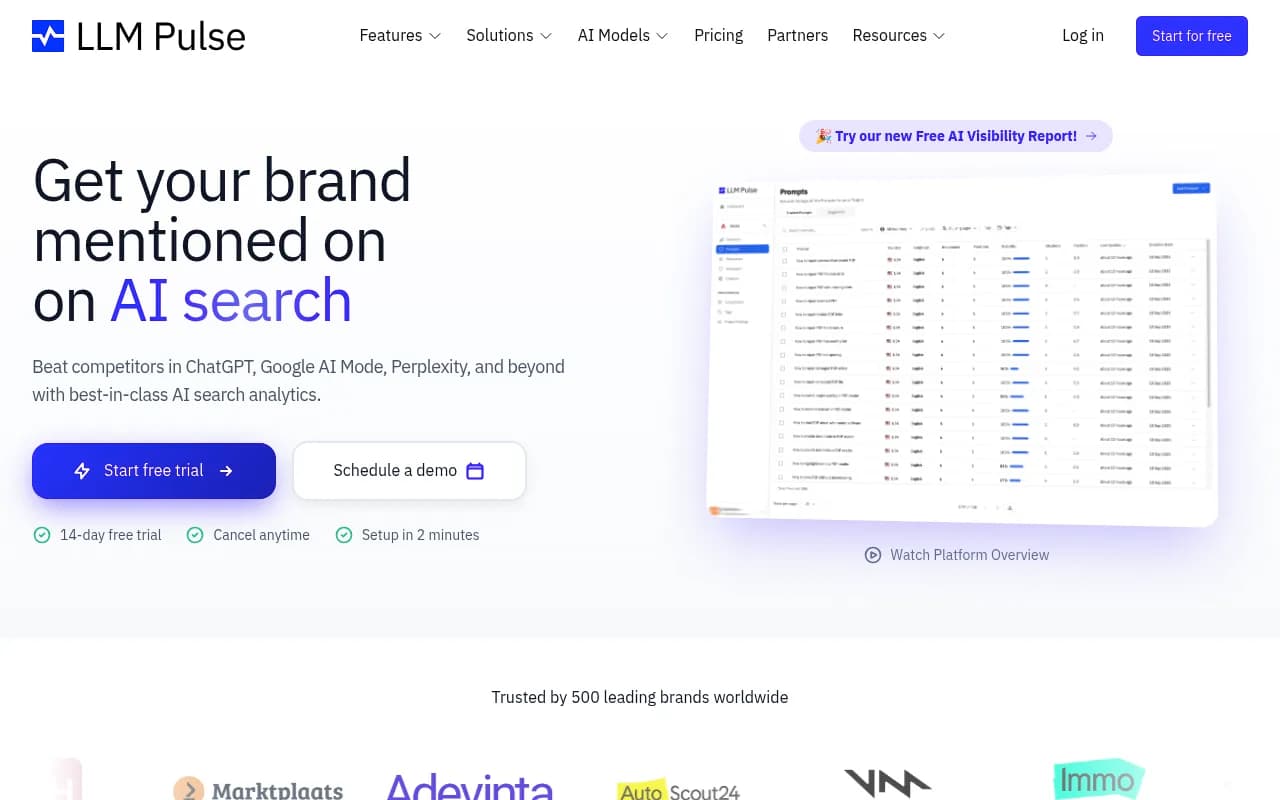
For teams that want to track across many AI engines with a focus on citations, LLM Pulse and Rankshift are worth a look.

The bottom line
The AI brand monitoring space is full of tools that will happily charge you $200/month to show you a dashboard. The harder question is what happens after you see the data.
Before you buy, run through these ten questions with any vendor you're evaluating. Pay particular attention to questions 5, 6, and 9 — gap analysis, content generation, and traffic attribution. Those three capabilities are what separate a tool that makes you feel informed from one that actually moves the needle.
The category is moving fast. Tools that were monitoring-only six months ago are adding content features. Tools that had content features are adding attribution. The gap between the leaders and the rest is narrowing — but it's still real, and it still matters for your budget.